The energy that sound carries
When a thing vibrates, the air around it is set vibrating too, and the disturbance spreads out in every direction as a sound wave. These waves do not merely wobble the air. They carry energy away from the source. When that energy reaches your ear, it makes your eardrum vibrate, and you hear a sound. So hearing is your ear collecting energy that a vibrating body sent out.
That raises a question. How much energy is a particular sound carrying? The amount of energy that sound waves carry away from the source in one second is called the intensity of sound. If one sound has a greater intensity than another, it is moving more energy away from its source every second.
Intensity of sound: the amount of energy carried away from the source by sound waves in one second is called the intensity of sound.
Intensity and loudness go together. A sound with greater intensity is heard as a louder sound. That is why the same drum sounds different when you tap it gently and when you strike it hard. A hard strike sends more energy into the air every second, so the intensity is greater, and your ear reports that as a louder sound.
Loudness and the decibel
The loudness of sound is measured in a unit called the decibel, written in short as dB. Every sound from a whisper to the clatter of a machine can be placed on this one scale, so the decibel gives a fair way of saying how loud one sound is compared with another.
Decibel: the unit used for measuring the loudness of sound. It is written in short as dB.
The decibel is also used to describe how well a person hears. Someone who cannot hear sound in the range from 40 dB up to 65 dB is said to be hard of hearing, and someone who cannot hear even sound up to 80 dB is said to be deaf. Sound of high intensity does harm to our ears.
Loud sound damages the ear. Do not stand for long beside a speaker, a machine or a horn that is running at full volume, and do not listen to earphones turned all the way up.
How loud everyday sounds are
The loudness of some sounds that we meet every day is given below. Reading these figures shows which of the sounds around us are ordinary and which are heavy enough to put our ears at risk.
| Activity that produces the sound | Loudness of the sound |
| A whisper | 0 to 20 dB |
| Inside a library | 20 to 40 dB |
| Ordinary conversation | 40 to 60 dB |
| Heavy street traffic | 60 to 70 dB |
| Sound of a printing press | 70 to 80 dB |
| Sound of a railway station | 85 to 110 dB |
| Sound of a motor car | 110 to 120 dB |
| Threshold of pain in hearing | 120 to 140 dB |
| Sound produced by mechanical disturbance | 140 to 160 dB |
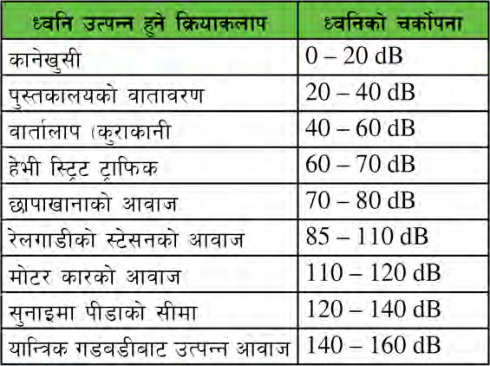
A whisper stays below 20 dB, while the clatter of a machine breakdown can reach 160 dB. Past about 120 dB a sound is not merely heard, it begins to hurt, and that point is called the threshold of pain in hearing.
Measurement of intensity of sound
Sound waves spread out in all directions from the source. Intensity is measured by asking how much effect these waves have on each unit of area of a surface that they strike at right angles. Striking at right angles means the waves arrive square on to the surface, at an angle of 90 degrees to it.
The effect of sound waves falling at right angles on unit area is called the intensity of sound, and it is denoted by I.
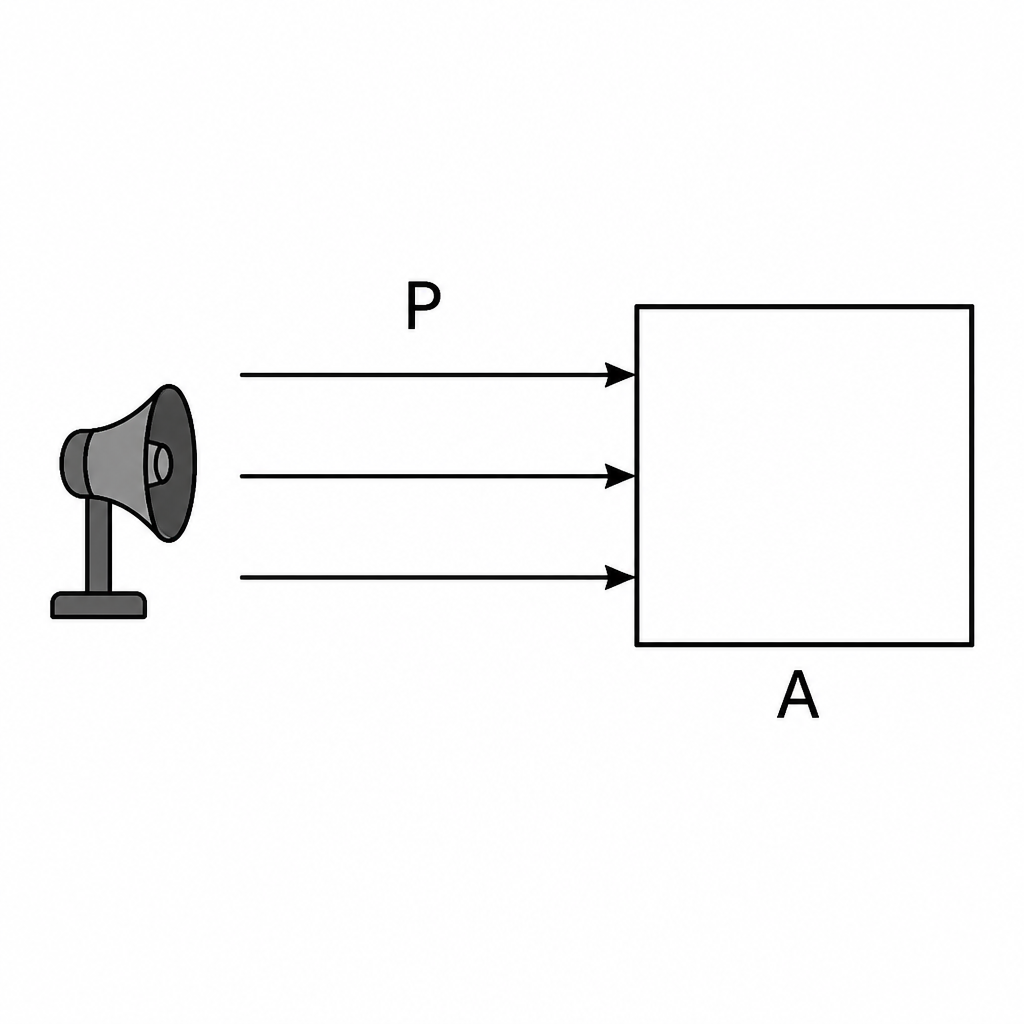
In the SI system, the intensity of sound is measured in W/m², that is watt per square metre. The intensity is worked out from this formula:
\[ I = \frac{P}{A} \]
In this formula,
- P = the sound power, measured in watt (W)
- A = the area, measured in square metre (m²)
Intensity and loudness are not the same thing. Intensity measures energy and is written in W/m². Loudness is what the ear experiences and is written in dB. Writing one of these units in the other one's answer makes the answer wrong.
Working out the intensity
A boy blows a whistle with a power of 2 × 10⁻⁴ W. Let us find the intensity of the sound over an area of 5 square metres.
Step 1: The sound power that is given:
\[ P = 2 \times 10^{-4} \text{ W} \]
Step 2: The area that is given:
\[ A = 5 \text{ m}^2 \]
Step 3: The formula for the intensity of sound is:
\[ I = \frac{P}{A} \]
Step 4: Putting the power and the area into the formula:
\[ I = \frac{2 \times 10^{-4} \text{ W}}{5 \text{ m}^2} \]
Step 5: Dividing 2 by 5 gives 0.4, so the intensity is:
\[ I = 0.4 \times 10^{-4} \text{ W/m}^2 \]
The unit of the answer has to be W/m², because a power in watt has been divided by an area in square metre. The formula never changes, only the numbers do, so the intensity can be found for any source whose power and area are known.
Factors affecting the intensity of sound
Sound from the same kind of source is not always equally intense. Sometimes it reaches us strongly and sometimes faintly. Five things decide the intensity of a sound, and they are taken one by one below.
1. Amplitude: the intensity of sound is proportional to its amplitude. The further a vibrating body swings from its resting position, the greater its amplitude is, and the greater the intensity of the sound it makes. Plucking a guitar string gently and pulling it well to one side before letting go gives exactly this difference.
2. Distance of listener from the source: the intensity is greater close to the source, and it falls as the listener moves further away. While sound travels through air, some of the sound energy is absorbed by the molecules of the air and some of it is reflected back. Only the remaining energy is carried forward. So the greater the distance between the source and the listener, the smaller the intensity of the sound that arrives.
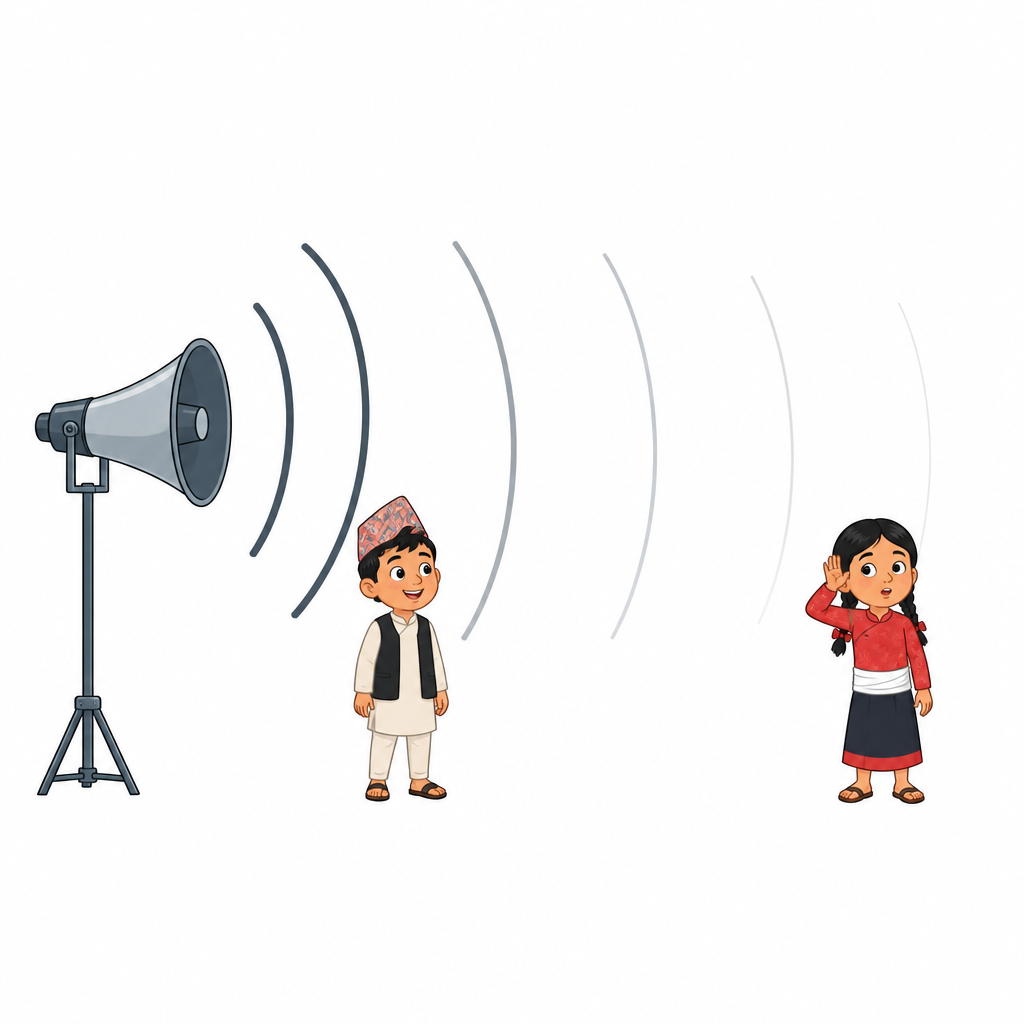
3. Density of medium: in a gaseous medium the intensity of sound is proportional to the density of that medium. Cold air has a greater density than hot air, so the intensity of sound is greater in cold air. That is why a distant bell or a vehicle on the road is heard so clearly on a cold winter morning.
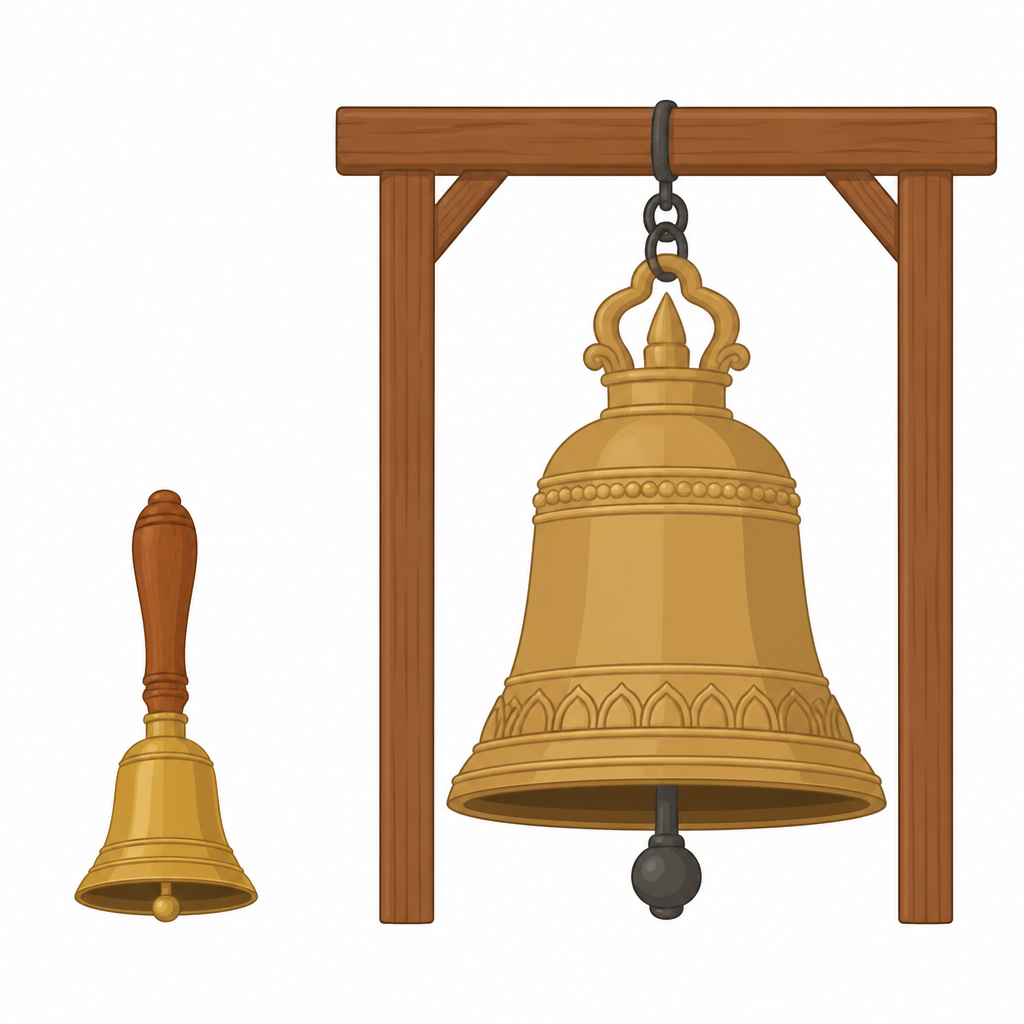
4. Area of vibrating body: as the area of the vibrating surface gets larger, the intensity of the sound produced also gets larger. A large surface pushes a larger amount of air at each swing, so it sends more energy into the air every second. This is why a small hand bell and the big bell of a temple do not sound alike.
5. Frequency of sound: the intensity of sound is proportional to the frequency of the sound. The more vibrations a body completes in one second, the higher its frequency is, and the greater the intensity of the sound becomes.
The five factors at a glance
| Factor | Effect on the intensity |
| Amplitude | Greater amplitude gives greater intensity |
| Distance of listener from the source | Greater distance gives smaller intensity |
| Density of medium | Greater density of a gas gives greater intensity |
| Area of vibrating body | Larger vibrating area gives greater intensity |
| Frequency of sound | Higher frequency gives greater intensity |
Four of the five factors raise the intensity when they grow. Distance is the one factor that lowers the intensity as it grows.
The full lesson is waiting for you
The notes are free to read in full. A free account opens the rest of the practice, and tracks your progress and confidence score for every subject. Presentations and videos need approval from Learn Yeti.