Sound and the Sources of Sound
A bird calls as soon as you wake up. The school bell rings. Buses pass on the road. A radio or a television plays in the next room. Your friends talk to you. Everything that reaches your ear in this way is called sound. Any object that gives out sound is called a source of sound. People, birds, a bell, a machine, a vehicle, a television and a radio are all sources of sound.
Source of sound: an object or a device that gives out sound is called a source of sound.
Energy comes in many forms, and sound is one of those forms. When this energy reaches the ear it gives us the sensation of hearing. That is why, even sitting in the dark with your eyes shut, sound still tells you what is happening around you.
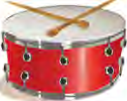

Vibration Makes Sound
Sound does not appear on its own. It is produced only when something is made to vibrate, that is, to shake to and fro very fast. You can test this for yourself with a tuning fork.
- Take a tuning fork.
- Strike it gently on a rubber pad.
- Bring it close to your ear and listen to what you hear.
- Now touch the two prongs lightly with your fingers and notice what you feel.
- Finally grip the prongs firmly in your hand and notice what happens to the sound.
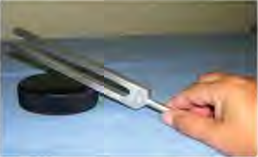
Held near the ear, the fork gives a steady note. Touched with the fingers, the prongs feel as if they are trembling. The moment your hand stops that trembling, the note stops too. Vibration and sound go together.
Vibration: the fast to and fro movement of an object about its resting position is called vibration.
Strike the tuning fork only on a rubber pad. Striking it on a stone, a desk edge or a wall damages the fork. Never let the vibrating prongs touch your ear or your teeth.
How a Sound Wave Travels Forward
When an object is struck, its particles are disturbed and start to vibrate to and fro. Those vibrating particles push the particles of the air beside them, and the disturbance is passed on from one particle to the next. The particles move about their mean position while the disturbance travels forward, and this travelling disturbance is the sound wave. A wave in which the particles vibrate forwards and backwards along the same direction in which the wave travels is called a longitudinal wave. A sound wave is a longitudinal wave.
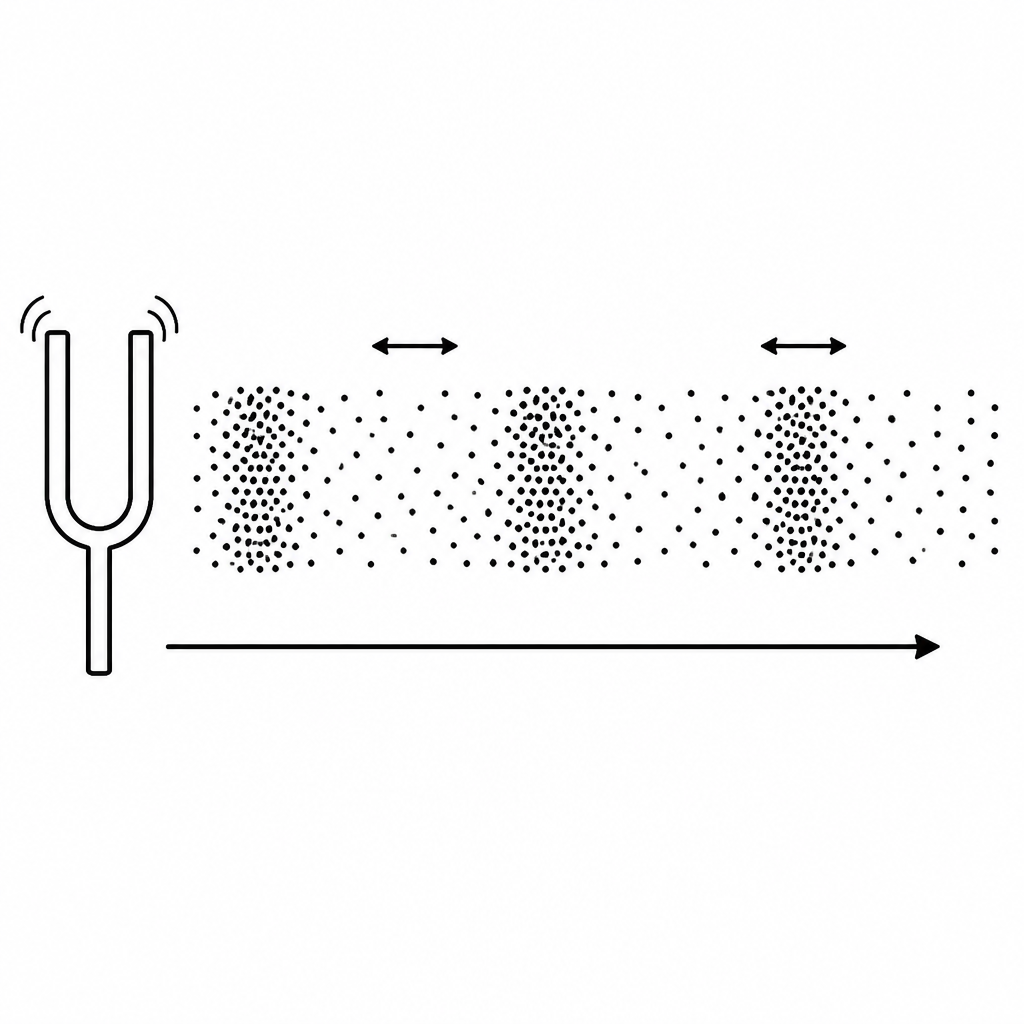
Longitudinal wave: a wave in which the particles of the medium vibrate about their mean position along the same direction in which the wave itself travels.
A sound wave is a mechanical wave, because it needs a material medium to carry it from one place to another. Sound travels through solids, through liquids and through gases. Where there is no medium at all, sound cannot travel from one place to another.
No medium, no sound. However strongly a source vibrates, its sound cannot move forward where there is no medium to carry it.
Characteristics of a Sound Wave
One sound is shrill, another is low. One carries a long way, another dies out close by. To state such differences exactly, four quantities of a sound wave are measured. They are frequency, time period, wavelength and amplitude.
Frequency
The total number of waves produced in one second is called frequency. It is denoted by the letter 'f'. In the SI system it is measured in hertz, written Hz. If a source sends out 50 complete waves in one second, the frequency of that sound is \( f = 50 \) Hz.
Frequency: the number of complete waves produced in one second. Its symbol is \( f \) and its SI unit is the hertz (Hz).
When a frequency is large, writing it in hertz gives a very long number. So larger units are also used: the kilohertz, the megahertz and the gigahertz. One kilohertz is one thousand hertz.
Time Period
The time taken to make one complete wave is called the time period. It is denoted by T and its SI unit is the second. If \( f \) complete waves are made in one second, then one single wave takes one part out of those \( f \) parts of a second. So the time period and the frequency are related in this way:
\[ T = \frac{1}{f} \]
Time period: the time taken for one complete wave to be formed. Its symbol is \( T \) and its SI unit is the second.
Wavelength
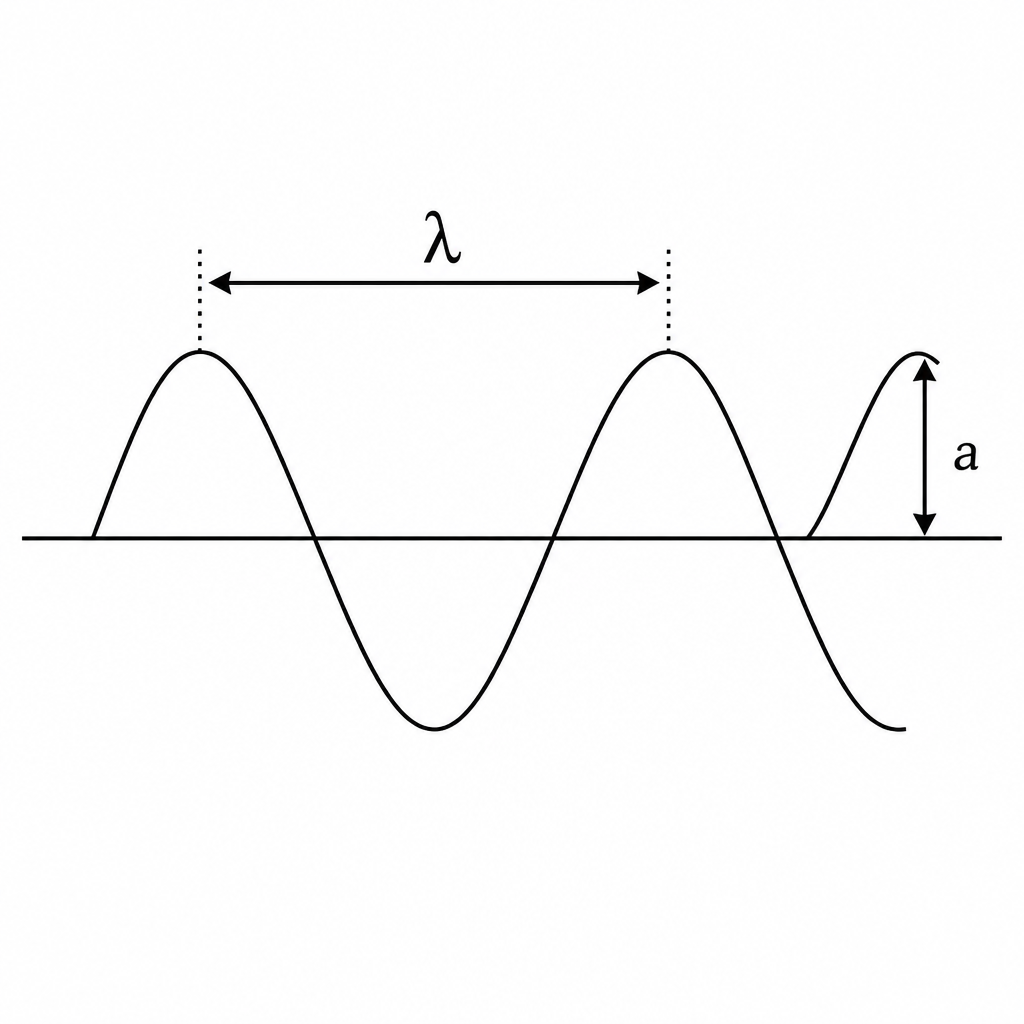
The distance covered by a sound wave in one complete vibration is called the wavelength. It is denoted by the Greek letter lambda, \( \lambda \), and its SI unit is the metre (m). On a wave picture, the distance from one crest to the very next crest is the wavelength.
Wavelength: the distance a sound wave covers in one complete vibration. Its symbol is \( \lambda \) and its SI unit is the metre (m).
Amplitude
The greatest displacement of a sound wave from its middle line, while the sound is travelling, is called the amplitude. It is denoted by 'a' and its SI unit is the metre (m). Tap a drum gently and the amplitude is small; hit it hard and the amplitude is large.
Amplitude: the maximum displacement of a sound wave from its middle position. Its symbol is \( a \) and its SI unit is the metre (m).
Wavelength and amplitude are both measured in metres, so students often mix them up. Wavelength is a distance measured along the wave, while amplitude is the height measured from the middle line.
The Four Characteristics Side by Side
| Characteristic | Symbol | SI unit | What it measures |
| Frequency | f | hertz (Hz) | number of waves made in one second |
| Time period | T | second | time taken to make one wave |
| Wavelength | λ | metre (m) | distance covered in one full vibration |
| Amplitude | a | metre (m) | greatest displacement from the middle |
Speed of Sound
The speed of sound is different in different media, but in one and the same medium the speed of sound stays fixed. Speed of sound means the distance the sound covers in unit time. In mathematical form it is written like this:
\[ v = f \times \lambda \]
Here \( v \) is the speed of sound, \( f \) is the frequency and \( \lambda \) is the wavelength. Wavelength is measured in metres and frequency is measured per second, so the unit of speed works out as metre per second (m/s).
In a given medium, the speed of sound does not change even when the frequency and the wavelength change. As the frequency rises the wavelength falls, and as the frequency falls the wavelength rises, so the product of the two stays the same.
The same formula can be turned round to find the other two quantities. For wavelength use \( \lambda = \frac{v}{f} \), and for frequency use \( f = \frac{v}{\lambda} \).
The full lesson is waiting for you
The notes are free to read in full. A free account opens the rest of the practice, and tracks your progress and confidence score for every subject. Presentations and videos need approval from Learn Yeti.