How Heat Moves From One Place to Another
When you hold a glass of hot tea, your hand feels warm because heat moves out of the glass and into your hand. When you touch a cold stone, heat moves the other way, out of your hand and into the stone, and that is why the stone feels cold. Heat always travels from a place at higher temperature to a place at lower temperature, and never by itself in the opposite direction. This movement of heat from one place to another is called heat transfer.
Heat transfer: the process in which heat moves from one place to another.
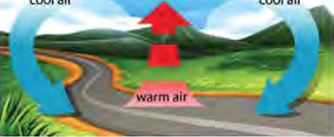
Heat can be transferred in three ways: conduction, convection and radiation. Standing beside a wood fire makes you feel warm, the air above a sunlit road grows hot and drifts upward, and gripping a hot pan burns your fingers. Heat is moving in all three cases, but it takes a different route each time. The route it takes inside a solid object is called conduction.

Watching Heat Creep Along a Metal Strip
A simple experiment shows whether heat really travels through a solid. Work through the steps below.
- Take a small metal strip or rod about 20 cm long.
- Put drops of candle wax at points along the strip and stick a pin on each drop so that the pins hang downward.
- Rest the strip firmly at the edge of a table so that it stays steady.
- Light a candle and heat only one end of the strip.
- Watch carefully to see which pin falls first and which pins fall later.
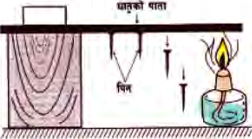
After a short while the pin nearest the heated end drops off first. The next pin follows, and then the rest fall one after another in order. They do not all fall together. A pin can only drop once the wax holding it has melted, so the order in which the pins fall shows how far along the strip the heat has reached. This proves that heat spreads step by step from the heated end towards the far end.
Because the pins fall in order instead of all at once, heat clearly does not fill the whole strip at one moment. It creeps along from one end to the other.
How Molecules Pass Heat Along Inside a Solid
The molecules of a solid are held tightly to one another, so they cannot wander away from their places. When the solid is heated, vibration is produced in its molecules, but each molecule stays where it is. The molecule at the heated end receives heat first and begins to vibrate more strongly. It then passes heat to the molecule next to it. That molecule warms up and passes heat on to its own neighbour. In this way heat moves from one molecule to the next until it reaches the far end. During this transfer the molecules themselves never travel from one place to another. They only keep vibrating in their own positions.
Conduction: the transfer of heat from one molecule to the next in a solid, in which the molecules vibrate in their own places instead of travelling from one end to the other.
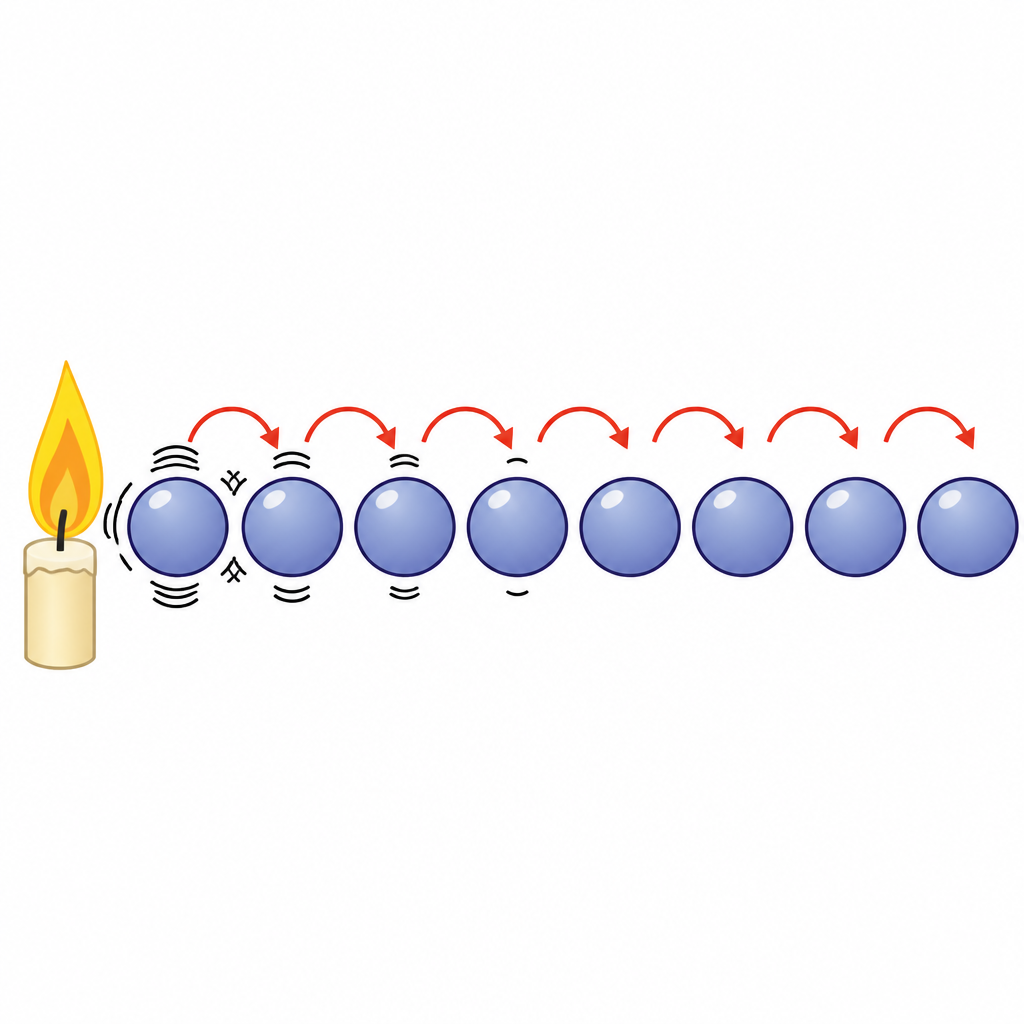
A line of classmates makes this easy to picture. Stand in a row at equal distances from one another. The person at one end picks up a stone or a brick and hands it to the next person, who hands it on to the third, and so on until the stone reaches the last person in the row. Nobody steps out of place, yet the stone travels the whole length of the line. Heat moves through a solid in exactly this way. The molecules stay put and only the heat is passed along.

Do not write that the molecules themselves travel from the hot end to the cold end during conduction. What travels is the heat, not the molecules. In a solid the molecules only vibrate where they already are.
Conductors and Insulators
Not every solid carries heat along equally well. The experiment below sorts out which materials let heat through and which do not.
- Collect a steel spoon, an aluminium ladle, an iron nail, a pencil, a piece of wood and a plastic pipe.
- Hold one end of one object in your hand.
- Put the other end into the flame of a burning candle.
- After a short time, and under your teacher's watch, feel whether the end in your hand has become hot.
- Repeat the same test with each object in turn and write the result in a table.
Never touch the end that has been in the flame. Feel an object only under your teacher's watch, and if a spoon or nail has already become very hot, take it out of the flame at once and set it down somewhere safe.
| Object | Does heat pass through it? | Conclusion |
| Steel spoon | Yes | Conductor of heat |
| Aluminium ladle | Yes | Conductor of heat |
| Iron nail | Yes | Conductor of heat |
| Pencil | No | Insulator of heat |
| Piece of wood | No | Insulator of heat |
| Plastic pipe | No | Insulator of heat |
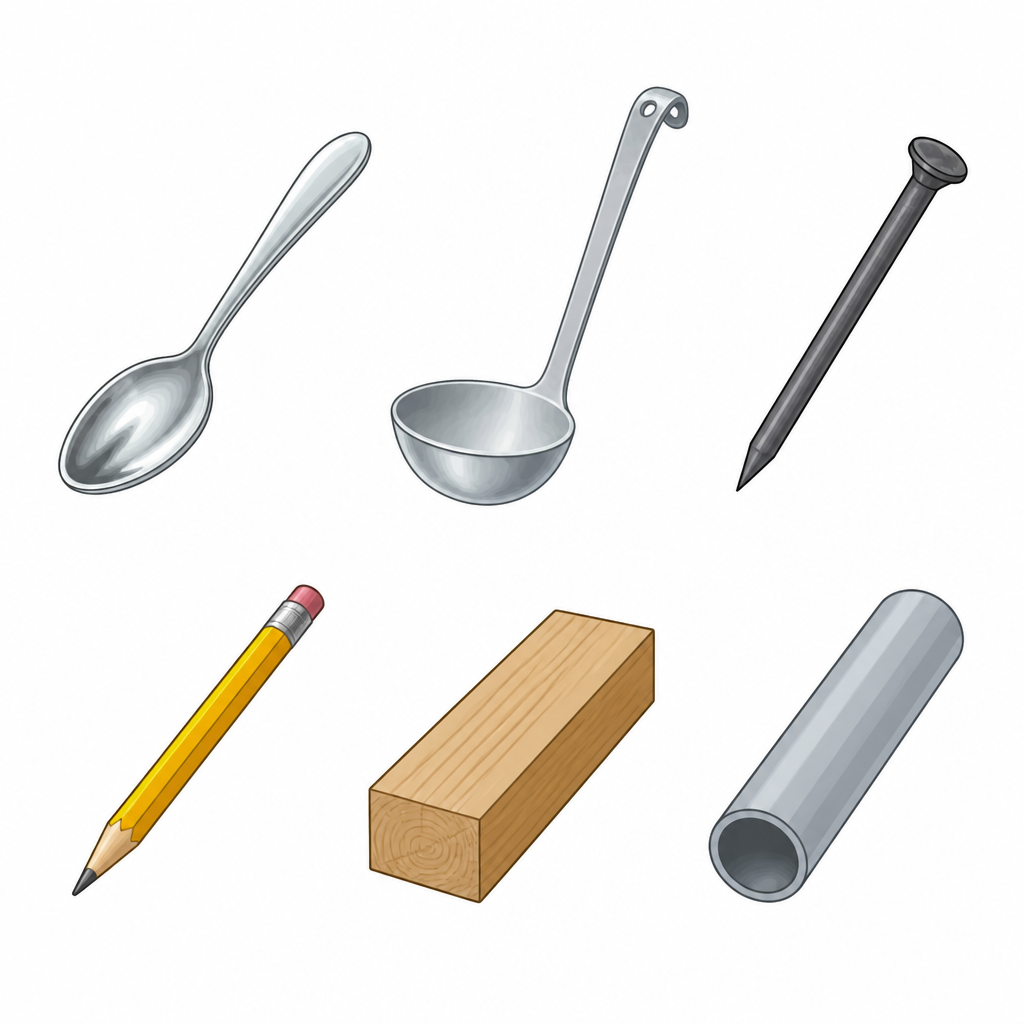
When one end of the steel spoon, the aluminium ladle or the iron nail is heated, the other end becomes hot as well. In the pencil, the piece of wood and the plastic pipe, heat does not reach the far end at all. Those objects simply catch fire instead. As a rule heat passes through metals, while it does not pass through non-metals.
Conductor: a material through which heat travels. Metals such as iron, copper, aluminium, gold and silver are conductors of heat.
Insulator: a material through which heat does not travel. Some non-metals, such as wood and plastic, are insulators of heat.
How Fast Different Things Conduct Heat
Even among the materials that do carry heat, some carry it faster than others. Conduction capacity is an internal property of the material itself. It tells us how quickly or how slowly that material passes heat along. A material with high conduction capacity moves heat faster than one with low conduction capacity.
Conduction capacity: the internal property of a material that tells how fast or how slowly it conducts heat.
Most metals have a high conduction capacity, so they become hot very quickly when brought near a source of heat. This property is the reason metals are used for cooking, and kitchen vessels are usually made of metal. Plastic, cotton and rubber, on the other hand, have an extremely low conduction capacity. That property is useful to us as well. Warm clothes are made of cotton, for example, and they stop body heat from escaping into the atmosphere.
Conduction capacity is not the same in every metal either. It depends on the molecular properties of the substance and on its temperature. Diamond is not a metal, yet its conduction capacity is higher than that of metals. Graphite too is a non-metal that conducts.
Do not settle on the neat rule that every metal conducts and every non-metal does not. Diamond and graphite are non-metals and both conduct heat, and diamond's conduction capacity is even higher than that of metals.
Heat Conduction in Everyday Life
Cooking vessels are made of copper, steel, iron or aluminium, but their handles are made of wood or of thermosetting plastic. A jacket keeps you warm. A house built of mud stays cool in the summer and warm in the winter. On very cold days birds look fat. Every one of these facts is connected with the conduction of heat. The uses of heat conduction in daily life can be listed as follows.
- Cooking pots, pans and kettles are made of metal because they pass heat easily from the source right through to the food.
- The handle of a tea kettle is made of plastic, because plastic is an insulator of heat and so it does not let the heat reach your hand.
- On cold days woollen clothes or blankets keep people warm, because wool stops body heat from going out. Air is trapped between the fibres, and since air is an insulator, such clothes keep the body warm even more effectively.
- Tea cups and coffee mugs are made of porcelain, because porcelain is an insulator of heat.
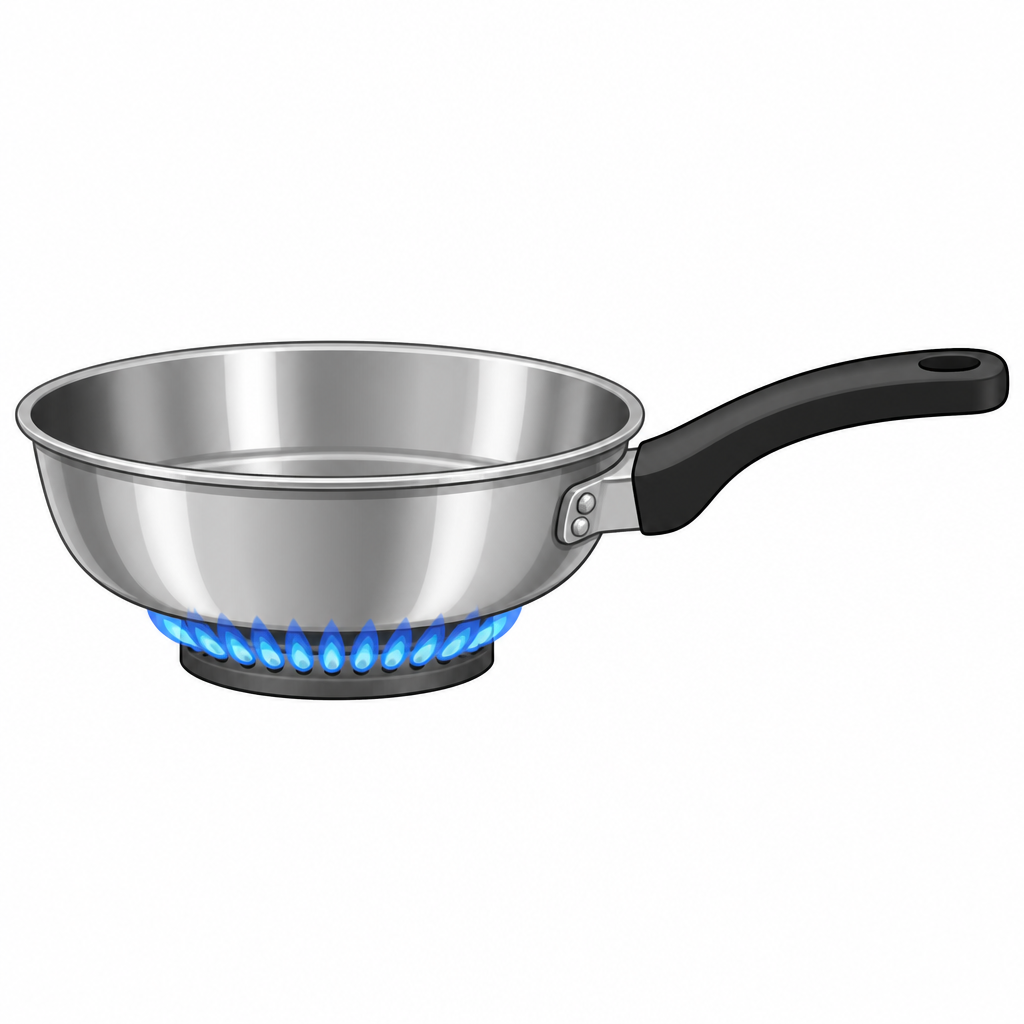
Look around your own home or kitchen and you will find many things that were made the way they are because of how well their material conducts heat. Asking yourself why each object is made of the material it is made of connects this idea to everyday life.
The full lesson is waiting for you
The notes are free to read in full. A free account opens the rest of the practice, and tracks your progress and confidence score for every subject. Presentations and videos need approval from Learn Yeti.