A Spherical Mirror Is a Piece of a Sphere
Hold a shiny steel spoon and look at yourself in it. The face you see in the hollow inside of the spoon is not the same as the face you see on the bulging outside, and neither of them is the upright, same sized image a flat mirror gives. The reason is that the reflecting surface is not flat but curved. A mirror whose reflecting surface is curved in this way is called a spherical mirror.
Spherical mirror: A spherical mirror is like a piece cut from a complete sphere. When the inner surface of that sphere does the reflecting, the mirror is a concave mirror. When the outer surface does the reflecting, it is a convex mirror.
To say where a spherical mirror sends light, you first need the names of a few points and lines that belong to it. These names are the language of spherical mirrors. Once the six of them are settled in your head, the behaviour of both a concave mirror and a convex mirror becomes easy to describe.
The big shiny mirror fixed at a blind bend in a road or in a building's car park is a convex mirror. Its reflecting surface bulges outward, so it squeezes a wide stretch of space into one small view. A concave mirror is the one used as a shaving mirror, behind the bulb of a torch and in a solar cooker.

Pole, Centre of Curvature and Radius of Curvature
Every distance measured on a spherical mirror is measured from some fixed point, so the first job is to be sure where those points are. The first point sits on the mirror itself, the second sits at the centre of the sphere the mirror was cut from, and the third quantity is simply the distance between those two points.
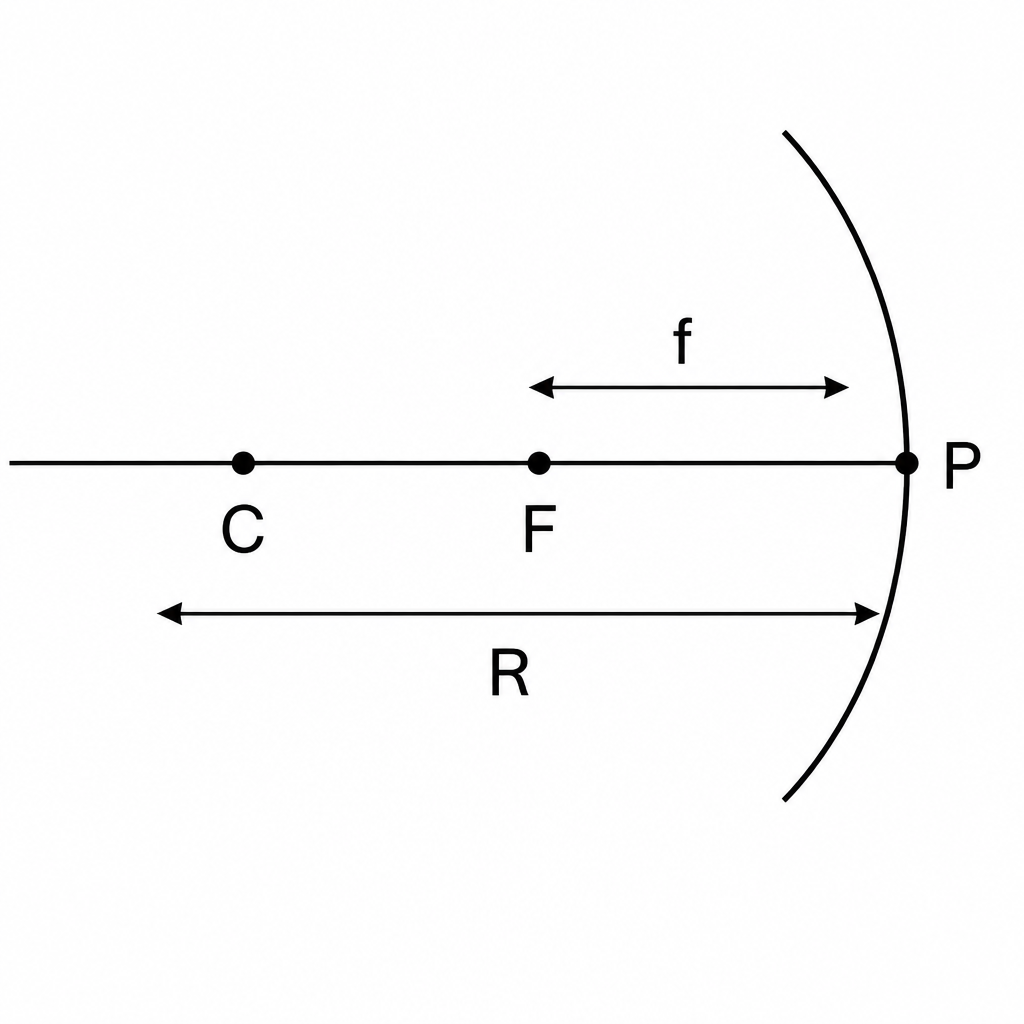
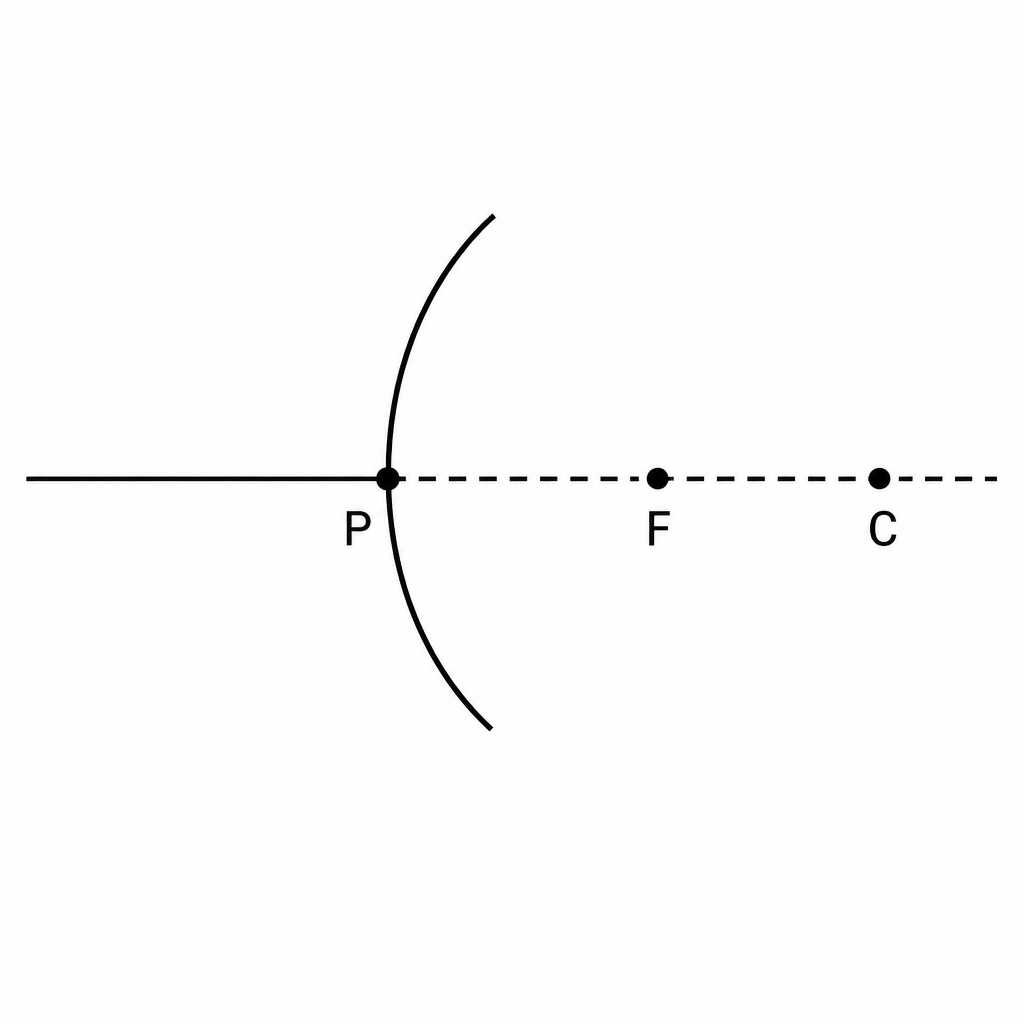
Pole of the mirror: The mid point of the reflecting surface of a spherical mirror is called the pole of the mirror. It is shown by the symbol P. All distances are measured from this point.
Centre of curvature: The centre of the complete sphere of which the spherical mirror is a part is called the centre of curvature. It is shown by the symbol C.
Radius of curvature: The radius of the sphere of which the mirror is a part is called the radius of curvature. In practice it is the distance between the centre of curvature C and the pole P. It is shown by the symbol R.
Suppose a mirror is cut from a sphere whose radius is 30 centimetres. The radius of curvature of that mirror is 30 centimetres, and its centre of curvature C lies exactly 30 centimetres away from its pole P. The more sharply a mirror is curved, the smaller its radius of curvature is.
The Principal Axis
The pole and the centre of curvature are two separate points. The straight line drawn through them is the most important line on a spherical mirror, because the path of every ray is described by how that ray is placed with respect to this line.
Principal axis: The straight line joining the pole P and the centre of curvature C is called the principal axis.
The principal axis strikes the mirror surface exactly at a right angle. That is why a ray travelling along the principal axis itself comes straight back along the same path. Rays arriving from a far away object travel very nearly parallel to the principal axis, and it is these rays that show where the principal focus lies.
The Principal Focus
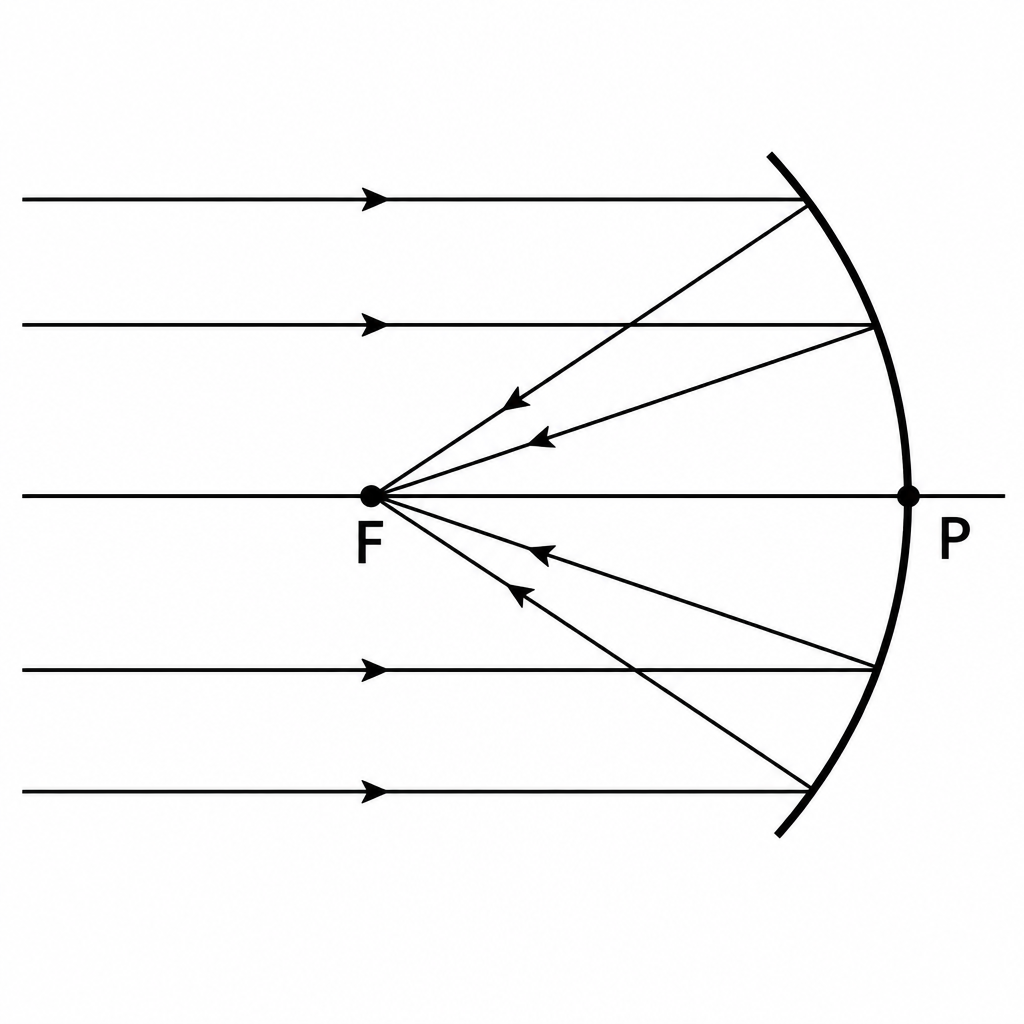
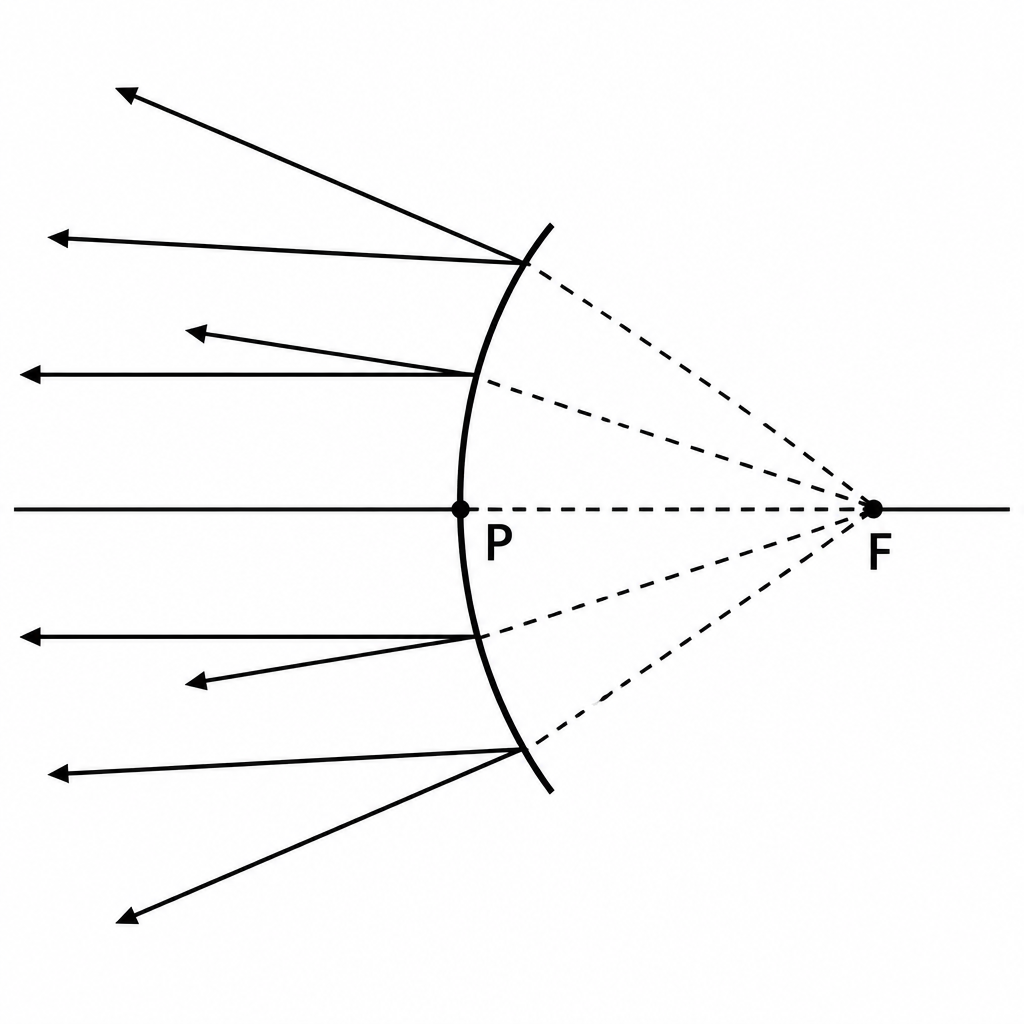
Send many rays parallel to the principal axis onto a concave mirror. Each ray strikes a different part of the surface, yet after reflection they all meet at one single point. On a convex mirror the same parallel rays spread out after reflection, that is, they diverge. If those spreading rays are continued backwards, they all seem to be coming from one single point behind the mirror.
Principal focus: The point at which rays of light parallel to the principal axis meet after reflection from a concave mirror is called the principal focus, and it lies in front of the mirror on the principal axis. On a convex mirror, the point from which the reflected rays appear to come is the principal focus, and it lies behind the mirror. It is shown by the symbol F.
A concave mirror gathers light into one place, so it can be thought of as a light gathering mirror. A convex mirror spreads light out, which is exactly why it shows such a wide view.
The Focal Length
Focal length: The distance between the pole P and the principal focus F is called the focal length. It is shown by the symbol f and it is measured in metres.
The principal focus F always lies between the pole P and the centre of curvature C. So the focal length f is always shorter than the radius of curvature R. A gently curved mirror has a long focal length, and it gathers light only at a point far from itself.
Do not treat the centre of curvature C and the principal focus F as the same point. C is the centre of the sphere the mirror was cut from, while F is where parallel rays meet. Both lie on the principal axis, but C is always further from the mirror than F is.
Reflection from Concave and Convex Mirrors
On a concave mirror, rays of light parallel to the principal axis are reflected and gathered at one point. That point is the principal focus, and it lies in front of the mirror on the principal axis. A convex mirror reflects the same parallel rays and scatters them, and those scattered rays appear to come from one point behind the mirror. That point is the principal focus of the convex mirror, and it lies behind the mirror.
Rules of Reflection for a Concave Mirror
Three rules settle where any ray goes after it strikes a concave mirror. Once these three are remembered, you can draw a ray diagram of your own.
- A ray of light travelling parallel to the principal axis is reflected from a concave mirror and passes through the principal focus.
- A ray of light coming from the principal focus is reflected from a concave mirror and travels parallel to the principal axis.
- A ray of light coming from the centre of curvature returns along the same path.
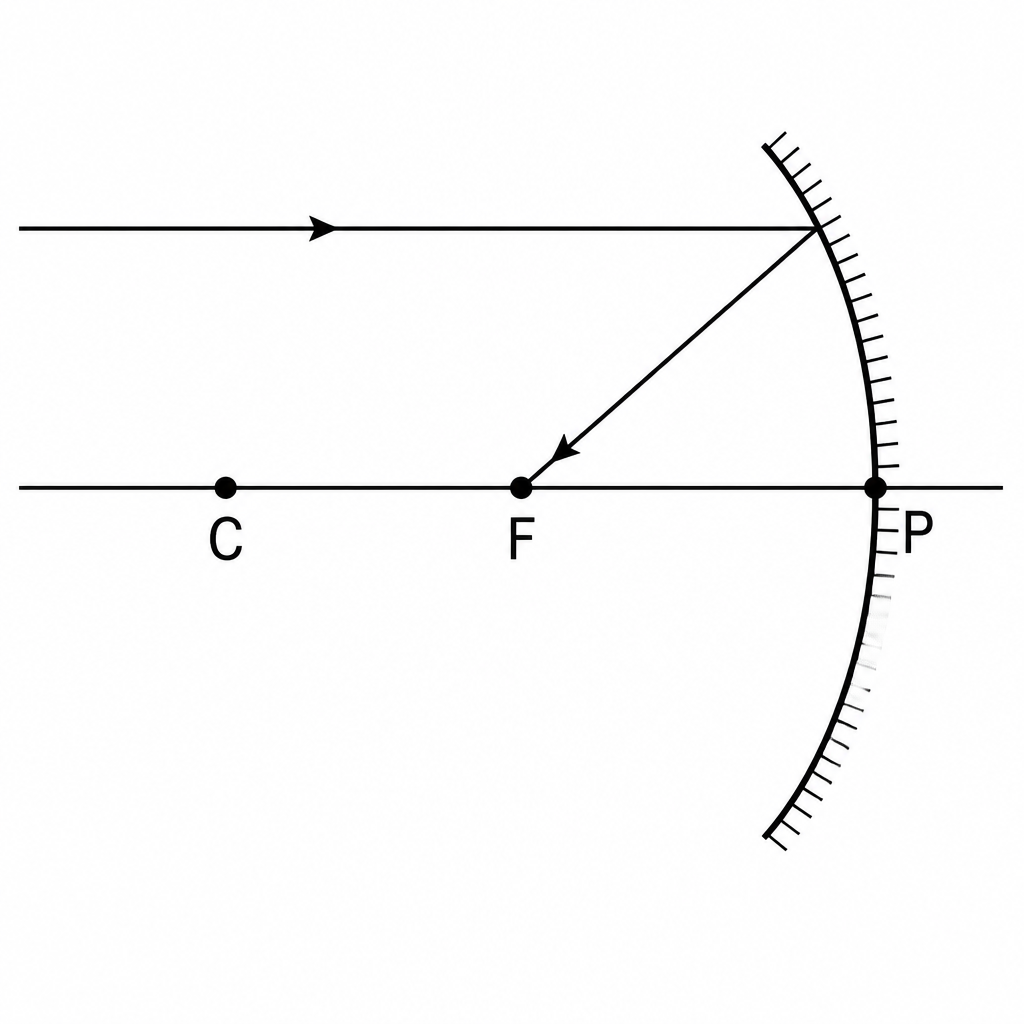
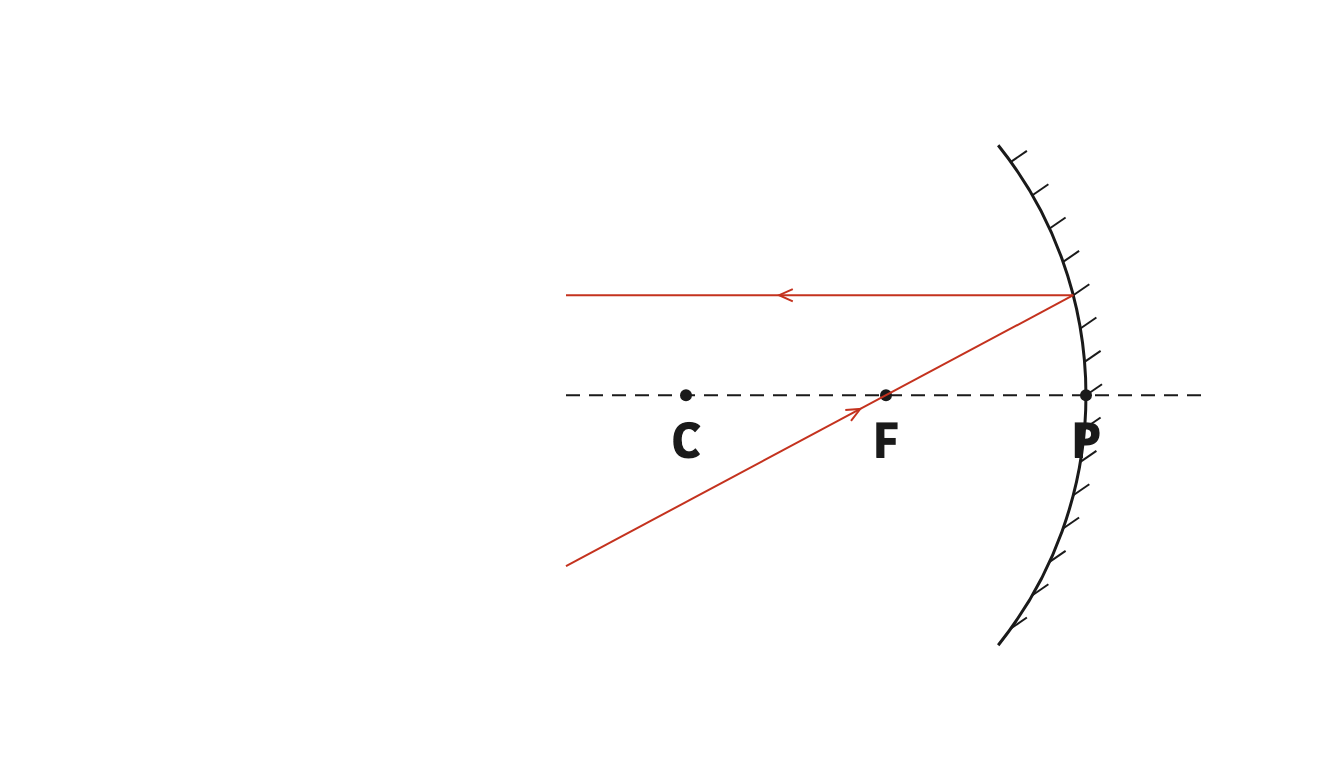
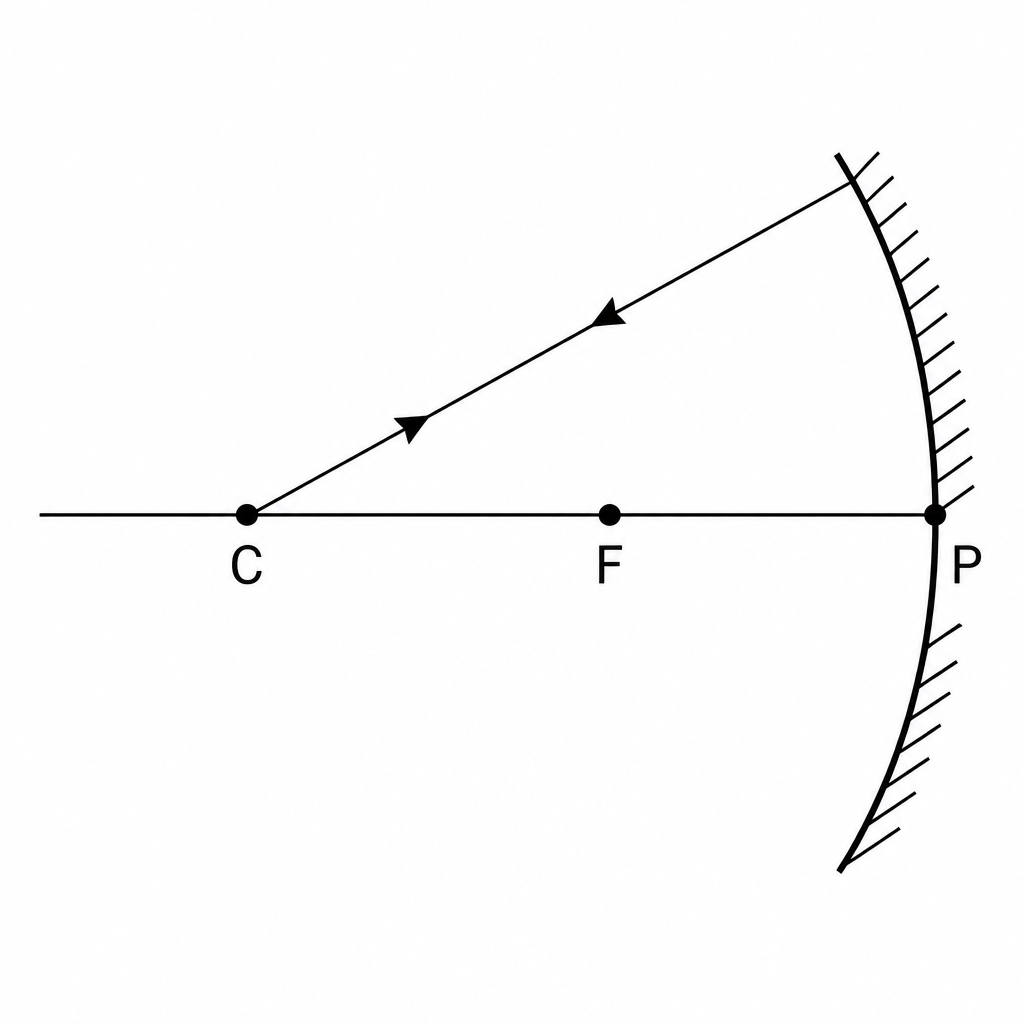
The first rule and the second rule are the reverse of each other. Light can travel back along any path it can travel forward along. So these two need not be learnt separately, because one of them gives you the other.
Rules of Reflection for a Convex Mirror
Because the surface of a convex mirror bulges outward, its important points lie behind the mirror. So its rules are stated in terms of where a reflected ray appears to come from, and where an incoming ray is aimed.
- On a convex mirror, the principal focus and the centre of curvature lie behind the mirror.
- A ray of light travelling parallel to the principal axis, after reflection from the mirror, appears to come from the principal focus.
- A ray of light aimed at the centre of curvature is reflected back along the same path.
When you draw a convex mirror, never place F and C in front of it. Both of them lie behind the mirror, and the lines reaching them must always be drawn broken, because no light actually travels there.
The Two Mirrors Side by Side
Setting the same questions against both mirrors makes the difference clear.
| Point | Concave mirror | Convex mirror |
| Reflecting surface | Inner surface of the sphere | Outer surface of the sphere |
| Principal focus F | In front of the mirror | Behind the mirror |
| Centre of curvature C | In front of the mirror | Behind the mirror |
| Effect on parallel rays | They are gathered at one point | They are spread apart, that is, they diverge |
| Where it is used | Shaving mirror, solar cooker, torch | Road bends, side mirror of a vehicle |
The full lesson is waiting for you
The notes are free to read in full. A free account opens the rest of the practice, and tracks your progress and confidence score for every subject. Presentations and videos need approval from Learn Yeti.