How All the Water in a Beaker Gets Hot
When water is heated, the flame touches only the bottom of the vessel, yet after a little while the water at the top is hot too. A simple experiment lets you watch how the heat travels upward. You need two identical beakers for it.
- Take two beakers and fill each of them about two thirds full with water.
- Drop a few grains of red ink into the water in both beakers.
- Place one beaker on the wire gauze of a tripod stand and heat it from below.
- Leave the other beaker standing beside it without heating it at all.
- Watch the two beakers turn by turn and write down the difference you see.
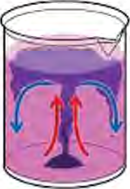
In the heated beaker the coloured water slowly warms, becomes lighter and travels upward, while the colder water from above comes down to take its place. The grains of red ink make this path visible. As the movement goes round and round, after some time all the water in the beaker becomes hot. This process inside the beaker is what we call convection.
In the beaker that is not heated, the colour merely spreads out slowly. No part of that water becomes lighter and rises, so no convection is taking place there. The difference between the two beakers shows that convection does not begin on its own. It begins because one part of the liquid is made hotter than another.
Never hold the hot beaker with bare hands and do not bend your face over water that is heating. Always keep the beaker on the wire gauze, because a beaker put straight into the flame can crack.
What Convection Is
Convection is the process in which heat spreads through a liquid or a gas by the movement of the molecules of that liquid or gas themselves.
When a liquid or a gas is heated, the density of the heated layer falls. That warm, less dense part moves upward, and cooler material of greater density sinks to fill the space it has left. The exchange repeats again and again until every part of the liquid or the gas has become hot. This is how heat spreads through liquids and gases by convection.
In convection the molecules themselves carry the heat. Heated molecules travel from one place to another and take their heat along with them.
Do not treat convection and conduction as the same thing. In conduction the particles stay where they are and only the heat is passed along, while in convection the particles themselves move and carry the heat with them. That is why convection does not take place in solids.
Convection in Air and the Blowing of Wind
Heat spreads through air by convection in the same way as it does through a liquid. During the day the Sun heats the surface of the Earth, and then the layer of air resting on that surface is heated too. The warm air becomes light and rises, and cooler air from around flows in to occupy the place it has left.
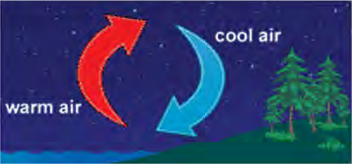
This constant coming and going of air is what we call wind. Convection is the main reason why wind blows at all. Warm light air moving up and cool air moving down to replace it is convection in the atmosphere. It is also why you feel gusts of cooler air passing over you when you stand in an open field on a sunny day.
Sea Breeze
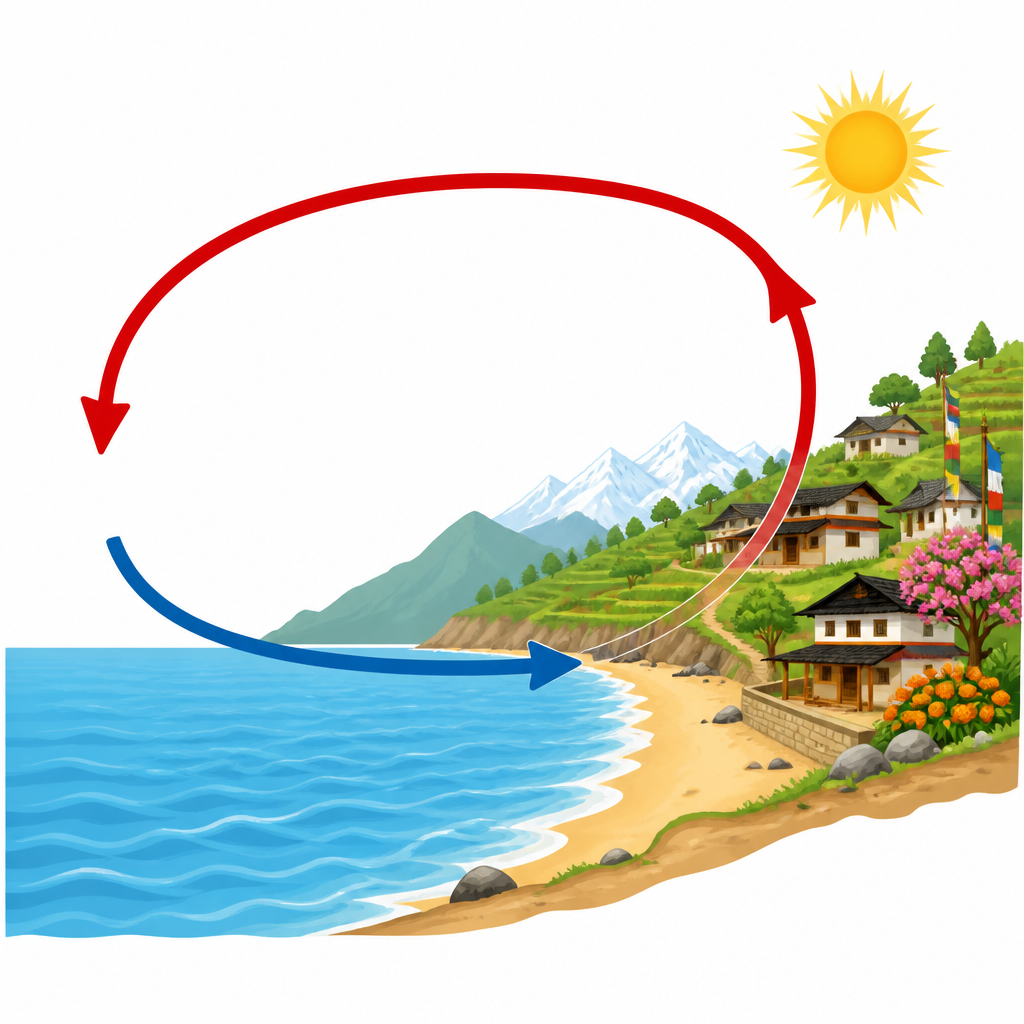
A sea breeze happens during the daytime. The Sun heats both the surface of the sea and the land beside it. Water has a large capacity for absorbing heat, so the sea takes in a great deal of the Sun's energy yet grows warm far more slowly than the land does. As a result the temperature over the land rises and the air in the atmosphere above it is heated.

Warm air has a low density, so it expands and lifts. The pressure of the air over the land near the coast therefore becomes low, while over the sea the pressure stays high. Because of this difference in air pressure, cool air flows from the sea towards the land. That is the cool breeze you feel on your face when you stand on a seashore in the afternoon.
The cool wind that flows from the sea towards the land during the day because of the difference in air pressure is called a sea breeze.
Land Breeze
A land breeze happens at night. When the Sun sets, both the land and the sea begin to cool down. The land loses its heat much sooner than the warm water does. As a result the sea stays at the higher temperature, and that keeps the air pressure over the sea low.
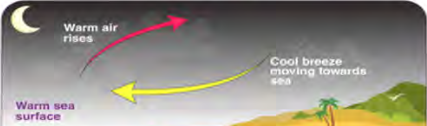
The cool wind that flows from the land out towards the sea at night is called a land breeze. At the same time warm air from over the sea moves in towards the land.
Types of Convection
Convection is of two kinds, natural and forced. In the first kind nobody has to do anything, because the difference in temperature does the work by itself. In the second kind an outside force is used to push the liquid or the gas along.
Natural convection: when a difference of temperature creates a difference of density inside a liquid or a gas, and the movement of the molecules that follows from it carries the heat, that is called natural convection.
- The blowing of a sea breeze.
- Water vapour rising and forming clouds.
- The rumbling of thunder in a storm cloud.
Forced convection: when an outside agency such as heat, electricity or a chemical is used to drive a liquid or a gas so that heat is spread through it, the process is called forced convection.
- Switching on a fan so that the air of a room is driven about.
- Using a water heater or a geyser to heat the water in a tank.
| Basis | Natural convection | Forced convection |
| Cause | Difference of temperature and density | An outside force or agency |
| Control | Nature carries it out by itself | People start it and stop it |
| Example | Sea breeze, forming of clouds | A fan, a geyser |
Convection Currents and the Weather
Convection comes up again and again in the study of the weather, because it explains how heat and moisture are carried about in the atmosphere. In general, heat travels by convection from a warmer region towards a cooler one. The day's convection begins after sunrise, when radiation from the Sun heats the ground. As the ground grows hotter it warms the layer of air resting directly on it.
Bare surfaces such as sand, rock and a paved footpath heat up faster than water or ground covered with plants, so the air at the surface and around it is warmed unevenly. Over a patch that heats quickly, the air becomes less dense than the cooler air beside it and begins to climb.
A rising current of air of this kind is called a thermal.
As the air rises, heat and moisture travel straight up with it into the atmosphere. The hotter the surface becomes, the further convection reaches into the atmosphere, which is why convection is most active on a hot day. Climbing air spreads out and begins to cool, and if it is carrying plenty of moisture, clouds are formed. Flashes of lightning, claps of thunder and heavy downpours are all bound up with convection.
Convection also carries surplus heat away from the surface of the Earth. If convection did not take place in nature, the average temperature of the air at the surface is estimated to be about \( 125\,^\circ\text{F} \) instead of the livable \( 59\,^\circ\text{F} \) we have now.
Convection in Everyday Life
Have you watched a balloon full of hot air lift into the sky? Have you watched steam curling up from a hot cup of coffee? Convection means the carrying of heat from a place of higher temperature to a place of lower temperature through a liquid or a gas. When the molecules of a liquid or a gas are heated, their speed increases and they move further apart from one another.
- Boiling water and other liquids works because of convection inside the vessel.
- In warm blooded mammals, the circulation of blood spreads body heat by convection.
- Fans and air conditioners used in the hot season work on the principle of convection.
- Radiators, refrigerators and the hot air poppers used for making popcorn all use the principle of convection.
- Rainfall, storms, the forming of clouds and lightning all have convection behind them.
The full lesson is waiting for you
The notes are free to read in full. A free account opens the rest of the practice, and tracks your progress and confidence score for every subject. Presentations and videos need approval from Learn Yeti.