How Heat Gets Held Inside a Closed Space
Heat always moves from a hotter place to a cooler one. So keeping a place warm really means blocking the paths by which heat escapes. Hot water in an open glass cools down quickly, while the same hot water in a well closed container stays hot for a long time. The water in the closed container has gained no new heat. It has simply not been allowed to lose any.

Now turn that idea round. Suppose heat has an open road in but a blocked road out. Heat then keeps building up inside, and that space becomes warmer than the air around it. This is exactly the idea behind a building that lets sunlight in but does not let heat out. Such a building is called a greenhouse.
What a Greenhouse Is
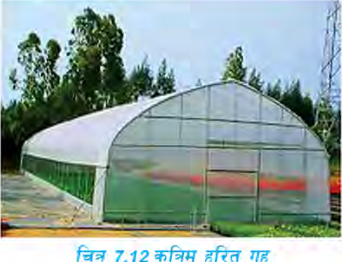
Greenhouse: a house built of a transparent material such as glass or light permitting transparent plastic, which stores the heat received from solar radiation inside it and so helps the plants growing there stay green and healthy.
A greenhouse built by people is called an artificial greenhouse. It is also known as a hot house, because the air inside it stays warmer than the air around it. On vegetable farms these structures are usually built in the shape of a long tunnel. Even while cold wind is blowing outside, the plants inside go on growing in warmth.
How the Glass Traps the Heat
A greenhouse gets warm not by magic but because of the way radiation behaves. The radiation arriving from the sun and the radiation leaving the plants inside are not the same kind, and glass does not treat the two in the same way. The process runs like this.
- Radiation given out by the sun passes in through the glass of the greenhouse.
- Once inside, the soil and the plants absorb some of the energy of that radiation.
- The energy sent back out is then radiation of long wavelength, and radiation of long wavelength cannot get out through the glass or the plastic.
- The radiation that cannot leave is converted into heat energy, so heat energy collects in the greenhouse and the temperature inside rises.
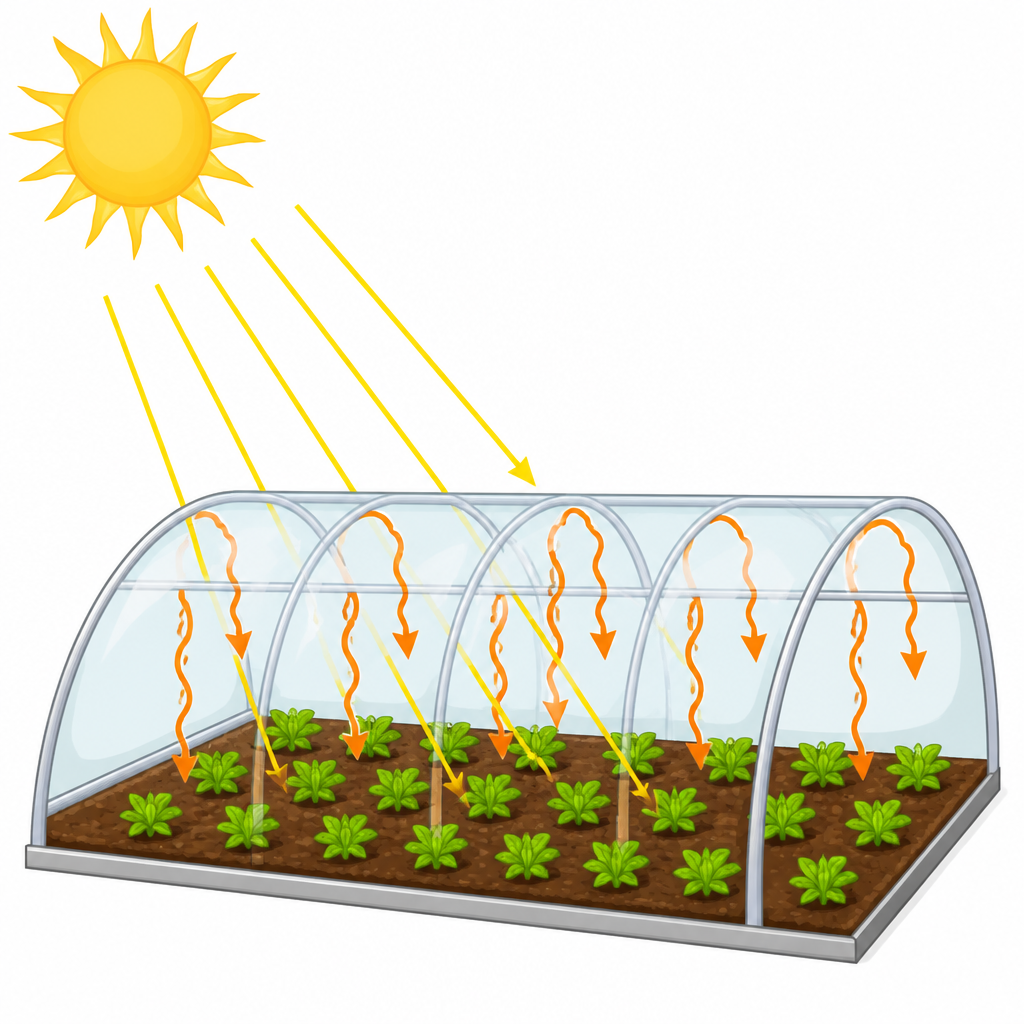
Greenhouse effect: the process in which radiation that has entered through a transparent wall cannot get out again, collects as heat energy, and so raises the temperature inside.
The Earth Itself Is a Greenhouse
Industrialisation has raised the amount of greenhouse gases in the earth's atmosphere. Carbon dioxide, chlorofluorocarbon, methane and nitrous oxide are the main ones. When the amount of these gases in the atmosphere goes up, they begin to absorb heat from the solar radiation. Climate change has been pushing the earth's temperature up as well. For this reason the earth itself can be compared with a greenhouse.
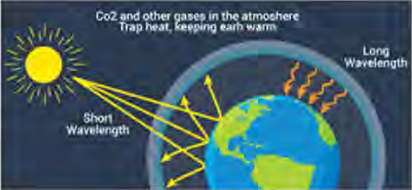
Of the radiation the earth receives from the sun, some is reflected back from the earth's surface and some from the atmosphere. The greenhouse gases present in the atmosphere absorb this reflected solar radiation and store it in themselves. As a result more and more heat collects, just as it does in an artificial greenhouse, and the temperature of the earth's atmosphere rises. This rise in the temperature of the atmosphere caused by the greenhouse gases present in it is called the greenhouse effect.
What the glass does for an artificial greenhouse, the greenhouse gases do for the whole earth.
Comparing the Artificial and the Natural Greenhouse
Heat is trapped in the same way in both, but they differ a great deal in what they are made of, how large they are and how far people control them.
| Basis | Artificial greenhouse | Natural greenhouse |
| What holds the heat in | Glass or transparent plastic | The greenhouse gases of the atmosphere |
| Size | A small part of a garden or a field | The whole earth |
| Who makes it | Built by people | Happens in nature by itself |
| Control | The temperature can be adjusted by opening or covering it | Cannot be controlled directly, only by reducing the gases |
| Main benefit | Off season vegetables and shelter for plants from cold | Keeps the earth warm enough for life |
Making a Model Greenhouse
You can find out for yourself that the temperature rises inside a greenhouse. For this you need small pieces of glass or of light permitting transparent plastic, about four of A4 paper size, small nails as required, a number of small bamboo or wooden sticks, a piece of plywood or a square wooden board, and a laboratory thermometer.
- On the piece of plywood or the square wooden board, stand small bamboo or wooden sticks upright all round the edge and fix them with glue or with nails.
- In the middle of the board fix three sticks that are a little taller than the ones at the edge, and nail one long strip across the top of these three.
- Now join that strip to the sticks at the edge with other small sticks, so that the two sides become sloping surfaces.
- Cover this sloping frame from above with the small pieces of glass or of light permitting transparent plastic. The finished model should have the tunnel shape used for growing vegetables.
- With a laboratory thermometer, measure the temperature of the air of the place where you are and write it down.
- Make a hole in the top part of the model, push the laboratory thermometer through it, keep the model in the sun for some time and watch what change comes in the reading of the thermometer.
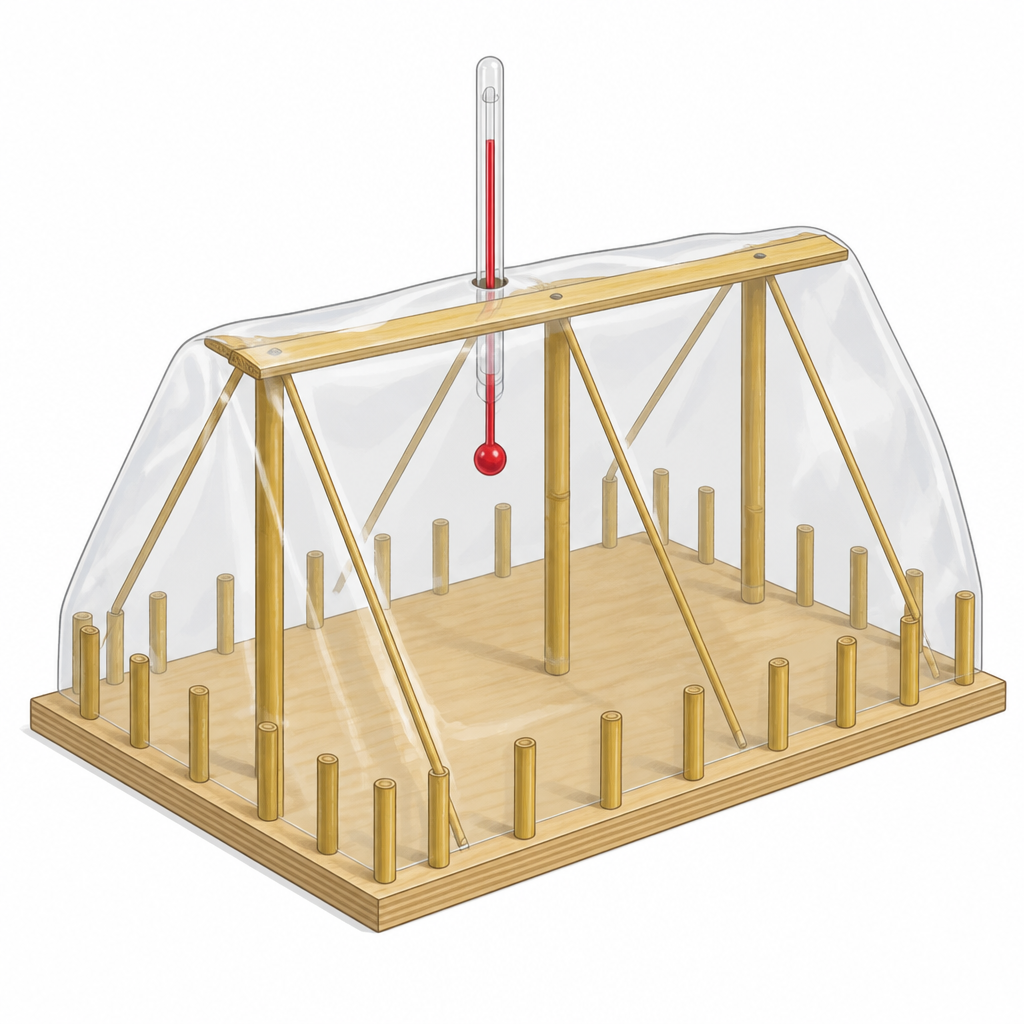
The rays of light that come in through the glass or the transparent plastic on the sloping surface raise the temperature inside the model, so the temperature inside is higher than the temperature of the air outside. This happens because more rays enter through the sloping surface and because the rays reflected inside come back into the model instead of leaving it. The tunnel used on a vegetable farm is nothing but a large version of this small model, so a visit to a tunnel on a nearby farm makes the whole idea much clearer.
The edges of pieces of glass are very sharp, so lift them slowly and keep your fingers clear while hammering the nails. If a laboratory thermometer breaks, do not touch what comes out of it.
Why a Cloudy Night Feels Warmer
After a sunny day, the heat the ground has soaked up travels upward as radiation all through the night. If the sky is clear, that heat goes straight out above the atmosphere and is lost, so the night turns cold. When there is cloud, the cloud absorbs the heat rising from below and sends a large part of it back down again. Here the cloud is doing the same work as the glass of a greenhouse, and that is why a cloudy night feels warmer than a night under a clear sky.
Effects of the Greenhouse Effect
As the amount of greenhouse gases in the atmosphere goes on rising, the greenhouse effect grows stronger, and its results show up right across the earth.
- It raises the temperature of the atmosphere.
- It brings changes in the water cycle.
- It affects human health.
- It reduces agricultural production and productivity.
- It makes glaciers and snow ranges melt.
- It raises the level of the sea, which brings the problem of flooding to settlements on the coast.
- It brings a decline in biodiversity.
- It causes desertification.
- It creates imbalance in the ecosystem.
How the Greenhouse Effect Is Useful
After reading those effects it is easy to think that the greenhouse effect itself is a bad thing, but that is not so. The natural greenhouse effect is very necessary. Without it the temperature of the earth would fall and living things would be in danger, and the existence of life on the earth could be wiped out. It is when the greenhouse effect becomes too strong that many harmful effects fall on the environment.
Calling the greenhouse effect itself harmful is wrong. The harm comes from too much of it, not from the effect itself.
Because the temperature rises inside an artificial greenhouse, it brings a number of practical benefits. That is why greenhouses are being used more and more in a country with as many kinds of climate as ours.
- Off season vegetables can be grown.
- A good income can be earned from those off season vegetables.
- Plants that were losing their existence in cold temperatures can be saved.
- Even in a very cold country, plants that grow in warm places can be kept alive.
The full lesson is waiting for you
The notes are free to read in full. A free account opens the rest of the practice, and tracks your progress and confidence score for every subject. Presentations and videos need approval from Learn Yeti.