Heat That Crosses Empty Space
Stand outside at midday and your face feels warm. Sit beside a heater and your hands feel hot. Now think about the Sun. Between the Sun and the Earth there is only empty space, with no air in it at all. So how does the Sun's heat reach us?
For conduction, the hot thing and the cold thing must be joined by matter. Nothing joins the Sun or the heater to us, so conduction cannot be the answer. Convection does not fit either. In convection the heated air molecules rise upward, they do not come down to the person sitting below. Yet the heat does arrive. That means the heat travelled to us without any medium at all.
Heat and light are produced in the Sun. From the Sun they spread out as waves. These waves need no medium to travel through, so they cross the vacuum of outer space and arrive at the surface of the Earth. Heat spreading in this way, with no medium, is called radiation.
Radiation: the method of heat transfer in which heat travels without any medium. Heat can be transferred by radiation even through a vacuum, which is space with no matter in it.

Conduction and convection both need a medium. Radiation does not. That single difference is what separates radiation from the other two methods.
What a Wave Is
We have said that radiation travels as waves. So the next thing to understand is what a wave actually is. A quiet pool of water is enough to show it.
- Find still water, such as a pond, a lake or water standing at the edge of a road.
- Drop a small stone into the middle of it.
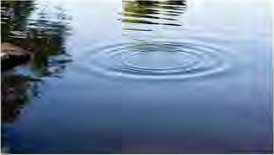
- Watch the round ripples spreading out from the place where the stone fell, moving towards the bank.
- Now watch a leaf or a twig floating on the water. It only bobs up and down. It does not travel to the bank with the ripple.
After the stone falls, the surface of the water rises and dips, and the ripple looks as though it is walking towards the bank. That travelling disturbance is a wave. As the wave spreads, the water itself stays where it was. A stretched rope behaves in the same way. Shake one end of it and a wave runs along the rope. Wherever something vibrates, waves are produced in just this manner.
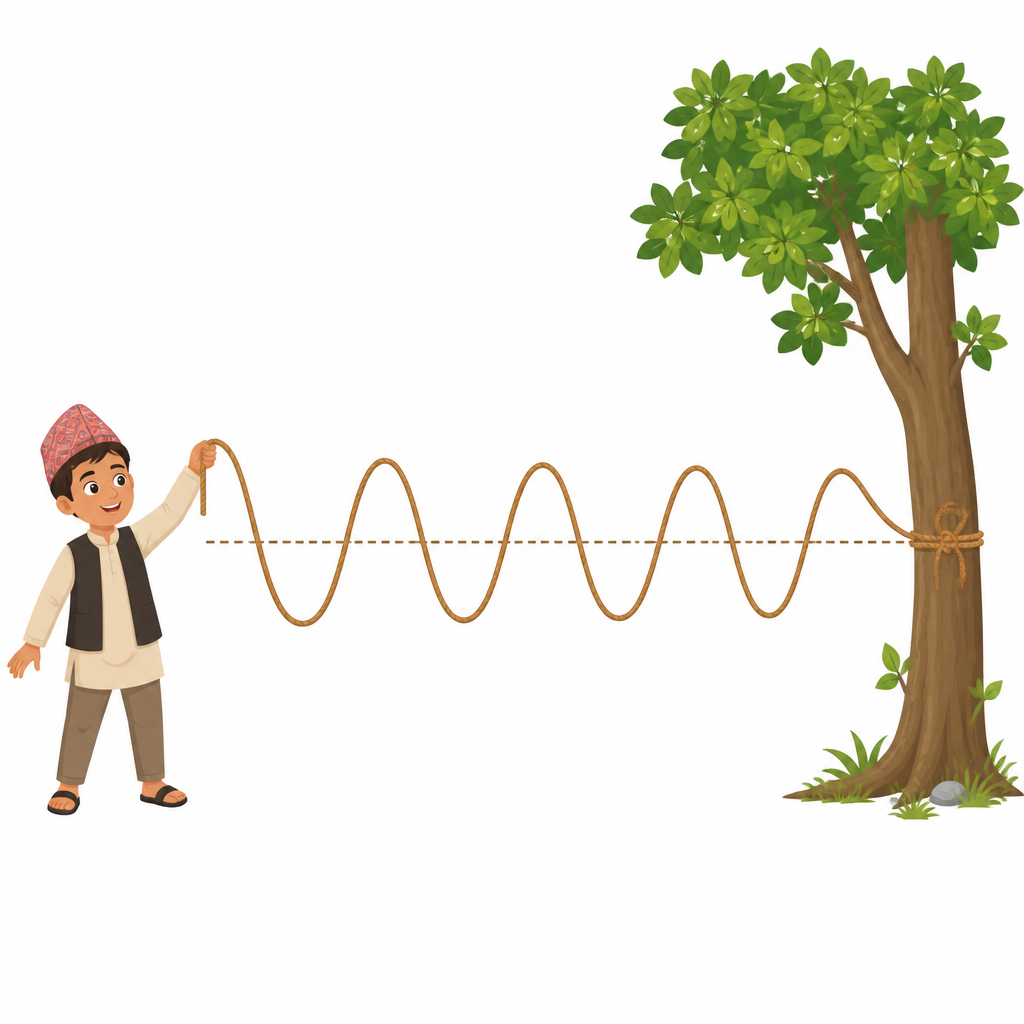
Wave: a disturbance produced by vibration, which travels forward and carries energy with it.
A wave moves, but the matter does not move along with it. The ripple reaches the bank, yet the water does not travel to the bank. The wave runs down the rope, yet the rope stays where it is. What travels is energy, not matter.
Mechanical and Electromagnetic Waves
Some waves need a medium in order to travel and some do not. Waves are divided into two kinds on exactly this basis.
Mechanical wave: a wave that needs a medium in order to travel. A sound wave is an example of a mechanical wave.
Electromagnetic wave: a wave that needs no medium in order to travel. Light, infrared, gamma rays and ultraviolet waves are examples of electromagnetic waves.
A mechanical wave is energy passed on by the vibration of matter. The matter that vibrates while the energy passes through it is called the medium. Some of the wave's energy is used up in the medium as it goes, so the wave grows weaker and can travel only a limited distance. The speed of a mechanical wave is different in solids, in liquids and in gases.
| Medium | Speed of sound |
| Air | 332 m/s |
| Water | 1481 m/s |
| Iron | 5120 m/s |
Light from the Sun and from other stars crosses the vacuum of outer space and arrives at the Earth. Light waves, and the invisible infrared waves that carry heat, both travel without any medium, and both are electromagnetic waves. Because there is no medium to soak up their energy, that energy is conserved as they travel. This is why electromagnetic waves can cross enormous distances at the speed of light.
The light waves produced in the Sun travel at this speed:
\[ 3 \times 10^8 \text{ m/s} \]
Moving at that speed, those waves take about 8 minutes and 20 seconds to reach the Earth.
| Point | Mechanical wave | Electromagnetic wave | |
| Medium | Needed | Not needed | |
| Examples | Sound wave | Light, infrared, gamma rays, ultraviolet | |
| Energy | Used up in the medium, so it falls | Conserved as it travels | |
| Range | Only a limited distance | Very far, at the speed of light |
Electromagnetic Waves and the Radiation Method
Now join the two ideas together. The particles of every object are always in motion, and that motion makes the object give out electromagnetic radiation. Heat moves from one place to another by means of that radiation.
Thermal radiation: the movement of heat from one place to another by means of the electromagnetic radiation that is produced by the motion of the particles of matter.
It is the infrared part of the electromagnetic spectrum that carries heat. The heat the Earth gets from the Sun comes to it as radiation of this kind, and no medium is needed to carry it. That is why your face feels warm the moment you step into sunshine, even on a day when the air itself is cold.
How Surface Colour Changes Radiation
Which colour of surface takes in more heat can be tested quite easily in sunshine.
- Take three tins of the same size with lids that fit, one white, one black and one golden.
- Make a hole of the same size in each lid, just wide enough for a thermometer.
- Push a thermometer into each of the three tins.
- Stand all three tins in the sunshine for the same length of time.
- After a while, read the three thermometers and see which tin has reached the higher temperature.
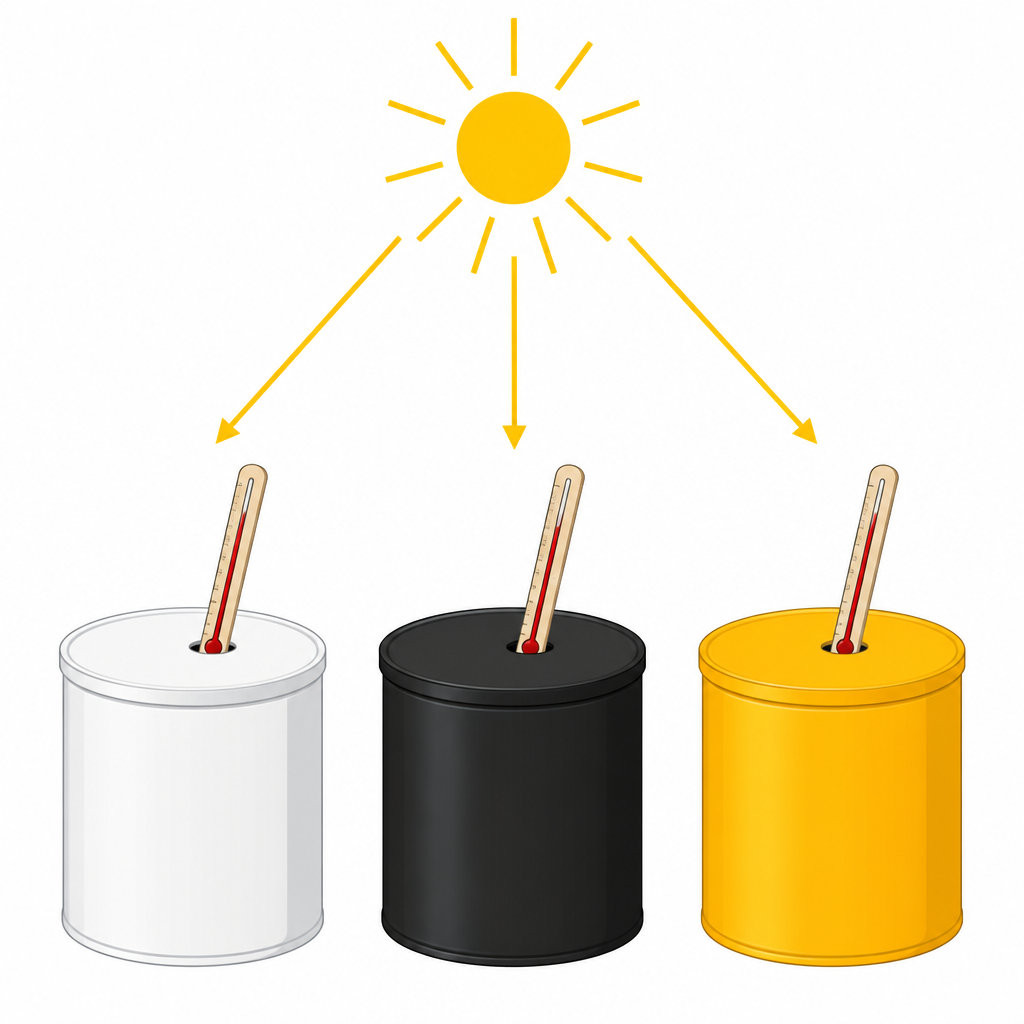
The thermometer in the black tin shows the highest temperature. A black surface is good at both heat absorption and heat emission, while a white or pale surface is poor at both. So a hot dark object gives out a large amount of radiation, and a white or pale object both gives out less radiation and takes in less heat.
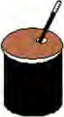
It is wrong to think that a black surface only takes heat in. A black surface takes in a lot of heat and, once it is hot, it also gives out a lot. Absorption and emission always go together.
People make use of this in daily life. In hot places clothes are usually white, while in cold places dark clothes are the better choice. The surface of a solar heater is painted black so that it absorbs as much of the Sun's light as possible. The outside of the bottom of a cooking pot is often blackened so that food cooks quickly and fuel is saved.
Everyday Uses of Heat Radiation
Why does hot tea, or a cooked meal, go cold after a while? When a thing is hotter than its surroundings it gives out heat as radiation, so its temperature keeps falling until it is the same as the surroundings. When a thing is colder than its surroundings it is taking heat in, so its temperature keeps rising.
- When we sit beside a fire, the heat of the fire reaches us by radiation and we feel warm.
- The heat of the Sun's light reaches the surface of the Earth by radiation, and the Earth becomes warm.
- The cooling fan at the back of a refrigerator throws the heat it has collected out into the room around it.
- In hot weather people wear white or light coloured clothes, which take in less heat.
Structure and Function of a Thermos
A thermos can hold something at nearly the same temperature for a long time. Put something hot into it and it stays hot for hours. Put something cold into it and it stays cold just as long. The reason lies in the way it is built.
- A thermos is usually made of glass, and it has two walls, one inside the other.
- The space between the two walls is a vacuum, with no air left in it.
- The facing sides of both walls are made shiny, like silver.
- The whole glass part is held inside a plastic or metal case, resting on supports of wood or plastic called corks.
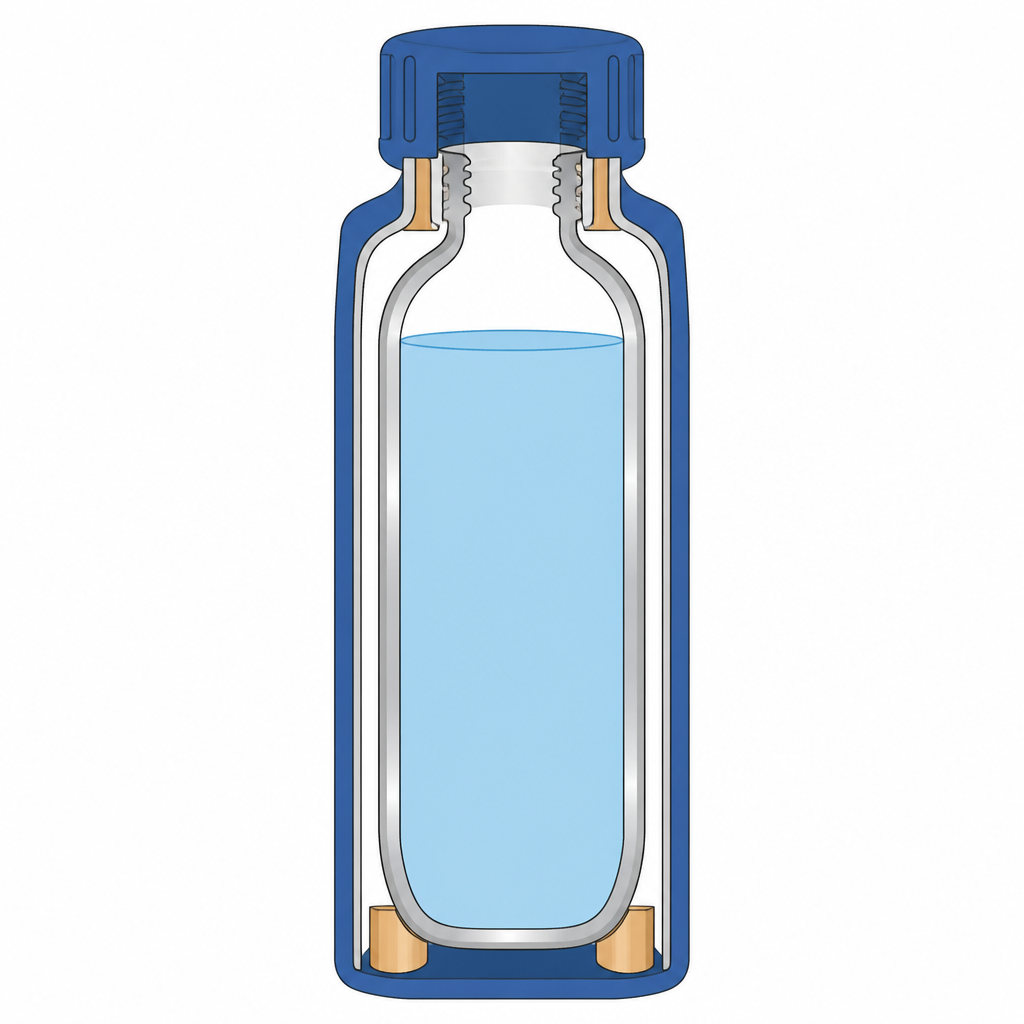
Now look at what each part does. Glass is a poor conductor of heat, so heat cannot pass out through it by conduction. Between the two walls there is a vacuum, and with no air there heat cannot pass by convection either. The silvered surfaces reflect heat back, and so they block radiation. In this way all three methods of heat transfer are stopped inside a thermos.
| Part of the thermos | Which method it blocks |
| The glass walls | Conduction |
| The vacuum between the walls | Convection |
| The silvered surfaces | Radiation |
That is why a hot drink in a thermos stays hot and a cold drink stays cold. Only a small amount of heat escapes by conduction through the place where the two walls meet, and because that amount is small, thermos flasks today are often made of metal, usually steel, instead of glass.
A thermos is one object that answers all three methods of heat transfer at once. Blocking only one of them would not be enough, so it blocks all three.
The full lesson is waiting for you
The notes are free to read in full. A free account opens the rest of the practice, and tracks your progress and confidence score for every subject. Presentations and videos need approval from Learn Yeti.