Light Changes Direction at a Boundary
Light travels in a straight line as long as it stays inside one medium. A material that light can pass through, such as air, water or glass, is called an optical medium. Something interesting happens at the boundary where one optical medium meets another. Put a straight pencil into a glass of water so that it leans, and look at it from the side. The pencil seems to break at the water surface. The pencil has not bent at all. The light coming from it has changed direction as it left the water and entered the air. This change of direction at a boundary is called refraction, and two simple experiments show exactly how it happens.
Of two optical media, the one in which light travels more slowly is called the optically denser medium, and the one in which light travels faster is called the optically rarer medium. In this sense water is denser than air, and glass is also denser than air. Which of two media is denser and which is rarer can be found by watching which way a ray of light bends when it crosses from one into the other.
A Laser Beam Entering and Leaving Water
To see refraction clearly, we need a narrow beam of light. A laser pointer gives one. If no laser pointer is available, a simple ray box does the job. A bulb is placed inside a cardboard box, and a thin slit is cut in one wall of the box. A narrow ray of light comes out through the slit. The second medium is a beaker filled a little more than half with water.
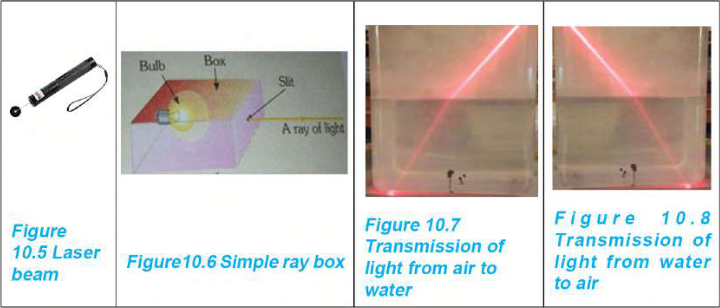
Never point a laser pointer at anyone's eyes, including your own. If you use a ray box, switch the bulb off after some time, because the heat of the bulb can set the cardboard on fire.
First, the beam is sent into the water from the upper side of the beaker, so the light passes from air into water. Inside the water the beam does not carry on in the direction it had in air. It bends at the surface. To say which way it bends, we imagine a line drawn perpendicular to the water surface at the point where the beam enters. This imaginary line is called the normal. The beam inside the water turns towards the normal.
Next, the beam is sent in from the lower part of the beaker so that it travels up through the water and comes out into the air. This time the light passes from water into air. The beam that comes out into the air turns away from the normal. In the two cases the beam bends in opposite directions.
Why does this happen? The speed of light in air is about \( 3 \times 10^8 \) m/s, and in water it is \( 2.25 \times 10^8 \) m/s. When light enters water from air, its speed decreases, and this slowing down makes the beam bend towards the normal. Because the beam bends towards the normal in water, water is taken to be the denser medium. When light leaves water and enters air, its speed increases again, and the beam bends away from the normal. So air must be the rarer medium.
| Light passes from | Speed of light | Which way the ray bends | So the second medium is |
| Air to water | Decreases | Towards the normal | Denser |
| Water to air | Increases | Away from the normal | Rarer |
Rarer to denser: light slows down and the ray bends towards the normal. Denser to rarer: light speeds up and the ray bends away from the normal.
What Refraction Is
In both halves of the experiment, the light that bent at the surface, towards the normal or away from it, because its speed changed, is the refracted light. The bending itself has a name.
Refraction of light: The bending of light, or the change in its direction, when it passes from one optical medium to another is called refraction of light.
The cause of refraction is the change in the speed of light as it goes from one medium into another. The greater the change in speed, the more the light bends, which means the greater the refraction. For example, light travels even more slowly in glass than in water. So a ray coming from air at a given angle bends more when it enters glass than when it enters water.
Refraction is not special to light. Other waves, such as sound, also follow the laws of refraction when they pass from one medium into another.
Tracing a Ray Through a Glass Slab
A glass slab is a thick rectangular block of glass whose opposite faces are flat and parallel. Light enters it through one face and leaves through the opposite face, so it is refracted twice. If the path of the ray is traced on paper, we can measure exactly how much it bends each time. The method is:
- Place the glass slab on a sheet of plain paper and draw its outline with a pencil. Name the corners P, Q, R and S, with PQ as the face the light will enter.
- Mark a point O on the face PQ and draw the normal NN' through O, perpendicular to PQ.
- Draw a line AO that makes a chosen angle \( i \) with the normal.
- From the side of the face PQ, shine a laser beam along AO so that it enters the slab at O and comes out through the opposite face RS.
- Mark the point B where the beam comes out, and another point C on the beam after it has left the slab.
- Remove the slab, and at B draw the normal \( N_1N_1' \) perpendicular to RS.
- Join O to B, and B to C.
Now the paper shows the whole path of the light. AO is the incident ray, OB inside the glass is the refracted ray, and BC, which comes out into the air again, is the emergent ray.
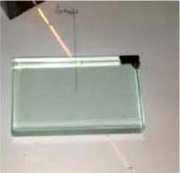
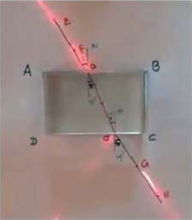
Watch the direction of the ray as it enters the glass and as it leaves. When it passes from air into glass, it bends towards the normal. When it passes from glass back into air, it bends away from the normal. This happens because air is the rarer medium and glass is the denser one. The diagram below names every ray, normal and angle along the whole path.
Terms Used in Refraction
Every part of the diagram has a name, and these names are used in every question about refraction. Learn each one together with its letters in the diagram.
Normal: The imaginary line drawn perpendicular to the surface that separates two media, at the point where the ray meets it, is called the normal. In the diagram, NN' and \( N_1N_1' \) are normals.
Incident ray: The ray that comes from the source of light and strikes the surface of the second medium is the incident ray. In the diagram it is AO.
Angle of incidence: The angle made by the incident ray with the normal is the angle of incidence, \( i \). In the diagram it is \( \angle AON \).
Refracted ray: The ray that bends at the boundary and travels on through the second medium is the refracted ray. In the diagram it is OB.
Angle of refraction: The angle made by the refracted ray with the normal is the angle of refraction, \( r \). In the diagram it is \( \angle BON' \).
Emergent ray: The ray that comes out of the object back into the first medium after refraction is the emergent ray. In the diagram it is BC.
Angle of emergence: The angle made by the emergent ray with the normal at the point where it comes out is the angle of emergence, \( e \). In the diagram it is \( \angle CBN_1' \).
Lateral shift: The perpendicular distance between the emergent ray and the incident ray extended in its original direction is called the lateral shift, also called lateral displacement. In the diagram it is CD.
Every angle in refraction is measured from the normal, never from the surface of the glass or water. A ray that makes 60° with the surface makes 30° with the normal, so its angle of incidence is 30°, not 60°.
| Term | In the diagram | Symbol |
| Normal | NN' and \( N_1N_1' \) | |
| Incident ray | AO | |
| Angle of incidence | \( \angle AON \) | \( i \) |
| Refracted ray | OB | |
| Angle of refraction | \( \angle BON' \) | \( r \) |
| Emergent ray | BC | |
| Angle of emergence | \( \angle CBN_1' \) | \( e \) |
| Lateral shift | CD |
Why the Ray Leaves Parallel to How It Entered
When the angles in the traced diagram are measured with a protractor, a clear pattern appears. Suppose the angle of incidence is 30°. At the face PQ, light passes from air, the rarer medium, into glass, the denser medium. It slows down and bends towards the normal, so the angle of refraction comes out smaller than 30°, at about 19°. For light entering glass from air, the angle of refraction is always smaller than the angle of incidence:
\[ r < i \]
At the face RS, light passes from glass back into air. Its speed increases in air, so the ray bends away from the normal, turning back by just as much as it turned at the first face. Because the two faces of the slab are parallel, the angle of emergence comes out equal to the angle of incidence:
\[ e = i \]
Since \( e = i \), the emergent ray BC travels in the same direction as the incident ray AO. BC is parallel to AO, but it is not on the same line. It has been moved sideways. The dashed line OD shows where the light would have gone if the slab were not there, and the gap CD between that line and the emergent ray is the lateral shift. The lateral shift happens because the ray bends towards the normal inside the glass and then away from the normal when it comes out into the air.
A glass slab does not change the direction of a ray. It only moves the ray sideways. So \( r < i \), \( e = i \), and the sideways gap CD is the lateral shift.
What Decides the Angle of Refraction
When light enters any transparent medium from air, the angle of refraction depends on two things: the nature of the medium, and the angle of incidence.
- The nature of the medium: in a medium where light slows down a lot, the ray bends a lot and the angle of refraction is small. For the same angle of incidence, the angle of refraction in glass is smaller than in water.
- The angle of incidence: when the angle of incidence is increased, the angle of refraction also increases, and when the angle of incidence is decreased, the angle of refraction also decreases.
Repeating the glass slab experiment with angles of incidence of 20°, 30° and 45° shows this. Each time the angle of incidence gets larger, the angle of refraction gets larger too, but it always stays smaller than the angle of incidence, and the angle of emergence always equals the angle of incidence. For a particular medium, the value of the angle of refraction for a particular angle of incidence can be worked out using the law of refraction.
The full lesson is waiting for you
The notes are free to read in full. A free account opens the rest of the practice, and tracks your progress and confidence score for every subject. Presentations and videos need approval from Learn Yeti.