Glass with Curved Surfaces
Look closely at a pair of spectacles. Each glass is not flat like a window pane. Its faces are gently curved, as if a small piece had been cut from the surface of a ball. A hand lens, the kind used to read tiny print or to look at an insect's leg, is made of the same kind of curved glass or plastic. Because such a face is a piece of the surface of a sphere, it is called a spherical surface.
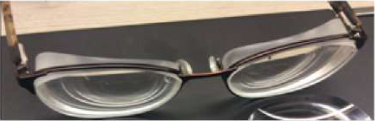
When light passes from air into glass and out again, it changes direction. This is refraction. In a flat pane, the bend on the way in is undone on the way out, so the light carries on almost as before. In a spherical surface, light is bent by different amounts at different parts of the glass. Because of this, light rays can be brought together to meet at a single point, or spread out so that they seem to come from a single point. This is what makes spectacles, hand lenses and cameras work.
Making a Water Hand Lens
You can make a working lens from a used plastic bottle. The shoulder of a round bottle, near its neck, is curved like part of a ball. Two circles cut from that part, joined face to face and filled with water, make a lens you can hold in your hand. The steps are set out in Activity 10.10.

Look through the finished lens at the print on a page. The letters look bigger than they really are. The water between the two curved plastic walls refracts the light. Because the lens is thicker in the middle than at its rim, the rays coming from the letters are bent towards each other. Even a single curved piece of bottle with water poured into it bends light in the same way, so it also acts as a lens.
A hot glue gun and its glue can burn skin, and cut plastic has sharp edges. Hold the pieces by their rims and ask an adult to help with the glue gun. Never look at the Sun through any lens. Do not leave a lens lying in strong sunlight either, because it can gather the Sun's rays onto one spot and burn eyes, paper or a table.
The water lens looks as if it has been cut out of two solid balls, because each of its faces is a slice of a sphere. A spherical mirror is also made from a slice of a hollow sphere, so a lens and a spherical mirror share several properties. Both, for example, have a centre of curvature and a principal axis. The difference is that a mirror reflects light back, while a lens lets light pass through it and refracts it.
What Is a Lens?
Lens: A lens is a transparent medium that has at least one spherical surface.
Glass, clear plastic and even water can form a lens, as long as light can pass through and at least one face is curved. The other face may be curved too, or it may be flat. Most lenses have two curved faces, and each face is part of the surface of its own sphere. After passing through a lens, light rays either come together at one point or spread out as if from one point.
Convex and Concave Lenses
There are mainly two types of lenses: the convex lens and the concave lens. Hold a lens by its edge and feel how thick it is. Whether the middle is thicker or thinner than the edge tells you which type it is.
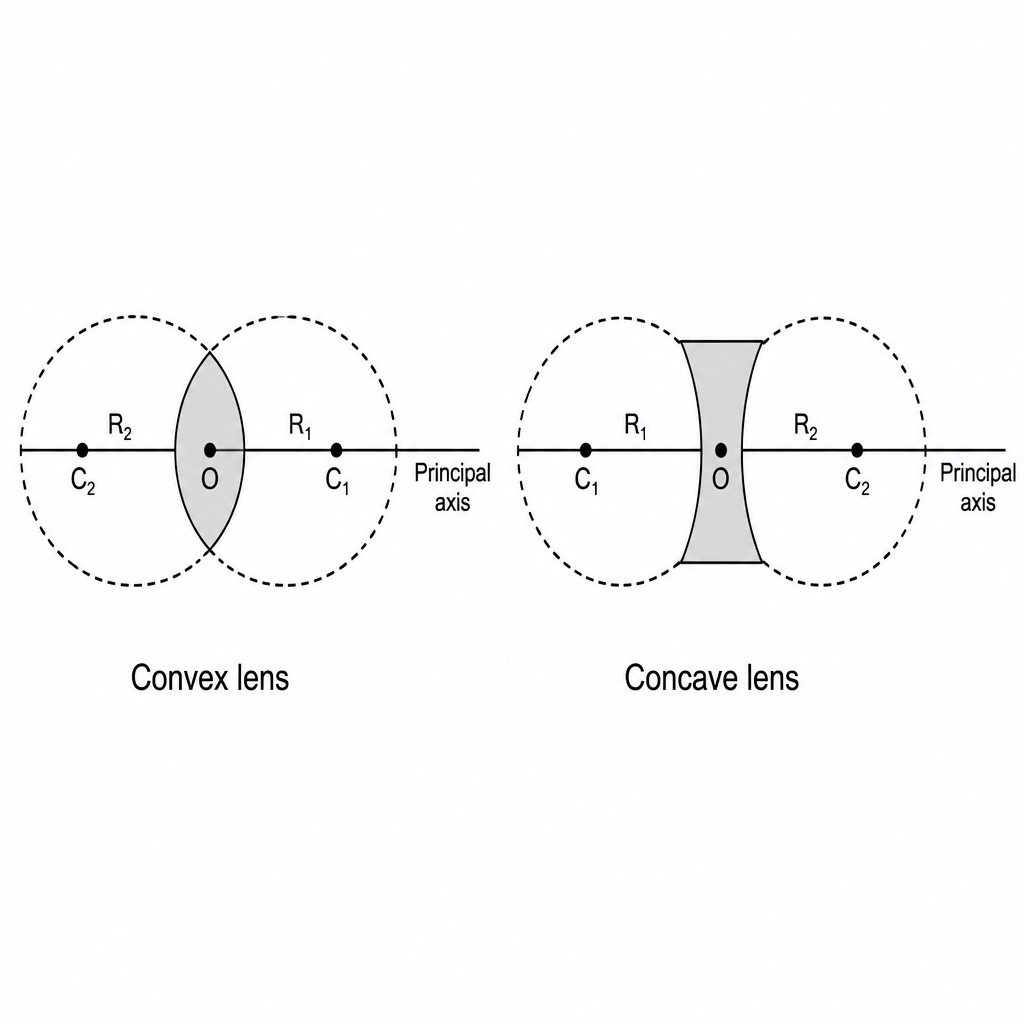
Convex lens: A convex lens is a lens that is thicker at the middle than at the edges. Since it converges light rays, it is also called a converging lens.
The water hand lens you made is a convex lens. Convex lenses are used in spectacles, cameras, microscopes, projectors and similar devices. Our own eyes also contain a natural convex lens.
Concave lens: A concave lens is a lens that is thinner at the middle than at the edges. Since it diverges light rays, it is also called a diverging lens.
| Feature | Convex lens | Concave lens |
| Thickness | Thick in the middle, thin at the edges | Thin in the middle, thick at the edges |
| Faces | Faces bulge outward | Faces curve inward |
| Effect on light | Brings parallel rays together | Spreads parallel rays apart |
| Other name | Converging lens | Diverging lens |
The Six Shapes of Lenses
A face of a lens can bulge outward, curve inward or be flat. Combining these faces gives three shapes of converging lens and three shapes of diverging lens. The rule for sorting them never changes: a thicker middle means converging, and a thinner middle means diverging.
| Group | Shape | Its two faces |
| Converging | Biconvex | Both faces bulge outward |
| Converging | Plano-convex | One face flat, the other bulges outward |
| Converging | Concavo-convex | One face curves in, the other bulges out more strongly |
| Diverging | Biconcave | Both faces curve inward |
| Diverging | Plano-concave | One face flat, the other curves inward |
| Diverging | Convexo-concave | One face bulges out, the other curves in more strongly |
A concavo-convex lens has one hollow face, yet it is a converging lens. Do not sort a lens by the name of one face. Compare the thickness at the middle with the thickness at the edge.
Terms Related to a Lens
To draw a lens and talk about it clearly, scientists use a few fixed names and letters. The diagram below marks all of them on both a convex and a concave lens.
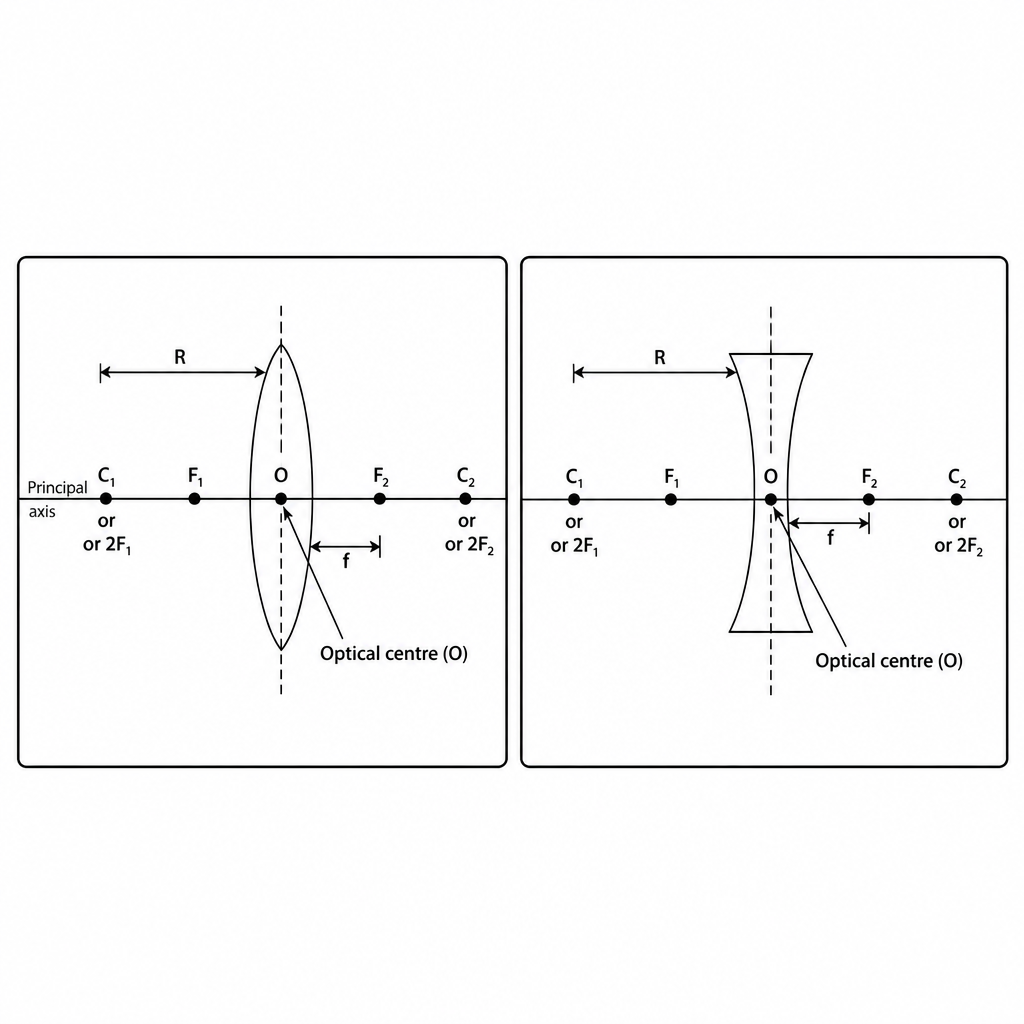
Centre of curvature: The centre of curvature is the centre of the sphere that forms a curved part of the lens. Since most lenses are formed from two spherical surfaces, they have two centres of curvature, usually labelled \( C_1 \) and \( C_2 \).
The sphere that makes the right-hand face of a convex lens has its centre on the left of the lens, and the sphere that makes the left-hand face has its centre on the right. In ray diagrams, \( C_1 \) of a convex lens is also written \( 2F_1 \) and \( C_2 \) is written \( 2F_2 \), because these points lie twice as far from the lens as the focus does.
Radius of curvature: The radius of curvature is the distance from the centre of curvature to the surface of the lens. In a ray diagram, it is denoted by R.
A sphere with a large radius gives a gently curved face, while a small radius gives a sharply curved one. So a lens with a large R looks flatter and thinner.
Optical centre: The optical centre is the geometrical centre of the lens, where the principal axis passes through the lens. In a ray diagram, it is denoted by O.
Principal axis: The principal axis is the line passing through the optical centre and the two centres of curvature of the lens. It divides the lens into two symmetric halves.
The half of the lens above the principal axis and the half below it are mirror images of each other. So whatever the upper half does to light, the lower half does by the same amount in the opposite direction.
Seeing Rays Converge and Diverge
A ray box with three slits sends out three thin, parallel beams of light. Place a thick convex lens in front of them, and after the lens the three beams bend inward and meet at one point. Take the convex lens away and put a thick concave lens there instead, and the three beams spread outward. The full method is in Activity 10.11.
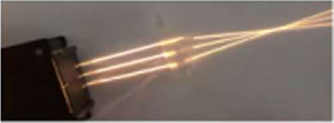
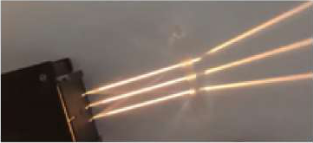
For the convex lens, the distance from the middle of the lens to the point where the rays meet can be measured straight away with a ruler. The rays from the concave lens never meet, so the spreading beams have to be extended backwards with a ruler. These extended lines meet at one point on the same side of the lens as the ray box. Measure the distance from the middle of the lens to that point. Both of these distances are important measurements of a lens, explained below.
A Lens as a Set of Prisms
A convex lens can be thought of as a stack of small prisms. In the upper half of the lens, the bases of the prisms face downwards, and in the lower half, the bases face upwards. A ray coming out of a prism is always bent towards the base. So a ray in the upper half bends down and a ray in the lower half bends up. Every ray is bent towards the principal axis.
The prisms near the edges are steeper, so a ray far from the principal axis is bent more sharply than one close to it. That is how all the parallel rays reach the same point on the principal axis. A ray travelling along the principal axis meets no slope at the middle of the lens, so it passes straight through without any deviation.
A concave lens can also be thought of as a set of prisms, but here the bases in the upper half face upwards and those in the lower half face downwards. Rays still bend towards the base, so the upper ray is sent further up and the lower ray further down. As a result, rays travelling parallel to the principal axis spread out after passing through the lens. A ray travelling along the principal axis still goes straight through without deviating.
Principal Focus
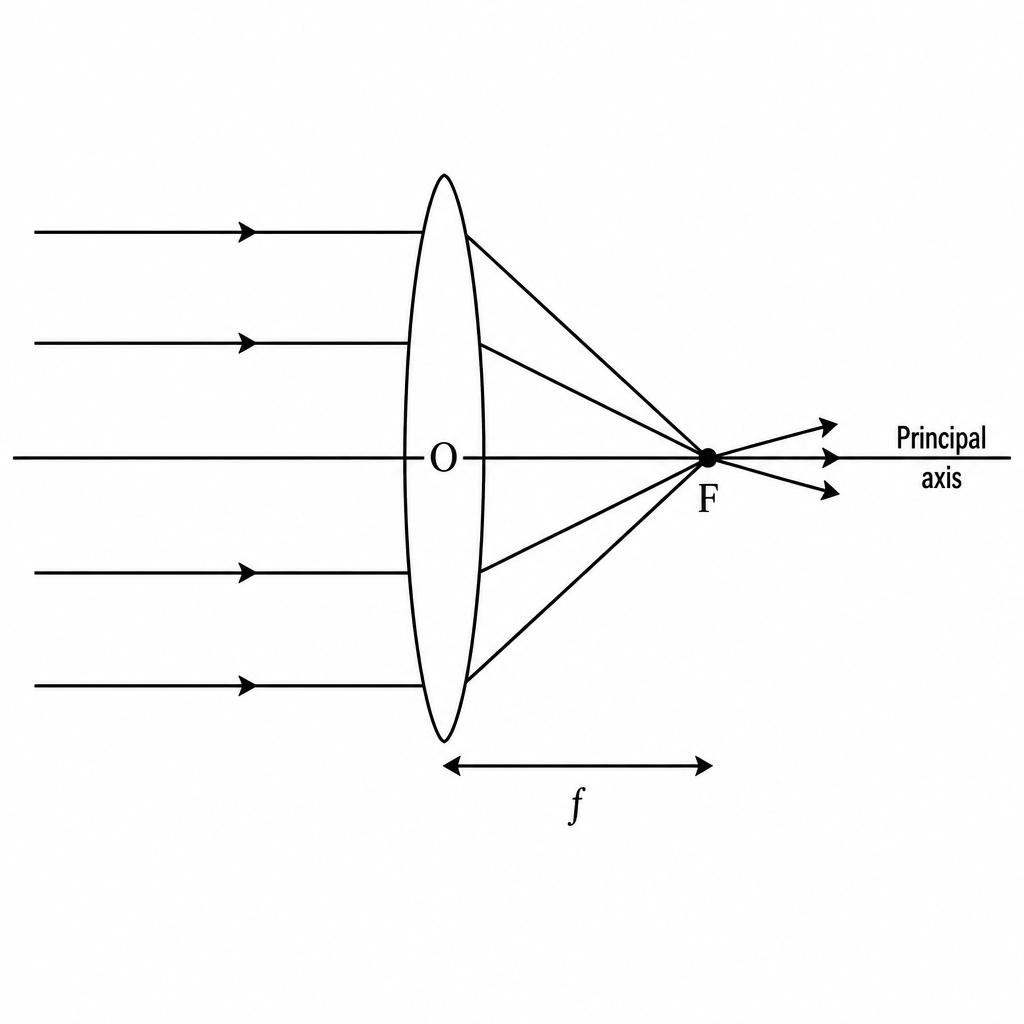
In a convex lens, rays travelling parallel to the principal axis meet at a point on the principal axis after passing through the lens. That point is the principal focus of the convex lens, and it is denoted by F. The rays really do meet there, so a sheet of paper held at that point shows a small bright spot.
The rays that leave a concave lens never cross each other. But when they are traced backwards, they appear to spread out from a single point on the principal axis, on the side the light came from. The point from which the light appears to diverge is called the principal focus of the concave lens.
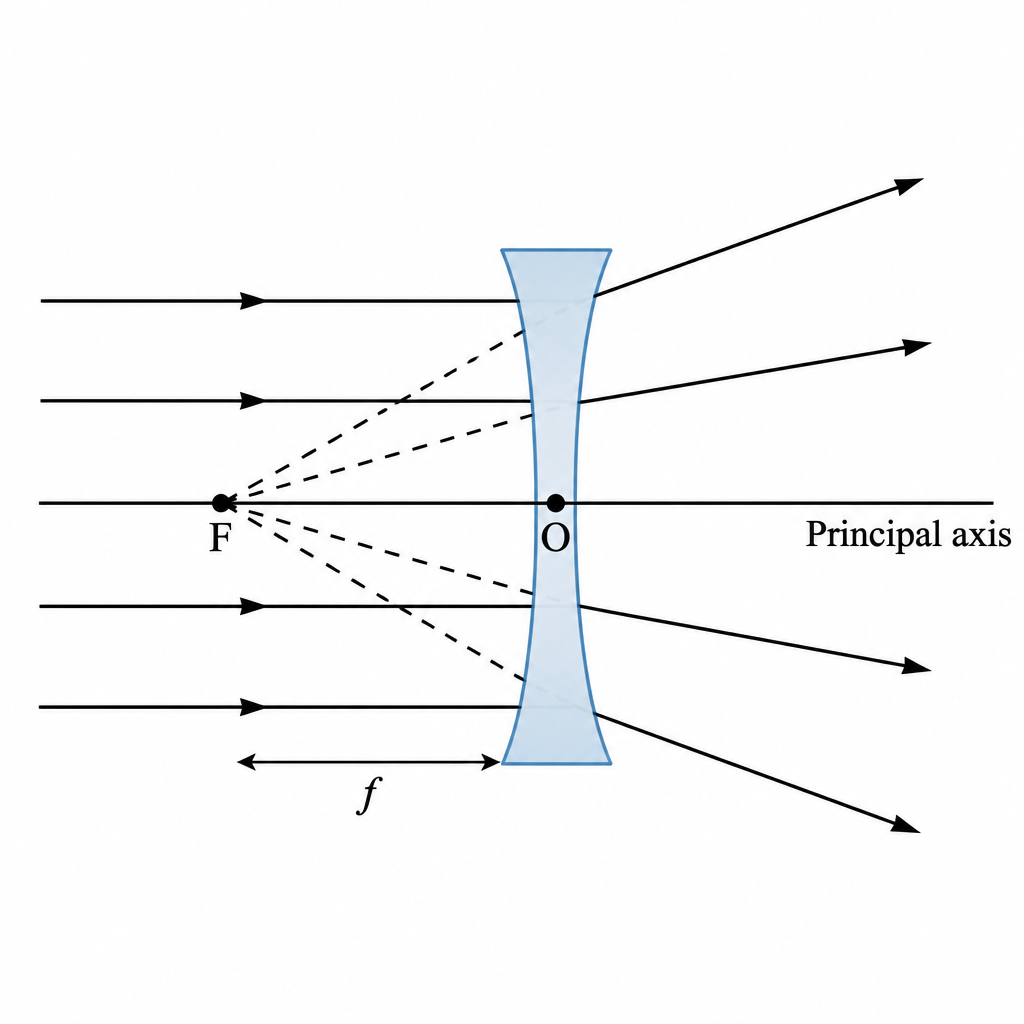
Principal focus: The principal focus is the point on the principal axis at which light rays travelling parallel to the principal axis converge, or from which they appear to diverge, after passing through the lens. It is denoted by F.
Light can arrive from either side of a lens, so a lens has two principal foci: \( F_1 \) on the left and \( F_2 \) on the right. For a thin lens, both lie at the same distance from the optical centre.
Focal Length
Focal length: The focal length is the distance from the optical centre O of the lens to its principal focus F. It is denoted by f.
The radius of curvature is twice the focal length:
\[ R = 2f \]
So if R is known, f is found by dividing R by 2, and if f is known, R is found by multiplying f by 2. A thick, strongly curved lens has a short focal length, and a thin, gently curved lens has a long one.
Example 1: A convex lens has a focal length of 15 cm. Find its radius of curvature.
Step 1: Writing down the given focal length:
\[ f = 15\ \text{cm} \]
Step 2: Using the relation between R and f:
\[ R = 2f \]
Step 3: Putting in the value of f and multiplying:
\[ R = 2 \times 15\ \text{cm} = 30\ \text{cm} \]
So the radius of curvature of this lens is 30 cm. Its centre of curvature lies twice as far away as its focus, which is why it is also marked 2F.
Example 2: A concave lens has a radius of curvature of 50 cm. What is its focal length?
Step 1: Rearranging \( R = 2f \) to find f:
\[ f = \frac{R}{2} \]
Step 2: Putting in the value of R and dividing:
\[ f = \frac{50\ \text{cm}}{2} = 25\ \text{cm} \]
So the focal length of this lens is 25 cm.
Do not mix up R and f. The centre of curvature is farther from the lens than the focus, so R is always larger than f. Write the unit in the answer too: '30' alone is not a complete answer, but '30 cm' is.
Terms and Symbols at a Glance
| Term | Symbol | Meaning in short |
| Centre of curvature | \( C_1, C_2 \) | Centre of the sphere a face belongs to |
| Radius of curvature | R | Distance from the centre of curvature to the lens surface |
| Optical centre | O | Geometrical centre of the lens |
| Principal axis | a line | Line through O, \( C_1 \) and \( C_2 \) |
| Principal focus | \( F_1, F_2 \) | Point where parallel rays meet or seem to come from |
| Focal length | f | Distance from O to F, with \( R = 2f \) |
The full lesson is waiting for you
The notes are free to read in full. A free account opens the rest of the practice, and tracks your progress and confidence score for every subject. Presentations and videos need approval from Learn Yeti.