Clear Vision and Its Range
A healthy eye sees clearly everything from about 25 cm away to objects as far as the horizon. The nearest point that the eye can see clearly without strain is called the near point, and for a normal eye it is about 25 cm from the eye. The farthest point the eye can see clearly is called the far point, and for a normal eye it is at infinity \( (\infty) \). So the range of normal human vision is from 25 cm to infinity.
Whatever the distance of the object, the cornea and the eye lens bend the light rays so that they meet exactly on the retina. Only when a clear image forms on the retina does the object look sharp. For a person whose eyes have a defect, the near point and the far point lie at different places from those of a normal eye.
What a Defect of Vision Is
A student on the back bench may find the letters on the board blurry while their own exercise book looks perfectly sharp. A grandfather, on the other hand, may hold the newspaper at arm's length because the letters blur when it is close. In both cases the letters only become clear when the page is moved nearer or further away. The reason is the same: the rays from the object are not being focused on the retina, so no clear image is formed there.
Defect of vision: the condition in which nearby or distant objects appear blurry because clear images of them are not formed on the retina.
Types of Defects of Vision
There are two main types of defects of vision in human eyes: short-sightedness, also called myopia, and long-sightedness, also called hypermetropia. The name tells you what the person CAN see well. A short-sighted person sees only near things clearly; a long-sighted person sees only distant things clearly.
Short-sightedness (Myopia)
A short-sighted person sees nearby objects clearly but distant objects look blurred. Parallel rays from a distant object meet in front of the retina, before they reach it. After crossing that point the rays spread out again, so on the retina they make a blurred patch instead of a sharp point. Rays from a nearby object still focus on the retina, which is why close things stay clear.
Short-sightedness (myopia): the defect of vision in which nearby objects are seen clearly but distant objects look blurred, because the image of a distant object forms in front of the retina.
For a myopic eye the far point is not at infinity. It is at some finite distance from the eye. For example, if someone's far point is 2 m away, they see objects within 2 m clearly, but everything beyond 2 m looks blurred.
Causes of Short-sightedness
Short-sightedness happens mainly for two reasons:
- (a) In some people the eyeball becomes elongated, so the distance between the lens and the retina increases. Even if the lens focuses normally, the retina has moved back, so parallel rays from distant objects meet in front of it.
- (b) To look at a distant object, the eye lens has to become thin. If the ciliary muscles cannot bring the lens to a thin enough shape, the focal length of the lens becomes less than required, and parallel rays from distant objects are focused in front of the retina.
Sometimes it is not only the curvature of the lens but also the curvature of the cornea that causes myopia. A cornea that is more curved than normal bends light too strongly, and again the rays meet in front of the retina.
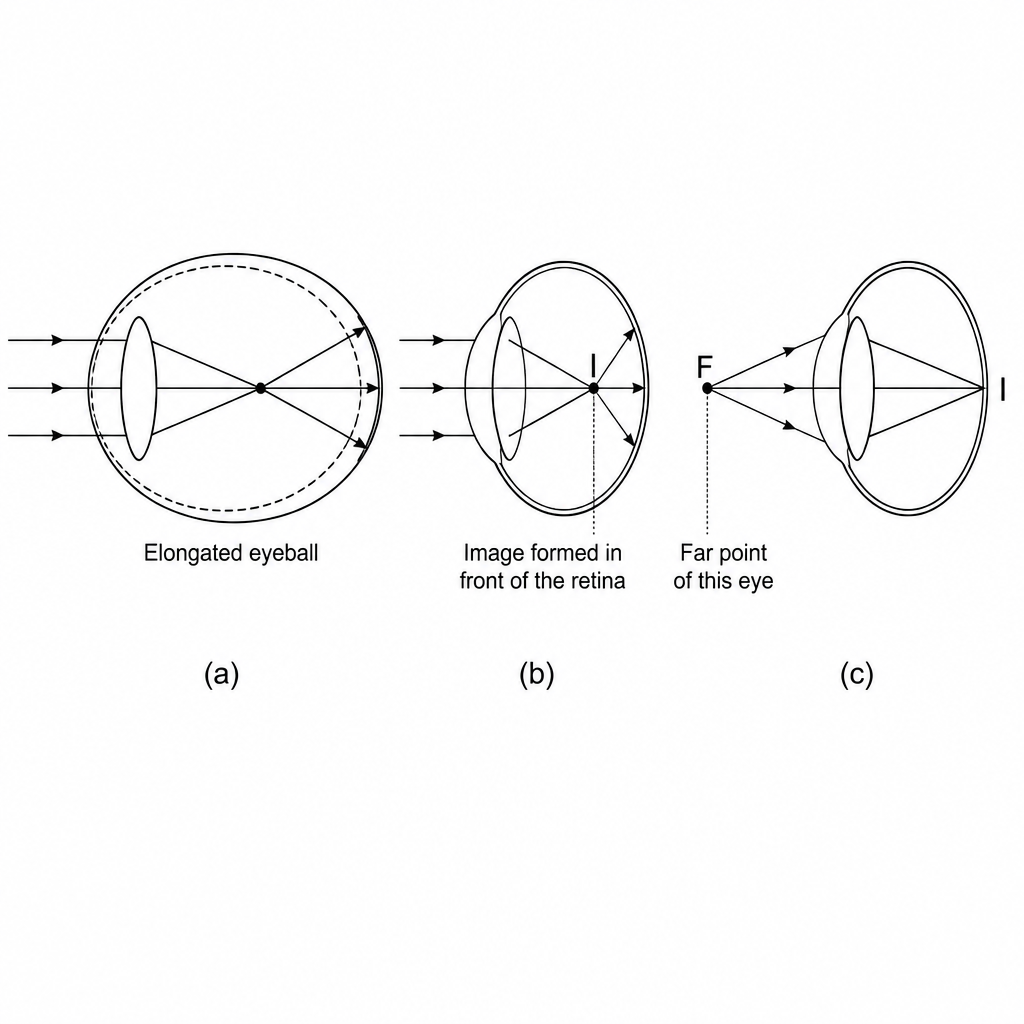
Correcting Short-sightedness with a Concave Lens
A myopic eye bends the rays so that they meet too early. So the problem is solved if the parallel rays from a distant object are spread out a little before they enter the eye. A lens that spreads rays out is a diverging lens, that is, a concave lens. A short-sighted person therefore wears spectacles with a concave lens of suitable focal length in front of the eye.
With the spectacles on, the rays travel like this:
- Parallel rays from the distant object first reach the concave lens.
- The concave lens diverges them a little, so that they appear to come from the far point F of the eye.
- These diverged rays are then refracted by the cornea and the eye lens.
- The rays now focus exactly on the retina and the distant object looks clear.
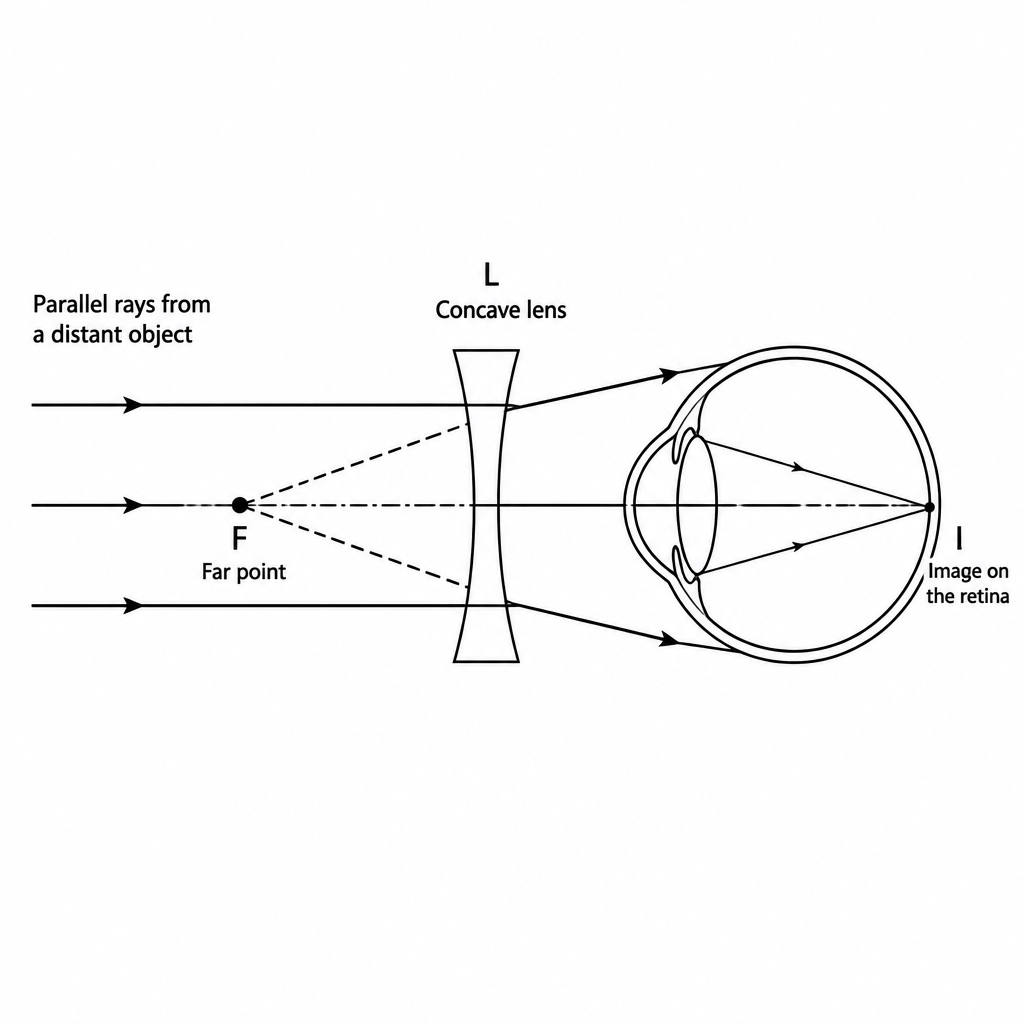
The focal length of the spectacle lens is chosen so that the rays it diverges are focused exactly on the retina, and the rays from distant objects appear to come from the far point F of the defective eye. Because spectacles sit very close to the eye, a person whose far point is 2 m away needs a concave lens with a focal length of about 2 m.
Myopia is corrected with a concave lens, not a convex one. A myopic eye already brings rays together too much; a convex lens would make them meet even earlier and make the blur worse.
Long-sightedness (Hypermetropia)
A long-sighted person sees distant objects clearly, but nearby objects look blurred. Rays from a nearby object have not yet come together when they hit the retina; they are bent only enough to meet behind it. So the retina receives a blurred patch.
Long-sightedness (hypermetropia): the defect of vision in which distant objects are seen clearly but nearby objects look blurred, because the image of a nearby object forms behind the retina.
For such an eye the near point is not at 25 cm but further away. If someone's near point is 1 m away, they must hold a book 1 m from their eyes to read it, which is hardly possible with the arms. This problem is usually seen in old age.
Causes of Long-sightedness
Long-sightedness also happens mainly for two reasons:
- (a) In some people the eyeball becomes too round, so the distance between the lens and the retina decreases. Rays from nearby objects are then focused behind the retina.
- (b) When looking at a nearby object, if the ciliary muscles cannot contract enough, the lens cannot be made thick enough. Its focal length increases, and rays from nearby objects are focused behind the retina.
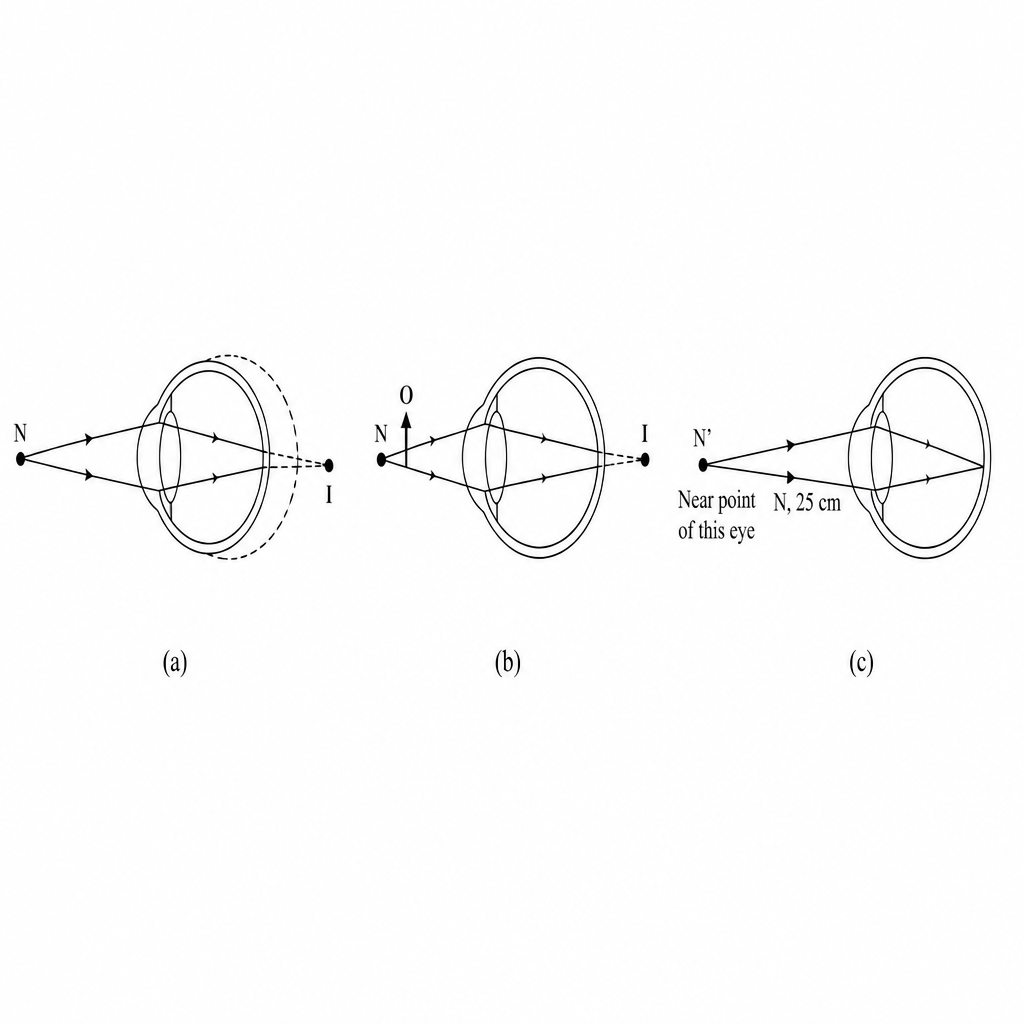
Correcting Long-sightedness with a Convex Lens
A long-sighted eye cannot bend the rays from a nearby object enough. So the problem is solved if those rays are brought together a little before they enter the eye. A lens that brings rays together is a converging lens, that is, a convex lens. A long-sighted person therefore wears spectacles with a convex lens of suitable focal length.
With the spectacles on, the rays travel like this:
- Rays from the nearby object first reach the convex lens.
- The convex lens converges them a little, so that they appear to come from the near point N of the defective eye.
- These rays are then refracted by the cornea and the eye lens.
- The rays now focus on the retina and the nearby object is seen clearly.
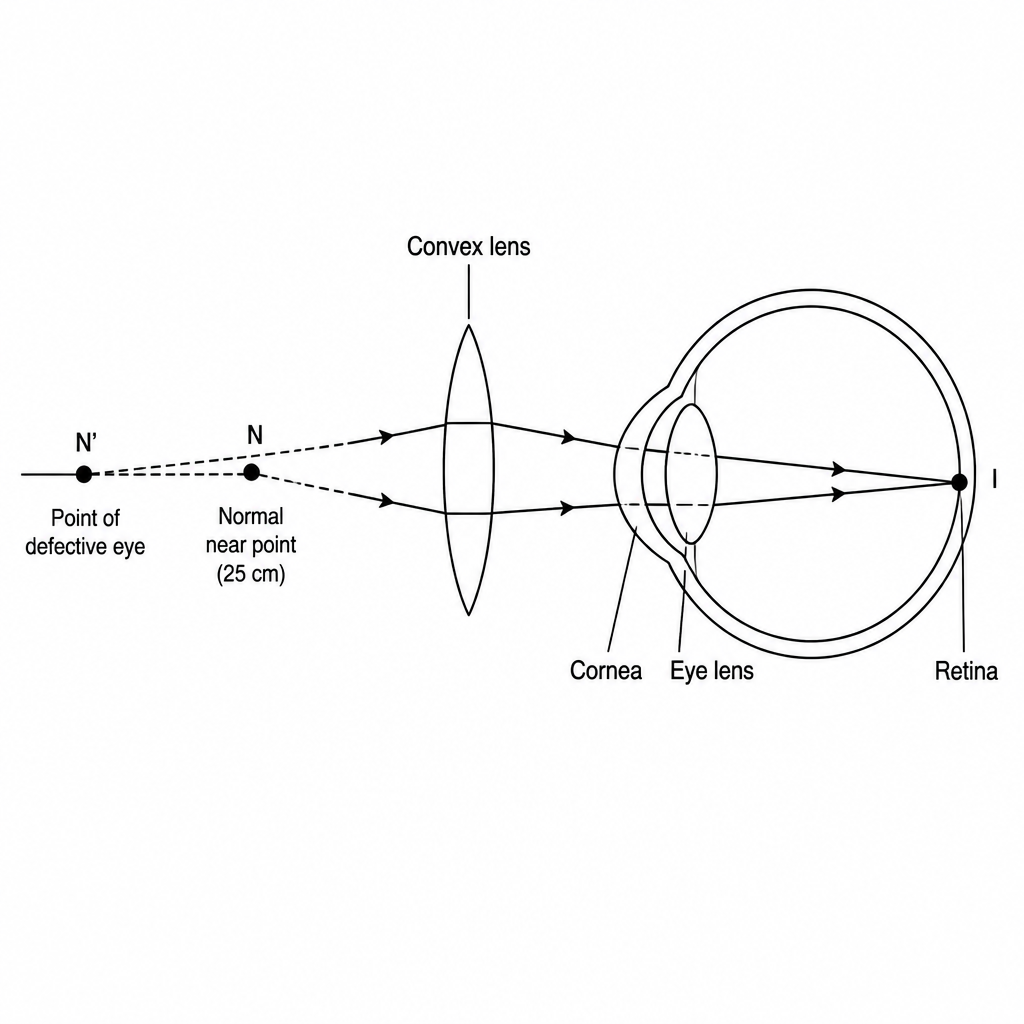
The focal length of the convex lens is chosen so that the rays it converges are focused on the retina and appear to come from the near point N of the long-sighted eye. For example, the lens makes a book held at 25 cm appear to be at 1 m, a distance at which that eye can focus.
Myopia and Hypermetropia Side by Side
| Feature | Short-sightedness (myopia) | Long-sightedness (hypermetropia) |
| Seen clearly | Nearby objects | Distant objects |
| Looks blurred | Distant objects | Nearby objects |
| Where the image forms | In front of the retina | Behind the retina |
| Eyeball | Elongated | Too round |
| Lens problem | Not thin enough, focal length too short | Not thick enough, focal length too long |
| Point that changes | Far point comes closer than infinity | Near point moves beyond 25 cm |
| Correcting lens | Concave (diverging) lens | Convex (converging) lens |
Contact Lenses
Spectacles are not the only way to correct a defect of vision. One other way is the contact lens, a thin artificial lens worn on the surface of the cornea. It sits on the thin film of tears over the cornea and covers the iris and the pupil. It refracts the light rays by just the necessary amount before they reach the eye lens.
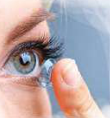
Contact lens: a thin artificial lens worn on the surface of the cornea, over the film of tears, to correct a defect of vision.
Contact lenses are useful when a person does not want to wear glasses, or when glasses get in the way. While playing football or basketball, for example, glasses can fall off or break. A player can wear contact lenses instead, and if the sun is strong, put ordinary sunglasses with no power over them.
Spectacles or Contact Lenses?
Glasses and contact lenses each have their own advantages and disadvantages. Glasses are very easy to use, and their lenses are of high quality and available in different sizes. However, high-power lenses are thick, and side vision through them is distorted when the wearer looks right or left. This problem does not occur with contact lenses, because they move along with the cornea. Since contact lenses sit so close to the eye, a low-power contact lens can do the work of a thick glass lens.
| Spectacles | Contact lenses | |
| Ease of use | Very easy to put on and take off | Need careful handling |
| Side vision | Distorted through thick lenses when looking sideways | Not distorted, because the lens moves with the cornea |
| Lens power | High power needs a thick lens | Lower power is enough, being so close to the eye |
| Care | Simple cleaning | Must be stored, cleaned and disinfected in specific ways |
The main disadvantage of contact lenses is the care they need. Because a contact lens sits directly on the cornea, any dirt or germs on it go straight into the eye, and improper use can damage the cornea itself.
Always wash your hands before putting in contact lenses and before taking them out. Clean and disinfect the lenses before reusing them, and store them only in the way prescribed. Never sleep overnight with contact lenses in. Improper use can infect and damage the cornea.
Laser Eye Surgery
Much of the bending of light entering the eye is done by the cornea. So by changing the shape of the cornea slightly, we can change how strongly the eye bends light. That is what laser eye surgery does.
- For short-sightedness, the laser beam is focused on the central part of the cornea. This flattens the cornea a little, so it refracts the rays a little less than before and they meet on the retina.
- For long-sightedness, the laser beam is focused on the edges of the cornea. This raises the middle of the cornea a little, so it bends the rays more and the image of a nearby object forms on the retina.
A special type of ultraviolet laser, called the excimer laser, is used for this.
Laser eye surgery: the process of correcting defects of vision by reshaping the cornea with a special type of ultraviolet laser called the excimer laser.
Laser eye surgery is performed on the outermost part of the cornea. Among the different laser techniques, the most popular is LASIK, short for Laser-assisted in situ keratomileusis. In LASIK, the laser beam focused on the cornea cuts out a thin flap, and the flap is folded back so that the cornea can be reshaped.
LASIK (Laser-assisted in situ keratomileusis): the most popular laser eye surgery technique, in which a laser cuts a flap in the cornea and the flap is folded back so the cornea can be reshaped.
The full lesson is waiting for you
The notes are free to read in full. A free account opens the rest of the practice, and tracks your progress and confidence score for every subject. Presentations and videos need approval from Learn Yeti.