Dust in the Eye During a Storm
Think of a windy afternoon when a gust throws dust or grains of sand into your face. A speck lands in your eye, the eye starts to water, and your hand goes straight up to rub it. Most people do this without thinking. But what does rubbing the eye again and again actually do? The answer lies in the clear, dome-shaped window at the very front of the eye, called the cornea. A grain of sand pressed and dragged across it by a finger works like sandpaper on glass. It leaves fine scratches on a surface that must stay smooth and clear for us to see well.
Blinking and tears are the eye's own way of washing a small speck out. Rubbing does the opposite, because it presses the speck harder into the cornea. To understand why a scratch here is so serious, we first need to know what the cornea does for our sight.
Do not rub your eyes when dust or sand gets into them. Rubbing drags the particle across the cornea and scratches it. If something stays stuck in the eye, ask an adult or a health worker for help.
The Cornea: Where Most Refraction Happens
Cornea: the transparent, curved front layer of the eye through which light first enters the eye. More refraction of light takes place at the cornea than at any other part of the eye.
Light coming from an object must be bent, or refracted, so that it comes to a focus exactly on the retina. Several parts of the eye share this job: the cornea, the watery fluid behind it and the crystalline lens. Of all of them, the cornea plays the biggest part. The maximum refraction of light in the eye takes place at the cornea. Its important values are given below.
| Property of the cornea | Value |
| Refractive index | 1.376 |
| Converging power | about +43 D |
| Share of the eye's light-refracting capacity | about two-thirds |
The letter D stands for dioptre, the unit of the power of a lens. The plus sign shows that the cornea behaves like a convex lens, because it converges light. Since power is the reciprocal of focal length in metres, a power of +43 D means a focal length of only about \( \frac{1}{43} \) m, which is roughly 2.3 cm. That is a very strong converging surface.
Why does the cornea bend light more than the lens itself? The amount of bending depends on how much the refractive index changes at a boundary. At the front of the cornea, light passes from air, whose refractive index is about 1, into the cornea, whose refractive index is 1.376. That is a big change, so the light bends a lot. Deeper inside, the lens is surrounded by watery fluid whose refractive index is close to its own, so the change at its surfaces is small and it bends light less. The curved front of the cornea adds to this converging power.
Because the cornea does about two-thirds of the eye's focusing, even a small scratch, a cloudy patch or a change in its shape moves the point where light meets. The picture on the retina then becomes blurred. That is why the cornea must be protected from being scratched, hurt or injured.
How the Cornea Gets Injured or Infected
The cornea sits at the very front of the eye, so it is exposed to the outside world. It can be harmed in two main ways: by physical injury and by infection. The common causes are these.
- Dust or sand in a storm: if the eyes are rubbed again and again with the hands, the particles scratch the cornea.
- Stones and pieces of metal: small flying pieces, for example while breaking stones or cutting metal, can strike and cut the cornea.
- Accidents: a fall, a blow to the face or a road accident can injure the cornea.
- Contact lenses: using contact lenses continually, or using them without proper cleaning, can lead to infection in the cornea.
The germs that infect the cornea may be bacteria, viruses or fungi. A bacterial, viral or fungal infection of the cornea causes corneal diseases and problems with vision. A cornea that has already been scratched is at greater risk, because germs get in more easily through a damaged surface.
A contact lens rests directly on the cornea. Never wear one without cleaning it properly, and do not keep lenses in continually, because a dirty lens can carry infection to the cornea.
Corneal Diseases and Their Effects on Vision
For clear sight, the cornea must do two things: stay transparent, and keep its correct smooth, curved shape. Injury and infection can spoil either of these. Three conditions of the cornea are important to know.
Corneal ulcer (keratitis): a sore on the cornea caused by infection of the cornea. If it is not treated immediately, it can make a person go blind.
In a corneal ulcer the eye usually looks red, and a whitish patch can be seen on the clear cornea. The patch blocks and scatters the light that should pass straight through, and as the sore deepens it can leave a permanent scar. This is why an infection of the cornea is never left to heal by itself.
Corneal edema: swelling of the cornea caused by fluid collecting between the layers of the cornea. It causes blurred vision.
When fluid builds up between the layers, the cornea thickens and loses its glass-like clearness. Light passing through it is scattered in many directions instead of travelling straight to a focus, so everything looks hazy, as if seen through a steamed-up window.
Keratoconus: a condition in which the surface of the cornea changes into a conical shape. It causes shortsightedness at first, and later the eye loses its vision.
Why shortsightedness first? A cone is much more sharply curved at its tip than a smooth dome. A more curved cornea bends light more strongly, so its converging power increases. Light from distant objects then comes to a focus in front of the retina instead of on it, which is exactly what happens in shortsightedness. As the cone grows steeper and more uneven, spectacles can no longer correct it, and sight is lost.
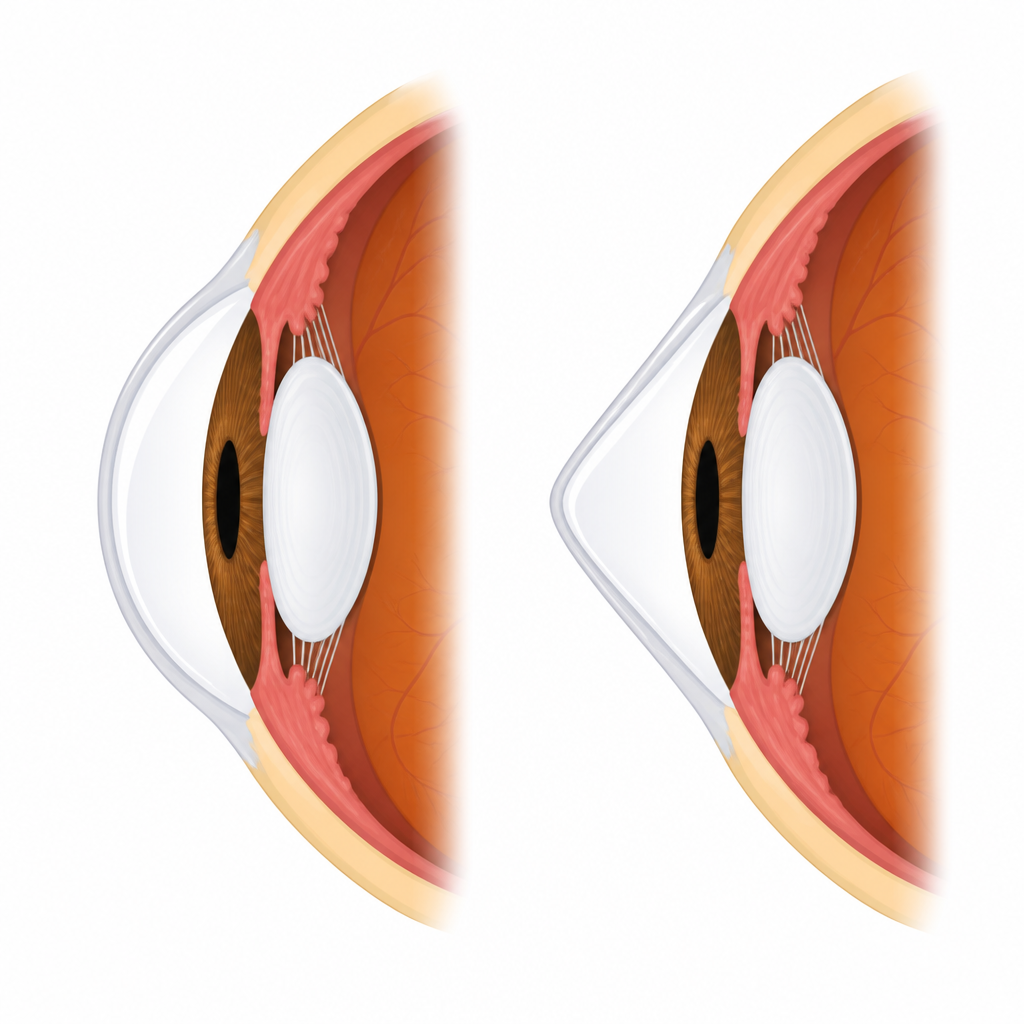
| Condition | What happens to the cornea | Effect on vision |
| Corneal ulcer (keratitis) | Infection by bacteria, viruses or fungi forms a sore | Blindness if not treated immediately |
| Corneal edema | Fluid collects between its layers | Blurred vision |
| Keratoconus | Its surface changes into a cone shape | Shortsightedness first, then loss of vision |
Ordinary corneal problems can be cured by proper treatment, especially when they are treated early. When the cornea is so badly damaged that treatment cannot cure it, the damaged cornea can be replaced.
Corneal Transplantation
In Nepal, the second leading cause of blindness after cataract is corneal degeneration, the gradual damage and clouding of the cornea. Many people who are blind for this reason can see again if the damaged cornea is replaced with a healthy one.
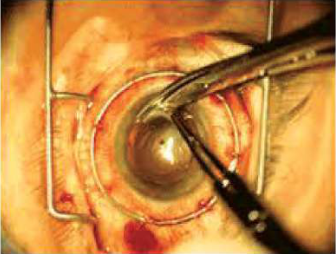
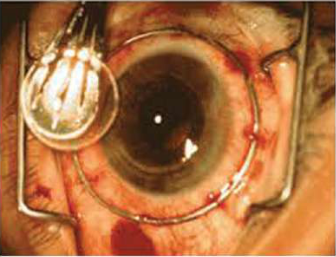
Corneal transplantation: the process of replacing a damaged cornea with a good cornea by eye surgery.
Corneal replacement can be done for people who were born with puffy eyes, and for people whose corneas were damaged because infections, injuries and similar problems did not get immediate treatment. In the operation, the surgeon removes the damaged part of the cornea and fits a healthy cornea in its place, fixing it with very fine stitches. The healthy cornea comes from a person who donated their eyes.
Eye Donation and the Nepal Eye Bank
A healthy cornea for transplantation cannot be made in a factory. It can only come from a human donor. Some people donate their eyes to an eye bank, so that after their death other people can use the corneas of their eyes.
Eye donation: giving one's eyes to an eye bank so that, after one's death, the corneas can be used to give sight to other people.
Eye bank: an organisation that collects, stores and distributes donated corneas for transplantation.
After the death of a person who has donated their eyes, the following is done:
- The eyelids of the donor are closed properly, so that the cornea is protected from direct sunlight.
- Doctors remove only the cornea, not the whole eye.
- The cornea is removed from the eye within 8 to 12 hours of death.
- The cornea is stored safely until it is given to a patient who needs it.
Time matters here. The sooner the cornea is removed after death, the better its quality. Every donor has two corneas, so one donor can help up to two people see again.
In Nepal, the Nepal Eye Bank has been established under Tilganga Eye Institute for the collection, storage and distribution of corneas. People who wish to donate their eyes can pledge their eyes to it, and hospitals that carry out corneal transplantation receive corneas from it.
Eye donation does not mean taking an eye from a living person, and the whole eye is not taken out. Only the cornea is removed, and only after the donor has died.
Blindness caused by a damaged cornea can often be reversed. A cornea donated after death, collected quickly and stored safely, can give sight to someone who is still living.
The full lesson is waiting for you
The notes are free to read in full. A free account opens the rest of the practice, and tracks your progress and confidence score for every subject. Presentations and videos need approval from Learn Yeti.