The two conditions behind every example
Everything in this topic comes from one idea. When light travels from a denser medium into a rarer medium, it bends away from the normal. If the angle of incidence keeps growing, the refracted ray bends further and further away until, at the critical angle, it just skims along the boundary. Beyond that angle no light gets out at all. The boundary sends every bit of it back into the denser medium, like a perfect mirror. This is total internal reflection.
Total internal reflection needs two things at the same time: the light must be going from a denser medium into a rarer medium, and the angle of incidence must be greater than the critical angle of the denser medium.
A diamond, a bubble in water, a test tube dipped in a beaker, a road baking in the sun and the air on a quiet night all meet these two conditions. For each example below, ask yourself two questions. Where is the denser medium? Why is the angle of incidence larger than the critical angle? Once you can answer both, the example explains itself.
Sparkling of a diamond
Diamond has a very high refractive index. The higher the refractive index of a material, the smaller its critical angle, because \( \sin c = \frac{1}{n} \). For diamond the critical angle is only 24°. So a ray inside a diamond that meets the diamond-air boundary at any angle greater than 24° cannot escape. Most rays inside a diamond strike its faces at angles bigger than this, so total internal reflection happens very easily.
The shape of a diamond adds to this. A diamond is cut into many flat faces, and the number of faces decides its shape. The faces are cut so that as many as possible of the rays that enter the diamond are reflected again and again inside it. Light that would otherwise pass straight through keeps bouncing between the faces and finally comes out through the top in bright flashes. This is why a diamond sparkles.
Now imagine a piece of ordinary glass cut with exactly the same faces. It will not sparkle like a diamond. The critical angle of glass is 42°, much larger than 24°. Many rays inside the glass meet its faces at angles smaller than 42°, so instead of being reflected they are refracted and come out through the opposite face. The light leaks away, and next to a diamond the glass looks dull.
| Material | Critical angle | What happens to most rays inside | How it looks |
| Diamond | 24° | Totally internally reflected many times | Sparkles brightly |
| Glass cut like a diamond | 42° | Refracted out through the opposite face | Shines far less |
A diamond sparkles because of two things working together: its small critical angle of 24° and the way its faces are cut.
Shining of a surface
Shining of a surface: an object shines because light is strongly reflected from its smooth surface.
A polished steel plate or a mirror looks bright because it reflects most of the light that falls on it. A boundary between two transparent media can do the same job. When light inside water or glass meets a boundary with air at more than the critical angle, all of it is reflected. The water-air or glass-air boundary then looks silvery and bright, just like a mirror. The two examples below show this.
An air bubble inside water
Watch a bubble rising in a glass of water or in a fish tank. It looks like a tiny shining silver ball. Light coming through the water is travelling in the denser medium. When it reaches the surface of the bubble, it is about to enter air, the rarer medium. For many of these rays the angle of incidence at the water-air boundary is greater than the critical angle of water, so they are totally reflected at the surface of the bubble. This reflected light reaches our eyes, and seen from outside the bubble shines.
A test tube dipped in water
Take an empty, dry test tube and dip part of it into a beaker of water, holding it slanted. Now look down at it from above the water. The part under the water looks shiny, almost like polished silver, while the part above the water looks quite ordinary.
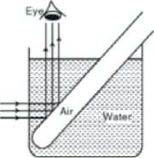
Light from the side travels through the water and reaches the thin glass wall of the tube. Inside the tube there is only air. So the light is trying to pass from water and glass, which are denser, into air, which is rarer. Because the tube is slanted, the rays meet its wall at a large angle of incidence, greater than the critical angle. They are totally reflected at the wall and travel up towards the eye. That is why, seen from outside the beaker, the immersed part of the tube looks shiny.
Fill the test tube with water and the shine disappears. There is no longer any air, the rarer medium, on the far side of the wall, so total internal reflection cannot happen.
Mirage
Mirage: an illusion of a pool of still water on a road or on sand, seen on hot days, caused by the total internal reflection of light in layers of hot air.
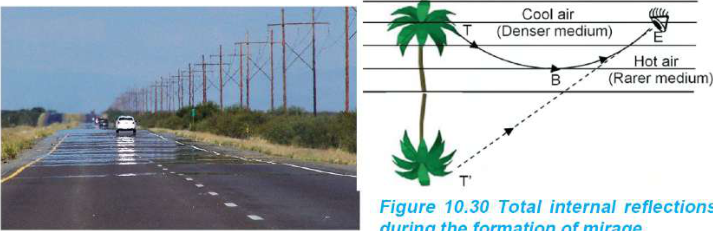
Travel along a black pitched road on a hot summer afternoon and you may see what looks like a pool of still water a little way ahead. Cars and poles even seem to be reflected in it. But when you reach the spot, the road is completely dry. The water was never there. This kind of illusion is called a mirage.
How a mirage forms
The sun heats the road strongly, and the road heats the air touching it. So the air forms layers at different temperatures, with the hottest layer just above the road and cooler layers higher up. The temperature decreases as we go up. Hot air is less dense than cool air and has a lower refractive index, so each upper layer has a higher refractive index than the layer just below it. The hot layer near the ground behaves like the rarer medium, and the cooler layer above it behaves like the denser medium.
Now follow the light from the top of a tall object such as a tree:
- Light from the treetop travels downwards, from cool air into warmer and warmer air, which means from a denser medium into a rarer one.
- At each layer the ray is refracted away from the normal, so it meets the next layer at a larger angle of incidence.
- Close to the ground, at some layer, the angle of incidence becomes greater than the critical angle for that layer.
- Total internal reflection takes place there, and the ray turns and starts travelling upwards.
- The rising ray bends back through the layers and finally enters the observer's eye.
Our eyes and brain always assume that light travels in straight lines. So the observer traces the incoming ray straight back and sees the tree below the surface of the road, upside down, as if it were reflected in a pool of water. The image does not stay still. Because the refractive indices of the air layers change continuously as the hot air moves, the image seems to flicker, like a reflection on the surface of rippling water.
The cool air higher up is the denser medium and the hot air near the road is the rarer medium. Many students write this the wrong way round. Heating makes air expand, so hot air is less dense and has the smaller refractive index.
Refraction of sound between warm and cool air
Refraction of sound: the bending of sound waves as they pass between layers of air at different temperatures.
Sound waves are also refracted when they pass from one layer of air into another. Sound travels faster in warm air than in cool air. So for sound, a warm layer behaves like the rarer medium and a cool layer like the denser medium. What happens to light in a mirage can happen to sound as well, and the result depends on whether it is day or night.
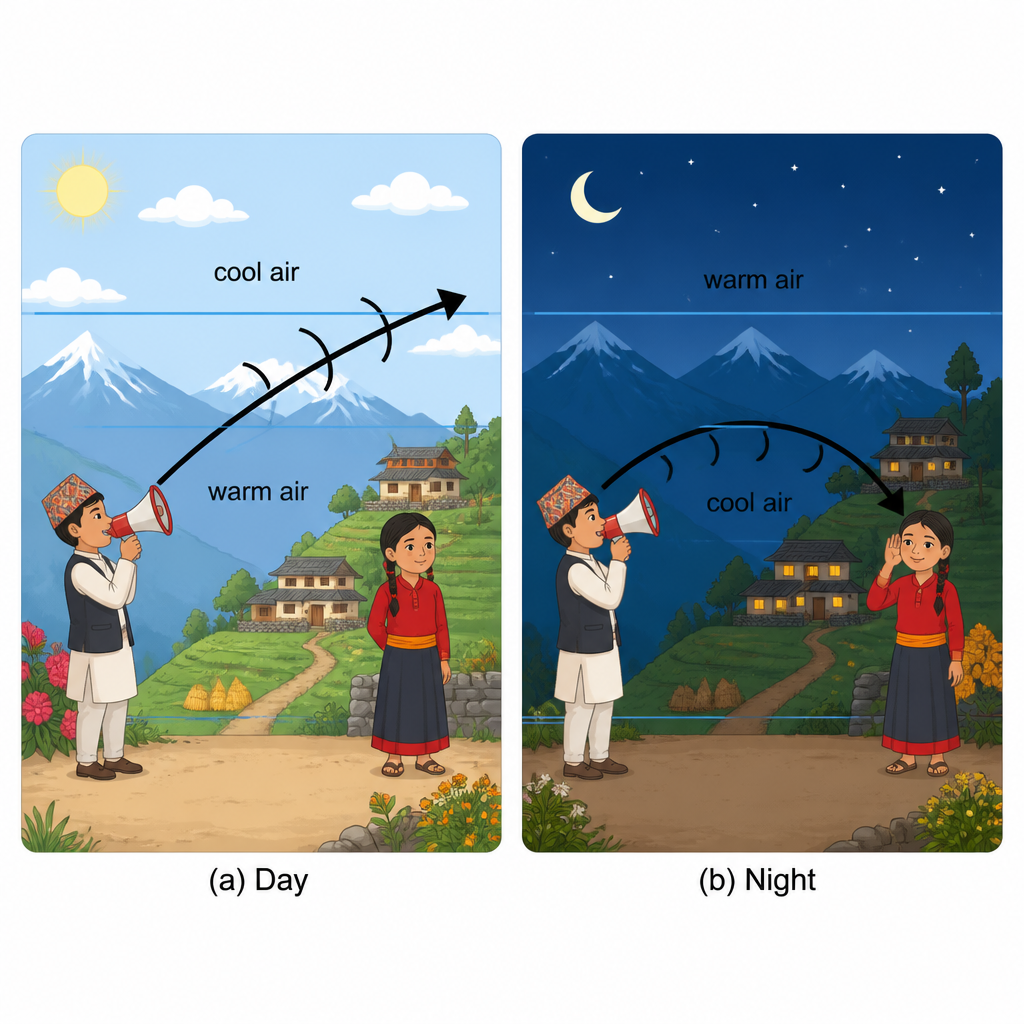
During the day the sun heats the ground, so the air near the ground is warm and the air above it is cooler. Sound from a source travels up into the cooler layers and is refracted towards the normal at each layer. The sound waves therefore bend upward, away from the ground. Little of the sound reaches a listener some distance away, and that listener cannot hear it clearly.
At night the ground cools quickly, so the air near the ground becomes cool and the air above stays warmer. Sound travelling upward now passes into warmer layers and is refracted away from the normal at each one, so it bends downward. At a certain layer its angle of incidence becomes greater than the critical angle, and the sound is totally internally reflected back towards the ground. A listener on the ground, even far from the source, hears the sound clearly.
| Time | Air near the ground | Air higher up | Which way sound bends | Distant listener |
| Day | Warm | Cool | Towards the normal, upward | Cannot hear clearly |
| Night | Cool | Warm | Away from the normal, downward, then totally reflected | Hears clearly |
This is why a distant temple bell, a truck on a far-off road or a dog barking in the next village can be heard much more clearly on a quiet night than at midday.
The consequences side by side
The table below lists, for each example, which medium is denser, which is rarer, and what we see or hear. In every case the wave tries to pass from the denser medium into the rarer one, meets the boundary at more than the critical angle, and is turned back.
| Example | Denser medium | Rarer medium | What we see or hear |
| Diamond | Diamond | Air | The diamond sparkles |
| Air bubble | Water | Air inside the bubble | The bubble shines like silver |
| Test tube | Water and glass | Air inside the tube | The immersed part looks shiny |
| Mirage | Cool air higher up | Hot air near the road | A pool of water with inverted images |
| Sound at night | Cool air near the ground | Warm air higher up | Distant sounds are heard clearly |
The full lesson is waiting for you
The notes are free to read in full. A free account opens the rest of the practice, and tracks your progress and confidence score for every subject. Presentations and videos need approval from Learn Yeti.