How much does light bend?
When a ray of light passes from air into glass, it changes direction at the surface. This bending of light as it goes from one transparent medium into another is called refraction. To describe it exactly we need a few names. The point where the ray meets the surface is the point of incidence. The line drawn at right angles to the surface at that point is the normal. The ray arriving at the surface is the incident ray, and the ray that carries on into the second medium is the refracted ray. The angle between the incident ray and the normal is the angle of incidence, \( i \). The angle between the refracted ray and the normal is the angle of refraction, \( r \).
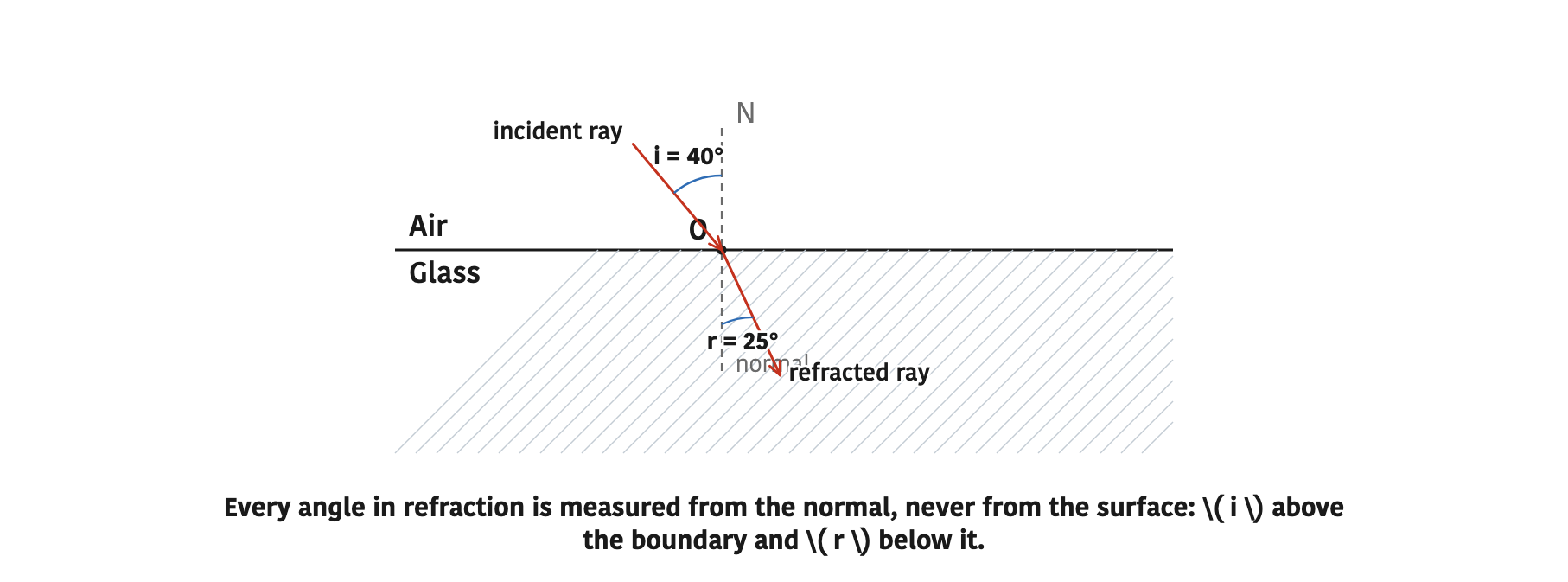
Going from air into glass, light bends towards the normal, so \( r \) is always smaller than \( i \). That alone is not enough, though. If you know the angle of incidence, can you work out the angle of refraction without measuring it? To answer this, scientists measured many pairs of angles and searched for a pattern that held every time. The pattern they found is written as the two laws of refraction.
Testing refraction with a semicircular glass slab
A semicircular glass slab is a thick block of glass shaped like half a disc. It has one flat face and one curved face. On a sheet of plain paper, an x-axis and a y-axis are drawn to make four quadrants, and degree marks are drawn around the origin with a protractor. The slab is laid with its flat face along the x-axis and the midpoint of that face exactly on the origin. The y-axis then becomes the normal to the flat face at the very point where the light will enter.
A narrow beam from a ray box or a laser pointer is sent through the flat face so that it always strikes the origin. Because the beam enters at the centre of the half circle, it travels inside the glass along a radius. A radius meets the curved face at right angles, so the beam leaves the curved face without bending a second time. That is exactly why a semicircular slab is chosen: all the bending happens at the flat face, and the angle of refraction can be read straight off the degree scale.
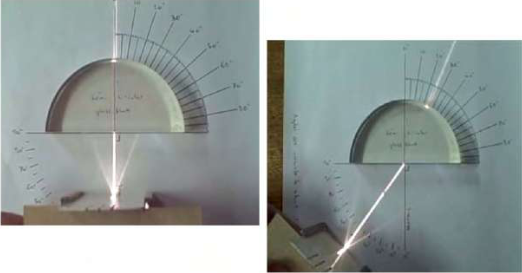
Two things are seen in this experiment. When the beam falls normally on the flat face, that is along the y-axis with \( i = 0^\circ \), it passes straight through without bending. When the beam is tilted so that the angle of incidence increases, the angle of refraction inside the glass also goes on increasing.
Never look into a laser pointer and never point it towards anyone's eyes. Even a small laser can damage the eye. Keep the beam flat along the paper at all times.
What the readings show
Below is one set of readings taken with a glass slab. The sine of each angle has been found with a calculator. Compare what happens when the angles themselves are divided with what happens when their sines are divided.
| \( i \) | \( r \) | \( i \div r \) | \( \sin i \) | \( \sin r \) | \( \sin i \div \sin r \) |
| 15° | 10° | 1.50 | 0.259 | 0.174 | 1.49 |
| 30° | 19.5° | 1.54 | 0.500 | 0.334 | 1.50 |
| 45° | 28° | 1.61 | 0.707 | 0.469 | 1.51 |
| 60° | 35° | 1.71 | 0.866 | 0.574 | 1.51 |
Look at the column \( i \div r \). The more the beam is tilted, the larger it becomes, climbing from 1.50 to 1.71. So the angles themselves are not in a fixed ratio. Now look at the last column. \( \sin i \div \sin r \) comes out at about 1.5 every single time. The small differences of 0.01 or 0.02 appear only because a protractor can be read to the nearest half degree. This steady ratio of the sines is the pattern that the laws of refraction describe.
Dividing the angles, such as 30° ÷ 19.5°, does not give the constant. The law uses the sines of the angles. Set the calculator to degree mode (DEG) before pressing sin, or every value will come out wrong.
The first law of refraction
First law of refraction: When light passes from one optical medium to another, the incident ray, the normal and the refracted ray all lie in the same plane at the point of incidence.
A plane is a flat surface, like a sheet of paper. In the slab experiment the incoming beam, the y-axis acting as the normal, and the refracted beam are all traced on one sheet of paper. The refracted ray never lifts up off the paper and never dips below it. So when you look for where a refracted ray goes, you only need to look inside the flat plane that holds the incident ray and the normal.
The second law of refraction: Snell's law
Second law of refraction: The ratio of the sine of the angle of incidence to the sine of the angle of refraction remains constant for a pair of media. This constant value is the refractive index of the pair of media and is denoted by \( \mu \).
\[ \frac{\sin i}{\sin r} = \text{constant} \; (\mu) \]
The law is named Snell's law after the mathematician Willebrord Snellius, who discovered it. The symbol \( \mu \) is the Greek letter mu. The words "for a pair of media" matter. Air and glass have one constant; air and water have a different one. Change either medium and the constant changes. But as long as the pair stays the same, it makes no difference whether the angle of incidence is 15° or 60°: the ratio stays the same.
Once \( \mu \) for a pair of media is known, the angle of refraction for any angle of incidence can be calculated instead of measured: \( \sin r = \frac{\sin i}{\mu} \).
Refractive index
Refractive index (\( \mu \)): the constant ratio \( \frac{\sin i}{\sin r} \) for light passing from one medium into another. It tells how strongly light bends when it crosses from the first medium into the second.
The refractive index is a ratio of two sines, and sines are plain numbers with no unit, so the refractive index has no unit. For light going from air into glass its value is about 1.5. When the first medium is air or vacuum, the value is simply called the refractive index of the second medium, so we say the refractive index of glass is 1.5.
The larger the refractive index, the more the light bends. For example, at an angle of incidence of 60°, the angle of refraction inside glass (\( \mu = 1.5 \)) is about 35°, but inside diamond (\( \mu = 2.42 \)) it is only about 21°. In diamond the light is pulled much closer to the normal.
Refractive index and the speed of light
Why does light bend at all? Because its speed changes when the medium changes. Light travels at about \( 3 \times 10^8 \text{ m/s} \) in air or vacuum, but at only \( 2 \times 10^8 \text{ m/s} \) in glass. For light going from air into glass, the value of \( \mu \) found from the sines is equal to the ratio of the speed of light in air, \( c \), to the speed of light in glass, \( v \).
Refractive index of a medium: the ratio of the speed of light in air or vacuum to the speed of light in that medium.
\[ \mu = \frac{c}{v} \]
Here \( c \) is the speed of light in air or vacuum and \( v \) is the speed of light in the medium. Checking the formula for glass:
\[ \mu = \frac{3 \times 10^8 \text{ m/s}}{2 \times 10^8 \text{ m/s}} = 1.5 \]
This agrees with the values between 1.49 and 1.51 found from the angles. Two completely different measurements, one of angles and one of speeds, give the same number. The m/s cancels in the division, which shows once more that the refractive index has no unit.
Refractive indices of some media
| Medium | Refractive index | Speed of light (m/s) |
| Water | 1.33 | 2.25 × 10⁸ |
| Alcohol | 1.36 | 2.19 × 10⁸ |
| Kerosene oil | 1.44 | 2.08 × 10⁸ |
| Glycerin | 1.47 | 2.04 × 10⁸ |
| Glass | 1.50 | 2.00 × 10⁸ |
| Diamond | 2.42 | 1.24 × 10⁸ |
The media in the table are arranged in increasing order of refractive index: water, alcohol, kerosene oil, glycerin, glass and diamond. In that same order the speed of light decreases, from \( 2.25 \times 10^8 \text{ m/s} \) in water down to \( 1.24 \times 10^8 \text{ m/s} \) in diamond. So the larger the refractive index, the more slowly light travels in that medium. A medium in which light travels more slowly is called optically denser. In diamond light moves at less than half its speed in air, which is why diamond bends light more than any other medium in the table.
You can check the table yourself. Multiply the refractive index in any row by the speed in that row. For water, \( 1.33 \times 2.25 = 2.99 \), which is about \( 3 \times 10^8 \text{ m/s} \). Every row gives the same answer, because \( \mu \times v = c \).
A higher refractive index means a lower speed of light, and the medium is optically denser. A lower refractive index means a higher speed of light, and the medium is optically rarer.
The full lesson is waiting for you
The notes are free to read in full. A free account opens the rest of the practice, and tracks your progress and confidence score for every subject. Presentations and videos need approval from Learn Yeti.