Light Going from Water into Air
Place a coin at the bottom of a cup of water and look at it from the side, at a slant. Light from the coin travels up through the water, meets the water surface, and then passes into the air on its way to your eye. Here water is the denser medium and air is the rarer medium. Whenever light passes from a denser medium into a rarer medium, it bends away from the normal.
Because the ray bends away from the normal, the angle of refraction \( r \) in the air is greater than the angle of incidence \( i \) in the water, so \( r > i \). If the angle of incidence is increased, the angle of refraction also increases. Since \( r \) is always the larger of the two, it is \( r \) that runs out of room first.
The Largest Angle of Refraction
How large can the angle of refraction become? It is measured from the normal, and a ray that leaves the surface can at most lie flat along that surface. It cannot lean any further. A ray lying along the water-air boundary makes an angle of 90° with the normal. So 90° is the largest possible angle of refraction when light passes from a denser medium into a rarer medium.
This is why the coin can still be seen when your eye is at the very level of the water, looking along the surface. The light reaching you left the water with an angle of refraction of 90°, skimming along the boundary. The angle of incidence inside the water at that moment has its own name. It is called the critical angle.
Critical Angle
The critical angle of glass can be found with a semicircular glass slab, a laser pointer and a protractor. The slab is placed so that the centre of its flat edge sits on the centre O of the protractor. The laser beam is aimed at O through the curved surface. Travelling along a radius, the beam meets the curved surface at right angles and enters the glass without bending. So the only bending happens at O, where the light leaves glass for air.
With a small angle of incidence, such as 25°, the beam comes out into the air bent away from the normal. As the angle of incidence is increased, the emerging ray leans further and further from the normal. At one particular angle of incidence, the refracted ray runs along the glass-air boundary, at 90° to the normal. That angle is the critical angle of glass. Increase the angle of incidence beyond it, to 65° for example, and no ray comes out into the air at all. The light turns back into the glass.
Critical angle: The angle of incidence in the denser medium for which the corresponding angle of refraction in the rarer medium becomes 90° is called the critical angle.
Critical Angles of Some Substances
The value of the critical angle depends on the materials of the two media. When the second medium is air, the critical angles of some common substances are these:
| Medium | Critical angle |
| Water | 49° |
| Alcohol | 48° |
| Kerosene oil | 44° |
| Glycerin | 43° |
| Glass | 42° |
| Diamond | 24° |
Read the table this way. A ray inside water that meets the water-air surface at more than 49° cannot get out into the air. For glass the limit is 42°, and for diamond it is only 24°. The smaller the critical angle, the more easily light is trapped inside the substance.
Total Internal Reflection of Light
What happens when the angle of incidence becomes greater than the critical angle? The light does not pass into the rarer medium at all. It is reflected back into the same medium it came from. In the semicircular slab, the beam sent in through the curved surface returns into the glass instead of coming out through the flat face.
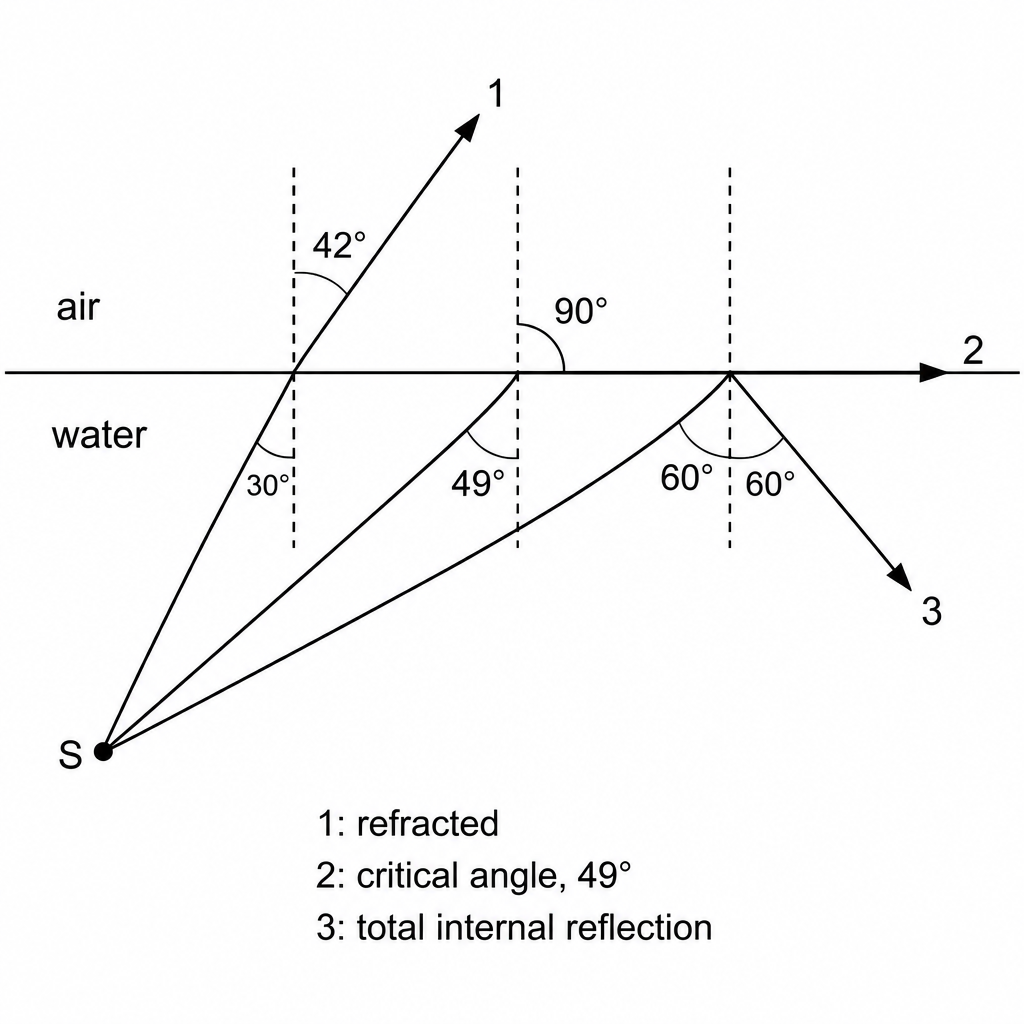
Total internal reflection of light: The phenomenon in which light passing from a denser medium to a rarer medium is reflected back into the same denser medium is called total internal reflection of light.
Total internal reflection is still reflection, so all the laws of reflection apply to it. The incident ray, the reflected ray and the normal lie in the same plane, and the angle of reflection equals the angle of incidence. A ray that strikes the flat face of the slab at 65° is reflected at 65° on the other side of the normal.
Why It Is Called Total
Normally, when light falls on the boundary between two media, part of it is reflected and the rest is refracted into the other medium. A glass window shows this. You can see through it, and at the same time you see a faint reflection of yourself in it. In total internal reflection none of the light is refracted. All of it is reflected, and that is why the word total is used. The word internal tells us that the reflection happens inside the denser medium.
Two Conditions for Total Internal Reflection
Total internal reflection takes place only when both of these conditions are met:
- (a) Light must be travelling from the denser medium to the rarer medium.
- (b) The angle of incidence must be greater than the critical angle.
Neither condition is enough on its own. Light going from air into water travels from a rarer to a denser medium, so it bends towards the normal and its angle of refraction never reaches 90°. However large the angle of incidence is made, it cannot be totally reflected there.
Equal to the critical angle is not enough. At exactly the critical angle the light is still refracted, running along the surface at 90°. Total internal reflection needs an angle of incidence greater than the critical angle.
A Fish Seen Twice in an Aquarium
Look through the side glass of an aquarium towards the water surface from a certain angle. Light from a fish swimming below travels up and strikes the underside of the water surface at an angle greater than 49°. It suffers total internal reflection there and comes back down to your eye. The underside of the surface behaves like a shiny mirror. So you see the fish itself below the surface, and also its image above that mirror-like surface, as if a second fish were swimming in the air.
Light Carried Along a Stream of Water
Total internal reflection can be seen in water with a plastic bottle and a laser pointer. The bottle is filled with water, and a few drops of milk or Dettol are shaken into it so that the water turns slightly cloudy. A small hole is made a little above the base, and a curved stream of water pours out. A laser beam is then sent from the opposite side of the bottle straight towards the hole. The light does not shoot straight out into the air. It bends round with the stream and travels down along it.
The same thing can be seen in a beaker of water. A laser beam is sent in through the side of the beaker and the pointer is tilted. At a large enough angle of incidence, the beam strikes the water surface from below and is reflected back down into the water instead of escaping into the air. The drops of milk scatter a little of the light sideways, which spreads the beam out so that its path through the water can be seen.
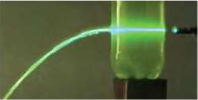
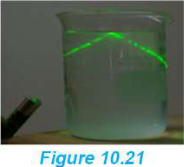
Here is why the light follows the stream. The beam meets the curved surface of the stream from the inside. At that surface the light is travelling from water, the denser medium, towards air, the rarer medium. Because the stream curves away, the angle of incidence is greater than 49°, the critical angle of water. Both conditions are met, so the light does not come out. It is totally reflected back into the water, crosses the stream and strikes the opposite surface, where the same thing happens again. The reflection repeats again and again, and the light is carried downwards inside the stream.
Prisms
A prism is a three-dimensional solid bounded by three rectangular surfaces and two triangular surfaces. The shape of its triangular base gives the prism its name. The base of an equilateral triangular prism is an equilateral triangle, so each of its corners is 60°. The base of a right-angled triangular prism is a right-angled triangle. In an isosceles right-angled prism the corners are 90°, 45° and 45°.
Prism: A three-dimensional solid object bounded by three rectangular surfaces and two triangular surfaces.
When a laser pointer is held so that its beam enters one face of a glass prism at right angles, the beam is often seen bouncing off the inside of another face instead of leaving through it.
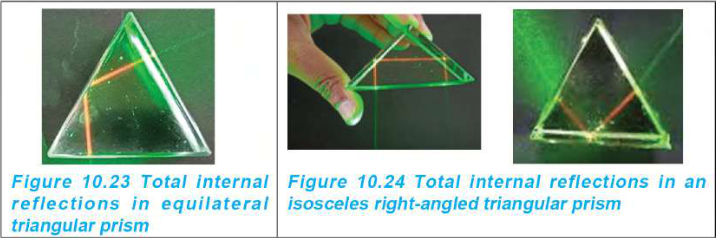
Total Internal Reflection in an Equilateral Prism
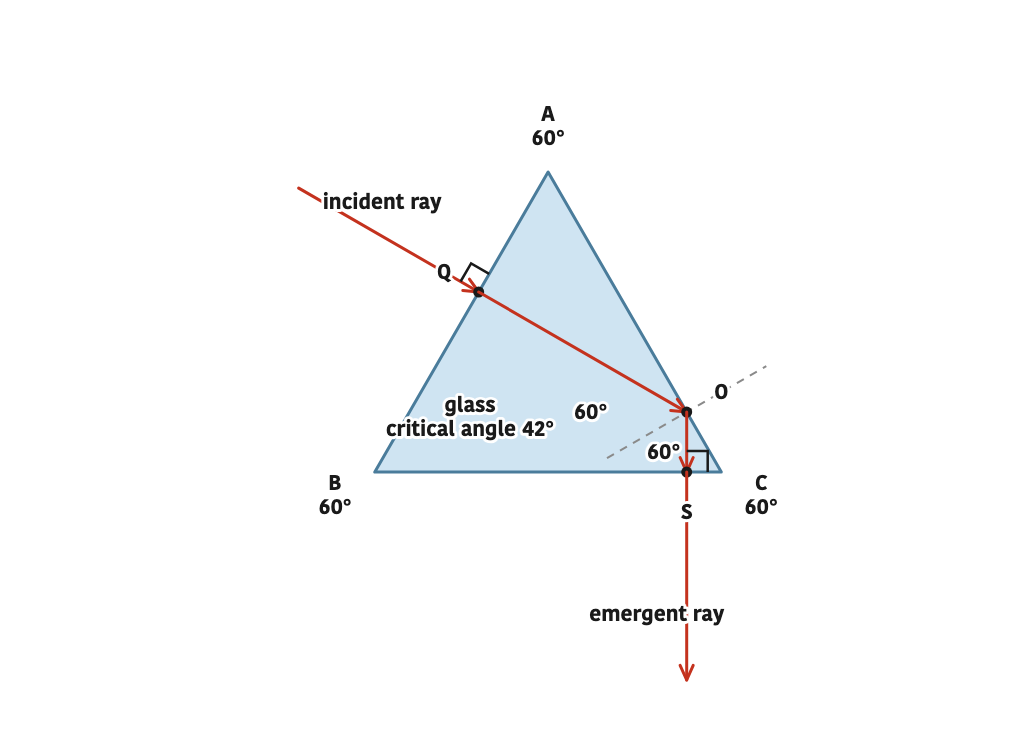
Take an equilateral glass prism ABC. A ray of light PQ falls normally on face AB. Follow its path one step at a time:
- Step 1: The ray meets face AB along the normal, so it enters the glass without any deviation.
- Step 2: It travels straight on and strikes face AC at the point O. Because faces AB and AC meet at 60°, the ray makes an angle of 60° with the normal at O.
- Step 3: At O the ray is travelling from the denser medium, glass, to the rarer medium, air, and its angle of incidence, 60°, is greater than the critical angle of glass, 42°. So total internal reflection takes place.
- Step 4: The reflected ray falls normally on face BC and passes out into the air without bending.
Turning Light Through 90° and 180°
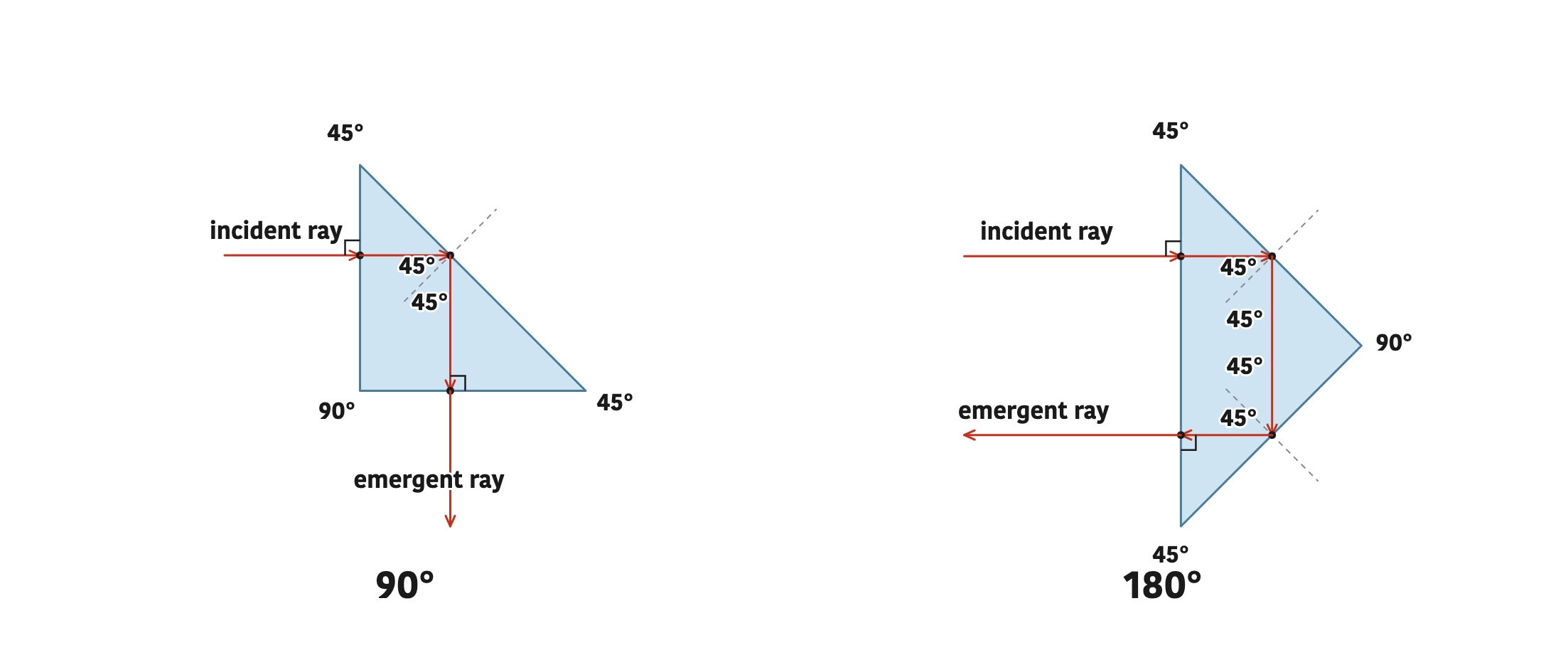
An isosceles right-angled glass prism can turn a beam of light round a corner. A ray enters one of the two short faces at right angles and goes straight on to the long face, the hypotenuse. It meets the hypotenuse at 45° to the normal. Since 45° is greater than 42°, the ray is totally reflected, and it leaves through the other short face at right angles. One total internal reflection has turned the light through 90°.
Now turn the same prism so that the light enters through the hypotenuse. The ray reaches one short face at 45° and is totally reflected across to the other short face. There it again meets the surface at 45° and is totally reflected a second time. It comes back out through the hypotenuse, travelling in the opposite direction. Two total internal reflections have turned the light through 180°.
Periscopes, SLR Cameras and Binoculars
Because a right-angled prism can reflect light through 90°, prisms are used in periscopes, SLR cameras and binoculars.
- Periscope: a right-angled prism at the top of the tube turns light from the object down the tube, and a second prism at the bottom turns it towards the eye. This lets a person see over a wall or a crowd, or look out of a submarine.
- SLR camera: light entering through the lens is sent up by a mirror to a prism, which turns it towards the viewer. So the photographer sees the same scene that will be photographed.
- Binoculars: each side has prisms that turn the light back on itself, so a long path for the light fits inside a short tube.
During total internal reflection none of the light is lost by refraction, so the power of the light is not weakened. The image stays bright and objects can be seen clearly.
Total internal reflection needs two things at once: light going from a denser to a rarer medium, and an angle of incidence greater than the critical angle. When both hold, every bit of the light is reflected back, and nothing escapes.
The full lesson is waiting for you
The notes are free to read in full. A free account opens the rest of the practice, and tracks your progress and confidence score for every subject. Presentations and videos need approval from Learn Yeti.