How a lens bends light
A lens is a piece of transparent glass or plastic with curved surfaces. When light passes from air into the glass and out again, it changes direction. This bending of light is called refraction. A convex lens is thicker in the middle than at its edges. It bends parallel rays inward so that they meet at one point, so we say it converges light. A concave lens is thinner in the middle than at its edges. It spreads parallel rays outward, so we say it diverges light.
Two convex lenses can look alike and still behave very differently. Hold a thin magnifying glass and a thick one in sunlight, and the thick one makes its bright spot of light much nearer to itself. Some lenses bend light gently and some bend it strongly. Scientists describe this strength with a single number, called the power of the lens.
Thickness, curvature and refraction
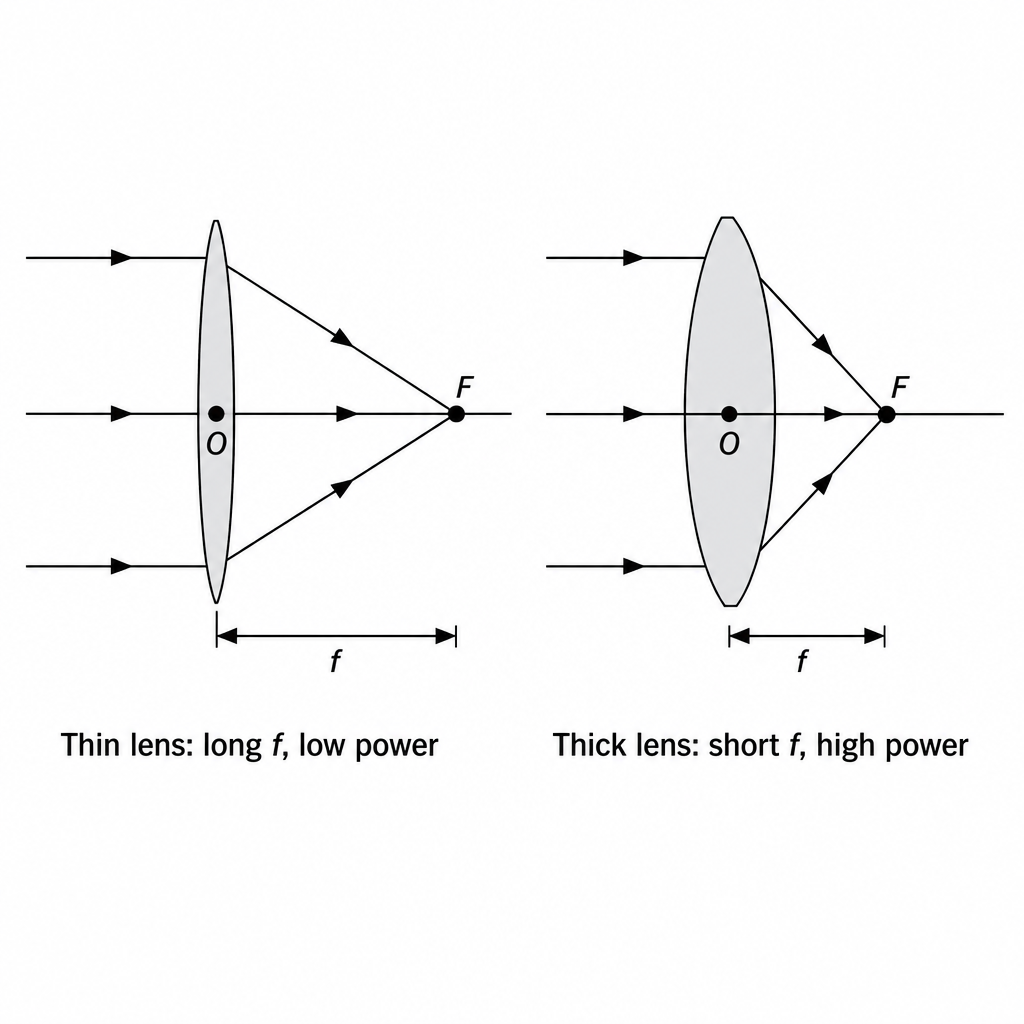
The curved surfaces of a lens are parts of spheres. A surface that curves sharply has a large curvature, and a surface that is nearly flat has a small curvature. A lens with a large curvature is thick, and a lens with a small curvature is thin. When light rays refract through a lens, the degree of refraction is more in a thick lens with large curvature than in a thin lens with small curvature.
You can watch this happen with a ray box. A ray box is a lamp inside a box whose narrow slits let out thin beams of light. Send three parallel beams through a thin convex lens and they meet far away from the lens. Send the same three beams through a thick convex lens and they bend more sharply and meet close to it. Concave lenses behave the same way in reverse. The thicker the concave lens, the more widely it spreads the beams apart.
Power of a lens
Power of a lens: the ability of a lens to converge or diverge light rays.
A lens that bends light strongly has a high power, and a lens that bends it gently has a low power. A convex lens uses its power to converge light, and a concave lens uses its power to diverge it. Notice that the word power here does not mean energy used per second, as it does for a motor or a bulb. It only tells how strongly a lens changes the direction of light.
Power depends on focal length
The focal length (f) of a lens is the distance from its optical centre (O) to its principal focus (F). Compare a thick and a thin convex lens once more. The thick convex lens, with greater curvature, converges parallel rays to a point closer to its optical centre. So its focal length is shorter, but its ability to converge light rays is higher. In the same way, a concave lens with a shorter focal length has a higher ability to diverge light rays.
The shorter the focal length, the greater the power. The longer the focal length, the smaller the power. So the power of a lens depends on its focal length (f).
This is why a small, thick magnifying lens that focuses sunlight only a few centimetres away is more powerful than a large, thin reading lens that focuses sunlight half a metre away.
Real focus, apparent focus and the sign of focal length
To compare lenses fairly, focal length must be measured by the same rule every time, and the number must also show which kind of lens it belongs to. A plus or minus sign does this job.
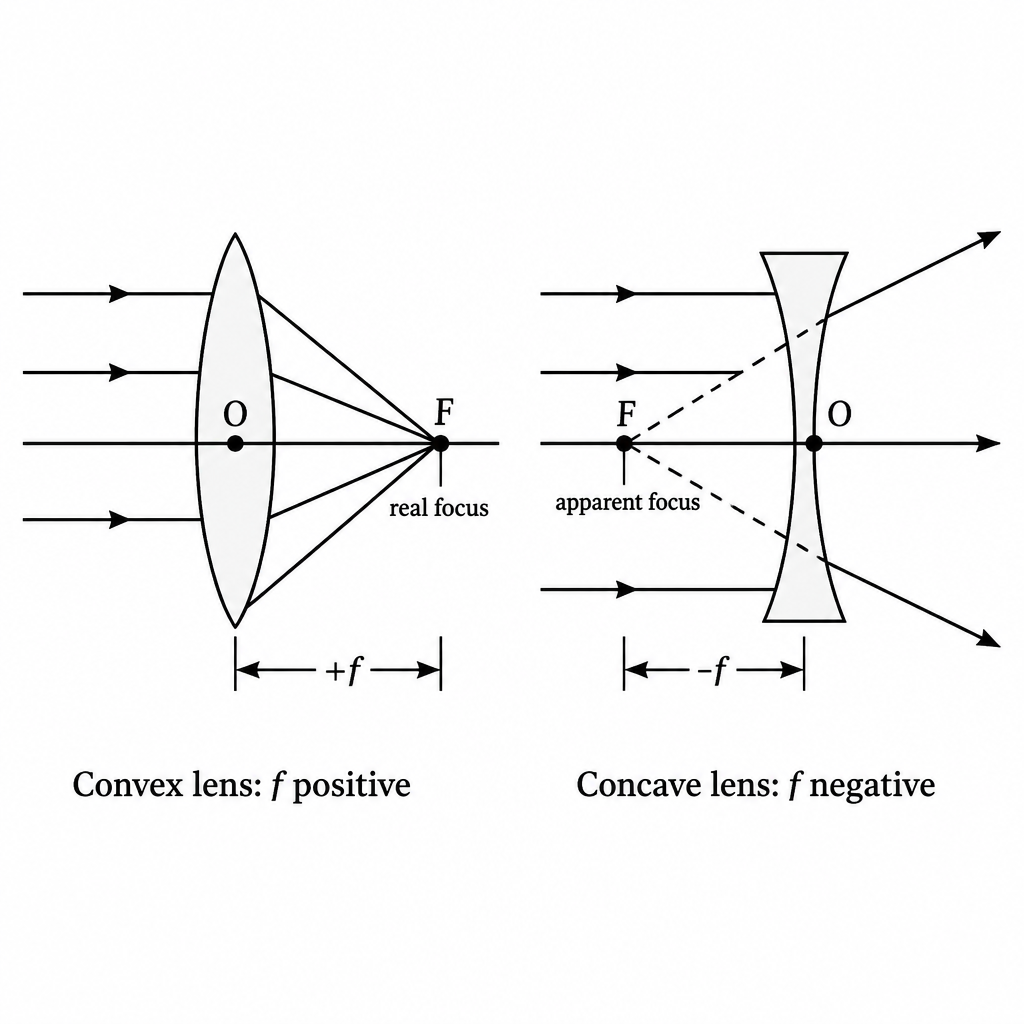
In a convex lens, the refracted rays really cross each other at the focus on the far side of the lens. Light actually reaches this point, and a screen placed there shows a bright spot, so it is a real focus. The distance between the lens and the focus formed by the intersection of real rays is taken as a positive focal length.
In a concave lens, the refracted rays spread apart and never meet. But if they are extended backward, on the side of the incident rays, the extended lines appear to intersect at one point. This point is called the apparent focus. The distance between the apparent focus and the lens is the focal length of the concave lens, and it is taken as negative.
Apparent focus: the point on the principal axis where the refracted rays of a concave lens appear to meet when they are extended backward on the side of the incident rays.
The formula for power
A shorter focal length gives a greater power, so power and focal length change in opposite directions. Mathematically, the power of a lens is defined as the reciprocal of its focal length in metres:
\[ P = \frac{1}{f\ (\text{in metre})} \]
Here P is the power of the lens and f is its focal length in metres. The SI unit of power is the dioptre, and it is written D. A convex lens whose focal length is exactly 1 m has a power of \( \frac{1}{1\ \text{m}} = 1\ \text{D} \). A convex lens of focal length 0.5 m has a power of 2 D, which makes it twice as strong.
Dioptre (D): the SI unit of the power of a lens. A lens of focal length 1 m has a power of 1 D.
Change centimetres into metres before using the formula. For a lens of focal length 40 cm, writing \( \frac{1}{40} \) gives 0.025, which is wrong. The focal length is 0.4 m, so the power is 2.5 D.
The sign of power: convex and concave lenses
The sign of the power follows the sign of the focal length. A convex lens has a positive focal length, so its power is also positive. A concave lens has a negative focal length, so its power is negative. The sign alone tells you the kind of lens: plus means convex, minus means concave.
| Feature | Convex lens | Concave lens |
| Shape | Thicker in the middle | Thinner in the middle |
| Action on parallel rays | Converges them | Diverges them |
| Focus | Real focus: rays really meet | Apparent focus: rays only appear to meet |
| Sign of focal length | Positive (+) | Negative (-) |
| Sign of power | Positive (+) | Negative (-) |
| Example | f = +0.4 m, P = +2.5 D | f = -0.25 m, P = -4 D |
Never drop the minus sign of a concave lens. A lens of +4 D and a lens of -4 D are two different lenses: one converges light and the other diverges it.
Reading the power of spectacle lenses
Eye doctors describe spectacle lenses by their power, not by their focal length. A card from an eye clinic may say -4 D or +2 D. A lens marked +2 D is a convex lens and it converges light. A lens marked -4 D is a concave lens and it diverges light. Ignoring the sign, the bigger the number, the more powerful the lens.
You can test this yourself. Let the beams of a ray box fall on the lenses of a friend's or relative's spectacles, then ask the owner the power of each lens. The lenses with positive power bring the beams together, and the lenses with negative power spread them apart.
Glass lenses and the lens of the eye
The curvature of a glass lens remains constant. It does not change on its own, so its focal length and its power stay fixed. The convex lens inside our eye is different. Its curvature can be changed when we look at distant objects or at nearby objects, and this changes its power. That is how the same eye can see a far hill clearly and then read a book held in the hand.
The full lesson is waiting for you
The notes are free to read in full. A free account opens the rest of the practice, and tracks your progress and confidence score for every subject. Presentations and videos need approval from Learn Yeti.