Light Changes Direction When It Changes Medium
Inside one medium, light travels in straight lines. When it crosses slantwise into a different medium, for example from water into air, its speed changes and it bends. This bending is refraction. Water is optically denser than air. Its refractive index is about 1.33, while that of air is almost exactly 1. So a ray leaving water and entering air speeds up and bends away from the normal. A ray going the other way, from air into water, slows down and bends towards the normal.
Our eyes and brain have no way of knowing that the light bent on its journey. The brain always assumes that light reached the eye in a straight line. So it follows each ray straight back and sees the object at the point where those straight lines meet. If refraction bent the rays on the way, that meeting point is not where the object really is, and we see an image of the object in a false place. Almost every everyday consequence of refraction comes from this one fact.
The eye traces light back in straight lines. If the light bent on the way, the object appears where those straight lines point, not where it really is.
The Coin That Reappears
A simple experiment shows refraction making a hidden object visible. A coin lies at the bottom of an empty steel glass. The observer moves their head backwards until the rim of the glass just hides the coin, and then keeps perfectly still. A friend slowly pours water into the glass without disturbing the coin. As the water level rises, the coin comes back into view. Neither the coin nor the eye has moved, yet the coin can now be seen.
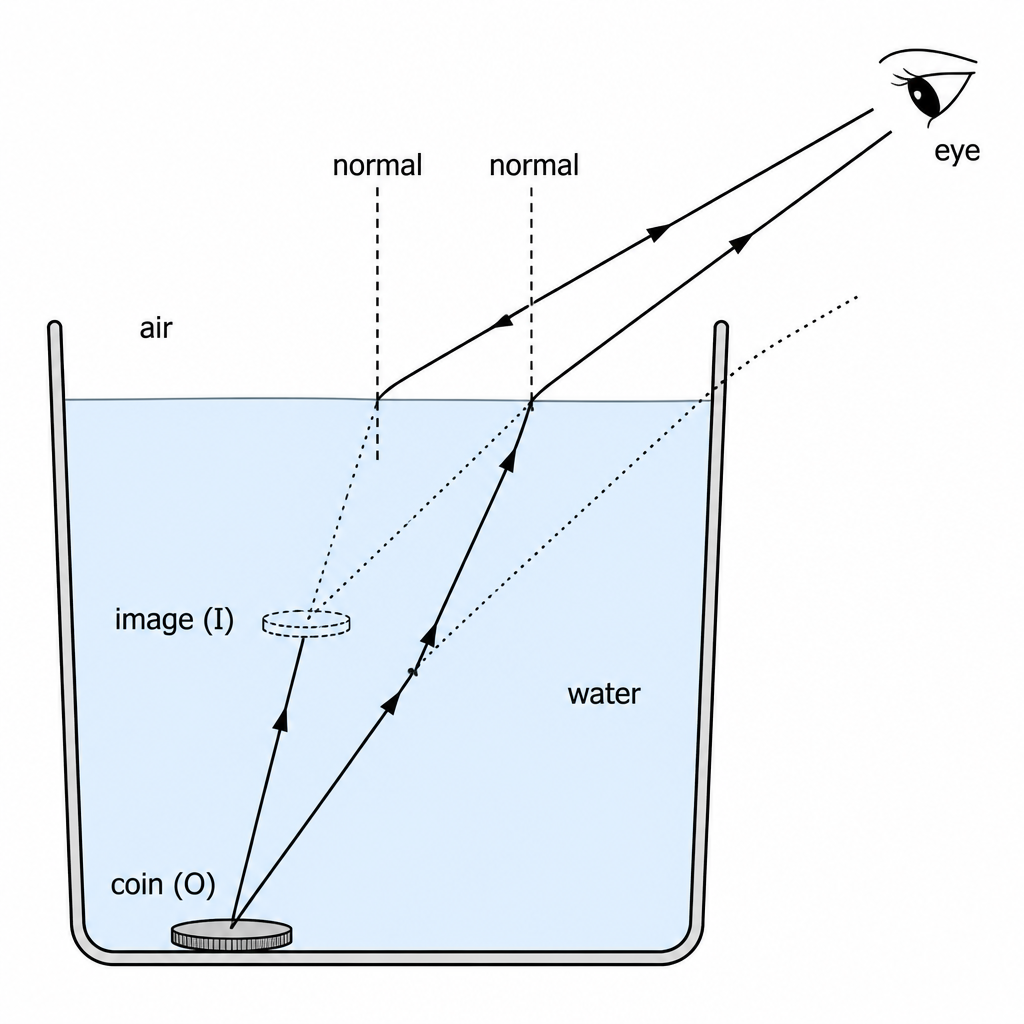
In the empty glass, light from the coin travels straight through air, and the rim blocks every straight path from the coin to the eye. Once there is water in the glass, the light reflected by the coin first travels through the water and then crosses the surface into the air. The path of one such ray goes like this:
- Light reflected by the coin at O travels upwards through the water in a straight line.
- At the water-air surface it passes from a denser medium (water) into a rarer medium (air).
- There it bends away from the normal, tilting towards the rim, so it now passes over the rim.
- The refracted ray enters the observer's eye.
- The eye traces the refracted rays straight back. They meet at a point I, higher than O, and the coin is seen at I.
The coin is seen because of the refraction of light at the surface of the water. Refraction raises the image of the coin from O to I, just high enough to be seen over the rim.
Bent Pencils and Shallow Water
The same raising happens every time we look at something under water. Dip a straight pencil slantwise into a glass of water and look at it from the side. It seems to bend sharply at the water surface, as if it were broken. The pencil has not changed at all. Light from the part in the air reaches the eye directly, so that part is seen where it is. Light from the part under water bends away from the normal as it leaves the water, and when the eye traces it back, that part appears raised towards the surface. The two parts no longer line up, so the pencil looks bent.
For the same reason, water always looks shallower than it really is. Every point on the bottom of a pond, a tank or a bucket is seen raised, so the whole bottom appears closer to the surface. A fish in a pond, or a stone lying on the bed of a clear stream, appears nearer to the top than it actually is.
Real depth: the actual distance of an object under water from the surface of the water.
Apparent depth: the depth at which an object under water appears to be when seen from above. Because of refraction, the apparent depth is always less than the real depth.
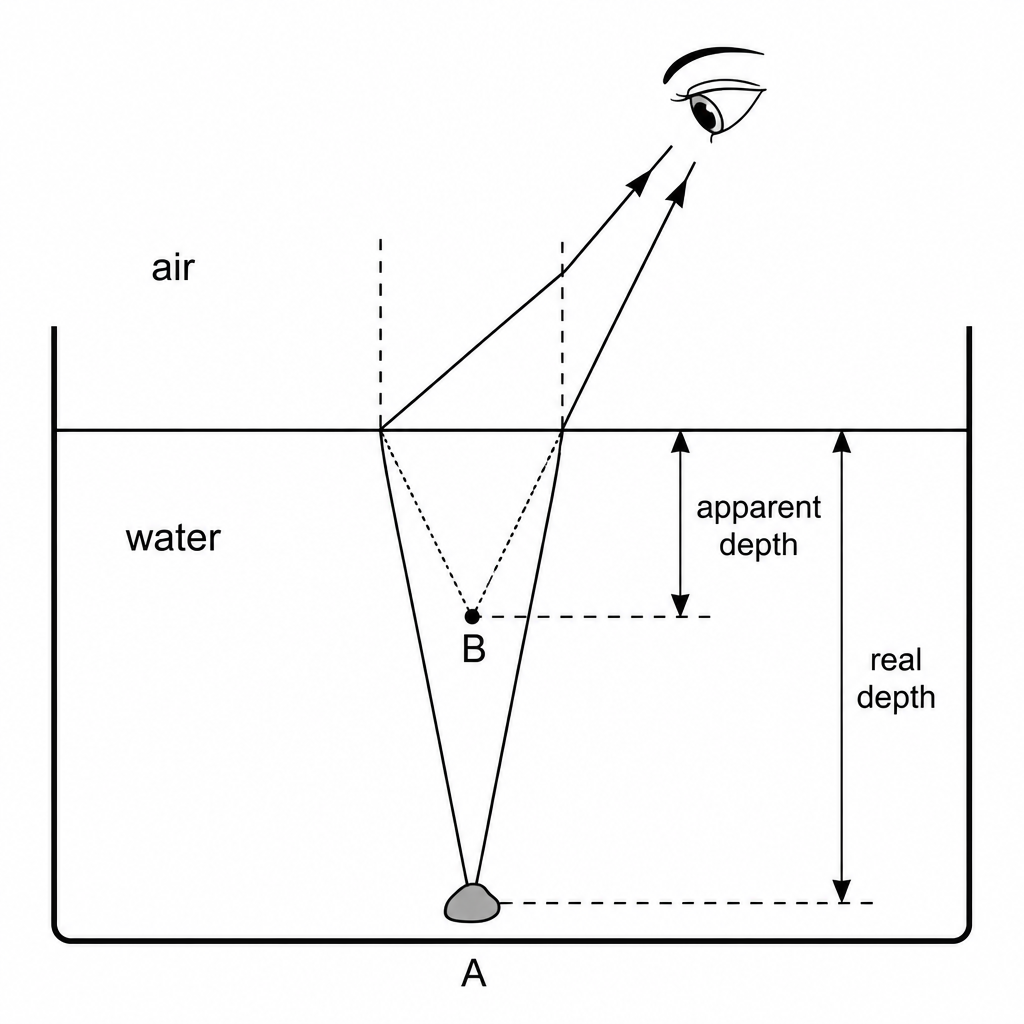
A pond, river or swimming pool is deeper than it looks. Never decide by eye alone that water is shallow enough to step or jump into.
The effect also works in the opposite direction. A diver under water who looks up at a person standing at the edge of a pool receives light that has passed from air into water. That light bends towards the normal as it enters the water. When the diver traces it straight back, the person appears higher above the water than they really are.
Refraction in the Earth's Atmosphere
Refraction does not need water. The air around the earth is itself made of layers of different density. Air close to the ground is densest, and it becomes thinner and thinner with height. Layers of different density have different refractive indices, so the refractive index of the atmosphere changes with altitude above the earth's surface. Light arriving from outer space passes from almost empty space into thin air, then into denser and denser air. It bends a little towards the normal at each layer. After these successive refractions its path is not a straight line but a gentle curve.
Atmospheric refraction: the bending of light as it passes through the layers of the earth's atmosphere, which have different refractive indices.
Two things we see in the sky every day and every night are explained by atmospheric refraction: the twinkling of the stars, and the sun appearing before sunrise and staying visible after sunset.
Why the Stars Twinkle
Light from a star travels an enormous distance through space and then reaches us after successive refractions through the different layers of the atmosphere. These layers are never still. Wind, heating and cooling keep moving them and changing their positions all the time. So even at the same place, the starlight is bent sometimes away from the normal and sometimes towards it. The ray that reaches the eye keeps shifting slightly, from moment to moment.
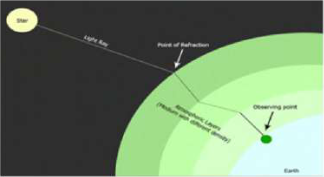
A star is so far away that it looks like a single point of light. When the bending changes, both the position of that point and the amount of its light that enters the eye change. The star seems to flicker in brightness and to shift very slightly in position. This is what we call twinkling.
Twinkling of stars: the continuous change in the brightness and position of a star, caused by refraction of its light in the moving layers of the atmosphere.
Planets and satellites do not twinkle. Their light passes through the same moving air, but they are much closer to the earth and appear bigger. The small changes of position caused by the atmosphere cannot be noticed against their size, so they shine with a steady light.
The star itself is not flickering. Its light leaves the star steadily. The twinkling is added on the way, inside our own atmosphere.
The Sun Before Sunrise and After Sunset
Just before sunrise, the sun is still below the horizon. A straight line from the sun to an observer would pass through the earth, so without an atmosphere the observer could not see it yet. But the sun's rays enter the atmosphere and pass from rarer to denser layers. At each layer they bend towards the normal, and after these successive refractions they follow a curved path over the horizon and into the observer's eye. The eye traces the arriving rays straight back, and they seem to come from a point above the horizon. So the sun is seen above the horizon while it is actually below it.
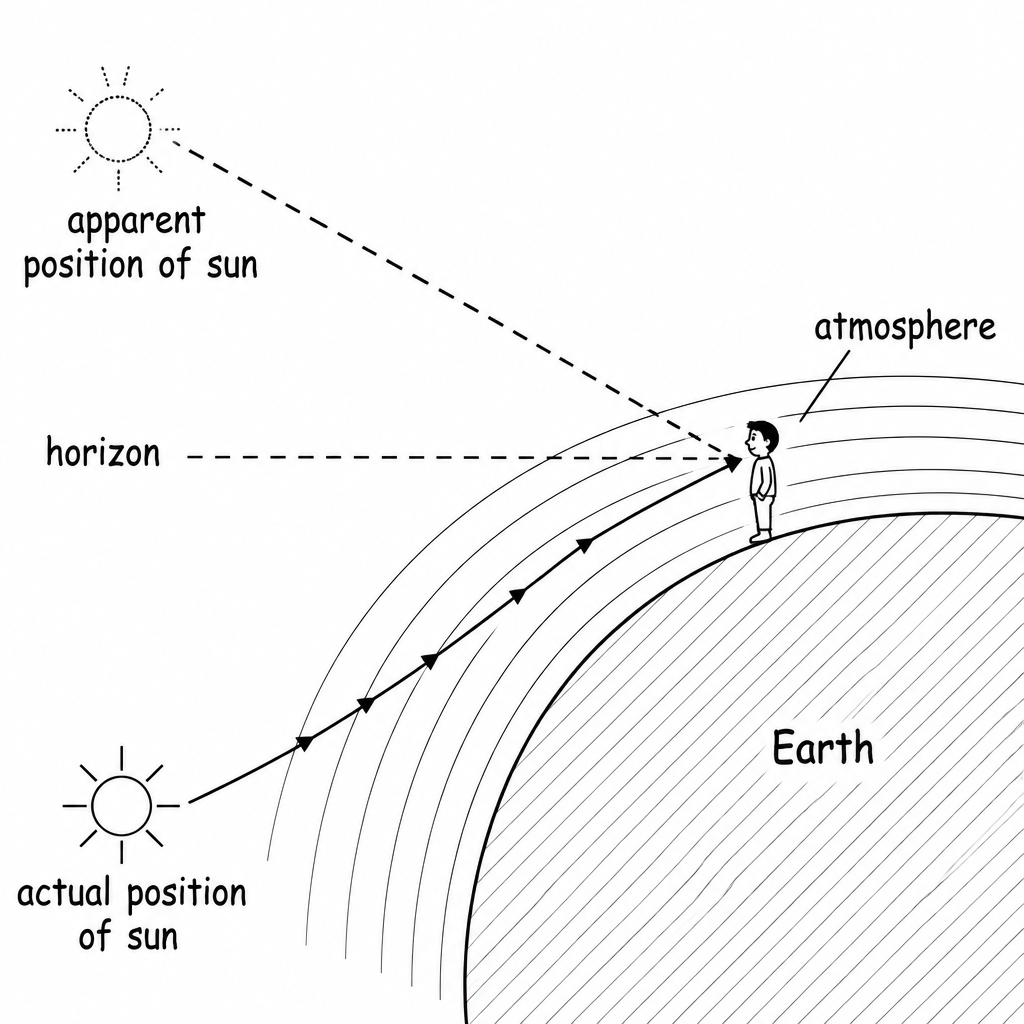
The same happens in the evening, in reverse. After the sun has actually set, its light is still bent over the horizon for a short while. As a result, the sun is visible about two minutes before the actual sunrise and about two minutes after the actual sunset. Every day is therefore a few minutes longer than it would be if the earth had no atmosphere.
This is the coin experiment on the scale of the sky. The coin lay below the line of sight, hidden by the rim of the glass, and the water bent its light over the rim so that it could be seen. The sun lies below the horizon, hidden by the curve of the earth, and the atmosphere bends its light over the horizon so that it can be seen. There is one difference: light from the coin goes from denser to rarer and bends away from the normal, while sunlight goes from rarer to denser and bends towards it. In both cases the image is raised, and an object below the line of sight becomes visible.
The Consequences Side by Side
| What we see | Light passes | What happens to the image |
| Hidden coin reappears | Water to air | Raised, so it clears the rim |
| Pencil looks bent | Water to air | Under-water part raised |
| Water looks shallow | Water to air | Bottom raised, apparent depth less than real depth |
| Stars twinkle | Space into moving air layers | Brightness and position keep changing |
| Sun seen before sunrise and after sunset | Space into denser air layers | Raised above the horizon |
The full lesson is waiting for you
The notes are free to read in full. A free account opens the rest of the practice, and tracks your progress and confidence score for every subject. Presentations and videos need approval from Learn Yeti.