What an optical fibre is
A glass thread thinner than a human hair can carry light from one place to another, even around corners. This happens every day when you watch a video on a phone connected to your home Wi-Fi, and in hospitals when a doctor looks inside a patient's stomach without cutting the body open. Both depend on total internal reflection of light. When light travelling in a denser medium strikes the boundary with a rarer medium at an angle greater than the critical angle, none of it passes out. All of it is reflected back into the denser medium. A thread of glass built to use this fact again and again is called an optical fibre.
Fibre optics: the technology of transmitting light through a thin and transparent medium such as glass.
Optical fibre: the thin, transparent medium used to carry light in fibre optics.
How the internet reaches a home
For a cabled internet service, the internet provider brings a cable right up to the house. At the end of that cable, the outer covering is stripped away so that a very thin fibre is exposed. The fibre is fixed into a small connector, and the connector is plugged into the router. Inside the cable it is the optical fibre, not a copper wire, that carries the internet signal. This is why a fibre connection gives fast communication and fast internet.
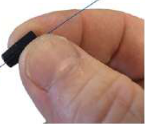
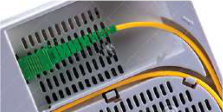
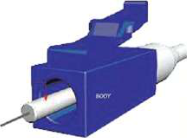
The connector holds the bare fibre in the exact centre of a hollow sleeve. This lines the end of the fibre up with the part of the router that receives the light, so the light passes from the cable into the router without being lost.
The parts of an optical fibre
Peel the plastic coat off a piece of fibre internet cable slowly and you find layer inside layer. At the centre is the core. The core is a bundle of very thin fibres made of a transparent material such as glass, and it is the part that actually carries the light. Around the core is the cladding. The cladding is also transparent, but it is made of a material whose refractive index is lower than that of the core. Outside both is a plastic coating, which protects the thin glass inside.
Glass fibres are very thin and break into tiny sharp pieces. Strip the cable slowly with a teacher nearby, keep broken bits away from your eyes and skin, and put them in a paper to throw away. Never look into the end of a fibre that is plugged into a working router.
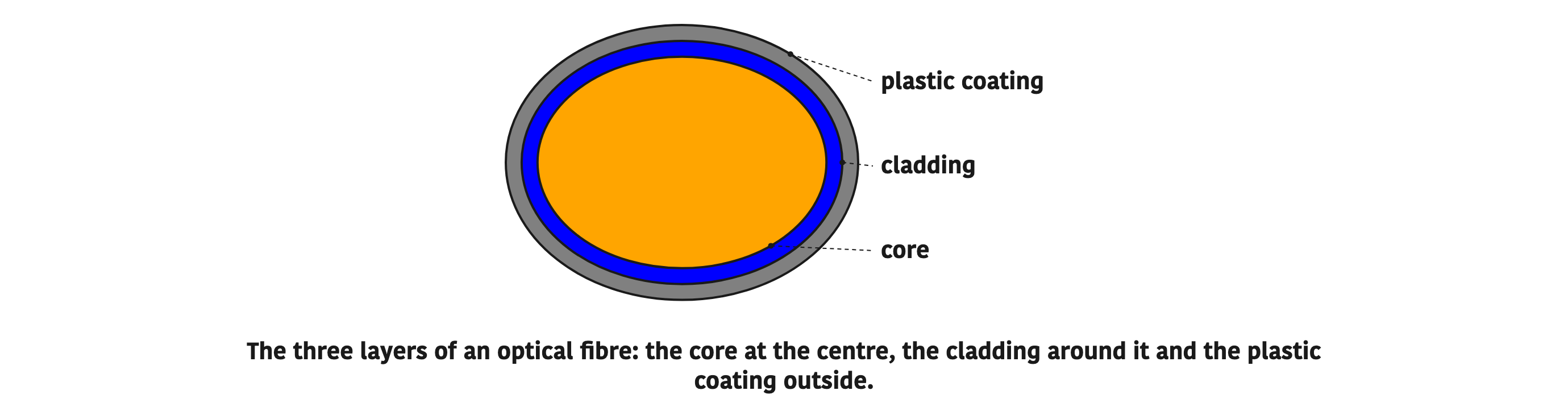
Core: the central part of an optical fibre, a bundle of thin fibres of a transparent material such as glass, through which the light travels.
Cladding: the layer surrounding the core, made of a material of lower refractive index than the core, so that total internal reflection can take place inside the core.
| Layer | What it is | Its job |
| Core | Bundle of thin glass fibres at the centre | Carries the light |
| Cladding | Transparent layer of lower refractive index | Makes total internal reflection possible in the core |
| Plastic coating | Outer cover | Protects the glass inside |
How light travels inside the fibre
The cladding is what makes the fibre work. The core has a higher refractive index than the cladding, so the core is the optically denser medium and the cladding is the rarer one. Light going from a denser medium towards a rarer medium is exactly the situation in which total internal reflection can happen.
Light is sent into one end of the fibre so that it meets the boundary between the core and the cladding at an angle of incidence greater than the critical angle. At that boundary no light escapes into the cladding. It is totally reflected back into the core, crosses to the opposite side, meets the boundary again at a large angle and is reflected again. The light moves forward along the fibre in a zig-zag path made of many total internal reflections.
At every one of these reflections, two conditions are met:
- The light is travelling from the denser core towards the rarer cladding.
- The angle of incidence \( i \) at the core-cladding boundary is greater than the critical angle \( c \), that is \( i > c \).
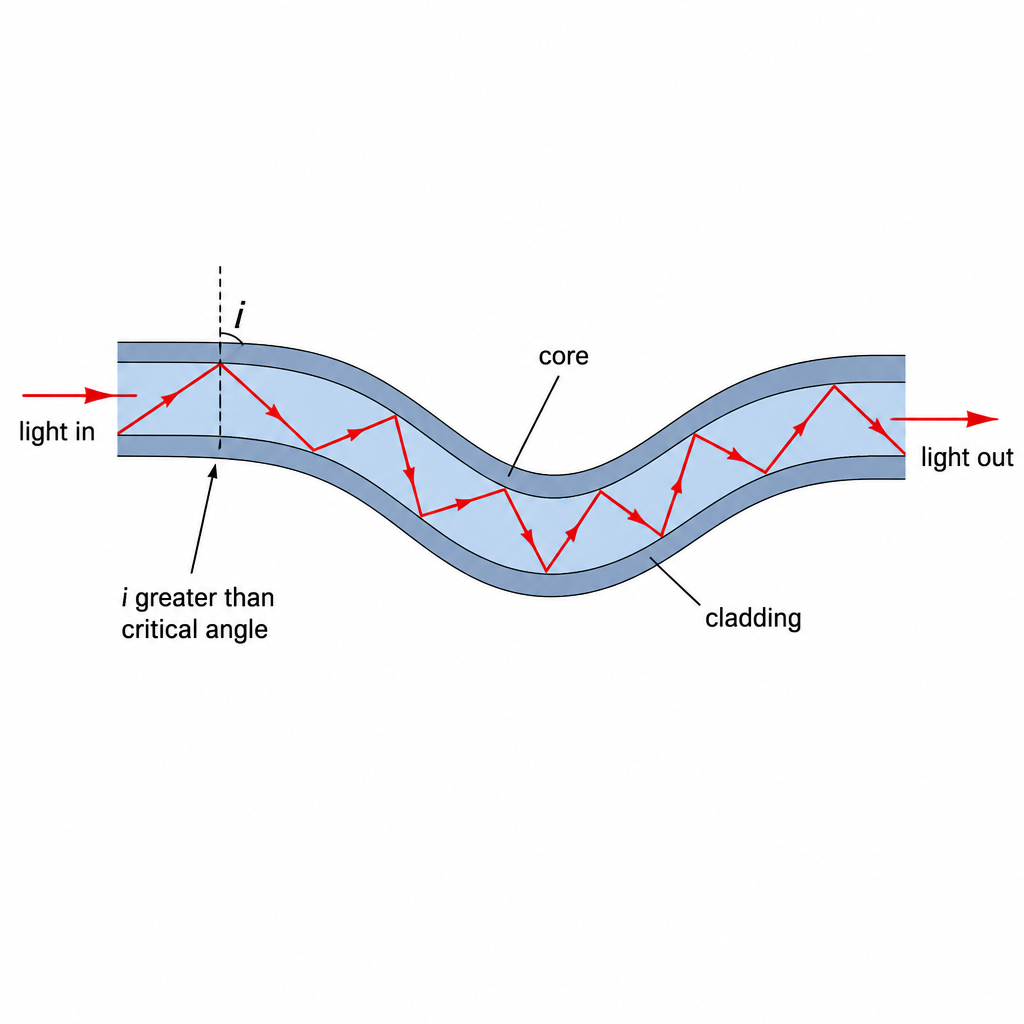
It does not matter whether the fibre is straight or bent. A curve changes the place where the light meets the boundary, but the angle of incidence stays greater than the critical angle, so the light keeps being reflected inside the core. It does not come out through the cladding, and it finally emerges from the other end of the fibre. This is how a fibre carries light around corners, under roads and across whole countries.
The signal inside an optical fibre is light, and it is kept inside by total internal reflection of light. Write 'light' in your answer, not 'sound'. The reflection happens at the boundary between the core and the cladding, not at the outer plastic coating.
From medicine to communication
Optical fibres were first used in the medical field. Doctors passed light into the body along fibres so that they could observe its internal parts. After that, fibres began to be used to carry communication signals at the speed of light. Today optical fibres are still used for medical check-ups, and even to make decorative items such as glowing lamps, but by far their widest use is in the communication sector.
Use of optical fibres in telecommunication
In communication technology, optical fibres carry signals and data very quickly in the form of light waves, using total internal reflection. A signal such as a phone call or internet data is first converted into light. That light is sent through the fibres, where total internal reflection keeps it inside the core, so it travels at high speed. Compared with older methods such as ordinary wires and copper cables, optical fibres carry a much larger volume of data, much faster and more securely, over long distances.
For example, data can travel through a fibre at a rate of 1 Gbps. A single optical fibre can carry thousands of telephone calls at the same time. The same feature lets people receive internet signals at home, watch high-definition videos, upload and download large files and do many other tasks online.
| Feature | Optical fibre | Wire or copper cable |
| Signal carried as | Light | Electric current |
| Volume of data | Very large | Smaller |
| Speed | Very fast | Slower |
| Security | More secure | Less secure |
| Long distance | Well suited | Less suited |
Optical fibre networks in Nepal
Optical fibre cables are bundled together and laid along the ground. In Nepal, they have been laid along national roads such as the East-West Highway, the Mid-hill Highway and other roads. These cables are joined to the international network through India and China. Bundles of optical fibre cable are laid not only on the ground but also through the air and under the sea for long-distance communication. Using these cables, an international network of optical fibre has been built, which is why a video filmed on another continent can reach your phone in a moment.
Use of optical fibres in the medical field: endoscopy and colonoscopy
Endoscopy: a non-surgical method of examining the internal organs of the body.
The instrument used is called an endoscope. It is a long, thin, flexible tube carrying optical fibres and a camera. It is used to examine the digestive system, including the esophagus, the stomach and the small intestine. Suppose a doctor needs to find out whether a patient has an ulcer in the stomach. The endoscope is inserted through the patient's mouth and guided down the esophagus into the stomach, where the doctor can see its inner lining.
Inside an endoscope, two bundles of optical fibres are kept parallel to each other. One bundle carries light to the internal organ and lights it up. The other bundle collects the light reflected by the lit organ and carries it back out. The shape of the organ can then be viewed directly, or shown on a video monitor connected to a camera. Both bundles work by total internal reflection, so the light follows the tube even as it bends through the body.
Colonoscopy: a type of endoscopy used to examine the colon and large intestine, in which the instrument is inserted through the rectum.
The instrument works in the same way as an endoscope. Only the route and the organs differ: it enters through the rectum instead of the mouth, and it shows the large intestine instead of the stomach.
An endoscope is the instrument. Endoscopy is the examination done with it. In the same way, a laparoscope is the instrument and laparoscopic surgery is the operation that uses it.
Keyhole surgery
Keyhole surgery: a procedure in which a surgeon operates inside the body through a small incision (cut) in the skin. It is also called laparoscopic surgery.
It gets its second name from the laparoscope, the instrument pushed in through the small incision so that the surgeon can see the shape of the internal organs. The surgeon does not look through a large opening at all. Watching the monitor, the surgeon works with other slim surgical instruments along with the laparoscope.
Laparoscope: an instrument containing bundles of optical fibres and a camera, which sends light inside the body and captures the shape of the internal organs to show it on a monitor.
Keyhole surgery is used to:
- remove damaged or diseased organs
- take a small sample of tissue for examination, which is called a biopsy
- remove gallstones
- remove kidney stones
Biopsy: taking a small sample of tissue from the body so that it can be examined.
In every medical use the fibres do the same job: they carry light into a dark place inside the body and bring back the light that shows what is there.
Optical fibre uses at a glance
| Use | Where the fibre goes | What the fibre does |
| Telecommunication | Along roads, through the air, under the sea | Carries signals as light |
| Endoscopy | Through the mouth to the esophagus, stomach and small intestine | Lights the organ and brings its image back |
| Colonoscopy | Through the rectum to the colon and large intestine | Lights the organ and brings its image back |
| Keyhole surgery | Through a small incision in the skin | Lets the surgeon see the organs on a monitor |
| Decoration | Inside lamps and ornaments | Carries light to glowing tips |
The full lesson is waiting for you
The notes are free to read in full. A free account opens the rest of the practice, and tracks your progress and confidence score for every subject. Presentations and videos need approval from Learn Yeti.