White Light and Coloured Light
Look at the flame of a gas stove. It burns with a blue light. A sodium vapour street lamp gives out a yellow light. Each of these sources gives light of mainly one colour. Sunlight is not like that. We see sunlight as white every day, but it is really a mixture of seven colours: red, orange, yellow, green, blue, indigo and violet.
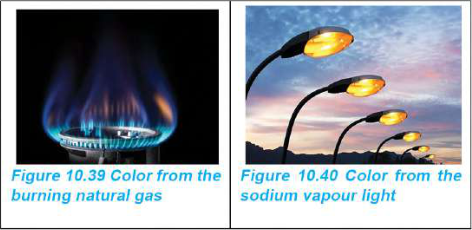
All seven colours reach our eyes at the same time, so we never see them one by one. The eye reads the whole mixture as white. If sunlight is passed through a suitable medium, such as a glass prism, the seven colours separate and can be seen on their own.
White light is not one colour. It is seven colours travelling together.
Dispersion of Light through a Prism
A prism is a clear block of glass with two triangular ends and three rectangular faces. Send a narrow beam of light from a ray box, or a beam of sunlight, onto one rectangular face of the prism. Let the light that comes out of the other face fall on a white wall or screen. Now turn the prism slowly. At one position a band of seven colours appears on the screen. Red is at the top of the band and violet is at the bottom.
When you use sunlight, never look straight at the sun, not even through the prism. Let the sunlight fall on the prism and look only at the band of colours on the screen.
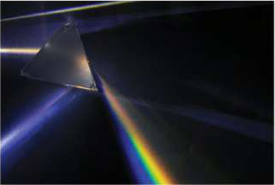
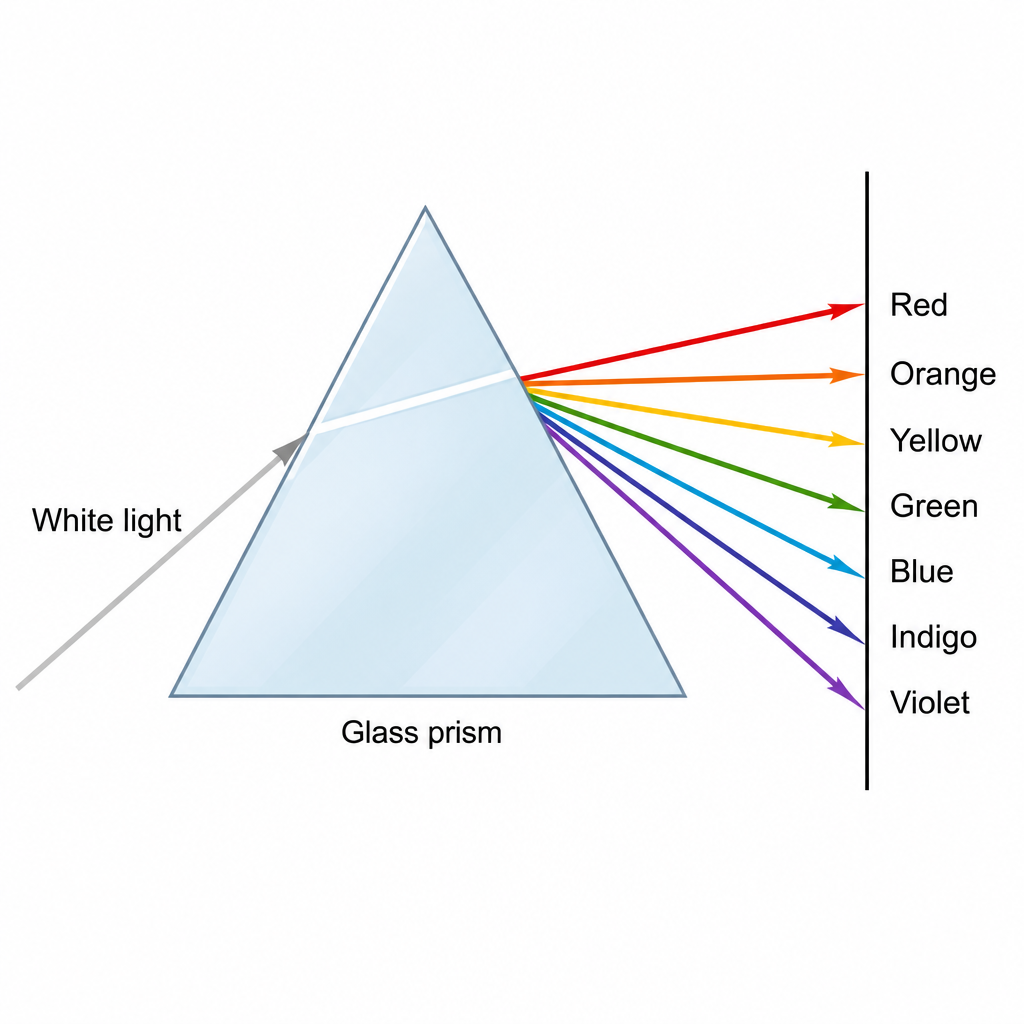
Dispersion of light: The process in which light falling on the surface of a prism or a similarly shaped object splits into seven colours (red, orange, yellow, green, blue, indigo and violet) while passing through the object is known as the dispersion of light.
The Seven Colours and Their Wavelengths
Light travels as a wave, and the waves of the seven colours have different wavelengths. These wavelengths are extremely small, so they are written in metres as multiples of \( 10^{-7} \). A length of \( 10^{-7} \) m is one ten-millionth of a metre. The limits of wavelength for each colour are given in the table below.
| Colour of light | Limit of wavelength (in metres) |
| Red | From \( 6.2 \times 10^{-7} \) to \( 7.8 \times 10^{-7} \) |
| Orange | From \( 5.9 \times 10^{-7} \) to \( 6.2 \times 10^{-7} \) |
| Yellow | From \( 5.8 \times 10^{-7} \) to \( 5.9 \times 10^{-7} \) |
| Green | From \( 5.0 \times 10^{-7} \) to \( 5.8 \times 10^{-7} \) |
| Blue | From \( 4.6 \times 10^{-7} \) to \( 5.0 \times 10^{-7} \) |
| Indigo | From \( 4.4 \times 10^{-7} \) to \( 4.6 \times 10^{-7} \) |
| Violet | From \( 3.8 \times 10^{-7} \) to \( 4.4 \times 10^{-7} \) |
Reading the table from top to bottom, the wavelength keeps getting shorter. Red light has the longest wavelength, reaching up to \( 7.8 \times 10^{-7} \) m. Violet light has the shortest, starting from \( 3.8 \times 10^{-7} \) m. If a light wave has a wavelength of \( 5.5 \times 10^{-7} \) m, it lies between \( 5.0 \times 10^{-7} \) m and \( 5.8 \times 10^{-7} \) m, so it is green light.
Visible spectrum: The band of the seven colours arranged in decreasing order of their wavelengths is called the visible spectrum.
The seven colours of the visible spectrum are remembered as VIBGYOR: Violet, Indigo, Blue, Green, Yellow, Orange, Red. The word starts from the shortest wavelength. Read it backwards, from R to V, and you get the order of the table.
Cause of Dispersion of Light
Light is an electromagnetic wave. In a vacuum, all electromagnetic waves travel at the same speed. In a medium such as glass or water, however, the speed is different, and in a given medium the speed of a wave depends on its wavelength. So inside a prism the seven colours travel at different speeds. Red light, with the longest wavelength, moves comparatively faster than the other colours. Violet light has both the shortest wavelength and the lowest speed of the seven.
When light passes through a prism, it is refracted twice: once as it enters the first face and again as it leaves the second face. Because they travel at different speeds, the colours separate inside the prism and come out bending towards the base, so each one falls on a different place on the screen. Red light, with the longest wavelength and the highest speed, deviates the least and is seen at the upper part of the screen. Violet light, with the shortest wavelength and the lowest speed, deviates the most and falls on the lower part of the screen.
| Property | Red light | Violet light |
| Wavelength | Longest | Shortest |
| Speed in glass | Fastest | Slowest |
| Deviation | Least | Most |
| Position on the screen | Upper part | Lower part |
Because VIBGYOR begins with violet, many students think violet appears at the top of the screen. It does not. Violet bends the most and lands at the bottom, while red bends the least and stays at the top. Also, the colours differ in speed only inside a medium; in a vacuum they all travel at the same speed.
Light as a Group of Seven Colours: Newton's Disc
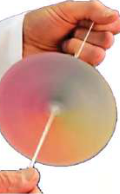
A prism splits white light into seven colours. The reverse can also be done: the seven colours can be mixed back into white. To show this, a round cardboard disc is divided into seven equal parts and painted in the order VIBGYOR. A thread is passed through two holes near the centre, and pulling and relaxing the thread makes the disc spin very fast.
Newton's disc: A disc made by painting the seven constituent colours of light in proportion on it is called Newton's disc.
When the disc turns slowly, the seven colours can still be seen separately. Once it spins very fast, the eye cannot pick out each colour on its own, and all seven seem to reach the eye together. The colours mix and the disc looks white, or nearly white.
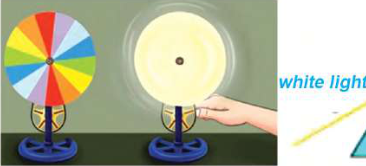
A prism takes white light apart into seven colours, and Newton's disc puts seven colours back together into white. Both show that white light is a group of seven colours.
Recombining the Colours with a Second Prism
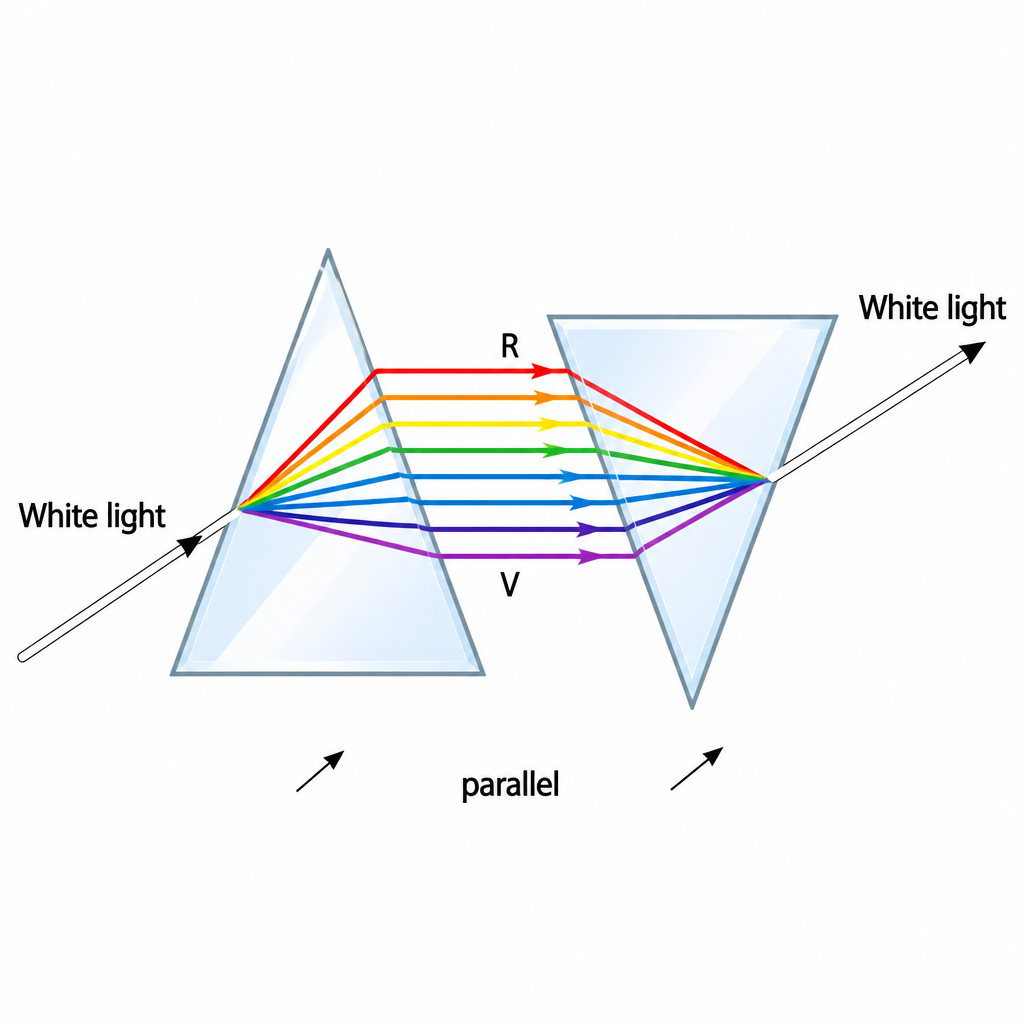
Take two identical prisms and place the second one upside down next to the first. The first prism separates white light into seven colours. As these colours pass through the upturned second prism, each colour is bent back the opposite way by the same amount. The seven colours are recombined, and white light comes out of the second prism. The ray that leaves the second prism is parallel to the direction of the light that entered the first.
Rainbow
Rainbow: A rainbow is a circular colourful arc that appears in the sky when the sun lies behind water droplets present in the air.
A rainbow forms because of the dispersion of light by water droplets hanging in the air. In this process each round droplet does the same job as a small prism. Inside one droplet, the light goes through these stages:
- Step 1: A ray of sunlight strikes point A on the surface of the round droplet and enters it.
- Step 2: Refraction on entering splits the light into seven colours inside the droplet.
- Step 3: The seven colours reach the opposite surface of the droplet and are totally internally reflected there. Red light, deviated the least, is reflected from point B, and violet light, deviated the most, is reflected from point C.
- Step 4: The light is refracted again as it comes out of the droplet, and the colours leave at different angles to form a rainbow.
The sky holds a very large number of droplets, and each one sends a colour towards our eyes. Together they make the coloured arc. From the ground a rainbow looks like a semicircle, because the ground blocks its lower half. Seen from the sky, for example from an aeroplane, it can be seen as a complete circle.
A rainbow is dispersion of light happening in nature, with water droplets doing the work of a prism.
The full lesson is waiting for you
The notes are free to read in full. A free account opens the rest of the practice, and tracks your progress and confidence score for every subject. Presentations and videos need approval from Learn Yeti.