What the Night Sky Shows Us
On a cloudless night, a little away from the street lights, the sky fills with hundreds of small points of light. Some of them sit perfectly still, some seem to twinkle, and now and then a bright streak crosses the sky and disappears in a second. Everything of this kind is called a celestial body: planets, satellites, stars, meteors, asteroids and comets. The sky holds far more than these bodies. Dust particles, particles of cloud and gas, ordinary matter, dark matter, leptons and photons are spread all through it, and energy is held within all of them. Every one of these things lies enormously far from the Earth. A gap that looks small to the eye becomes a very long number the moment we write it down in kilometres.
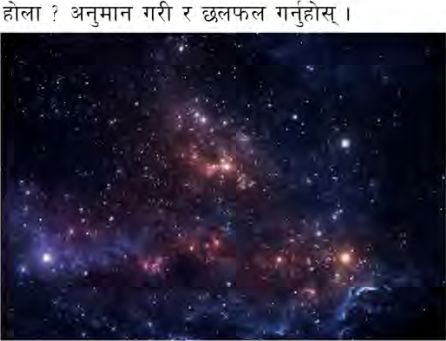
Celestial body: Any of the objects lying in the sky, such as a planet, a satellite, a star, a meteor, an asteroid or a comet, is called a celestial body.
Space: The Sky Without a Boundary
Standing at the foot of a hill, the sky looks as if it ends just behind the ridge. That ending belongs to our eyes, not to the sky. Wherever we manage to look, the sky is already carrying on further. This endless sky, which reaches on and on with no boundary anywhere, is called space. Nobody so far has been able to work out how far space extends. That is not a confession of failure but a plain statement of fact, because every time a stronger instrument looks further out, more light is found waiting beyond.
Space: The boundless sky that is seen stretching on without end is called space.
The Universe: Space, Time, Matter and Energy Together
The unlimited extent of space is itself the universe. The word does not mean empty room alone. Space, meaning unlimited room, together with time, matter and energy, all taken as one single whole, is called the universe. Put another way, the universe stands for total existence. Whatever exists, wherever it is and whenever it is, falls inside the universe. The Earth, the Moon, the stars and all other celestial bodies and materials are parts of this one whole. We are not spectators standing outside it and looking in; we are a very small part inside it.
Universe: Space, which is unlimited room, taken together with time, matter and energy as one whole, is called the universe.
Space: the unlimited room in which every body sits.
Time: the order in which every event happens.
Matter: the material that bodies and particles are made of.
Energy: the energy held within that matter.
The spread of the universe and its limit are endless. That is why a map of the universe can never be given an outer edge.
The Observable Universe
The universe is endless, yet the part of it we can see is limited. The portion of the universe that a powerful telescope is able to reach is called the observable universe. The distance from one side of it to the opposite side is estimated at about 46 billion light years. The number sounds huge, but it is not a measurement of the whole universe. It measures only the part whose light has managed to arrive here. Any star or galaxy whose light has not yet reached the Earth lies outside the observable universe altogether.
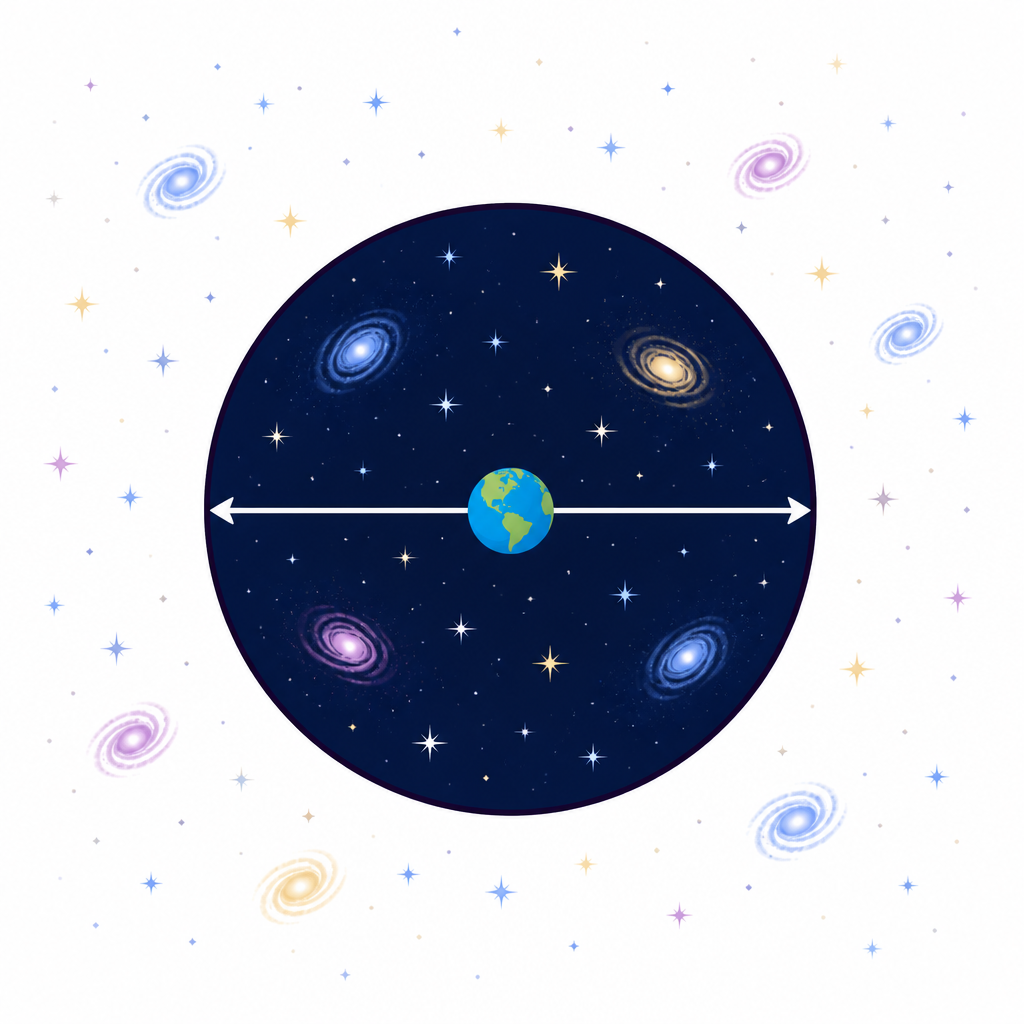
Observable universe: The part of the universe that can be seen with a powerful telescope is called the observable universe.
Do not treat the observable universe as the whole universe. The figure of 46 billion light years is the width of the part we can see, not the size of the universe. The universe itself has no limit.
The Light Year
When the distance of a star is written out in kilometres, the number becomes so long that it is hard even to read aloud. Astronomy therefore uses a much larger unit. The distance that light travels in one year is called one light year, written in short as l.y. One light year is a distance of 9.46×10¹² km.
One light year (l.y.): The distance that light travels in one year is called one light year.
\[ 1 \text{ l.y.} = 9.46 \times 10^{12} \text{ km} \]
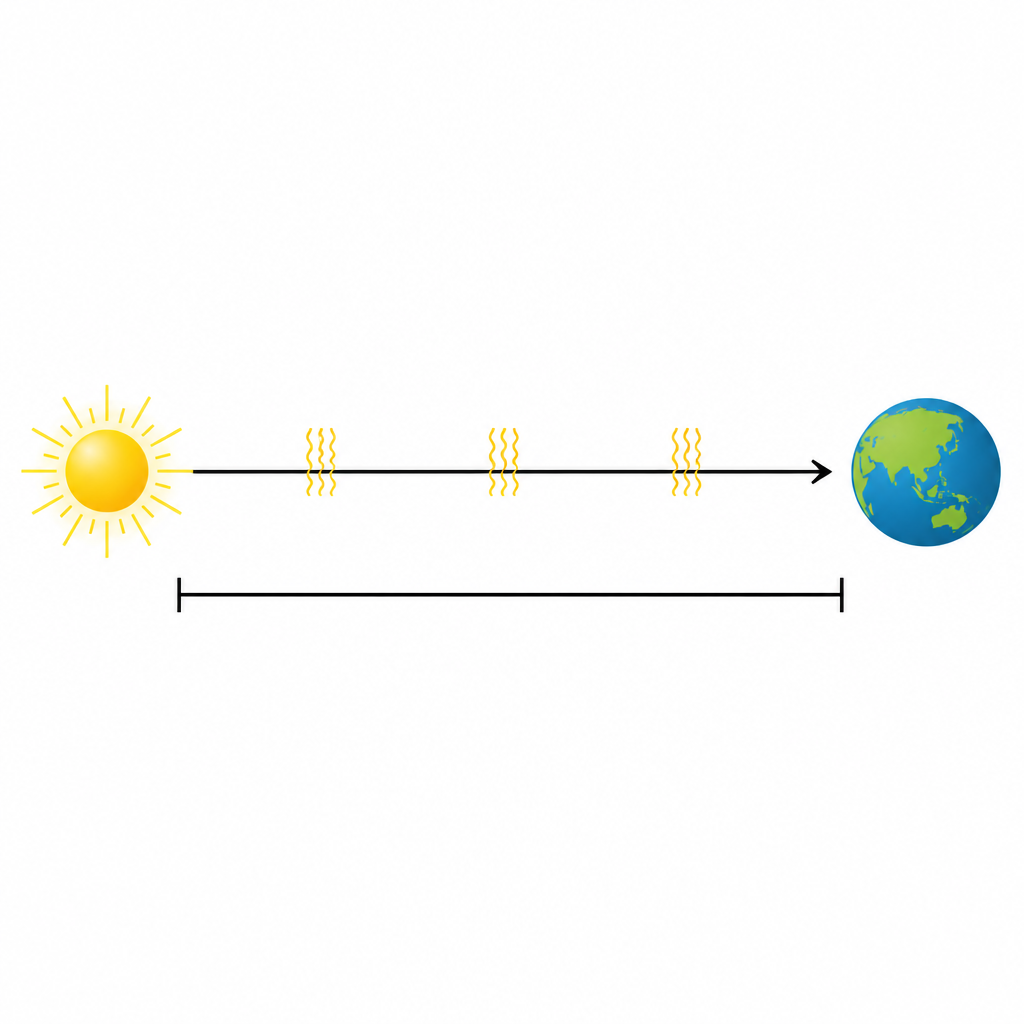
The word 'year' is inside the name, yet a light year is not a unit of time. It is a unit of distance. Saying 'that star is 8 light years away' is correct; saying 'that star is 8 light years old' is wrong.
Let us work out the width of the observable universe in kilometres. The distance given is 46 billion light years, which is 46×10⁹ light years.
Step 1: The mathematical statement is:
\[ 46 \times 10^{9} \times 9.46 \times 10^{12} \]
Step 2: First the number parts are multiplied:
\[ 46 \times 9.46 = 435.16 \]
Step 3: Now the powers of ten are multiplied:
\[ 10^{9} \times 10^{12} = 10^{21} \]
Step 4: Writing the two results together:
\[ 435.16 \times 10^{21} = 4.3516 \times 10^{23} \]
So the width of the observable universe is about 4.35×10²³ km. The light year exists precisely so that a number of this length does not have to be written out again and again.
Astronomy: The Study of the Whole Universe
The light of a star, the motion of a planet, the make-up of a galaxy and the expansion of the universe all belong to a single branch of science. The science that studies the whole universe is called astronomy. Astronomy cannot bring its subject into a laboratory and test it, so its main tools are careful observation and careful measurement.
Astronomy: The science that studies everything to do with the whole universe is called astronomy.
How the Universe Began: The Big Bang Theory
Different studies place the origin of the universe about 13.8 billion years ago. No factual proof of the origin itself has been found, but research into the expansion of the universe led to the big bang theory being put forward. In other words, scientists did not watch the beginning happen. They measured the expansion going on today and then calculated backwards from it.
In 1924 the American scientist Edwin Powell Hubble studied the sky through a telescope and established that spiral nebulae are moving further and further away from the Earth. That single result opened a new line of thinking about how the universe began. In 1927 the Belgian scientist George Lemaitre put forward a theory saying that the universe is expanding continuously. Running that expansion backwards along the time line showed that every body and all the energy of the universe started out from one extremely dense point. George Lemaitre gave that dense point the name primeval atom.
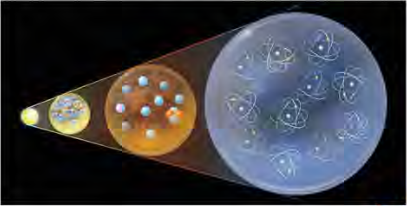
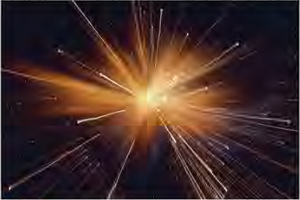
Big bang theory: The theory saying that the extremely dense point, the primeval atom, exploded and kept expanding until today's universe came into existence is called the big bang theory.
What Happened After the Big Bang
After the big bang, the tiny particles needed for building matter, called prematter, were spread out from the primeval atom at tremendous speed. These particles joined together, and from them atoms, energy and time were formed. Out of that came the stars, the star clusters and the constellations, and so the universe with all of today's celestial bodies became possible. None of this finished in one moment. It went on for billions of years, and it is still going on.
- The extremely dense primeval atom exploded.
- The material inside it spread outward in every direction at tremendous speed.
- The prematter particles needed for building matter joined together.
- Atoms, energy and time were formed.
- Stars, star clusters and constellations took shape.
- The universe with all of today's celestial bodies came into being.
Stephen Hawking and the Mathematical Singularity
In 1970 Stephen Hawking re-explained the idea that the universe came into existence through a big bang out of a mathematical singularity. A singularity is a point at which all matter and all energy are packed together beyond anything we can picture. He set this explanation out in 1988 in his book 'A Brief History of Time: From the Big Bang to Black Holes'. One idea, then, was made steadily stronger by the work of three scientists, one after another.
Three Scientists Behind the Idea
| Scientist | Year | Contribution |
| Edwin Powell Hubble | 1924 | Showed through telescope study that spiral nebulae are moving away from the Earth |
| George Lemaitre | 1927 | Put forward the theory that the universe is expanding continuously and that all bodies and energy began from one extremely dense point |
| Stephen Hawking | 1970 | Re-explained the origin of the universe as a big bang out of a mathematical singularity |
Looking up the work of these three for yourself makes it clear how a scientific theory is built up one step at a time.
- Use the internet to find out about the work of Hubble, Lemaitre and Hawking on the big bang theory.
- On a sheet of card board paper, put their pictures, a short life story of each and the contribution each made to the big bang theory.
- Display the finished card in class and discuss it with your friends.
The full lesson is waiting for you
The notes are free to read in full. A free account opens the rest of the practice, and tracks your progress and confidence score for every subject. Presentations and videos need approval from Learn Yeti.