How old is the earth?
Nobody was standing there with a notebook when the earth was made, so its age has to be worked out from evidence that is still lying around us. Scientists study how old rocks are, and they study the fossils buried inside those rocks. From such study it is estimated that the earth came into being about 4.6 billion years ago. That number is easy to say and hard to picture. One billion is a thousand million, that is a one followed by nine zeros.
The earth did not appear on its own. Heavenly bodies such as planets, satellites and stars came into being only after the universe itself began, and the earth is one of those planets. The sun, the other planets, their satellites and the earth all belong to one single story. So asking how the earth began is really asking how the whole solar system was formed.
Hypothesis: an explanation a scientist puts forward, on the strength of evidence and reasoning, for how some natural event may have happened. It is not a settled fact. It can be questioned and criticised.
Four hypotheses about how the earth began
At different times, different scientists gave different explanations of how the earth was formed. The four best known of them are set out below. Learn who gave which hypothesis and in which year, because each one paints a completely different picture of the beginning.
| Hypothesis | Scientists | Year |
| Nebular hypothesis | Immanuel Kant and Pierre Simon Laplace | 1755 and 1796 |
| Planetesimal hypothesis | George Buffon | 1745 |
| Binary hypothesis | Thomas Chrowder Chamberlin and Forest Ray Moulton | 1905 |
| Tidal hypothesis | Sir James Jeans and Harold Jeffreys | 1919 |
There is one question that separates these four hypotheses at once: what was already there at the start? In the nebular hypothesis there was only a cloud of gas and dust, and the sun itself was made out of it. In the other three the sun already existed, and the planets came later.
The nebular hypothesis of Kant and Laplace
The German scientist Immanuel Kant gave this hypothesis in 1755, taking Newton's law of gravitation as its base. According to him the solar system slowly built itself out of one enormous cloud. No outside body came along and made it.
Nebula: an enormous cloud-like mass of gas and dust particles lying in space.
The way the solar system grew out of that nebula is described step by step below.
- In the place where the solar system now lies, there was a nebula, a cloud-like mass of gas and dust particles of enormous size.
- Pulled by their own mutual gravitation, those gas and dust particles were drawn in and slowly began to collect at the central part.
- While they were collecting, an eddy current was set up, and from it the centre began to spin rapidly on its own axis.
- That drew in still more matter, so a very large ball of gas and dust particles was formed there.
- At the central part of that ball the density and pressure of the matter kept rising, so the temperature rose too, and the sun was formed.
- Because of centrifugal force the matter in the outer part of the ball gradually flattened out like a plate.
- While revolving round the newly formed sun, that flattened matter gathered into heaps here and there by its own gravitation, and those heaps turned into the planets.
- Matter that was circling round a planet as its centre went on circling and gathering in the same way, and turned into satellites.
- The leftover nebular matter lying far from the centre, which the gravitation of the sun, the planets and the satellites could not gather in, drew together among itself and became asteroids.
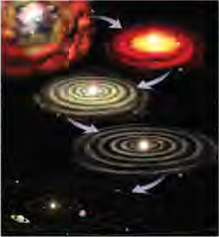
In 1796 the French mathematician Pierre Simon Laplace corrected Kant a little and added something of his own. He said that matter was flung off ring by ring from the equator of the rapidly spinning central ball, and that those rings in turn became the planets. Spin a wet cloth round fast like a wheel and drops of water fly off all round it. He said the satellites were flung off from the planets in exactly that way.
Features of the nebular hypothesis
- This hypothesis means that the earth and all the other planets were solid and cold right from the beginning. However, while matter was still gathering, meteorites came in from space and struck the planets hard, so the part of a planet that was struck may have melted for a short time.
- Since all of them were formed by the gradual flattening of one spinning nebular ball, the planets, satellites and asteroids all revolve round the sun staying in very nearly the same one plane.
The planetesimal hypothesis of George Buffon
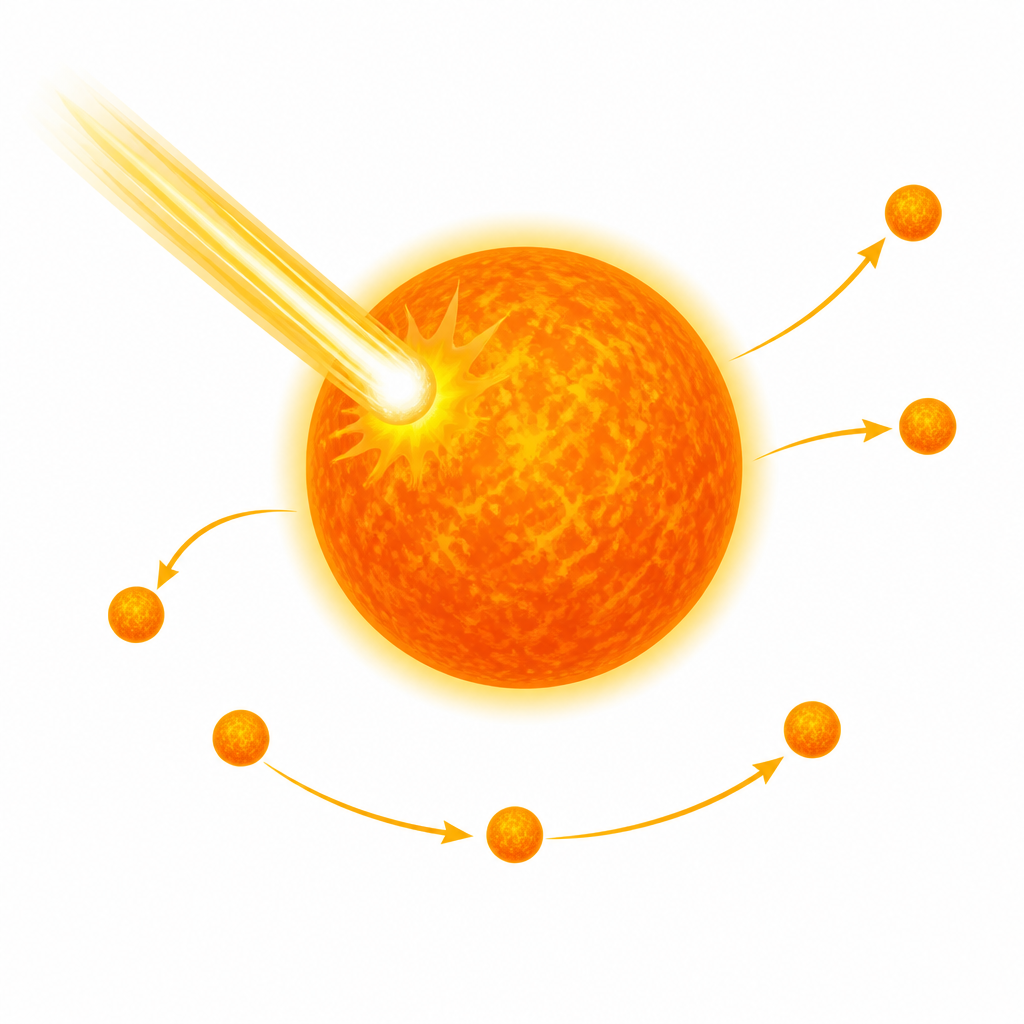
The French scientist George Buffon put forward the planetesimal hypothesis in 1745. According to it, before the planets existed there was only the sun here. Long ago a huge comet came from somewhere and struck the sun a heavy blow. Pieces of solar matter were thrown out by that collision. Some of them escaped into space, some fell back into the sun and were lost in it, and some began to revolve round the sun. As they revolved they cooled down little by little and became the planets and satellites.
Features of the planetesimal hypothesis
- According to this hypothesis the earth and the other planets were extremely hot to begin with, and cooled down later because their distance from the sun increased.
- Even when the masses of all the planets, satellites and asteroids of the solar family are added together, the total is only about one percent of the mass of the sun. So the possibility that all these members were thrown out of the sun cannot be denied.
The binary hypothesis of Chamberlin and Moulton
The American scientists Thomas Chrowder Chamberlin and Forest Ray Moulton gave this hypothesis in 1905. According to them our sun once had a fairly large binary star as its companion. The sun and that binary star were revolving round each other. While they were revolving, the powerful star and the sun came close together on one occasion, and gravitation pulled hot matter out of the sun. That matter cooled and the earth and the other planets were formed from it. The binary star that had come close then went off along its own path, and the planets began to go round the sun.
Binary star: a companion star that stays paired with another star, the two of them revolving round each other.
Criticism of the binary hypothesis
This whole hypothesis stands on the sun having a companion star. Yet it has not been known till today that the sun has any binary star at all. Explaining the birth of the planets by leaning on something for which there is no evidence is the weakest point of this hypothesis.
Do not treat the planetesimal, binary and tidal hypotheses as one and the same. In the planetesimal hypothesis a comet actually collides with the sun. In the binary hypothesis the sun's own companion star comes close while the two are revolving round each other. In the tidal hypothesis a visiting star never collides at all. It merely passes close by and travels on.
The tidal hypothesis of Jeans and Jeffreys
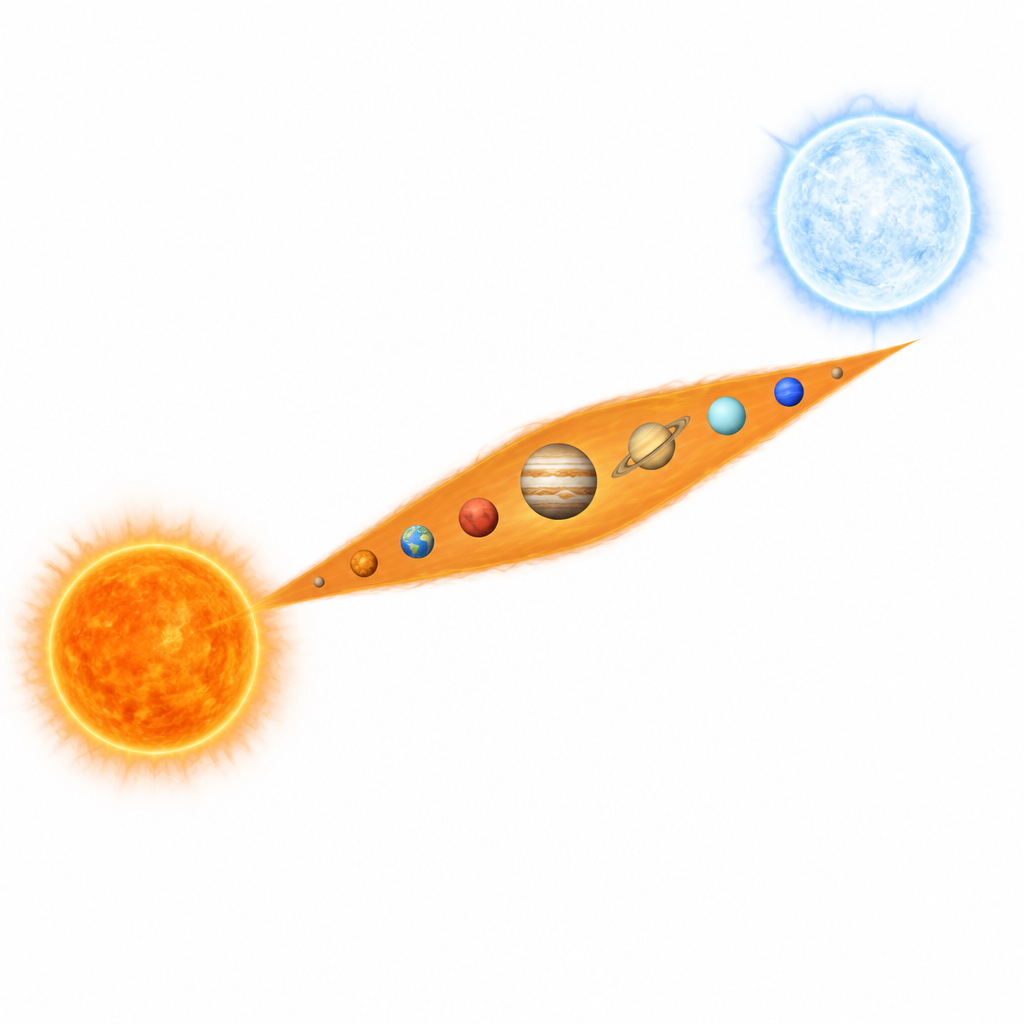
The British scientists Sir James Jeans and Harold Jeffreys gave this hypothesis in 1919. According to it, at first there was only the sun in the solar system. Long ago a star even bigger than the sun passed close by the sun at great speed. As it came near, its powerful gravitation raised a long tongue of matter from the sun's surface in the form of a tide. This tongue is also called a filament. Before any collision could happen the star had already travelled far away, so the tongue stayed behind and began to move round the sun. In course of time it cooled and shrank, and the planets and satellites were formed out of it.
Filament: the long tongue of hot matter drawn out from the surface of the sun by the gravitational pull of a star passing close by.
Features of the tidal hypothesis
- The flame-shaped tongue drawn from the sun was pointed at both of its ends and thick in the middle. So Mercury and Pluto, which lie at the two ends, are both small, the planets between them grow larger and larger in turn, and Jupiter, which lies in the middle, has become the largest of all.
- Mars lies farther out than the earth, so by this reasoning Mars ought to have been larger than the earth. For some reason Mars exploded, its pieces flew off and became asteroids, and that must be why Mars ended up smaller than the earth.
The four hypotheses side by side
Read one after another, the four hypotheses can start to sound alike. The table below separates them by what existed at the start, how the matter for the planets got loose, and what condition the young earth was in.
| Hypothesis | What existed at the start | How the matter got loose | The young earth |
| Nebular | Only a nebula of gas and dust | By spinning and flattening, nothing was thrown out | Cold and solid |
| Planetesimal | Only the sun | Thrown out when a comet struck the sun | Extremely hot |
| Binary | The sun and its binary star | Pulled out when the two stars came close | Cooled from hot matter |
| Tidal | Only the sun | A passing star drew out a tongue of matter | Cooled from the hot tongue |
Not one of these four hypotheses can be called completely correct. Each of them explains some things well and fails to explain others. That is how science works. As new evidence is found the older explanation gets corrected, in the same way that Laplace corrected what Kant had said.
Making a model of the nebular hypothesis
Something you have read stays in the mind far better once you have made it with your own hands. To build a model of the nebular hypothesis of the earth's origin you need a knife, a sheet of thermocol, colour pencils and a compass.
- Take a white sheet of thermocol and, using the colour pencils and the compass, draw on it the picture the nebular hypothesis describes.
- Scrape the thermocol gently with the knife to shape the parts of that picture, and colour each part suitably.
- Display the finished model in class and discuss the features of the nebular hypothesis with your friends.
When you scrape the thermocol, keep the blade turned away from yourself rather than towards you, and keep your fingers well clear of the path of the blade.
The full lesson is waiting for you
The notes are free to read in full. A free account opens the rest of the practice, and tracks your progress and confidence score for every subject. Presentations and videos need approval from Learn Yeti.