What a Clear Night Sky Really Shows
On a clear night, when no cloud is in the way, the sky is crowded with points of light. To the naked eye every one of them looks the same: a small, bright dot. They are not all the same kind of object. Some of those dots really are single stars. Others are not one star at all, but a huge clump of lakhs and crores of stars packed together.
Such a group lies crores of light years away from us. A light year is the distance light travels in one year, and that distance is so vast that a whole group of stars sitting crores of light years away shrinks in our eyes to a single faint dot. That is exactly why we get into the habit of calling every point in the sky a star.
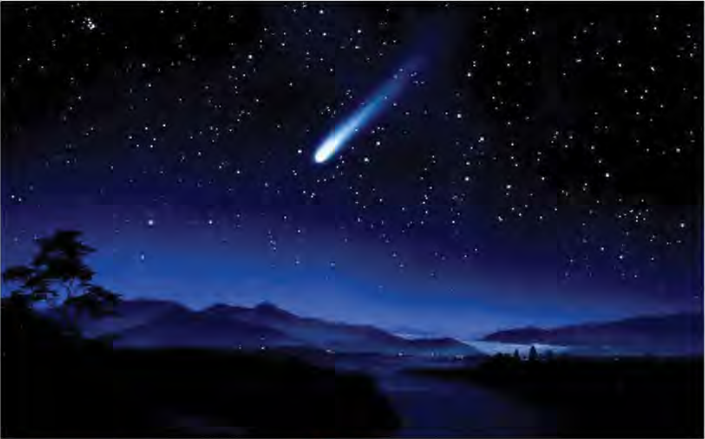
Do not assume that every bright point in the sky is one star. Some of those points are entire galaxies, and each of them holds crores of stars.
Besides stars, these groups hold gas and enormous clouds of dust, which are called nebulae. So a group like this is not only a collection of finished stars. It also carries the raw material out of which new stars are made.
Nebula: a vast cloud of gas and dust lying in space, inside which new stars can be born.
What a Galaxy Is
Out in space, crores of stars, the planet systems that belong to some of those stars, nebulae, the remains of old nebulae and dark matter all sit together. The thing that keeps them together instead of letting them drift apart is gravity. Gravity binds all of them into one enormous structure.
Galaxy: an astronomical structure formed when crores of stars, the planet systems belonging to some of those stars, nebulae, the remains of nebulae, dark matter and similar material are bound together by a system of gravitation.
The force that holds a galaxy together is gravitation. Without it, those crores of stars would long ago have scattered across space.
Our Own Galaxy, the Milky Way
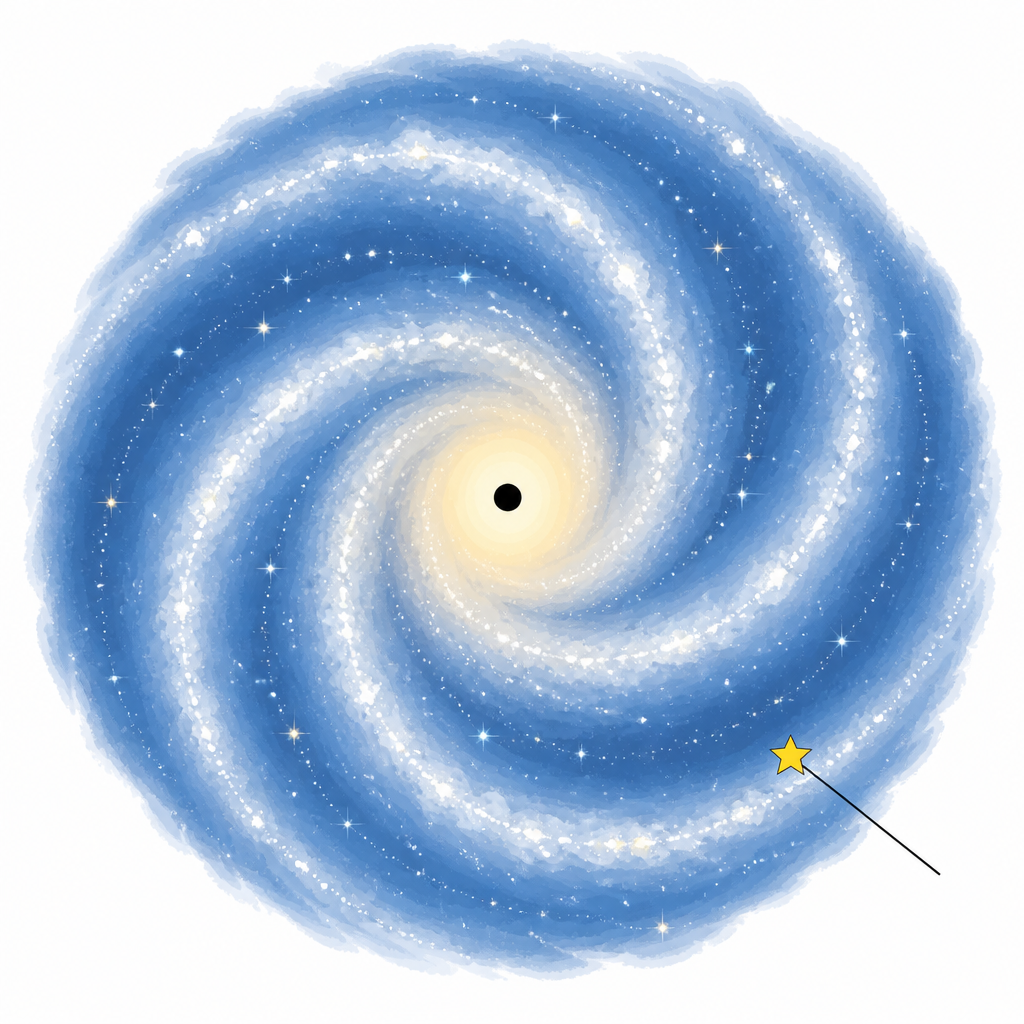
We are not looking at galaxies only from the outside. Our own solar system sits inside the galaxy named the Milky Way. It contains about 150 crore stars, small and large, and our Sun is one of them. The Earth goes round the Sun, and the Sun itself is just one member star of the Milky Way.
This is why most of the stars we can see at night are members of our own Milky Way. Because we are looking from inside the galaxy, we can never see its whole shape at once. It is like standing in the middle of a thick forest: you can see plenty of trees, but not the outline of the forest itself.
The Shapes of Galaxies
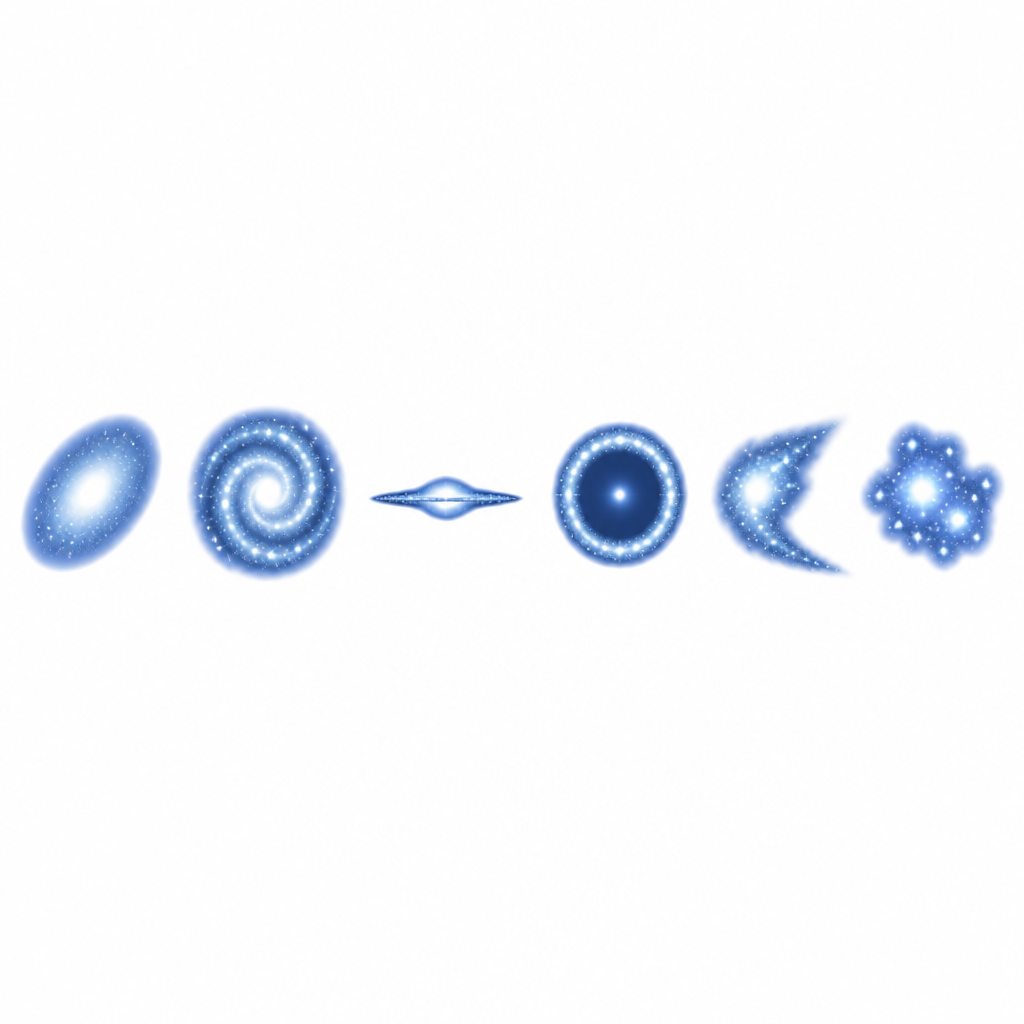
Galaxies are not all built to one pattern. They take the shape of an ellipse, a spiral, a lens, a ring, a peculiar form or an irregular form. In a spiral galaxy like our Milky Way, curved arms spread outward from a bright crowded middle, which is where the name comes from.
| Shape | What it looks like |
| Elliptical | A smooth oval or stretched ball of light |
| Spiral | Curved arms winding out of a bright centre |
| Lens shaped | Thick in the middle and thin at the rim, like a flat plate |
| Ring shaped | Empty in the middle, with a ring of stars around it |
| Peculiar | An odd form that fits none of the usual groups |
| Irregular | No settled shape at all, scattered and uneven |
Some Named Galaxies
Astronomers have given names to many galaxies. The Milky Way, Andromeda, Whirlpool, Sombrero and Messier are examples. Some of these names come straight from the way the galaxy looks. The Sombrero, for instance, is named after a wide flat hat, because seen edge on it looks exactly like one.

Looking at pictures of galaxies, one thing stands out at once. The middle of a galaxy is always the brightest and most crowded part, and the stars thin out as you move away from that centre.
How Many Galaxies Are There
According to information received from the spacecraft New Horizons, which NASA sent out, the number of galaxies in the observable universe was estimated in 2021 at \( 2 \times 10^{11} \).
\[ 2 \times 10^{11} = 200000000000 \]
Observable universe: the part of the universe whose light has had time to reach us, so it is the part we are able to look at with our instruments.
That figure is an estimate, not a head count. The Milky Way alone holds about 150 crore stars, and there are an estimated two hundred billion galaxies like it. Put those two numbers side by side and you begin to feel how large the universe actually is.
Where Galaxies Came From
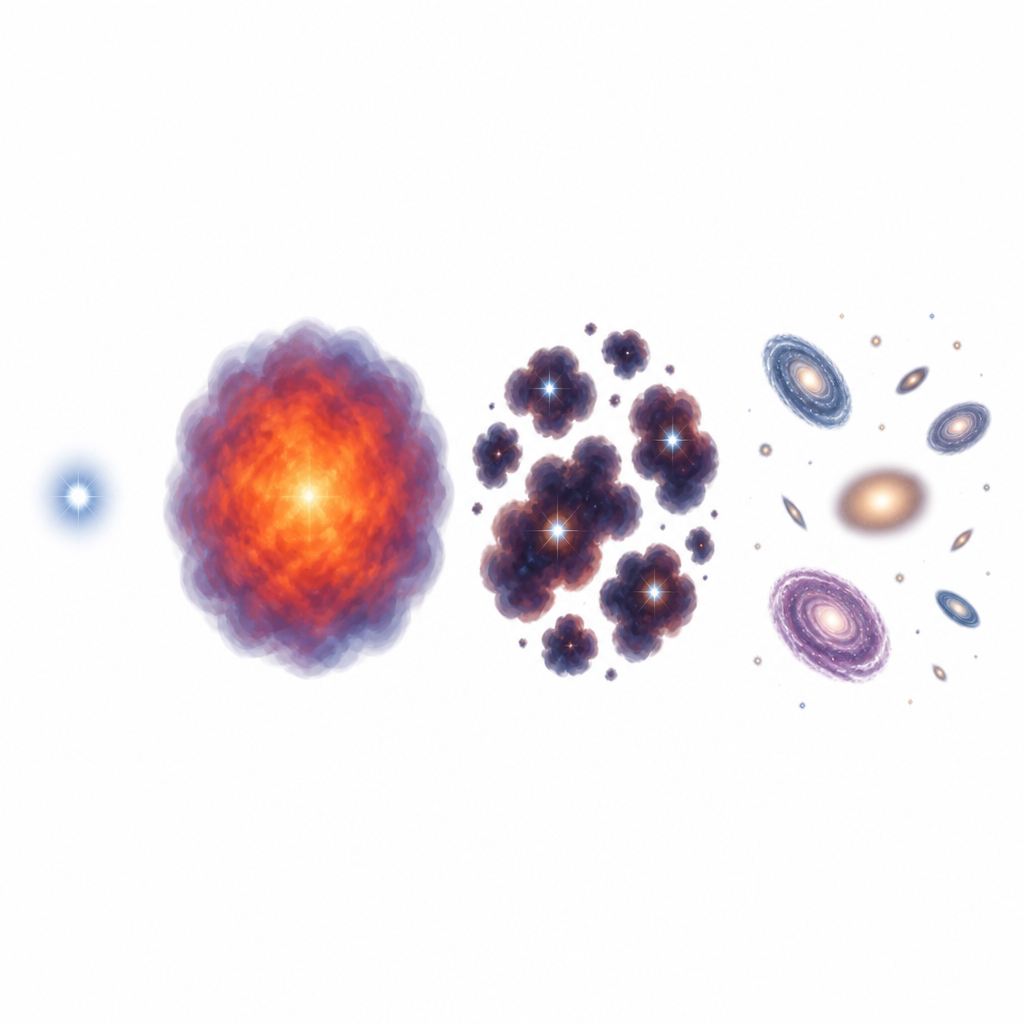
Galaxies came into being through the process called the big bang. The big bang is the event tied to the beginning of the universe. Matter spread out in every direction after it, gravity later pulled the clouds of gas together into stars, and those stars gathered into the groups we now call galaxies.
The Black Hole at the Centre
At the centre of a galaxy there is believed to be an extremely dense black hole. The stars of that galaxy revolve around it. In other words, just as the Earth revolves round the Sun, the crores of stars inside a galaxy keep circling their own centre.
A black hole is extremely dense, which means a huge amount of matter is packed into a small space. That is why its pull of gravity is so strong.
Watching the Sky from an Observatory
The naked eye cannot make out the shape of a galaxy. That needs a powerful telescope, and telescopes of that strength are kept at an observatory. A planetarium does a different job: it shows the sky on a dome or screen, which makes it easier to understand where the astronomical bodies sit.
Observatory: a place fitted with the instruments used for observing space.
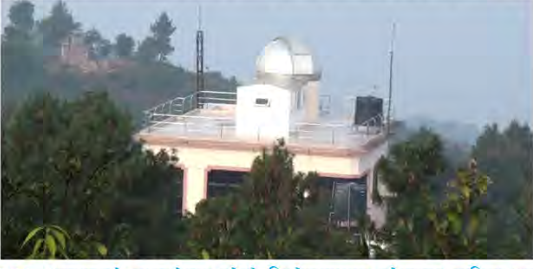
Nepal has such a place of its own: the Bishweshwar Prasad Koirala National Observatory Centre at Nagarkot in Bhaktapur. A class can visit the nearest observatory or planetarium, observe astronomical bodies through the powerful telescope kept there, and write up a visit report afterwards.
Never turn a telescope or a pair of binoculars towards the Sun and look through it. Doing so can destroy your eyesight.
A virtual tour of the sky, made with a piece of software or an application, is another way to observe planets, stars, galaxies and other bodies of the sky, and to prepare a report describing what each one is like.
The full lesson is waiting for you
The notes are free to read in full. A free account opens the rest of the practice, and tracks your progress and confidence score for every subject. Presentations and videos need approval from Learn Yeti.