How the Hot New Earth Cooled Down
In the early days of its formation, huge meteorites kept falling on the earth out of the sky. The blows they struck, and the heat those blows released, made the earth extremely hot again and again. In that state all the material of the earth was unstable, which means nothing could stay in one form or in one place for long.
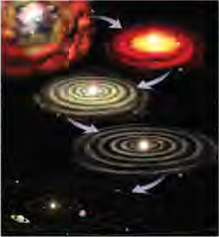
At such heat the metals were molten, so heavy material and light material got the chance to separate. Molten iron, nickel and other heavy metals began gathering toward the centre of the earth. Lighter elements such as silicon, magnesium and aluminium piled up near the surface instead. Even today the inside of the earth is made of heavy metals and the outside of lighter ones, and the reason lies in that early molten stage.
As the earth cooled, its material began to shrink. The shrinking left the surface uneven, and plains, hills and hollows were formed. The rise and fall of the ground we see around us today is a result of that long cooling.
Water, Gases and the First Living Things
The material that had boiled off the hot earth reacted chemically and formed gases and clouds. As the earth cooled further, rain began to fall from those clouds. In this way water, oxygen and other substances were formed, and the surroundings slowly became suitable for life to begin.
Hydrogen, oxygen and nitrogen gases reacted with one another and formed biomolecules. Through those molecules the very simplest prokaryotes came into being. From those simple living things, over an enormous stretch of time, all the developed plants, animals and micro-organisms of today have evolved.
Biomolecule: a chemical molecule that builds the body of a living thing and carries out the work that goes on inside it.
Prokaryotes: extremely simple single-celled living things whose cells have no nucleus enclosed in its own membrane.
Life began only long after the earth itself. The early earth was hot and unstable, it had no water and no suitable surroundings, so there was no chance for any living thing to survive on it.
The Geological Time Scale
To study evolution in order, the whole stretch of time from the origin of the earth up to the present has been divided into units. That division is called the geological time scale. Such a long span cannot be studied in one piece, so scientists have cut it into large blocks and set down which kinds of living things appeared in each block.
Geological time scale: the table made by dividing the whole period from the origin of the earth to the present day into units.
Eon: the largest unit of the geological time scale.
There are two eons: the Cryptozoic Eon and the Phanerozoic Eon. The Cryptozoic Eon has been divided into three eras, and the Phanerozoic Eon has also been divided into three eras. So an era is a smaller block sitting inside an eon.
| Eon | Eras inside it | Time span |
| Cryptozoic | Archeozoic, Proterozoic, Eozoic | 4.6 billion years ago to 570 million years ago |
| Phanerozoic | Palaeozoic, Mesozoic, Cenozoic | 570 million years ago to the present day |
An eon and an era are not the same thing. An eon is the larger unit and an era is a part inside it. Writing Cryptozoic as an era, or Palaeozoic as an eon, is therefore wrong.
The Cryptozoic Eon
The Cryptozoic Eon is the first block of time after the earth came into being. It runs from 4.6 billion years ago to about 570 million years ago. Some geologists also call it the Precambrian or the Azoic era. It takes up about 88% of the whole history of life on earth, yet for all its length very little is known about it.
This eon is divided into the Archeozoic, Proterozoic and Eozoic eras. What happened in each of them is set out below.
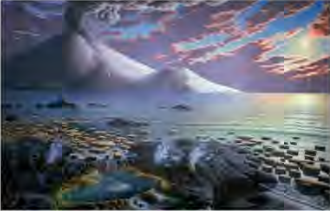
- Archeozoic era: the physical world of the earth was built, that is the land, the water, the air and a suitable temperature.
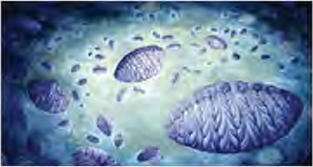
- Proterozoic era: extremely tiny single-celled prokaryotes living in water came into being.
- Eozoic era: single-celled eukaryotes in water, and some many-celled living things including soft-bodied algae, are believed to have developed.
The Phanerozoic Eon
The Phanerozoic Eon began about 570 million years ago and is still running today. It is short in length but it is the most important part of the story of evolution, because nearly every living thing whose name we know appeared during it. On the basis of which kinds of living things appeared and which died out, this eon has been divided into three eras: Palaeozoic, Mesozoic and Cenozoic.
The Palaeozoic Era
The Palaeozoic is the longest era, about 330 million years in length. It runs from 570 million years ago to 240 million years ago. In this era the development of life began in the sea, and animals and plants appeared on land as well. Invertebrate arthropods, molluscs and echinoderms, along with backboned animals such as fish and amphibians, and non-flowering plants, all appeared in this era.
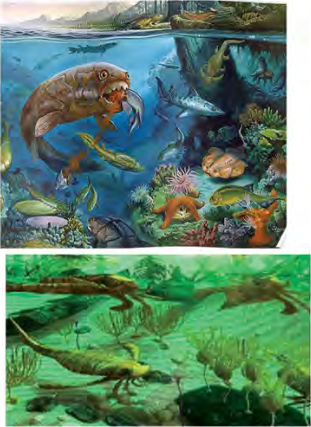
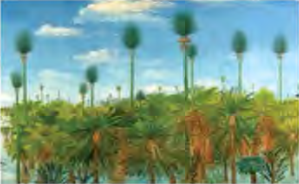
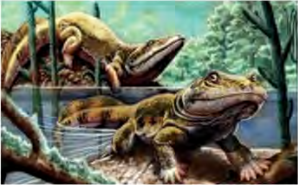
Looking at the main events and living things, the geography of the earth kept changing right through this era. In its first Cambrian period, water-living arthropod creatures and algae developed in enormous numbers, on a scale not found in any other block of geological time.
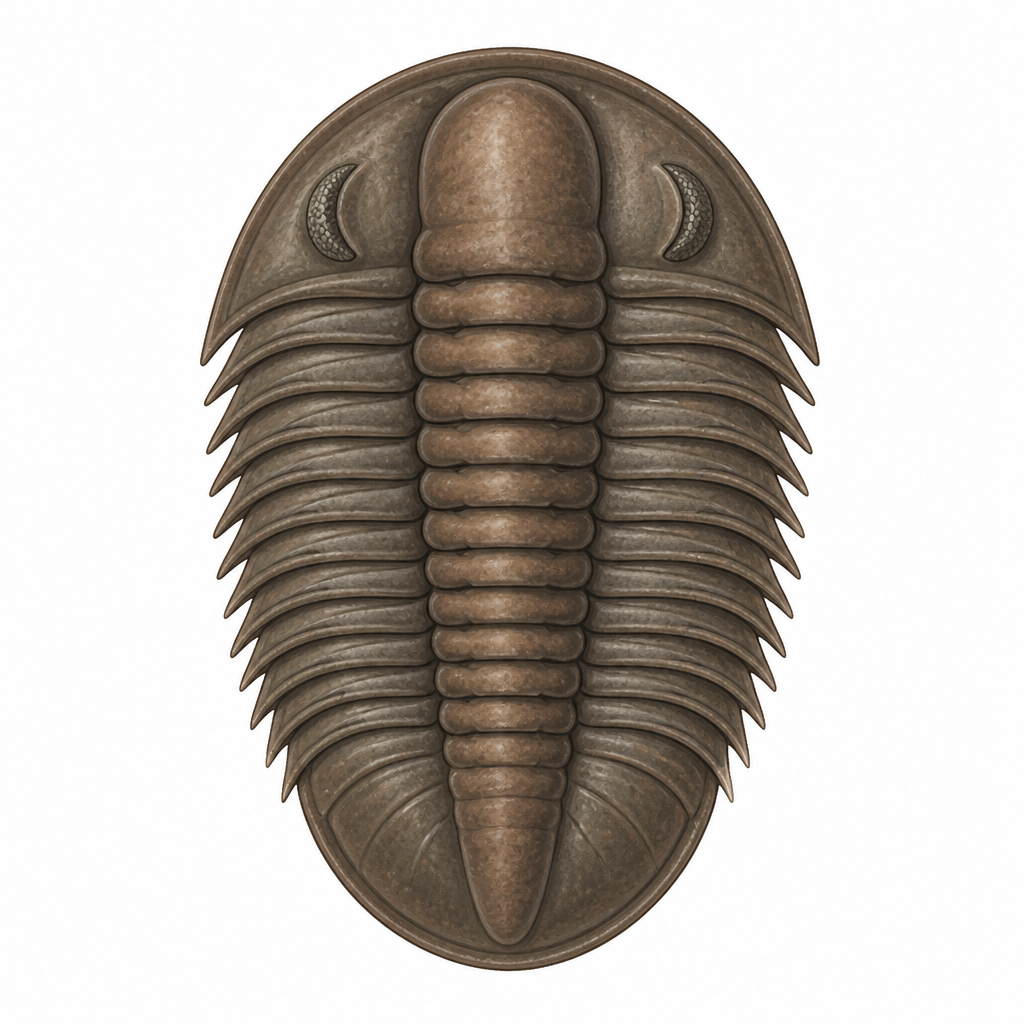
After that came trilobites, insects, molluscs, sea fish with lungs, shelled creatures, coral, sea scorpions and frog-like tetrapod amphibians, while the plants ran from water algae up to trees, ferns and lycopodium, forming huge, dense pteridophyte forests. Toward the end of this era there was violent movement of the earth's surface, and many living things were lost for ever.
The Mesozoic Era
This era runs from 240 million years ago to 65 million years ago, a total of 175 million years. Its chief features are changes in geography, changes in climate, and the development of many kinds of living things. So many groups came into being and developed, and animals and plants became so varied, that this era is counted as an important one for evolution.
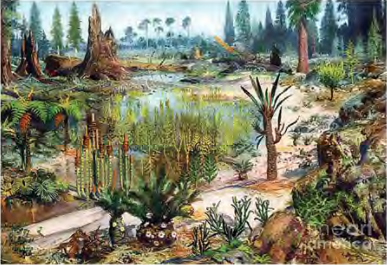
Among the main events, the weather first turned dry and the seasons began to change. Monsoon rain, strong winds, lightning and cloud made many kinds of animals and plants develop in the sea and on the land. The fern forests that had grown in the Palaeozoic were pushed aside, and forests of coniferous gymnosperms such as pine, cycas, ginkgo and ephedra took their place. For that reason this era is also called the Age of conifers. Toward its close there is evidence that undeveloped flowering plants appeared.
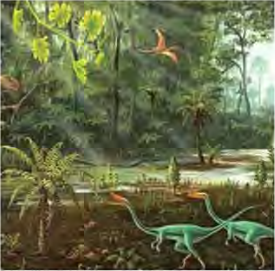
In this age many kinds of very large dinosaurs, belonging to the class of reptiles, came into being and also died out. Some dinosaurs lived in water, some on land, and some could fly through the air like birds. Among them were plant eaters, meat eaters, and those that ate everything.

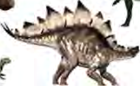
The story of the dinosaurs becomes clear when the Mesozoic is looked at in its three periods. In the first, the Triassic period, dinosaurs appeared. In the second, the Jurassic period, they became the most powerful animals on earth. In the last, the Cretaceous period, dinosaurs and a great many other animals and plants were wiped out.
At the end of the Cretaceous period an enormous fall of meteorites struck the earth, and volcanoes erupting everywhere spread poisonous gases until the whole environment turned toxic. That was unbearable for most living things, dinosaurs among them, and they all died out within a short time.
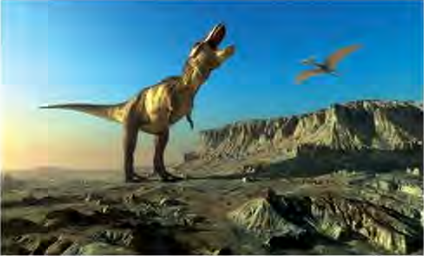
Besides dinosaurs, creeping animals such as lizards, crocodiles, snakes and geckos developed in this same era, so it is also called the Age of creepers. Toothed birds, mosquitoes, fruit-eating insects and undeveloped mammals also came into being during it.
Dinosaurs and human beings never lived at the same time. The dinosaurs were wiped out 65 million years ago, and human beings developed only much later than that, in the Cenozoic Era.
The Cenozoic Era
This is the modern era, and it is still going on. It runs from 65 million years ago to the present day. Every mammal now on earth, human beings included, and all the flowering plants, developed in this era. For that reason it is also called the Age of mammals or the Age of Angiosperm.
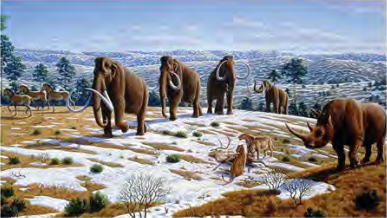
Among the main events, tectonic movement early in this era split all the continents apart, and each built its own surroundings and its own nature. The rising of the Himalaya, rivers carrying water, hills, valleys, plains, hollows and plateaus, together with the changing seasons, brought out many kinds of animals and plants. Elephants, horses, cats, birds, mice, rhinoceroses, primates and whales appeared, along with monocot and dicot plants. Animals such as the mammoth elephant with its huge tusks, the entelodon wild pig and the calicothere horse appeared in this same era and later died out too.
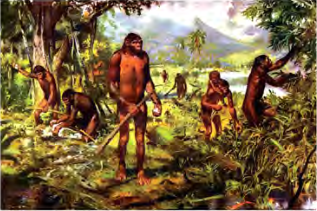
The story of human development also belongs to this era. About 6 million years ago, in the Miocene epoch, apes developed from the primates, and 4 million years ago human beings who walked on two legs appeared. Modern human beings, the Cro-magnons, developed only 56,800 years ago. Having lived a wandering forest life for a very long time, the Cro-magnons, or Homo sapience, took up farming and animal rearing and began a settled social life only 12 to 10 thousand years ago.
The Three Eras Side by Side
Setting the three eras of the Phanerozoic Eon beside one another makes it easy to remember which living things arrived when.
| Era | Time span | Main animals and plants |
| Palaeozoic | 570 to 240 million years ago | Trilobites, molluscs, fish, amphibians, fern forests |
| Mesozoic | 240 to 65 million years ago | Dinosaurs, creeping reptiles, toothed birds, conifer forests |
| Cenozoic | 65 million years ago to today | Elephants, horses, whales, human beings, flowering plants |
- The Mesozoic Era is called the Age of conifers and also the Age of creepers.
- The Cenozoic Era is called the Age of mammals and also the Age of Angiosperm.
- The Cryptozoic Eon is called the Precambrian, or the Azoic era.
The full lesson is waiting for you
The notes are free to read in full. A free account opens the rest of the practice, and tracks your progress and confidence score for every subject. Presentations and videos need approval from Learn Yeti.