Small Solid Objects Travelling Through Space
The solar system is not only the Sun, the planets and their moons. Between those large bodies there are countless small objects, most of them no bigger than a stone. Some are the size of a grain of sand, some would fit in your fist, and only a few are as large as a boulder. They are made of metals such as iron and nickel, or of rock. They do not burn, they give out no light of their own, and out in space nobody can see them with the naked eye.
Meteoroid: a small solid object travelling through space, made of metal such as iron and nickel, or of rock.
A meteoroid is solid, and its shape is irregular. It is not round like a planet. It looks like a broken piece of rock, with dents and sharp edges. These pieces never stay in one place. They wander through space, colliding with one another, breaking apart and changing direction as they go. When one large meteoroid is struck, many smaller pieces are made, and each of those then travels on a path of its own.
Where These Fragments Come From
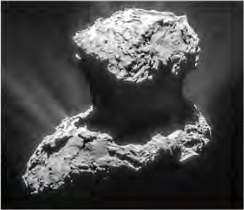
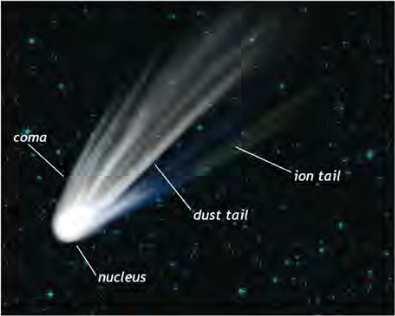
Meteoroids did not form on their own. They are pieces that broke away from asteroids or from comets. Asteroids are lumps of rock and metal, and when two of them collide, small fragments are knocked off and spread out through space. A comet, when it comes close to the Sun, loses the ice, dust and gas of its outer part, and solid grains are left behind along the way. Those loose pieces are the meteoroids that later come near the Earth.
What Happens When One Enters the Atmosphere
When a meteoroid wanders into the Earth's gravitational field, the Earth pulls it in. It therefore enters the atmosphere at a speed of about 20 kilometres per second to 80 kilometres per second. Moving that fast, it rubs against the air, and the friction produces a great deal of heat. That heat makes the piece glow, so it burns and falls towards the Earth's surface as a bright object.
To feel how fast that is, change the speed for one second into the distance covered in one hour. There are 3600 seconds in an hour, so 20 kilometres per second works out as:
\[ 20 \times 3600 = 72000 \]
That is 72000 kilometres in one hour. An aeroplane flies at about 900 kilometres per hour. So even the slowest meteoroid arrives far faster than an aeroplane, and it is exactly this enormous speed that makes it burn.
Rubbing two things together makes heat. Rub your palms together hard and they grow warm; strike a matchstick along the box and it catches fire. A piece entering the atmosphere is heated by the same kind of friction, and it glows.
Meteor, the Shooting Star
On a clear night, if you watch the sky long enough, you sometimes see a bright line drawn across it and gone in an instant. That bright line is the burning piece itself.
Meteor: the bright, very fast body seen in the night sky is called a meteor, or a shooting star. People also call it a falling star.
The name falling star must not make you think a real star is falling. A star is a burning body as big as the Sun or bigger, and it is enormously far away. A meteor is only a small stone or a grain of dust burning inside our own atmosphere.
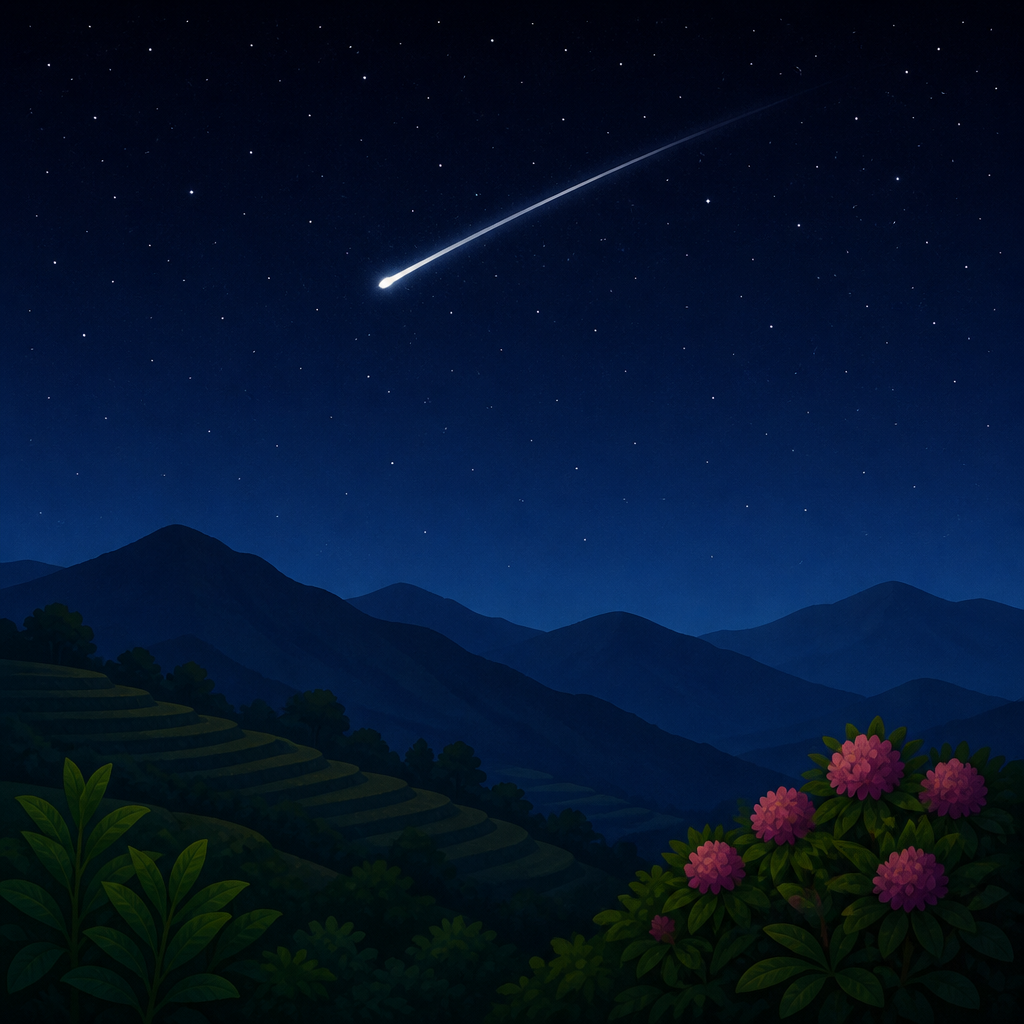
Meteors come down in the daytime as well. But sunlight is so bright then that our eyes cannot pick out a small glowing streak against it. That is why a meteor is seen only at night.
Meteorite, the Piece That Reaches the Ground
Most meteors burn away completely in the atmosphere. A small piece rubs against the air until nothing is left of it but ash and dust, and nothing at all reaches the ground. A meteor that is very fast and has a large mass, however, does not have time to burn away. Only its outer part burns, and the rest reaches the Earth's surface and strikes it.
Meteorite: a meteor that reaches the ground and strikes it is called a meteorite.
Telling the Three Words Apart
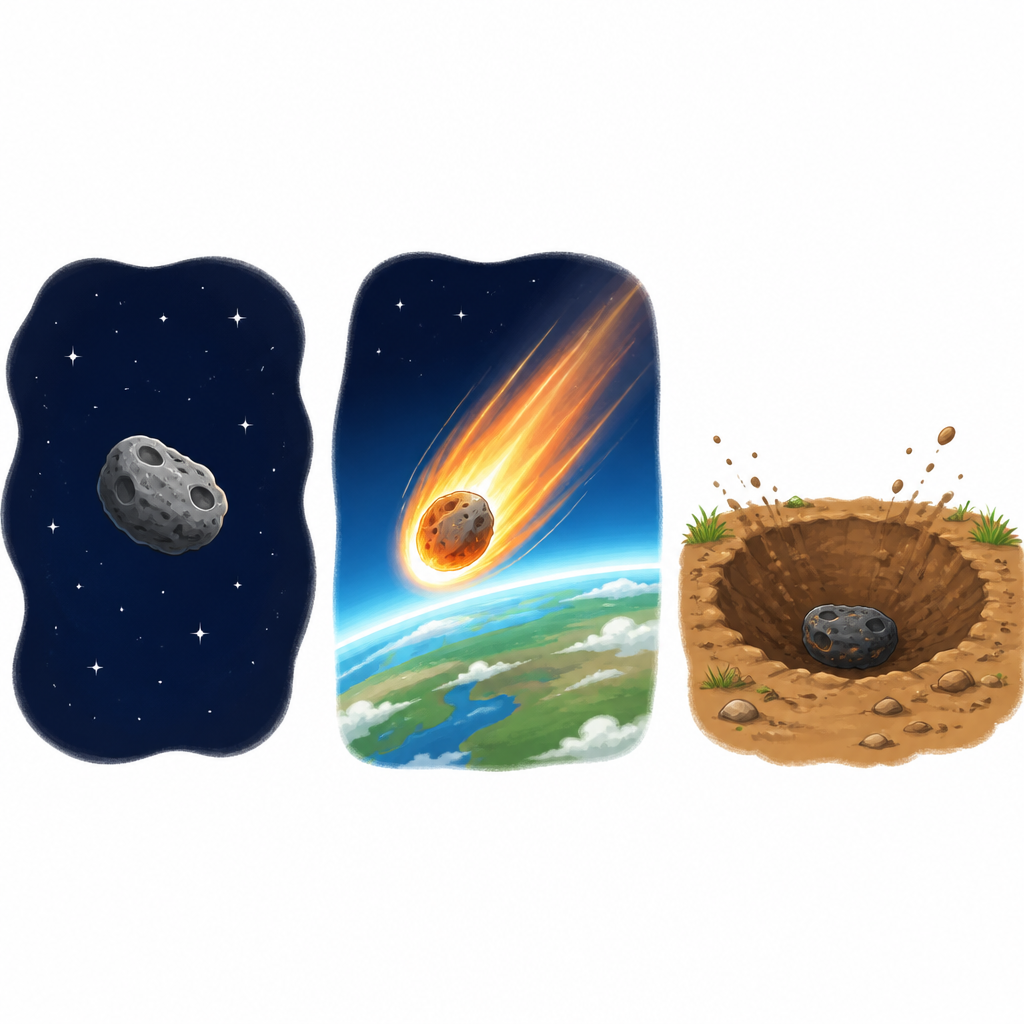
These three words are not the names of three different things. The same piece changes its name according to where it has got to. Their differences are set out below.
| Name | Where it is | Its condition there |
| Meteoroid | Out in space | An unburnt, solid piece of irregular shape |
| Meteor | In the Earth's atmosphere | A bright body heated by friction and burning |
| Meteorite | On the Earth's surface | The part that did not burn away and has struck the ground |
Meteor and meteorite sound alike, but they are not the same. The name while it is burning in the sky is meteor; the name once it has landed is meteorite. Swapping the two makes the answer wrong.
About 200 Meteors Every Day
Scientists say that about 200 meteors fall towards the Earth every day. That number sounds alarming, but it is not. Most of them are no bigger than grains of dust or small stones, and they burn up in the atmosphere. So they have no real effect on the Earth.
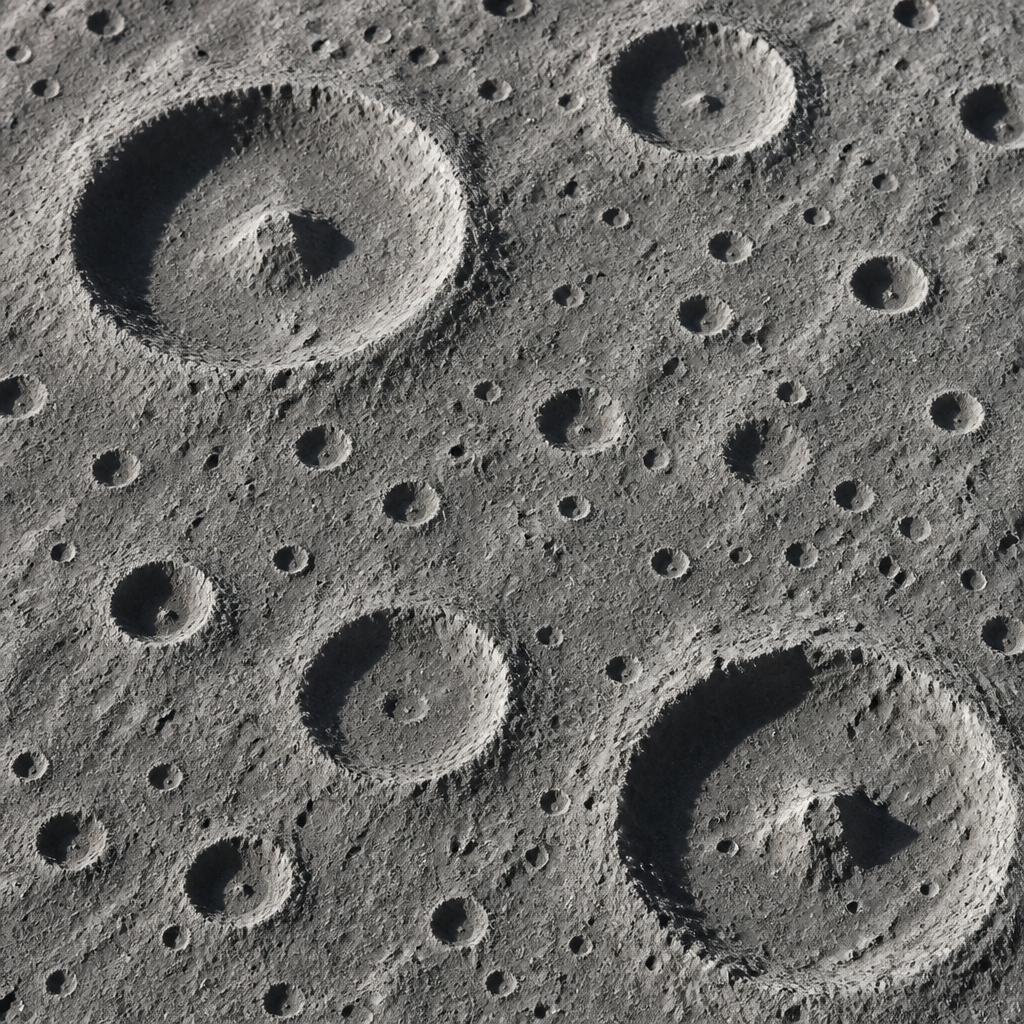
The Earth's atmosphere works like a thick shield. That shield stops the day's arrivals from ever reaching the ground. On a body that has no atmosphere, the pieces are not burnt at all; they strike the surface directly and dig out a hollow. The round pits of many sizes on the Moon's surface are the proof of this, and since there is no atmosphere there, nothing wears the pits away.
Meteor Shower
Meteors usually arrive one at a time. Sometimes, though, many meteors fall at one place. Bright streak follows bright streak out of the same part of the sky, and the display can go on for hours.
Meteor shower: the event in which many meteors fall at one place is called a meteor shower.
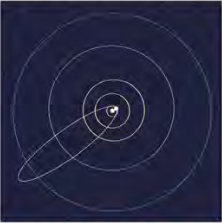
This happens because the pieces are crowded together in one region. As a comet travels along its long orbit, it leaves dust and small fragments all the way behind it. When the Earth passes through that crowded region on its own journey, many pieces enter the atmosphere at once, and many meteors are seen.
No instrument is needed to watch a meteor shower. Away from town lights, under an open and clear night sky, you let your eyes get used to the dark and then watch patiently. That is all it takes.
The full lesson is waiting for you
The notes are free to read in full. A free account opens the rest of the practice, and tracks your progress and confidence score for every subject. Presentations and videos need approval from Learn Yeti.