One Tree, Five Kingdoms
All living beings are sorted into five kingdoms: Monera, Protista, Fungi, Plantae and Animalia. When these kingdoms are drawn as the branches of a single tree instead of five separate boxes, a question appears at once. Why a tree? A tree has one trunk. Every branch grows out of that trunk, so every branch is connected to every other branch through it. Drawing the kingdoms this way says that all living beings are related to one another.
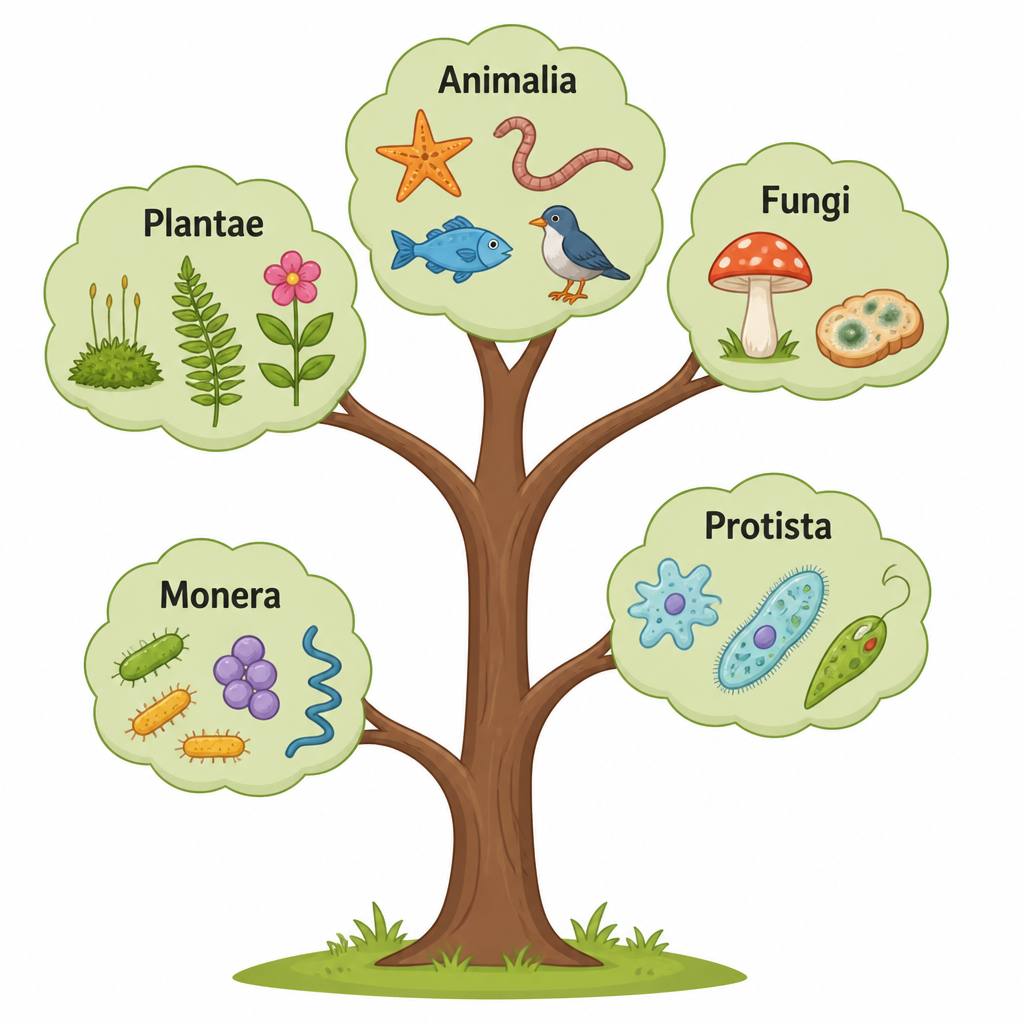
Study the basis on which the five kingdoms are separated and a pattern shows. Some kingdoms share many features with each other. Others share only a few. But no kingdom is completely unlike the rest. One feature is found in every living being without exception: its body develops from a living cell. A bacterium is a single cell. A mango tree and an elephant are made of millions of cells, and each of them began life as one cell. This shared feature tells us that all living beings have a common ancestry. Far back in time, they descend from the same early forms of life.
Common ancestry: the idea that different groups of living beings have descended from the same ancestor, which is why they share certain features.
Classification and Evolution: Two Studies That Meet
Biology has many branches. Two of them, classification and evolution, look like separate studies at first sight.
Classification of living beings: the process of grouping living beings on the basis of their similarities and differences.
Evolution: the process of gradual change of living beings from a simpler form to a more complex form.
Classification asks: which living beings are alike? Evolution asks: how did living beings change over time? The answers to these two questions fit together. Living beings that share many features are kept in the same group. Evolution explains why they share those features: they came from the same ancestor and have not yet become very different. Differences, on the other hand, are what make classification possible at all. If every living being were identical, there would be nothing to sort. Those differences are the new characteristics that appeared as life evolved.
A classification chart is also a rough map of evolution. Groups placed close together in the chart share many features and are closely related. Groups placed far apart share few features and are only distant relatives.
The Order in Which the Kingdoms Appeared
The five kingdoms are not only different from one another; they also appeared on Earth at different times. Classification shows this order, because the kingdoms can be lined up from the simplest body to the most complex:
- Prokaryotic organisms evolved first on the Earth. Their cells have no true nucleus. These simple organisms, such as bacteria, are now placed in the kingdom Monera.
- Eukaryotic organisms then evolved slowly. Their cells have a true nucleus enclosed by a membrane. These early eukaryotes, mostly single celled, are now placed in the kingdom Protista.
- During the long course of evolution, multicellular organisms developed gradually. These are the fungi, the plants and the animals, now placed in the kingdoms Fungi, Plantae and Animalia.
This is why, on the tree, Monera is drawn at the lowest branch, Protista a little higher, and the three multicellular kingdoms at the top. Height on the tree stands for time. So if someone asks whether monerans or protists evolved earlier, the answer is monerans, because a prokaryotic cell is simpler than a eukaryotic cell, and the simpler form came first.
Shared Features Show How Close Two Groups Are
Compare animals from different classes of vertebrates. Mammals (class Mammalia) and birds (class Aves) have a few common features: both are warm blooded, both breathe with lungs and both have a four-chambered heart. Mammals and fishes (class Pisces) have very few common features: a fish breathes with gills, is cold blooded and has a two-chambered heart. The number of shared features works as a measure of relationship. The more features two groups share, the more closely related they are.
A bat and an eagle make the point clearly. Both fly, and in both the forelimbs have become wings. Both are warm blooded, and both have a backbone and a four-chambered heart. Yet the bat is a mammal: its body is covered with hair, it gives birth to its young and it feeds them milk. The eagle is a bird: its body is covered with feathers, it has a beak and it lays eggs.
Their many shared features show that mammals and birds are closely related. Their differences show that, at some point, one ancestral group split into separate lines, and those lines kept changing in different directions. The formation of new species in this way is called speciation. The animals now grouped as mammals underwent speciation from the same ancestor, and the features they share are traces of that ancestor.
Speciation: the formation of new species from an ancestral species, as groups of its descendants change in different ways over a long time.
The Heart as Evidence
Within the vertebrates, one of the clearest pieces of evidence for evolution comes from the heart. Count the chambers of the heart in each class:
| Class of vertebrate | Examples | Chambers in the heart |
| Pisces | fish, shark | 2 |
| Amphibia | frog, salamander | 3 |
| Reptilia | snake, lizard | 3 |
| Aves | pigeon, eagle | 4 |
| Mammalia | human, bat | 4 |
A two-chambered heart pumps blood in a simple way. A three-chambered heart is a step further, and a four-chambered heart keeps blood rich in oxygen completely apart from blood poor in oxygen, which suits warm-blooded, active animals. Moving from fish to birds and mammals, the heart becomes more complex step by step. This series shows that advanced animals developed from less developed animals. The very differences that show evolution are the ones used to classify: the number of heart chambers is one of the features that separates one class of vertebrates from another.
A four-chambered heart alone does not make an animal a bird or a mammal. The crocodile has a four-chambered heart but belongs to Reptilia, because it has dry horny scales, is cold blooded and lays eggs. A class is decided by all of its features together, never by one feature.
Branching from a Common Ancestor
Now put the evidence together for fishes, birds and mammals. Their common features, such as a backbone, a heart and a circulatory system, show that all three classes evolved from the same ancestor many years ago. Over time, each line developed new characteristics, and in this way new organisms were formed.
But the three are not equally related. Birds are closer to mammals than fishes are. This means that birds and mammals separated from their common ancestor only a little while ago, as evolution counts time, while the line leading to fishes had split away much earlier. Even so, all three classes trace back to one distant common ancestor. In order, it runs like this:
- A distant common ancestor gives rise to all three classes.
- The line leading to fishes branches off first, so fishes share the fewest features with mammals.
- Later, the lines leading to birds and to mammals separate, so birds and mammals share more features with each other.
Common Ancestry in Animals and Plants
The same reasoning works beyond the vertebrates. Study the characteristics of the various phyla of the animal kingdom and some similarities appear among all of them. A flatworm and a frog look nothing alike. The flatworm is a soft, flat animal with no backbone. The frog is a vertebrate with lungs, limbs and a three-chambered heart. Yet both are multicellular, both are made of eukaryotic cells without cell walls, and both are heterotrophs, which means they take in food made by other living things. These shared features are why both belong to the kingdom Animalia.
Similarities like these, found in every phylum, prove that all the organisms of the animal kingdom have a common ancestry. In the course of evolution they advanced into many new forms, from simple sponges to insects, fishes and mammals.
Plants show the same pattern. An orange tree and a Cycas plant both have roots, stems and leaves, both have xylem and phloem, and both produce seeds. These shared features keep them together in the division Tracheophyta. But Cycas bears cones instead of flowers, and its seeds lie naked with no fruit around them, so it is a gymnosperm. The orange tree bears true flowers and its seeds are enclosed in a fruit, so it is an angiosperm.
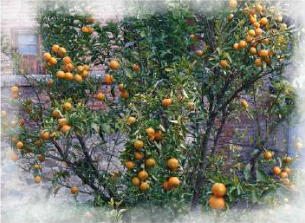

Gymnosperms were the first plants to produce seeds, and angiosperms are the most advanced plants of the plant kingdom. The fruit wrapped around the orange's seeds is a newer characteristic, added along the way. The shared features show the relationship; the new features show the direction of evolution.
Reading a Classification Chart as a Record of Evolution
Any classification chart can be read in this way. When you study one, these questions help:
- Which features do all the groups in the chart share? These point to the common ancestry of all of them.
- Which groups share the most features? These are the closest relatives, and they separated most recently.
- Which features appear only in some groups, such as a four-chambered heart or seeds enclosed in fruit? These are newer characteristics that developed during evolution.
- Which groups have the simplest bodies? These are likely to be the older forms, just as Monera is older than Protista.
Classification groups living beings by their similarities and differences. Evolution explains where those similarities and differences came from. That is the relation between the two.
The full lesson is waiting for you
The notes are free to read in full. A free account opens the rest of the practice, and tracks your progress and confidence score for every subject. Presentations and videos need approval from Learn Yeti.