Worms Are Not All the Same
In everyday speech we call many animals worms: the tapeworm that lives in the intestine of a pig, the thin white worm a child may pass in stool, the earthworm in a garden bed and the leech that clings to your leg on a wet monsoon trail. At first glance they look alike, because all of them are long and soft and have no legs. Zoologists do not put them in one group. They look closely at the shape of the body, the digestive tube, the way the animal breathes and reproduces, and whether it lives freely or on another animal. On these features, worm-like animals fall into three separate phyla.
- Platyhelminthes, the flatworms: the body is flat like a leaf or long like a ribbon.
- Nemathelminthes, the roundworms: the body is long and cylindrical with pointed ends, and it is not divided into segments.
- Annelida, the segmented worms: the body is long and cylindrical and divided into many ring-like segments.
Two ideas come up again and again in all three groups, and one idea explains how most flatworms and roundworms live. They are defined here so that the rest of the topic reads easily.
Triploblastic: an animal whose body develops from three germ layers (an outer, a middle and an inner layer) in the embryonic stage.
Bilateral symmetry: a body that can be divided into two equal halves, a left and a right, by a cut along its length.
Parasite: an organism that lives in or on the body of another organism, called the host, and gets its shelter and food from it, usually harming the host.
Platyhelminthes: The Flatworms
Put a tapeworm, a liver fluke and a blood fluke side by side. The tapeworm is long and narrow like a strip of tape. The liver fluke is flat and oval like a leaf. The blood fluke is thin and flat. None of them is round when cut across. The name of the phylum describes exactly this: 'platy' means flat and 'helminthes' means worms, so Platyhelminthes are the flatworms.
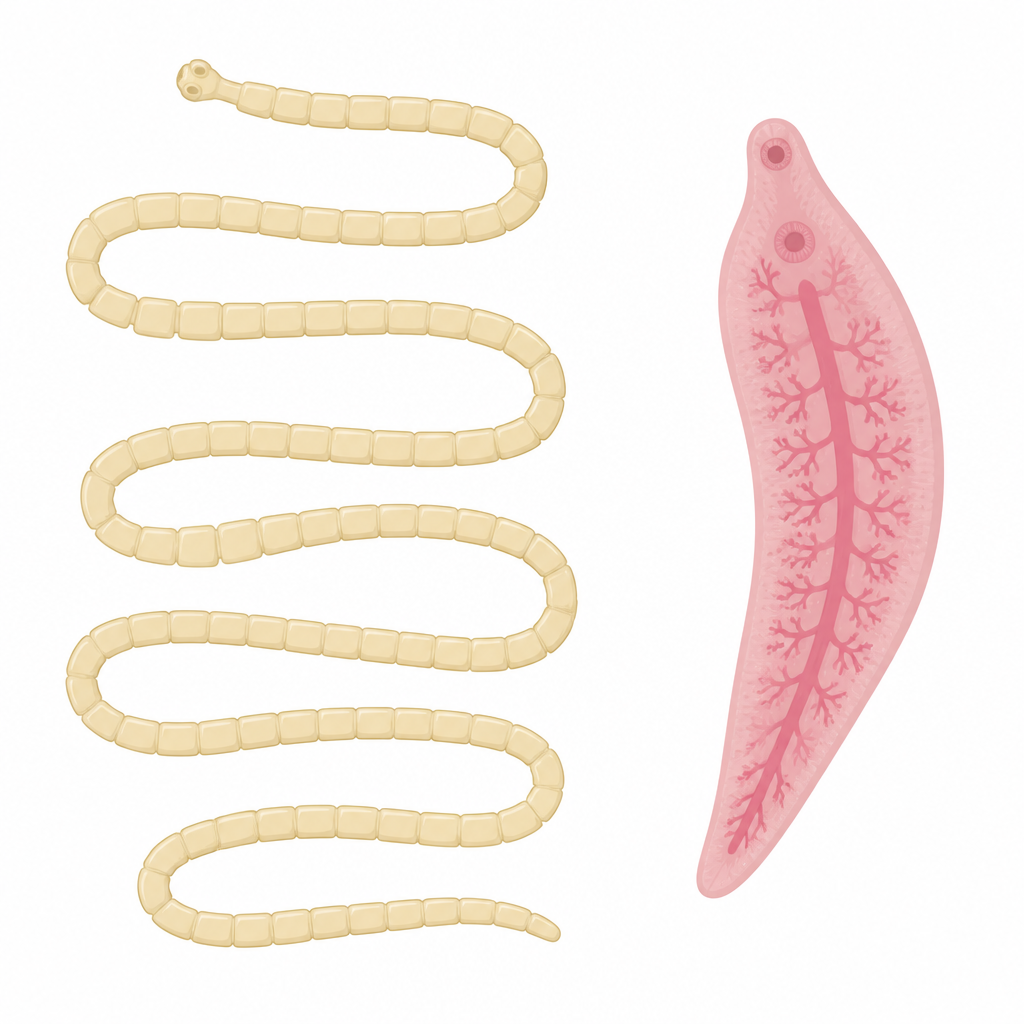
Most flatworms are parasites. They get shelter and food inside the bodies of other animals. A tapeworm lives in the intestine of humans, pigs or cattle, a liver fluke lives in the liver of sheep and cattle, and a blood fluke lives in blood vessels. Their mode of nutrition is parasitic: they take blood and ready-made nutrients from the host instead of hunting or making their own food. A few flatworms, such as Planaria, are free-living and move about in clean fresh water.
Characteristics of Platyhelminthes
- The body is flat and leaf-like or long and ribbon-like, so these animals are called flatworms.
- The body develops from three germ layers in the embryonic stage, so they are triploblastic.
- The mouth lies at the front (anterior) end on the lower (ventral) surface, but there is no anus. Hooks around the mouth help the animal hold on to the host.
- A sucker around the mouth helps it attach to the host and absorb blood and nutrients.
- They do not have a well-developed organ system.
- The space between the body wall and the internal organs is filled with parenchyma tissue, which helps in transport. There is no circulatory system.
- They respire through the general body surface.
- Male and female reproductive organs are in the same body, so they are hermaphrodite or bisexual. Fertilization is internal.
- They reproduce both sexually and asexually. Asexual reproduction takes place by fragmentation and regeneration.
- Most are parasites and a few are free-living.
Examples: liver fluke, tapeworm, blood fluke, Diplozoon, Otoplana and Planaria.
Having a mouth but no anus means the gut is like a bag with one opening. Food goes in through the mouth and the undigested remains have to come back out the same way. With no blood to carry materials, the soft parenchyma packed around the organs does the job of passing food and other materials through the body.
Hermaphrodite (bisexual): an animal that has both male and female reproductive organs in the same body.
Parenchyma: a soft tissue that fills the space between the body wall and the internal organs of a flatworm and helps in transport.
Fragmentation: asexual reproduction in which the body breaks into pieces and each piece grows into a new animal.
Regeneration: the ability to grow back a lost or damaged part of the body.
Nemathelminthes: The Roundworms
Ascaris (the common roundworm), the hookworm and the pinworm are parasites of humans and other animals. Their bodies are long, cylindrical and worm-like, and they taper to a point at each end. Cut one across and the cut face is round, which is why they are called roundworms. Ascaris lives in the small intestine and takes the food the person has digested. The hookworm hooks on to the wall of the small intestine and sucks blood; its young ones live in damp soil and enter the body through the skin of bare feet. The pinworm lives in the lower part of the intestine and is common in children, where it causes itching near the anus at night. These worms do harm the human body: they take away food and blood, and cause stomach pain, weakness and anaemia.
Roundworm eggs and young ones spread through dirty hands, unwashed vegetables and fruit, and soil where people defecate in the open. Washing hands with soap before eating and after using the toilet, washing raw food well, using a toilet and wearing slippers on damp soil break this chain.
Characteristics of Nemathelminthes
- The body is elongated and cylindrical with tapering ends.
- The body can be divided into two equal halves, so it is bilaterally symmetrical.
- They are triploblastic.
- They have a developed digestive system with a mouth, an anus and a sucker.
- Respiratory and circulatory systems are absent.
- They respire through the general body surface.
- They are unisexual: male and female are separate animals.
- They reproduce by the sexual method only. Fertilization is internal.
- Most are parasites and a few are free-living. The parasites cause disease in the bodies of other animals.
Examples: Ascaris, hookworm and pinworm.
Unisexual: an animal that has either male or female reproductive organs, not both, so males and females are separate individuals.
A roundworm's gut is a tube open at both ends: food enters at the mouth and waste leaves at the anus. A flatworm's gut has only the mouth. This one difference is a favourite exam point.
Annelida: The Segmented Worms
Earthworms, leeches and Nereis live in swampy or moist places. Their bodies are long and cylindrical like a roundworm's, but with one clear difference: the body is made of many ring-like segments placed one after another. This is called metameric segmentation. The earthworm is free-living and burrows through moist soil. The leech is an ectoparasite found in swamps and wet grass; it clings to the outside of vertebrates such as cattle and humans and sucks their blood. Nereis lives in the sea, in the sand and mud near the shore. All three belong to the phylum Annelida.
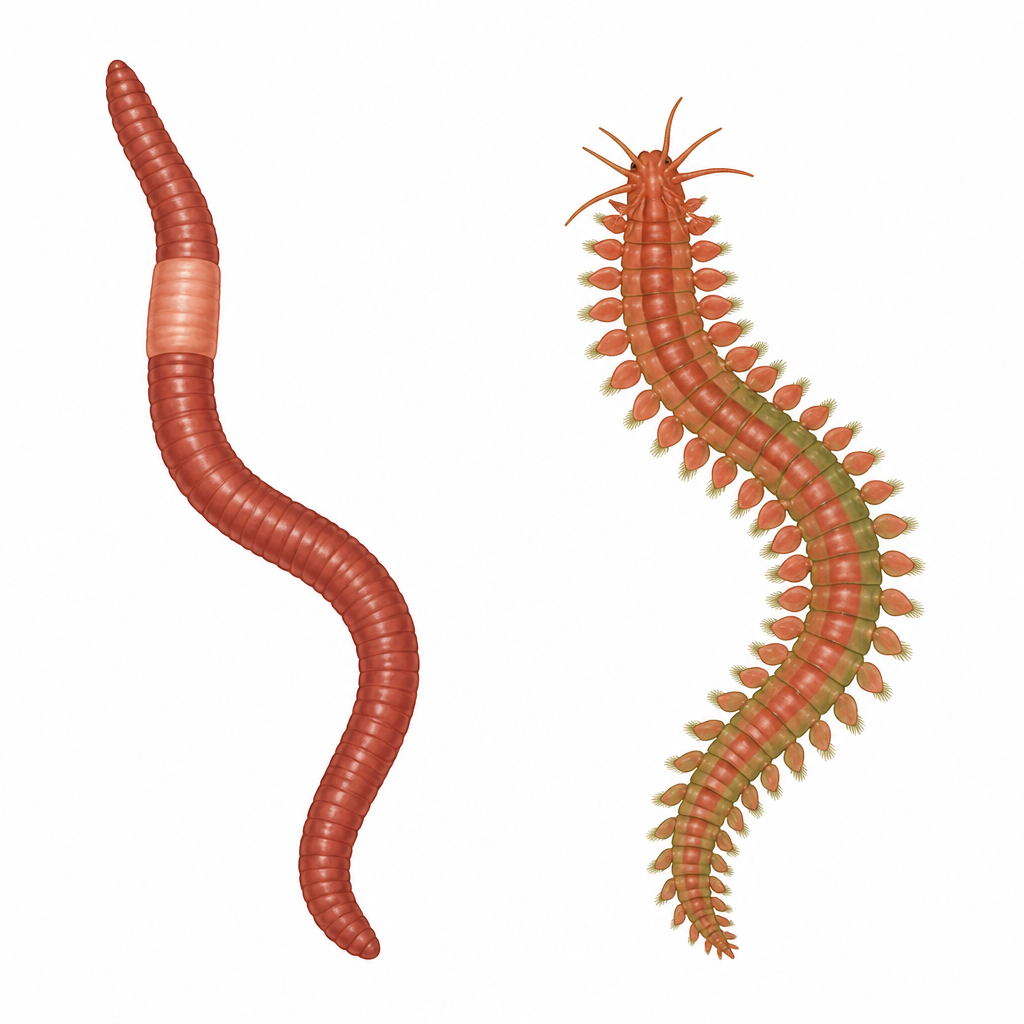
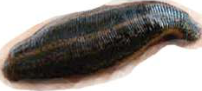
A live earthworm is the best specimen for seeing these features. Laid on a moist tray, it shows its rings, its wet shiny skin and the way it stretches and shortens its segments to move.
Handle the earthworm gently and with wet hands: dry hands damage the moist skin it breathes through. Never squeeze or pull it. Put it back into damp soil when you have finished looking, and wash your hands with soap.
Characteristics of Annelida
- The body is elongated, cylindrical and segmented both externally and internally.
- The body is bilaterally symmetrical and triploblastic.
- They have moist skin.
- They respire through their outer body surface.
- Excretion takes place through nephridia.
- The circulatory system is well-developed, and haemoglobin is found in the blood.
- The nervous system consists of a nerve ring and a nerve cord with nerves.
- The digestive system is well-developed.
- Some are hermaphrodite and some are unisexual.
- They have a high capacity for regeneration.
- They are found in moist land and in water, and some of them are ectoparasites.
Examples: earthworm, leech and Nereis.
The features fit together. An earthworm breathes through its skin, and oxygen can pass through skin only when it is wet, so the skin must stay moist. That is why an earthworm stranded on a hot, dry road soon dies. Its blood carries haemoglobin, the same red pigment found in our blood, and a proper system of vessels takes it round the body. Waste is removed by nephridia, small coiled tubes found in the segments.
Metameric segmentation: the division of the body into a series of similar segments repeated along its length, both on the outside and on the inside.
Ectoparasite: a parasite that lives on the outside of its host's body, like a leech sucking blood through the skin.
Nephridia: the excretory organs of annelids, small coiled tubes that remove waste from the body.
Comparing the Three Worm Phyla
All three phyla are triploblastic, and all of them live in or near moisture or inside another animal. What separates them is shown below, feature by feature.
| Feature | Platyhelminthes | Nemathelminthes | Annelida |
| Body shape | Flat, leaf-like or ribbon-like | Long, cylindrical, tapering ends, no segments | Long, cylindrical, segmented outside and inside |
| Digestive system | Mouth but no anus | Mouth, anus and sucker | Well-developed |
| Circulatory system | Absent; parenchyma helps transport | Absent | Well-developed, with haemoglobin |
| Respiration | General body surface | General body surface | Moist outer body surface |
| Sexes | Hermaphrodite | Unisexual | Some hermaphrodite, some unisexual |
| Reproduction | Sexual and asexual (fragmentation, regeneration) | Sexual only | High regeneration capacity |
| Way of life | Mostly parasites, a few free-living | Mostly parasites, a few free-living | Free-living; some ectoparasites |
| Examples | Tapeworm, liver fluke, Planaria | Ascaris, hookworm, pinworm | Earthworm, leech, Nereis |
Do not mix up the sexes. Flatworms are hermaphrodite, roundworms are unisexual, and annelids include both kinds. Do not call a roundworm segmented either: its body is smooth, and only annelids are divided into rings.
Flat body, no anus, hermaphrodite: Platyhelminthes. Round body, mouth and anus, unisexual: Nemathelminthes. Ringed body, blood with haemoglobin, nephridia: Annelida.
The full lesson is waiting for you
The notes are free to read in full. A free account opens the rest of the practice, and tracks your progress and confidence score for every subject. Presentations and videos need approval from Learn Yeti.