Sorting Living Beings into Five Kingdoms
Living things of every size share our surroundings. Some are so small that only a microscope can show them. Others are giants such as the blue whale, the elephant, the banyan and the peepal. To study so many organisms, scientists sort them into groups. Robert Harding Whittaker sorted all living things into five kingdoms. He looked at four features: the structure of the cell, the structure of the body, the mode of nutrition (how the organism gets its food) and the presence or absence of a cell wall.
Five kingdom classification: the system in which Robert Harding Whittaker divided all organisms into five kingdoms, Monera, Protista, Fungi, Plantae and Animalia, on the basis of cell structure, body structure, mode of nutrition and the presence or absence of a cell wall.
Three of these kingdoms can each be recognised in one sentence. Every member of Monera has a prokaryotic cell, a cell without a true nucleus wrapped in a membrane. Protista is made up of unicellular organisms whose single cell is eukaryotic. Fungi are saprotrophic: their cells have a cell wall but no chlorophyll, so they cannot make food and instead absorb it from dead and decaying matter.
Here are five familiar organisms. Watch how each one finds its kingdom.

- Bacteria have a prokaryotic cell, so they belong to Monera.
- Euglena is one eukaryotic cell that carries out every task of life, so it belongs to Protista.
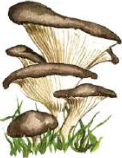
- A mushroom has no chlorophyll. It decomposes dead and decaying plants to get its food, so it belongs to Fungi.
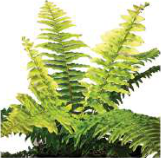
- A fern has chlorophyll and makes its own food. It is an autotroph and belongs to Plantae.
- A frog lacks chlorophyll, so it depends on other organisms for food. It is a heterotroph and belongs to Animalia.
Autotroph: an organism that makes its own food, as green plants do with the help of chlorophyll.
Heterotroph: an organism that cannot make its own food and depends on other organisms for it, such as a frog.
Reading the Five Kingdom Chart
The five kingdom system can be drawn as one chart. It is read from the top down. At each level one question is asked, and the answer sends the path one way or the other.
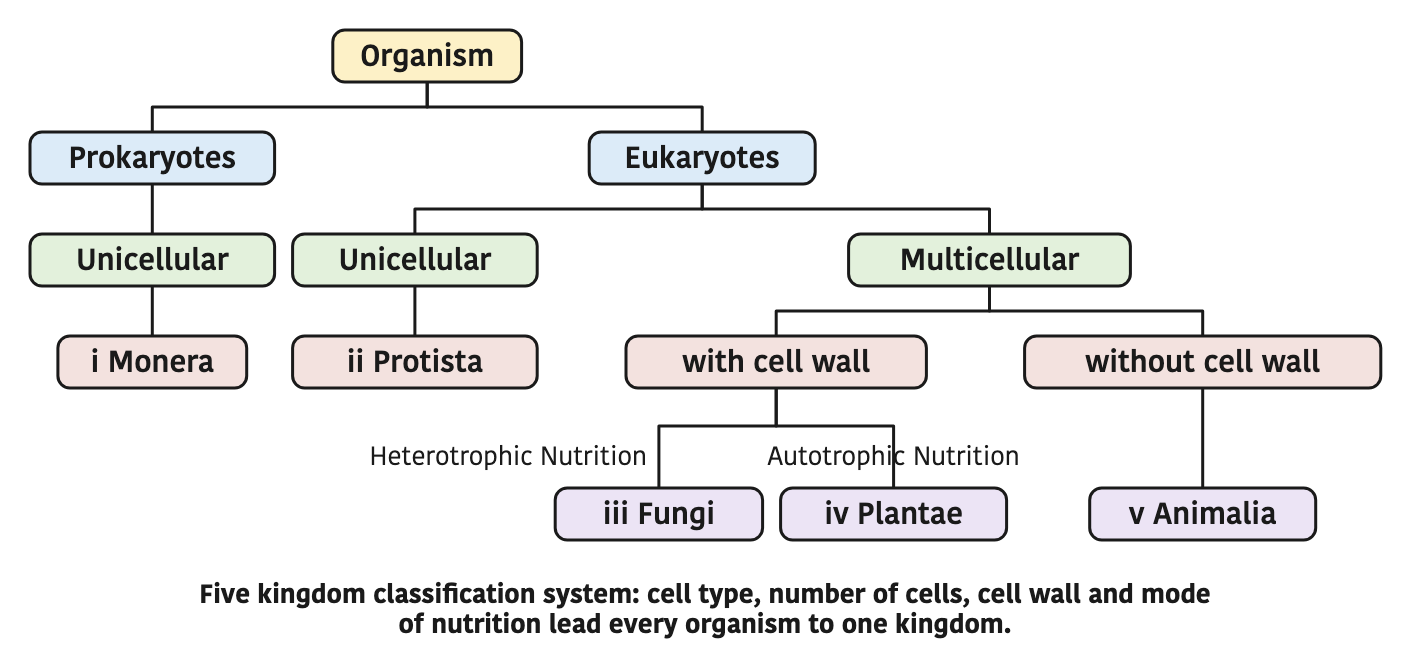
- First question: is the cell prokaryotic or eukaryotic? Prokaryotes are unicellular and form Monera.
- For eukaryotes the next question is: unicellular or multicellular? Unicellular eukaryotes form Protista.
- Multicellular eukaryotes are checked for a cell wall. Those without a cell wall form Animalia.
- Those with a cell wall are split by nutrition. Heterotrophic ones form Fungi and autotrophic ones form Plantae.
| Kingdom | Cell type | Body | Key feature | Example |
| Monera | Prokaryotic | Unicellular | No true nucleus | Bacteria |
| Protista | Eukaryotic | Unicellular | One cell does all the work | Euglena |
| Fungi | Eukaryotic | Multicellular | Cell wall, no chlorophyll, heterotrophic | Mushroom |
| Plantae | Eukaryotic | Mostly multicellular | Cell wall and chlorophyll, autotrophic | Fern |
| Animalia | Eukaryotic | Multicellular | No cell wall | Frog |
Fungi and Plantae both have a cell wall. The single feature that separates them is how they get food: plants make it, fungi absorb it.
Kingdom Plantae
Moss, fern, Chlamydomonas, pea, maize and pine look nothing alike. One is a single cell and another is a tall tree. Yet all of them carry a green pigment called chlorophyll in their bodies, and all of them make their own food in sunlight. That shared feature places them in one kingdom, Plantae.
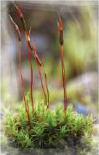

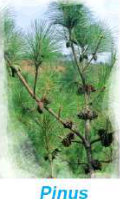
Kingdom Plantae: the kingdom of unicellular and multicellular green plants that contain chlorophyll, have a cell wall made of cellulose and make their own food.
- They contain chlorophyll.
- The kingdom includes both unicellular and multicellular plants.
- Their cell wall is made of cellulose.
- They are autotrophs.
- Some are flowering plants and some are non-flowering.
On the basis of their structure, the plants of this kingdom are classified into three divisions: Algae, Bryophyta and Tracheophyta. Here we study the first two, algae and bryophyta. Neither of these has vascular tissue, the tube-like tissue that carries water and food through a plant.
The three divisions of Plantae, from simplest to most developed: Algae, Bryophyta, Tracheophyta.
Division 1: Algae
The slippery green scum on the water of a pond or marsh is algae. Look at three algae below. Spirogyra forms green threads, Volvox is a hollow ball made of many cells joined together, and Fucus is a large brown seaweed of the sea.
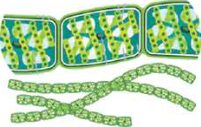
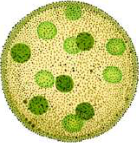
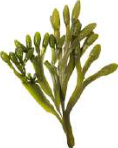
These three differ in shape, but they share one thing. In none of them can root, stem and leaf be told apart. Even the branch-like parts of Fucus are not a true stem. A plant body like this, not divided into root, stem and leaf, is called a thallus. Their cells contain both a cell wall and chlorophyll.
Thallus: a plant body that is not differentiated into root, stem and leaf.
Algae: the division of the simplest plants of kingdom Plantae, which have a thallus body and chlorophyll and live mostly in water or marshy places.
The main characteristics of algae are these:
- (a) They are either unicellular or multicellular.
- (b) They are autotrophs because they have chlorophyll. They prepare food and store it in the form of starch.
- (c) Their cell wall is composed of cellulose.
- (d) They reproduce both sexually and asexually.
- (e) They are found in ponds, rivers, the sea and marshy places.
Examples: Chlamydomonas, Volvox, Spirogyra, Ulothrix, Fucus and others. Chlamydomonas is a one-celled alga, while the others are made of many cells.
Division 2: Bryophyta, the Amphibian Plants
A soft green carpet on damp rocks, old walls or shaded soil is usually moss or one of its relatives. Marchantia, moss and Riccia are well-known plants of this division, bryophyta.
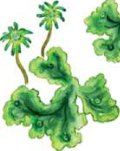
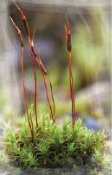
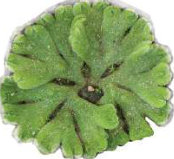
Bryophytes are green plants, more developed than algae. Their bodies come in two kinds. Marchantia and Riccia have a thallus, like algae. Moss, however, has a body differentiated into rhizoid, stem and simple leaf. Rhizoids are fine root-like threads that hold the plant to the soil, but they are not true roots.
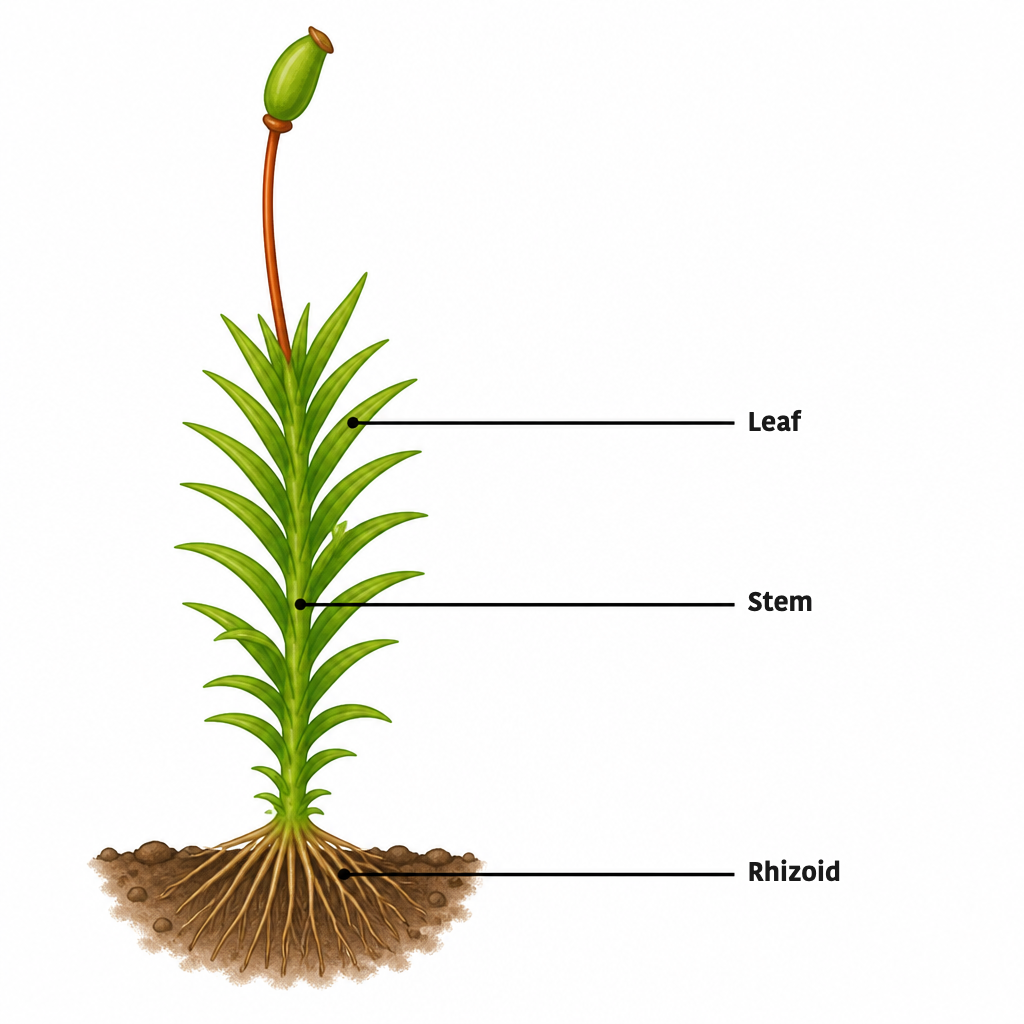
Rhizoid: a fine root-like thread that anchors a bryophyte such as moss to the soil, but is not a true root.
Bryophytes grow in moist and shady places. They live on land, yet they need water for fertilization, because the male gamete can reach the female organ only by swimming through water. Since they depend on both land and water, they are called amphibian plants, just as a frog is called an amphibian animal.
Bryophyta: the division of multicellular green plants, more developed than algae, with no vascular tissue, a body that is a thallus or is divided into rhizoid, stem and simple leaf, and a need for water in fertilization.
Amphibian plants: the name given to bryophytes, because they live on land but need water for fertilization.
The general characteristics of bryophyta are these:
- (a) They are multicellular plants.
- (b) They are autotrophs.
- (c) The plant body is either a thallus or differentiated into rhizoid, stem and simple leaf.
- (d) They are found in moist and shady places.
- (e) They are dioecious, and the plant body is the gametophyte.
- (f) They show alternation of generation, with the gametophyte generation dominant and independent.
- (g) They have no vascular tissue.
Examples: Marchantia, moss, Riccia and others. The last three characteristics need a closer look, and the next sections open them up.
Do not call Marchantia and Riccia algae just because their body is a thallus. They are bryophytes: they grow on moist land, need water for fertilization and show alternation of generation.
Male and Female Plants in Bryophyta
Bryophytes are dioecious, which means the male and female sex organs are on separate plants. A male plant produces male gametes in an organ called the antheridium. A female plant produces the female gamete, the ovum, in an organ called the archegonium. The green moss plant we see is this gamete-making stage, and so it is called the gametophyte.
Dioecious: having the male and female reproductive organs on separate plants.
Antheridium: the male sex organ of a bryophyte, where male gametes are produced.
Archegonium: the female sex organ of a bryophyte, where the ovum is produced.
Gametophyte: the phase of a plant that produces gametes in its antheridium and archegonium. In bryophytes it is the green plant we see.
The male gamete released from the antheridium swims through water to the archegonium. There it fuses with the ovum to form a zygote. This is why fertilization in these plants happens after rain or when dew has wet them.
Alternation of Generations
Once the zygote forms, the life of a bryophyte enters a new stage. The zygote germinates and develops into the sporophyte. The whole cycle runs like this:
- The green gametophyte plant forms male gametes in the antheridium and the ovum in the archegonium.
- A male gamete swims through water to the archegonium and fuses with the ovum to form a zygote.
- The zygote germinates and grows into the sporophyte, which stays attached to the gametophyte.
- Inside the sporophyte, the spore mother cell divides by meiosis to form haploid spores.
- The spores are scattered and, on moist ground, germinate into new gametophyte plants, and the cycle starts again.
Sporophyte: the phase of a plant that develops from the zygote and produces haploid spores when its spore mother cells divide by meiosis.
Alternation of generation: the phenomenon in which the sporophytic and gametophytic generations come one after another to complete the life cycle of a plant.
In bryophytes the gametophyte generation is dominant and independent. The green plant we see is the gametophyte, and the sporophyte depends on it for food.
Spores are not made by the gametophyte. Spores are made in the sporophyte by meiosis, and gametes are made in the gametophyte. The names tell you: the sporophyte makes spores, the gametophyte makes gametes.
Why Bryophytes Stay Small
Large plants have vascular tissue, which carries water up from the soil and food down from the leaves. Bryophytes have none. Water passes slowly from one cell to the next, which only works over short distances. So these plants grow only a few centimetres high, or they stay attached to their substratum, the rock, soil or bark they grow on, and spread across it.
Having no vascular tissue is the reason bryophytes stay small and keep to moist places.
Algae and Bryophyta Side by Side
| Feature | Algae | Bryophyta |
| Number of cells | Unicellular or multicellular | Multicellular |
| Plant body | Thallus only | Thallus, or rhizoid, stem and simple leaf |
| Habitat | Pond, river, sea, marshy places | Moist and shady land |
| Reproduction | Sexual and asexual | Alternation of generation, gametophyte dominant |
| Vascular tissue | Absent | Absent |
| Examples | Spirogyra, Volvox, Fucus | Marchantia, moss, Riccia |
Both divisions are autotrophs, both have cellulose cell walls and neither has vascular tissue. The difference is that algae live in water, while bryophytes have moved onto land but still depend on water to reproduce. That is why bryophytes are seen as a link between water plants and true land plants.
The full lesson is waiting for you
The notes are free to read in full. A free account opens the rest of the practice, and tracks your progress and confidence score for every subject. Presentations and videos need approval from Learn Yeti.