What Happens When a Lever Balances
A lever is a rigid bar that turns about a fixed point. That fixed point is called the fulcrum. Two forces act on every lever. One is the downward push of the heavy object being moved, which is called the load. The other is the force we apply ourselves, which is called the effort. Where each of these forces acts matters just as much as how big it is. So when we study a lever we measure two distances as well as two forces, and both distances are measured from the fulcrum.
Load distance: the distance from the fulcrum to the point where the load acts on the lever.
Effort distance: the distance from the fulcrum to the point where the effort is applied on the lever.
Mass and force are not the same thing. Mass is measured in kilograms, but force is measured in newtons (N). So a mass hung on a lever has to be changed into a force before it can be used. On the surface of the Earth a mass of \( 1\ \text{kg} \) gives a force of \( 10\ \text{N} \). A mass of 800 grams therefore gives 8 N, and a mass of 400 grams gives 4 N. This is how the masses hanging on a balance are turned into an effort and a load.
Balancing a Scale on a Stand
The relationship between the forces and the distances on a balanced lever is something you can see for yourself with a very simple set of apparatus. You need a thick plastic scale one metre long, a stand, a short piece of wire, some thread and a set of masses of different sizes.
- Take a thick plastic scale one metre long.
- Using the tip of a dot pen, make a small hole exactly at the middle of the scale, that is at the 50 cm mark.
- Pass the piece of wire through the hole and rest the scale on the stand so that it can turn freely.
- Adjust the empty scale until it stays level and does not tip to either side. This hole is now the fulcrum.
- Hang masses of different sizes on the right and the left of the scale with thread, and balance it again.
- Treat the mass on the right as the load and the mass on the left as the effort, and change both into newtons.
- Place the load at several different distances from the fulcrum, and each time balance it again with the effort.
- Each time, read the marks on the scale and record the effort, the effort distance, the load and the load distance in a table.
What the Readings Show
Now set the readings out in a table. The table holds the four measurements and two products as well. On the effort side the effort is multiplied by the effort distance, and on the load side the load is multiplied by the load distance. Setting the two products side by side lets you see the whole result of the experiment at a glance.
| S.N. | Effort (N) | E.D. (cm) | E × E.D. | Load (N) | L.D. (cm) | L × L.D. |
| 1. | 8 | 5 | 40 | 4 | 10 | 40 |
| 2. | 5 | 12 | 60 | 6 | 10 | 60 |
| 3. | 2 | 30 | 60 | 6 | 10 | 60 |
Look carefully at the last two columns. The first time both products came to 40, and the second and third times both came to 60. The forces and the distances were different every time, yet the two products always came out equal. Whatever masses you choose and wherever you hang them, as long as the scale is level these two products are always the same.
The Principle of the Lever
The experiment leads to one clear conclusion. When a lever is in balance, the effort multiplied by the effort distance equals the load multiplied by the load distance. It is written in short like this, where E stands for the effort, E.D. for the effort distance, L for the load and L.D. for the load distance.
\[ E \times E.D. = L \times L.D. \]
Principle of the lever: when a lever is in balance, effort times effort distance equals load times load distance.
Every lever works on this same principle. Whether it is a first class, a second class or a third class lever, this relationship holds whenever the lever is in balance.
Both distances must be in the same unit. If one distance is left in centimetres while the other is in metres, the answer will be wrong. Before starting the calculation, change them both to one unit, the way 50 cm becomes 0.5 m.
Distance Decides the Effort
This principle teaches us something very useful. Since the two products must stay equal, when one number on a side goes down the other number on that side has to go up. If the effort distance is made shorter, a larger effort is needed to balance the lever. In the same way, if the load distance is made shorter, even a small effort can lift a heavy load. This is why, when we lift a rock with a bar, we put the fulcrum close to the rock and hold the bar at its far end.
Sometimes a lever is used the other way round. In a pair of tongs the effort distance is shorter than the load distance, so the effort applied has to be larger than the load. Levers like this do not reduce the force needed, but they do make it easy to grip and move things. Even in these, the same rule about the two products is quietly at work.
Finding the Effort Needed
Now let us put the principle to work in a calculation. A load of 800 N is to be lifted with a lever. The distance from the load to the fulcrum is 50 cm, and the distance from the fulcrum to the effort is 1.5 m. How much effort must be applied to lift this load?
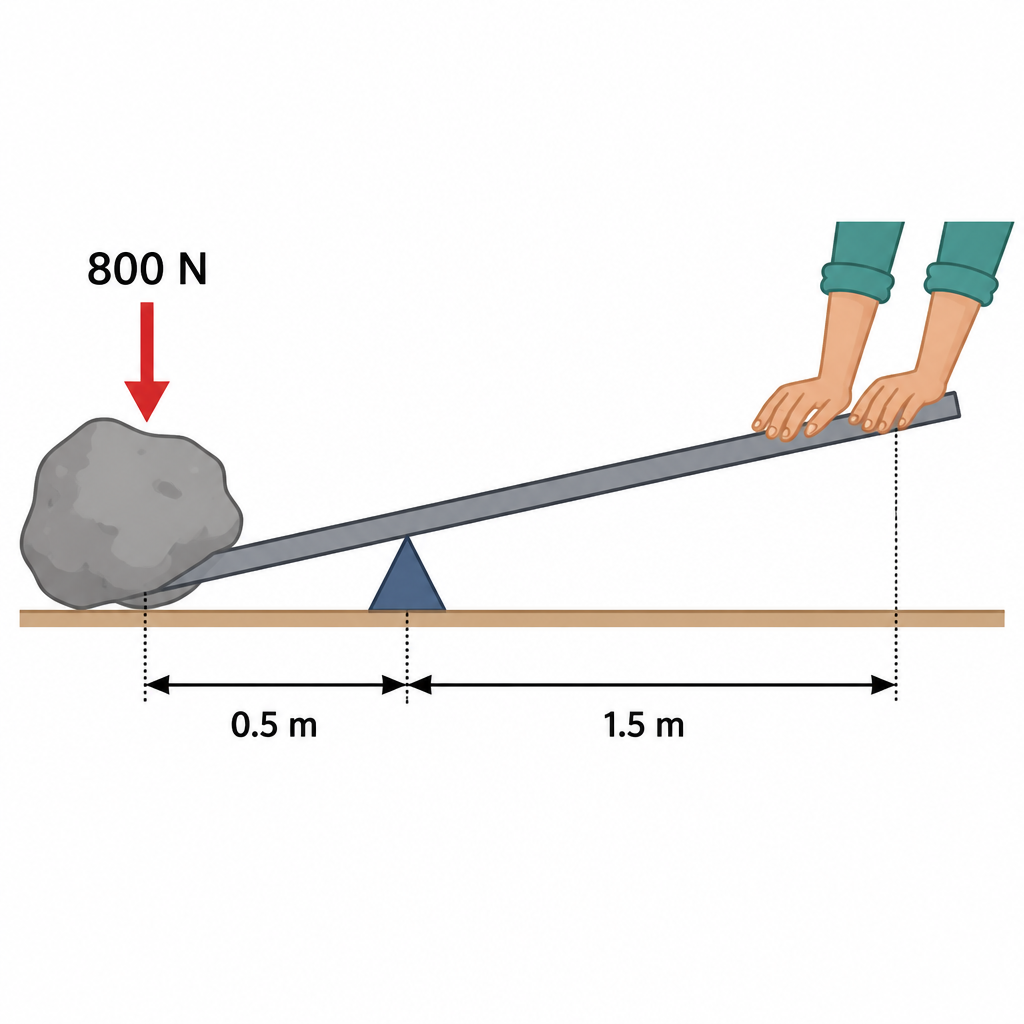
Step 1: Changing both distances to the same unit, the load distance becomes:
\[ L.D. = 50\ \text{cm} = 0.5\ \text{m} \]
Step 2: The lever is in balance, so by the principle of the lever:
\[ E \times E.D. = L \times L.D. \]
Step 3: Putting in the effort distance \( 1.5\ \text{m} \) and the load \( 800\ \text{N} \):
\[ E \times 1.5 = 800 \times 0.5 \]
Step 4: Dividing both sides by \( 1.5 \):
\[ E = \frac{800 \times 0.5}{1.5} \]
Step 5: Working out the division:
\[ E = 266.66\ \text{N} \]
So a heavy load of 800 N can be lifted with an effort of only 266.66 N. This big saving comes about because the effort distance is three times longer than the load distance.
Mechanical Advantage
When we do work with a lever, a large load can be lifted with a small effort. In the language of numbers this gain is called the mechanical advantage. The mechanical advantage of a lever is the ratio of the load to the effort while the lever is in balance. To find out how many times the applied force has been increased, we work out the mechanical advantage.
Mechanical advantage: the ratio of the load to the effort when the lever is in balance.
\[ MA = \frac{L}{E} \]
The load goes on top and the effort goes below. Both of them are forces, so both are measured in newtons, and in the division the newtons cancel each other out. That is why mechanical advantage has no unit at all. It is simply a number, and it tells us how many times the applied force has been increased.
Never write N or m after a mechanical advantage. Because it is a ratio, the answer is 4, not 4 N.
Working Out Mechanical Advantage
Suppose a person needs an effort of 150 N to raise a load of 600 N on a lever. What is the mechanical advantage of that lever? Here is how it is worked out.
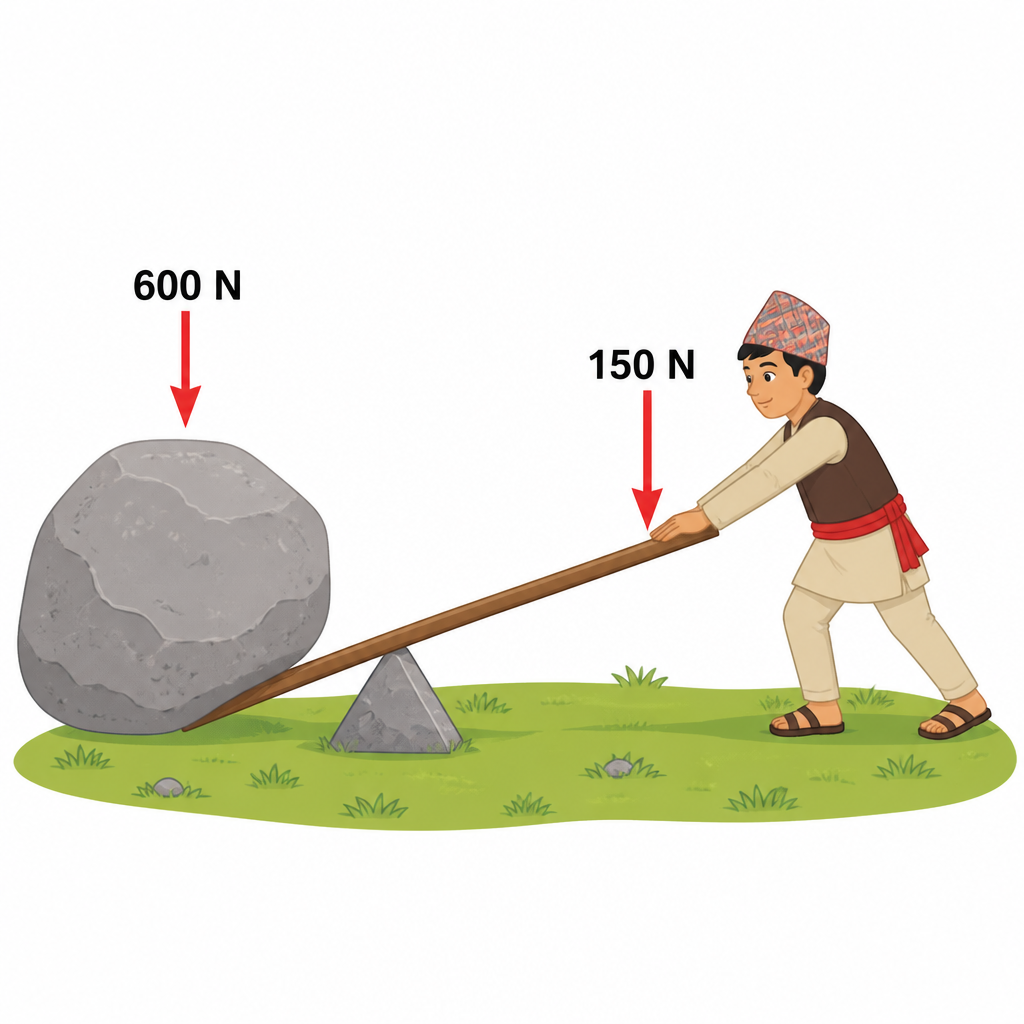
Step 1: The formula for mechanical advantage is:
\[ MA = \frac{L}{E} \]
Step 2: Putting in the load and the effort:
\[ MA = \frac{600\ \text{N}}{150\ \text{N}} \]
Step 3: In the division the newtons cancel, and only a number is left:
\[ MA = 4 \]
This means the lever helps the person to lift a load four times greater than the force applied, that is 600 N lifted by pressing with only 150 N.
What Mechanical Advantage Tells You
Just by looking at the number for mechanical advantage you can say at once what a lever is doing for you. The three possible cases are set out below.
Mechanical advantage greater than one: the lever multiplies the force, so an effort smaller than the load is enough.
Mechanical advantage equal to one: the load and the effort are equal, so there is no gain in force.
Mechanical advantage less than one: the effort has to be larger than the load, but the job becomes easier to control.
Mechanical advantage is affected by friction. When there is more friction at the fulcrum, part of the effort applied is used up in overcoming that friction, so the mechanical advantage becomes smaller. Keeping the fulcrum smooth and clean reduces the friction and lets the lever give more of the advantage it should.
The full lesson is waiting for you
The notes are free to read in full. A free account opens the rest of the practice, and tracks your progress and confidence score for every subject. Presentations and videos need approval from Learn Yeti.