Working with motion that is not steady
A body that keeps the same speed all the way has a fixed velocity. In real life, though, very few bodies move at one steady speed. On the way to school a bus runs fast on an open stretch, crawls through a crowded bazaar and stops at the junction. For such a journey the velocity at one single moment is not much use. What we really want to know is how fast the body moved on the whole, and that is what average velocity tells us.
Average velocity: the total distance covered in a definite direction in one unit of time is called the average velocity of the body.
The distance covered in a definite direction is called displacement, and we write it as \( s \). The total time taken is written as \( t \). Once these two are known, the average velocity is found like this.
\[ \bar{v} = \frac{s}{t} \]
- \( \bar{v} \) stands for the average velocity.
- \( s \) stands for the total displacement, that is, the whole distance covered in a definite direction.
- \( t \) stands for the total time taken to cover that displacement.
Let us work one out. A body covers 10 metres in a definite direction in 3 seconds, and then covers another 17 metres in the same direction in 6 seconds. We have to find its average velocity.
Step 1: Adding the displacement of both parts gives the total displacement:
\[ s = 10\,\text{m} + 17\,\text{m} = 27\,\text{m} \]
Step 2: Adding the time of both parts gives the total time:
\[ t = 3\,\text{s} + 6\,\text{s} = 9\,\text{s} \]
Step 3: Putting these values into the formula:
\[ \bar{v} = \frac{27\,\text{m}}{9\,\text{s}} \]
Step 4: Dividing gives the average velocity:
\[ \bar{v} = 3\,\text{m/s} \]
So the average velocity of the body is 3 m/s. Notice that in the first part the body moved at about 3.33 m/s and in the second part at about 2.83 m/s. The average velocity puts both parts together and reports the journey as one single number.
Average velocity from the first and the last velocity
Sometimes we do not know the distance and the time, but we do know how fast the body was moving at the start and how fast it was moving at the end. A bus, for example, starts from rest and after a while is moving at 20 m/s. In such a case we call the starting velocity \( u \) and the final velocity \( v \), and find the average velocity like this.
\[ \bar{v} = \frac{u+v}{2} \]
For that bus the starting velocity is \( u = 0\,\text{m/s} \) and the final velocity is \( v = 20\,\text{m/s} \), so the average velocity is \( \bar{v} = \frac{0+20}{2} = 10\,\text{m/s} \). This formula is used when the velocity rises or falls at a steady rate.
Measuring it in your own classroom
Average velocity is not only something to work out on paper. You can measure it in your own classroom. Do the following, one step at a time.
- Write the name of every friend in your class in a table.
- Ask each of them how far their home is from the school, or find it out with the help of a map.
- Note down in the same table how long each of them takes to reach school from home.
- Add up everybody's distance and divide by the number of friends. This gives the average distance for the class.
- Add up everybody's time and divide by the same number. This gives the average time.
- Finally divide the average distance by the average time to get the average velocity for the class.
\[ \text{average velocity} = \frac{\text{average distance}}{\text{average time}} \]
If the distance is noted in kilometres and the time in minutes, change the distance to metres and the time to seconds before dividing. Otherwise the answer that comes out is not in m/s.
The rate at which velocity changes
A car, a motorcycle or a bus on the road hardly ever keeps one steady velocity. Its velocity rises at one moment and falls at another. A bicycle rolling down a slope keeps gaining velocity. A stone dropped from a high place towards the surface of the earth also keeps gaining velocity as it falls. This rate at which the velocity grows is called acceleration.
Acceleration: the change of velocity in one unit of time is called acceleration. In the SI system it is measured in metres per second per second (m/s²).
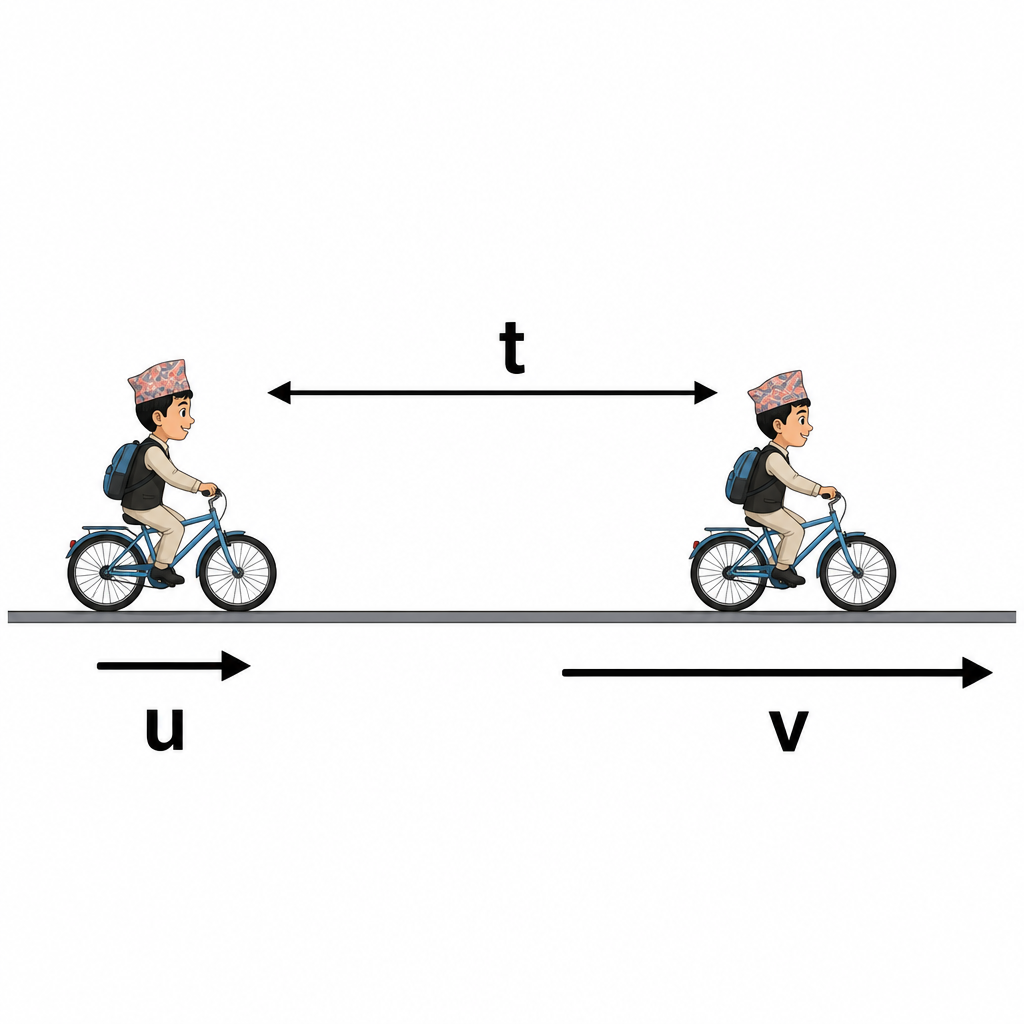
Suppose a cyclist has a starting velocity \( u \), and after a time \( t \) the velocity has changed to \( v \). Then the change in velocity is \( v - u \). Dividing that change by the time taken gives the acceleration.
\[ \text{acceleration} = \frac{\text{change in velocity}}{\text{time taken}} \]
\[ a = \frac{v-u}{t} \]
Worth holding on to: a body that starts moving from rest has a starting velocity \( u = 0\,\text{m/s} \), and a body that comes to a stop has a final velocity \( v = 0\,\text{m/s} \).
A body moving with a uniform velocity has no acceleration, that is, its acceleration is zero. Its final velocity and its starting velocity are equal, so \( v - u = 0 \). A bus running along a straight road at one steady velocity therefore has zero acceleration.
Now let us work one out. A car starts from rest and after 10 seconds its velocity has reached 25 m/s. What is its acceleration?
- Starting velocity \( u = 0\,\text{m/s} \)
- Final velocity \( v = 25\,\text{m/s} \)
- Time taken \( t = 10\,\text{s} \)
- Acceleration \( a = ? \)
Step 1: By the formula:
\[ a = \frac{v-u}{t} \]
Step 2: Putting in the given values:
\[ a = \frac{25 - 0}{10} \]
Step 3: Dividing gives the acceleration:
\[ a = 2.5\,\text{m/s}^2 \]
So the acceleration of that car is 2.5 m/s². What this means is that in every single second the velocity of the car grows by 2.5 m/s.
When velocity falls: retardation
The velocity of a moving body keeps going up and down. Pressing the brake of a moving vehicle makes its velocity fall, and pressing the accelerator makes it rise. The rate of decrease of velocity of a body is called retardation.
Retardation: the rate at which the velocity of a body decreases is called retardation. In retardation the final velocity is smaller than the starting velocity, so the value of the acceleration comes out negative.
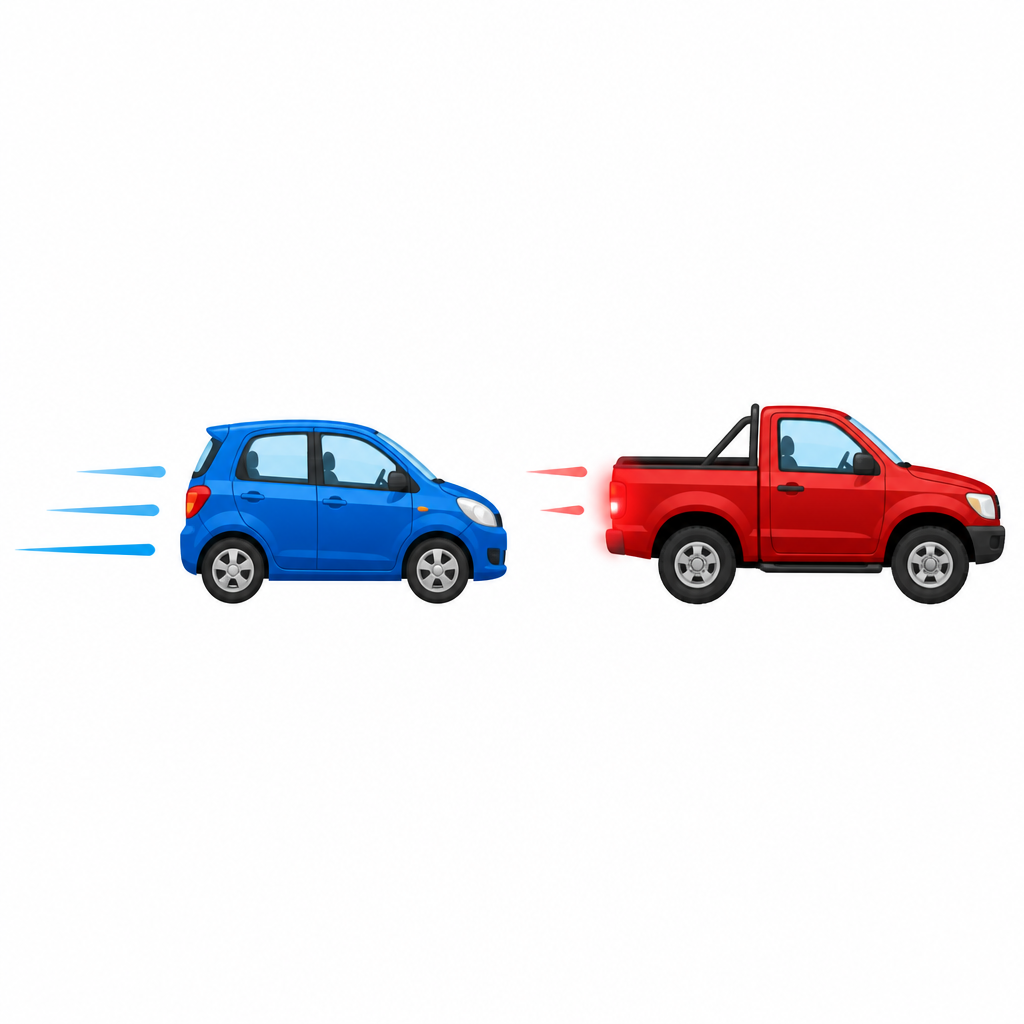
Retardation is worked out with the very same formula as acceleration. For example, a bus moving at 20 m/s comes to rest after 4 s. What is its retardation?
- Starting velocity \( u = 20\,\text{m/s} \)
- Final velocity \( v = 0\,\text{m/s} \)
- Time taken \( t = 4\,\text{s} \)
- Retardation \( a = ? \)
Step 1: By the formula:
\[ a = \frac{v-u}{t} \]
Step 2: Putting in the starting and the final velocity of the bus:
\[ a = \frac{0 - 20}{4} \]
Step 3: Dividing gives a negative value of acceleration:
\[ a = -5\,\text{m/s}^2 \]
The minus sign tells us that the velocity fell. So the retardation of that bus is 5 m/s².
If the value that comes out of the formula is negative, do not report it as acceleration. A negative acceleration is retardation, and the value of retardation is written as a positive number. Do not forget to write the unit m/s² either.
How acceleration and retardation differ
Both are rates at which velocity changes, but the change goes in opposite directions. The table below sets the difference out.
| Point of comparison | Acceleration | Retardation |
| Change in velocity | The velocity keeps rising | The velocity keeps falling |
| Final velocity | Larger than the starting velocity | Smaller than the starting velocity |
| Sign of the value | Positive | Negative |
| Everyday example | Pressing the accelerator | Pressing the brake |
Symbols and units of this topic
Before solving a numerical problem you must be sure of what each symbol stands for. Keep the table below in mind.
| Symbol | Meaning | Unit |
| u | Starting velocity | m/s |
| v | Final velocity | m/s |
| v̄ | Average velocity | m/s |
| s | Displacement | m |
| t | Time taken | s |
| a | Acceleration | m/s² |
Make it a habit to list the given values first, with these symbols and units in mind, and only then to write the formula. That is what makes the working both quick and correct.
The full lesson is waiting for you
The notes are free to read in full. A free account opens the rest of the practice, and tracks your progress and confidence score for every subject. Presentations and videos need approval from Learn Yeti.