A Liquid Also Pushes
Put a solid block on a table and its weight presses down on the table top. The force acting on each unit of area of that surface is what we call pressure. Now pour a liquid such as water, oil or milk into a vessel. A liquid has weight too, so it presses down on the base of the vessel in just the same way. The one difference is that a liquid flows and spreads out, so it pushes on the side walls as well as on the base.
This push is not felt at one spot only. At every point inside the vessel the liquid presses at right angles on the surfaces around it. At the base the whole column of water above has to be held up, so that is where the pressure is greatest.
The force that a liquid kept in a container produces on unit area is called the pressure of the liquid. This force acts at right angles to the surface it presses on.
The Bottle With Three Holes
A simple experiment shows how the pressure of a liquid changes with depth. All it needs is an empty plastic bottle or a polythene water container.
- Take an empty plastic bottle or a polythene water container.
- Make three holes in its side wall at three different heights: one near the top, one in the middle and one close to the bottom.
- Fit a short piece of thin pipe into each hole and close the mouth of each pipe tightly with tape.
- Fill the container with water right up to the top.
- Now open all three holes at the same moment and watch carefully how far each stream of water reaches.
Use a plastic bottle only and never a glass one. Making the holes needs a hot nail or a knife, so do that part only with your teacher or an adult beside you. Never point the jets of water towards anyone's face.
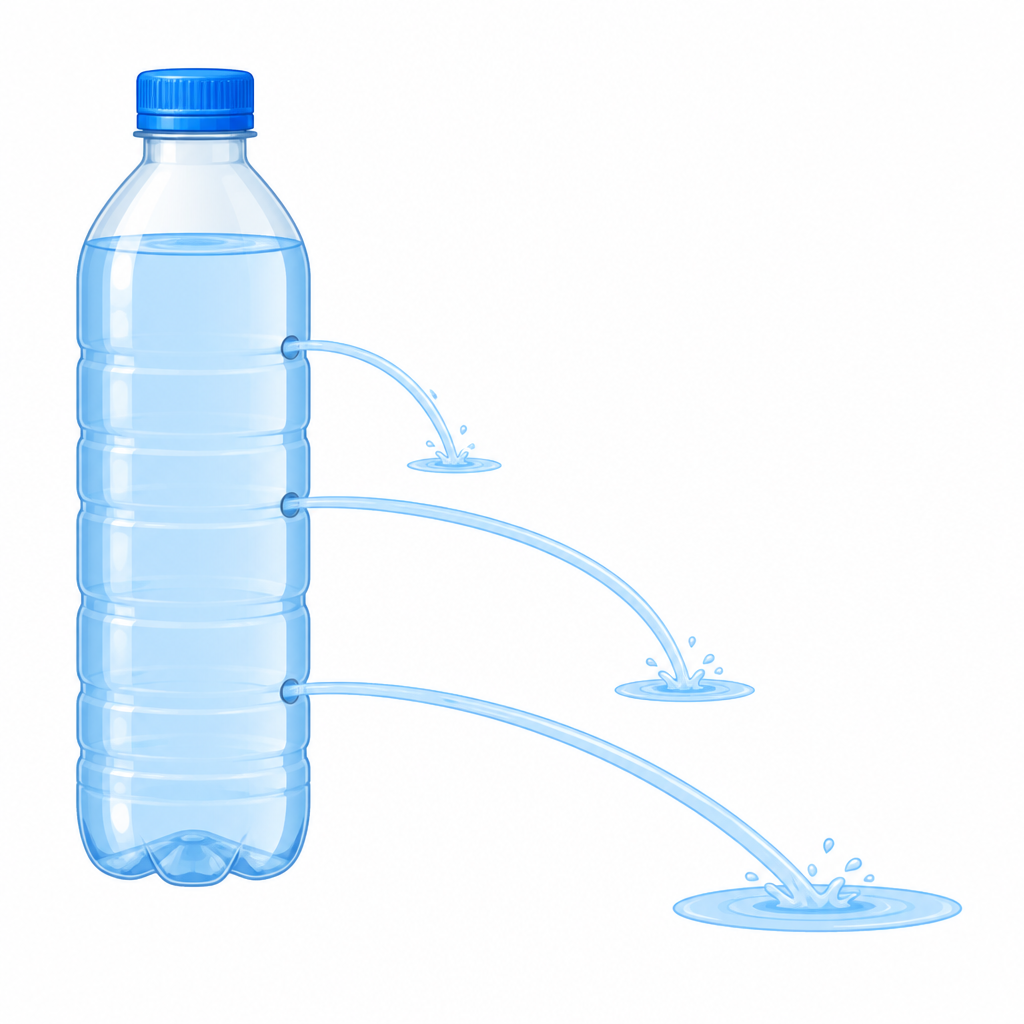
The water from the lowest hole comes out with a hard push and travels a long way. The stream from the hole above it does not reach so far, and the stream from the topmost hole falls almost at the foot of the bottle. All three holes are in the same bottle and hold back the same water, but they sit at different depths. So the pressure pushing the water out must be different at different depths.
The deeper you go into a liquid, the greater the pressure it exerts there.
Measurement of the Pressure of a Liquid
Now let us work out how big that pressure is. Suppose the base of a vessel has area A, the liquid standing in it has height h, the density of the liquid is d, and the acceleration due to gravity at that place is g. The volume of the liquid in the vessel is then \( V = A \times h \).
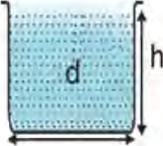
Density is the mass contained in unit volume of a substance. The density of water is 1000 kg/m³.
The force the liquid gives to the base of the vessel is simply its own weight W. Since pressure means the force falling at right angles on unit area, the formula builds up step by step like this.
Step 1: Dividing the weight of the liquid by the area of the base gives the pressure:
\[ P = \frac{W}{A} \]
Step 2: Weight is mass multiplied by the acceleration due to gravity, that is \( W = m \times g \). So this becomes:
\[ P = \frac{m \times g}{A} \]
Step 3: Mass is density multiplied by volume, that is \( m = d \times V \). So this becomes:
\[ P = \frac{d \times V \times g}{A} \]
Step 4: Putting \( V = A \times h \) in place of the volume:
\[ P = \frac{d \times A \times h \times g}{A} \]
Step 5: The area A appears above and below, so it cancels, and the formula for the pressure of a liquid comes out as:
\[ P = h d g \]
The unit of pressure is the pascal, written Pa. One pascal means a force of 1 N acting on an area of 1 m², so 1 Pa = 1 N/m².
What the Formula Tells Us
The relation \( P = h d g \) shows that the pressure of a liquid rests on three things only: the depth or height h of the liquid, its density d, and the acceleration due to gravity g. Greater depth means greater pressure, and greater density also means greater pressure.
| Symbol | What it stands for | Unit |
| P | Pressure given by the liquid | Pa or N/m² |
| h | Depth or height of the liquid | m |
| d | Density of the liquid | kg/m³ |
| g | Acceleration due to gravity | 9.8 m/s² |
One thing here deserves close attention. The base area A cancelled out at Step 5, so it does not appear in the final formula at all. That means the pressure on the base does not depend on how wide the vessel is.
Many students think that more water must mean more pressure. If a narrow glass and a wide tank hold water standing to the same depth, the pressure on the base is the same in both. Pressure is settled by depth and density, not by how much liquid there is.
Density matters just as much. Sea water has salt dissolved in it, so it is denser than river water. At the same depth, therefore, sea water presses harder than river water does. A fish whose body is built for a river is not built to bear that extra pressure, which is why it struggles to survive in the sea.
Everyday Uses of Liquid Pressure
A liquid has weight, it gives pressure, and that pressure grows as the depth grows. Many everyday arrangements are designed with exactly this behaviour in mind.
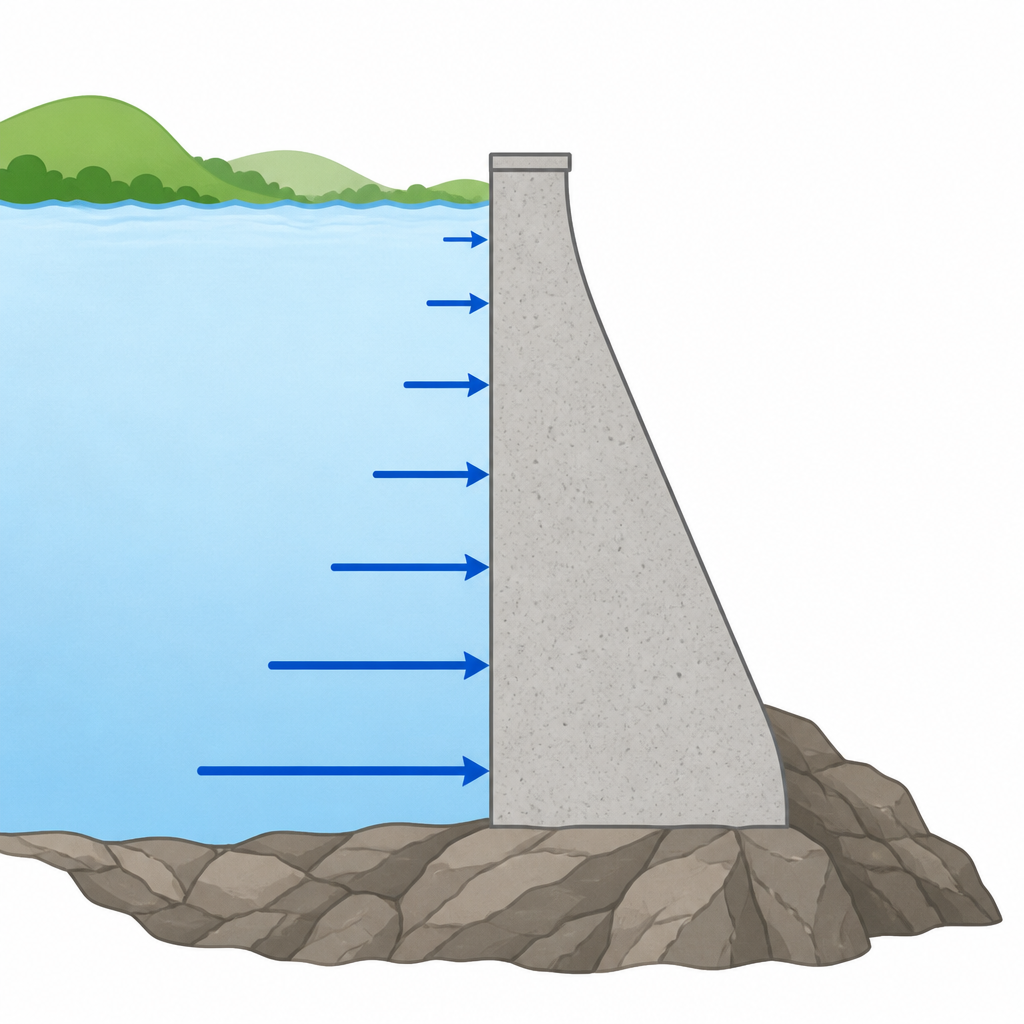
- The base of a deep pond, a dam or a water tank is built much thicker, because the water pressure is greatest at the bottom.
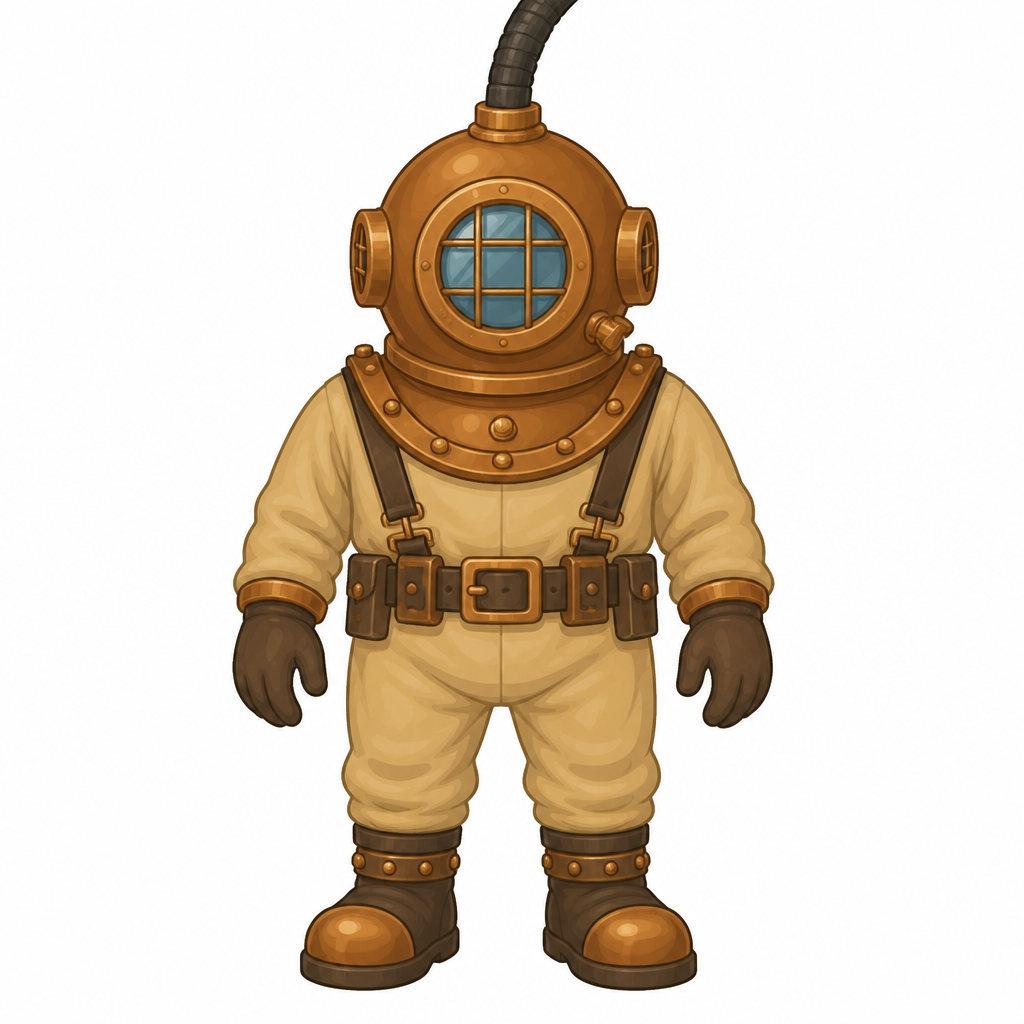
- A diver going down into the deep sea must wear a special suit, because the water pressure down there is greater than the body can bear.
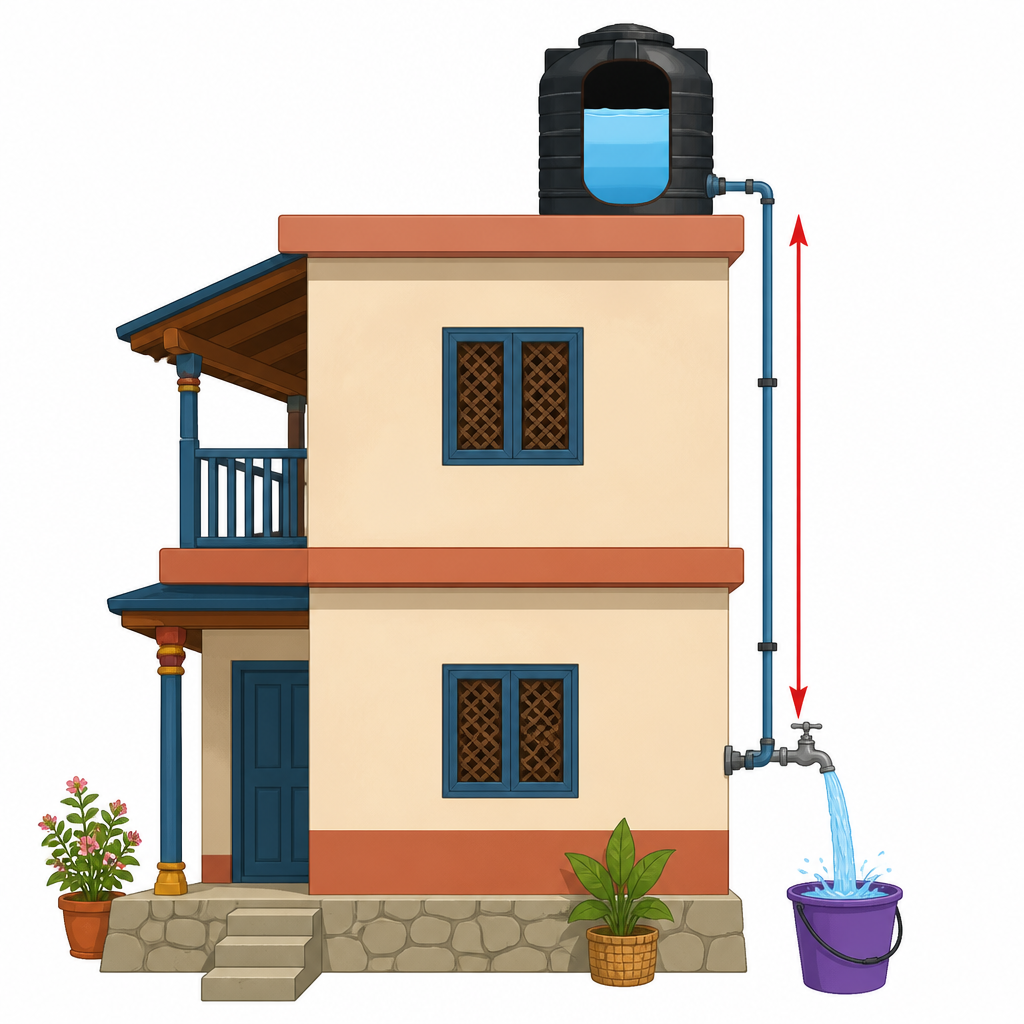
- A household water tank is placed at the highest point of the house, so that the water reaches the taps below with force.
- A bottle meant for holding mercury is given a thicker base than a bottle for other liquids, because mercury is very dense.
The shape of a dam shows this rule most clearly. Near the water surface the depth is small, so the pressure on the wall is small. Further down the depth increases and the pressure increases with it. That is why a dam wall is built thin at the top and very thick at the bottom.
The tank on a house roof works on the same rule. The height from the water surface in the tank down to the tap below is the h of the formula. The higher the tank is placed, the bigger h becomes, and the stronger the water pressure at the tap.
Deep in the sea this pressure becomes very large indeed. The human body cannot stand it, so a diver working at depth has to wear a strong sealed suit. Blood is a liquid too, which is why, when a person is standing, the blood pressure at the feet is higher than the blood pressure at the head.
The full lesson is waiting for you
The notes are free to read in full. A free account opens the rest of the practice, and tracks your progress and confidence score for every subject. Presentations and videos need approval from Learn Yeti.