A passenger inside a moving bus: at rest or in motion?
Think of a person sitting on a seat inside a bus that is running along a highway. However fast the bus goes, that person does not change position with respect to the bus. The seat stays where it is and the person stays on it. Compared with the bus, then, the passengers are at rest. Now look at the same person from a tree or a house standing at the roadside. Every moment that person is at a new place along the road. Compared with the surroundings, the passengers are in motion. One person is at rest and in motion at the very same moment. Which of the two you report depends completely on what you compare the person against. That is why rest and motion are both called relative states.
Travelling by bus gives you a second familiar experience. When your bus overtakes another bus going the same way, that other bus seems to creep past very slowly. A bus coming from the opposite direction, however, seems to shoot past in an instant. Both of those buses may in fact be running at much the same velocity. The difference does not lie in the velocity of the buses. It lies in what you are comparing them against. Putting a number on that comparison is exactly what this topic is about.

The reference point
To compare the position of any object you must first fix a definite point, a line or a place. Without such a fixed thing, the question of whether an object is at rest or moving simply has no answer. The definite point, line or place chosen for that comparison is called the reference point. A classroom door, an electricity pole at the roadside, or a straight line drawn on paper can all serve as a reference point, as long as it does not move.
Reference point: the fixed point, line or place chosen so that the position or the motion of an object can be compared against it.
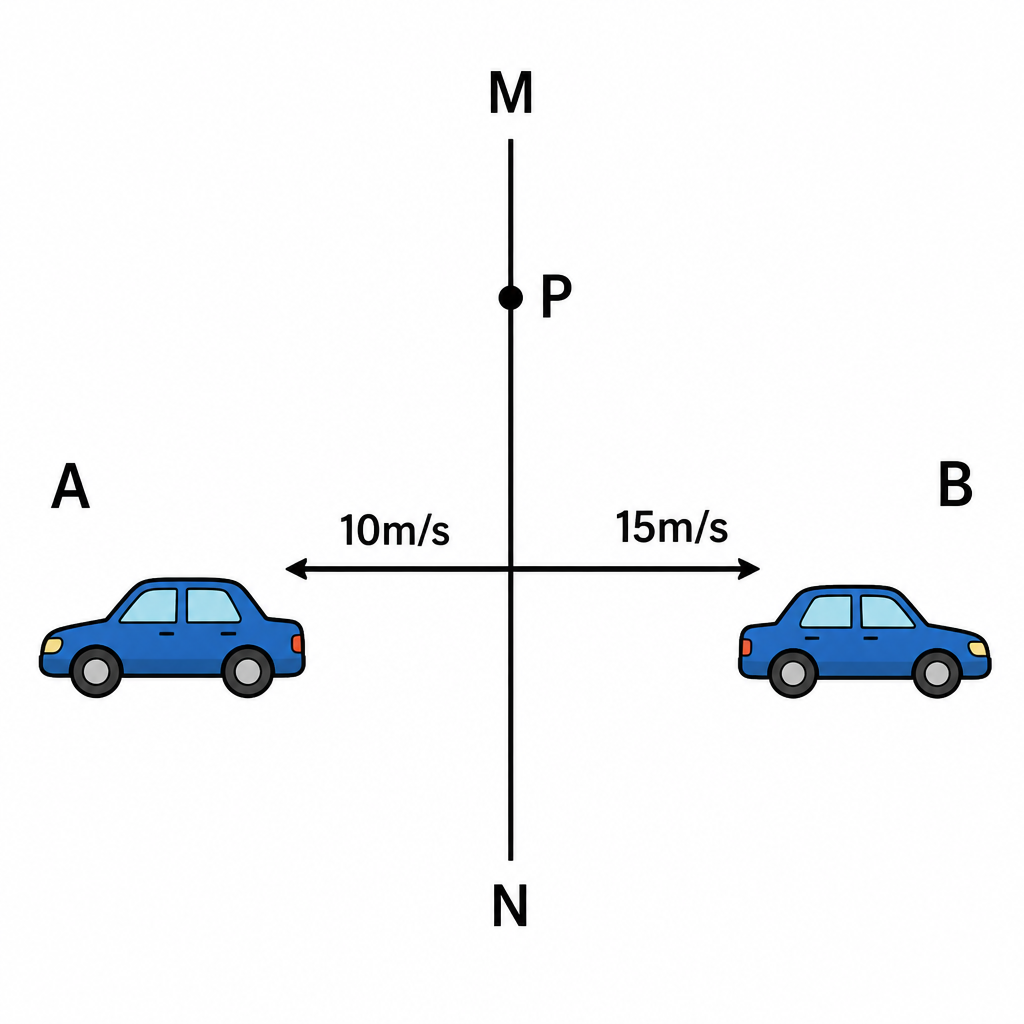
Take an example. Car A is moving towards the west with a velocity of 10 m/s, and car B is moving towards the east with a velocity of 15 m/s. Both cars set off from the reference line MN, and the point P marked on that line is the reference point. Only by standing at P can you say which car has gone which way, and how far.
What relative velocity means
The velocity of an object expressed by comparing it with a reference point is called its relative velocity. The reference point need not always be a pole planted in the ground. In everyday life we usually take another moving body as our reference. A passenger watching a second bus is using his own bus as the reference. So the next step is to look, one by one, at the three situations in which two vehicles can see each other.
Relative velocity: the velocity of an object as it is expressed by comparing it with a reference point.
(a) Moving in the same direction at the same velocity
Suppose two vehicles A and B leave the reference line PQ and travel in the same direction. Both have the same velocity, 22 m/s. That means each one covers 22 m in that fixed direction in every second. One second later both are 22 m away from the line PQ, so they are still exactly level with each other.
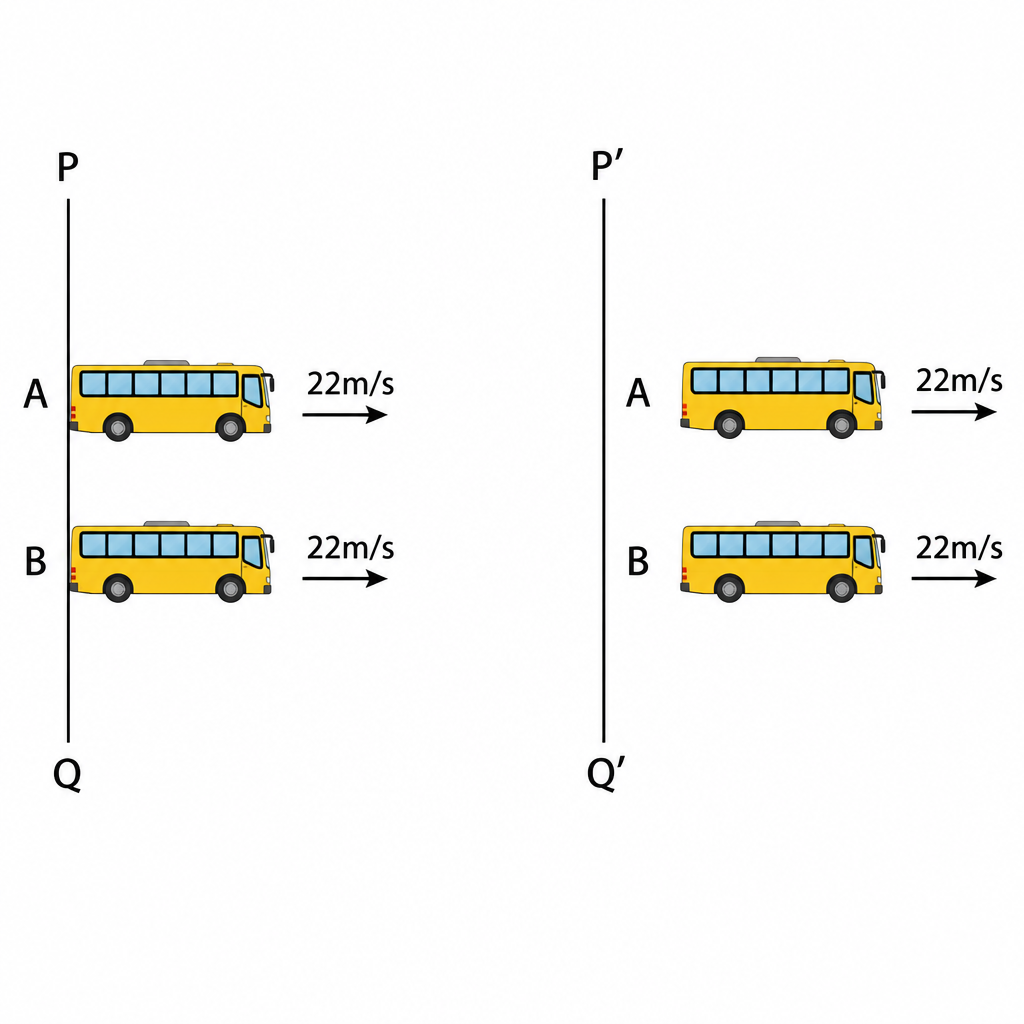
These vehicles do cover distance with respect to the line PQ, but with respect to each other they cover no distance at all. Looking out from A, you would not see B shift by even an inch. Their relative velocity is therefore zero.
\[ V_{AB} = V_A - V_B = (22 - 22)\ \text{m/s} = 0 \]
Passengers riding in two buses that run the same way at the same velocity feel that the other bus is standing still.
(b) Moving in the same direction at different velocities
Now car A and car B leave the reference line MN in the same direction, with velocities of 10 m/s and 15 m/s. Look at them one second later. In that second car A has covered 10 m and car B has covered 15 m. But seen from car A, car B has moved only 5 m in that second, because that is how much the gap has grown. So with respect to A, the velocity of B is 5 m/s.
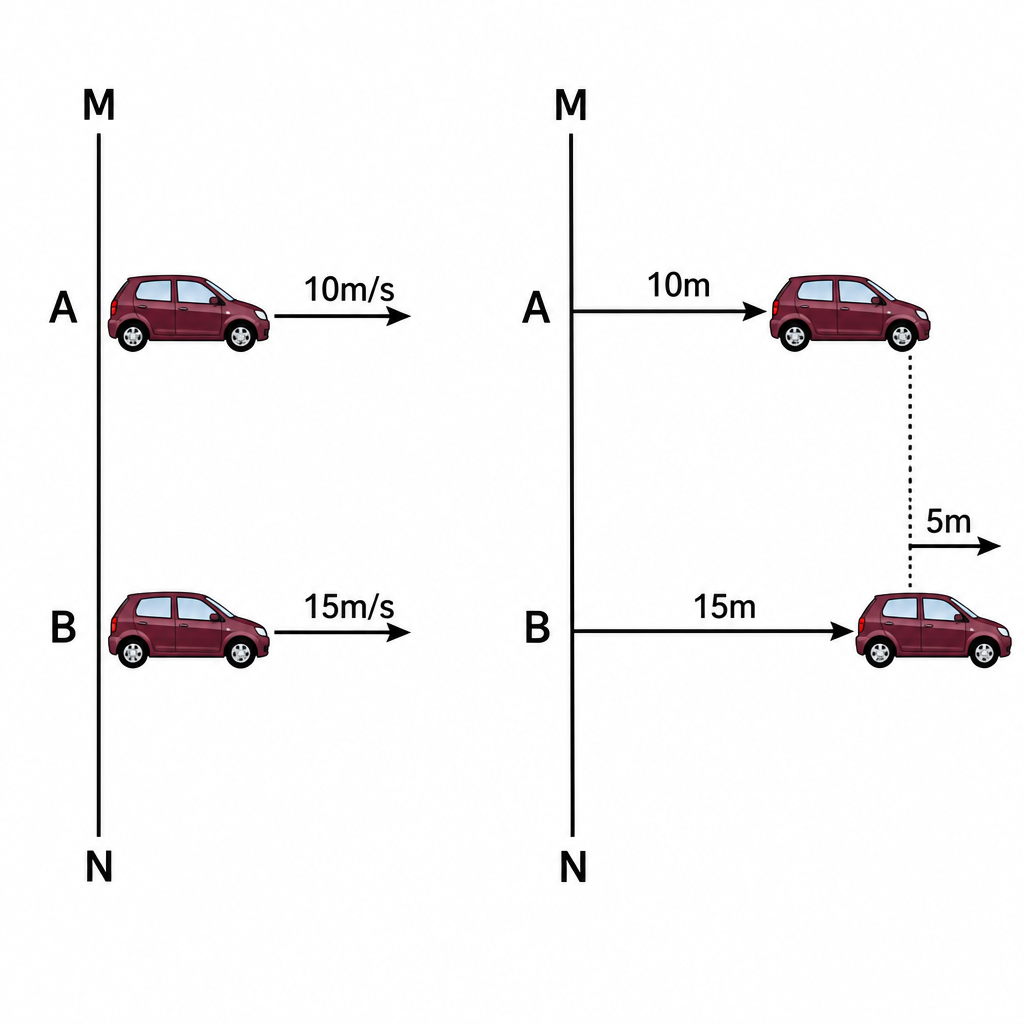
A general rule follows from this. For two vehicles running in the same direction, the relative velocity is found by subtracting the velocity of the second from the velocity of the first.
\[ V_{AB} = V_A - V_B \]
- \( V_A \) = the velocity of object A
- \( V_B \) = the velocity of object B
- \( V_{AB} \) = the relative velocity of A with respect to B
(c) Moving in opposite directions
Now cars A and B leave the reference line PQ in opposite directions. Both run at the same velocity, 20 m/s. In every second A gets 20 m away from the line on one side, while B gets 20 m away on the other side. So in one second the gap between them grows by 40 m.
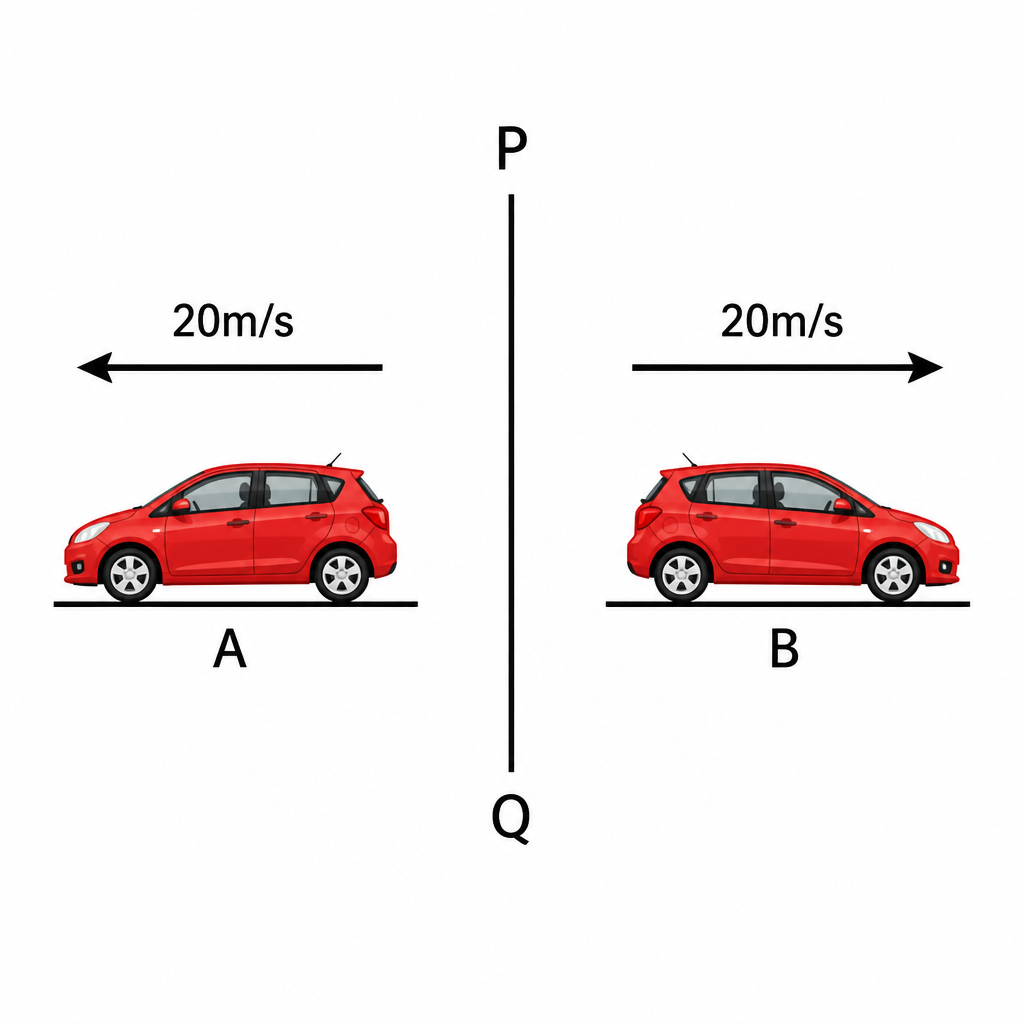
\[ V_{AB} = 20\ \text{m/s} + 20\ \text{m/s} = 40\ \text{m/s} \]
In this situation the passengers in car A and in car B each feel that the other car is going much faster than it really is. So for two bodies running in opposite directions, the relative velocity is found by adding one velocity to the other.
\[ V_{AB} = V_A + V_B \]
Whether you add or subtract is decided by the directions, not by the numbers. Same direction means subtract; opposite directions mean add. Reaching for addition without first reading the directions in the question is what spoils the answer.
The two rules side by side
Putting all three situations into one table makes them easy to hold in mind. In the example column the velocity of A is taken as 15 m/s and that of B as 10 m/s.
| Situation | Rule | Example |
| Same direction, same velocity | \( V_{AB} = V_A - V_B \) | both 22 m/s gives 0 |
| Same direction, different velocities | \( V_{AB} = V_A - V_B \) | 5 m/s |
| Opposite directions | \( V_{AB} = V_A + V_B \) | 25 m/s |
This is exactly why a bus being overtaken seems to crawl, while a bus coming head on seems to fly past. In the first case the velocities subtract, in the second they add.
The full lesson is waiting for you
The notes are free to read in full. A free account opens the rest of the practice, and tracks your progress and confidence score for every subject. Presentations and videos need approval from Learn Yeti.