Moving or Still Depends on What You Compare With
Every object in the universe is either in motion or at rest. You cannot decide which one it is simply by looking at the object on its own. You have to compare it with some point, some place or the surroundings around it. A flying bird, a moving bus and a walking person all change their position compared with the places around them, so they are in motion. A house and a tree do not change their position compared with the ground around them, so they are at rest. Our Earth is in motion too, because it keeps going round the Sun, although those of us standing on it never feel that motion.


When a force is applied to an object that is standing still and the object changes its place, we say the object has been brought into motion. Without the use of an outside force, a moving object cannot be brought to rest, and an object at rest cannot be set moving. A table shifts only when somebody pushes it, and a rolling ball stops only when somebody stops it or when the friction of the ground stops it.
Motion
Motion: when an object changes its position with respect to the other objects around it, the state of that object is called motion.
A flying plane, a moving truck, a walking dog and a rolling ball are some examples of motion. As time passes, each of them keeps changing its position with respect to the places around it. To say that an object is in motion is to say that its position keeps changing as time goes on.
Uniform and Non-uniform Motion
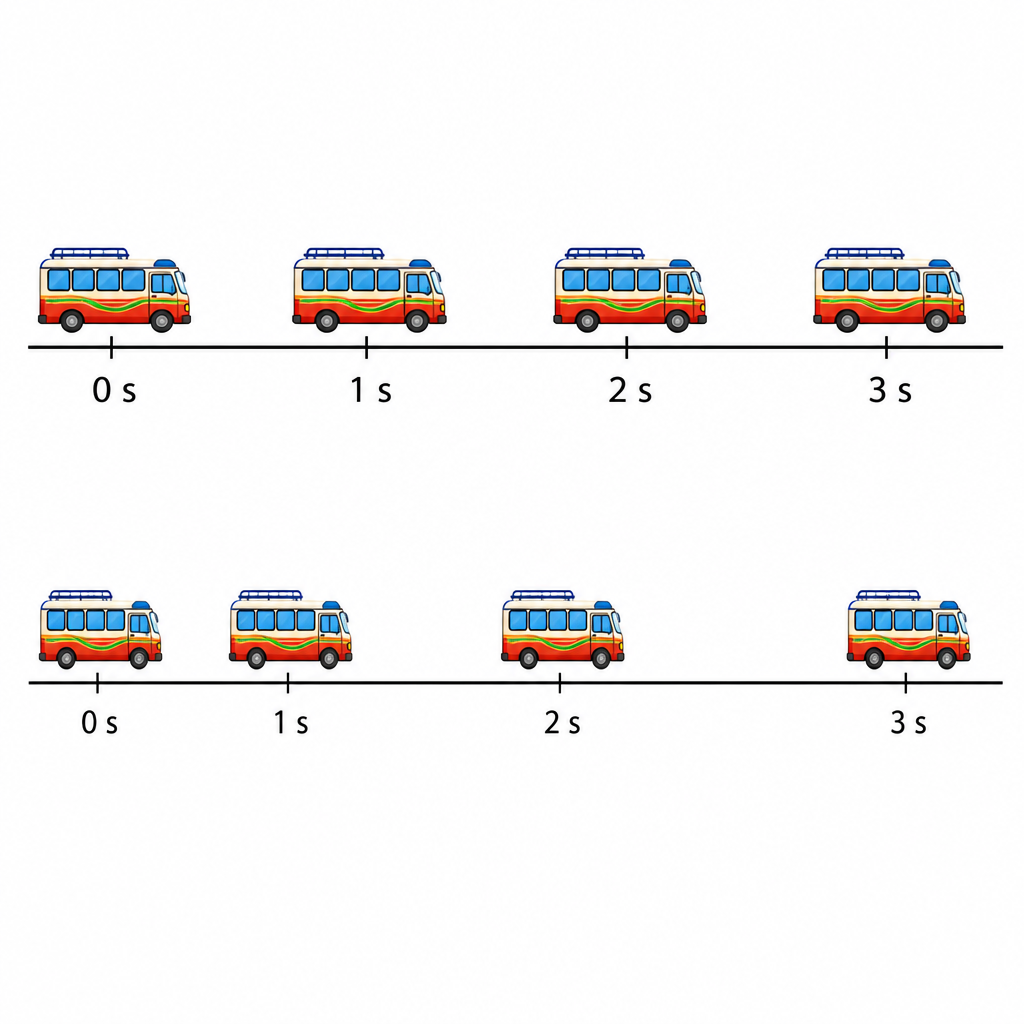
The motion of an object is of two kinds, uniform and non-uniform. Which kind it is, is decided by looking at how much distance the object covers in equal intervals of time.
- Uniform motion: the object covers equal distances in equal intervals of time. For example, a train that covers exactly 10 metres in every second.
- Non-uniform motion: the object does not cover equal distances in equal intervals of time. For example, a bus in traffic that moves quickly at one moment and slowly at the next.
Rest
Rest: when an object does not change its position with respect to the other objects around it, the state of that object is called rest.
A house, a tree and a bus that has stopped are some examples of rest. A tree that is seen at one place in the morning is seen at the same place in the evening. A stopped bus also stays at rest as long as it does not change its position with respect to the road.
Motion and Rest Are Relative
One object can be in motion with respect to a second object and, at the very same moment, at rest with respect to a third one. When you travel in a moving bus, the passengers inside are at rest with respect to the bus, because they do not change their seats or their place inside the bus. At the same moment those same passengers are in motion with respect to the road, because their place on the road keeps changing along with the bus. Motion and rest are therefore relative. Whenever you say that something is moving or standing still, you must also say what it is moving or standing still with respect to.
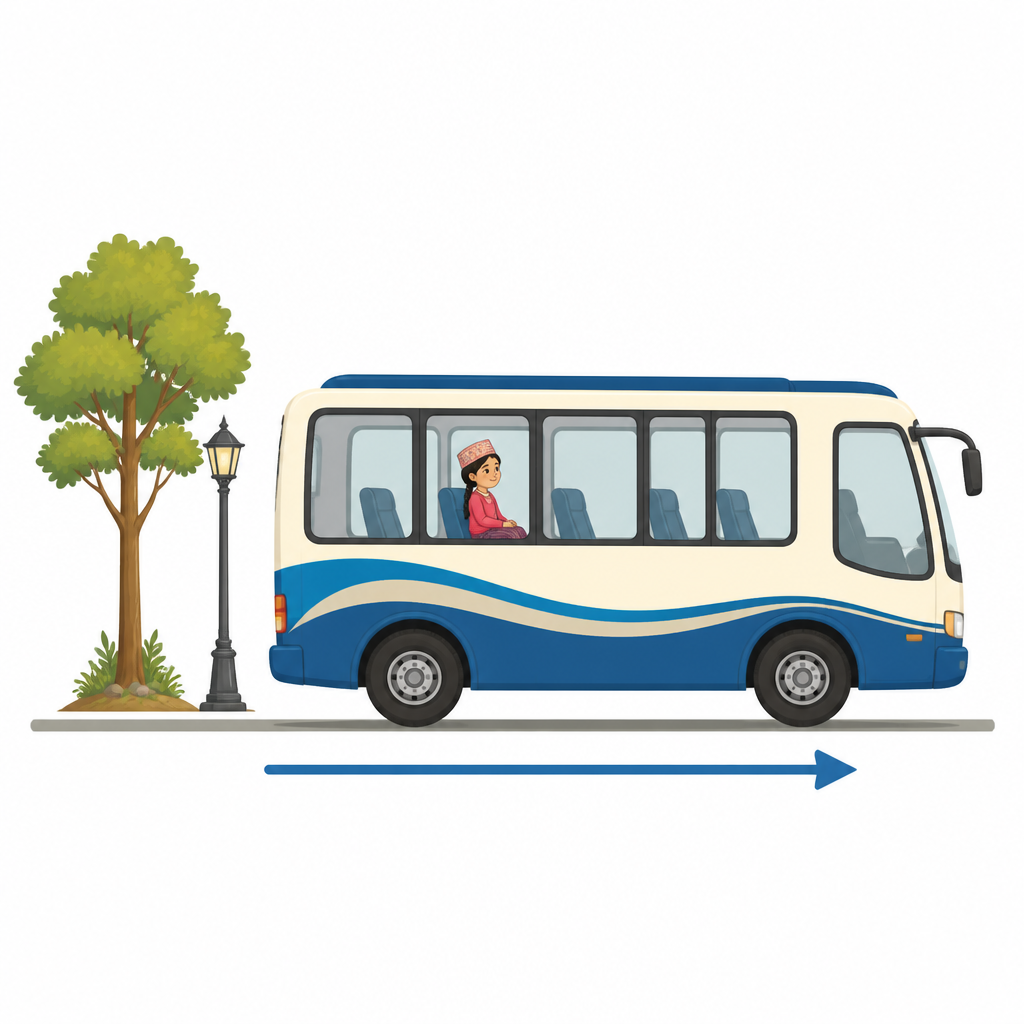
Motion and rest are not properties an object owns by itself. They are always stated by comparing the object with something else.
Writing only that an object is at rest leaves the answer incomplete. No answer about motion or rest is finished until you say what the object is at rest or in motion with respect to.
Speed
Which runs faster, a leopard or a deer? Some things run fast and some run slowly. When we say that a car moves at 20 metres per second, we mean that the car covers 20 metres in every single second. In the same way, saying that the speed of sound is 332 metres per second means that sound covers 332 metres in one second. Whatever runs fast has a greater speed, and whatever runs slowly has a smaller speed.
Speed: the distance covered in unit time is called speed. Speed is measured in metres per second (m/s).
Speed is found by dividing the distance covered by the time taken. Below, \( d \) stands for the distance covered, \( t \) for the time taken and \( v \) for the speed.
\[ v = \frac{d}{t} \]
Speed has only a value, that is, a magnitude, and it has no direction. Saying that a car moved at 20 metres per second tells you nothing about which way it went. Speed is therefore a scalar quantity.
Scalar quantity: a quantity that has only a magnitude and no direction is called a scalar quantity.
Velocity
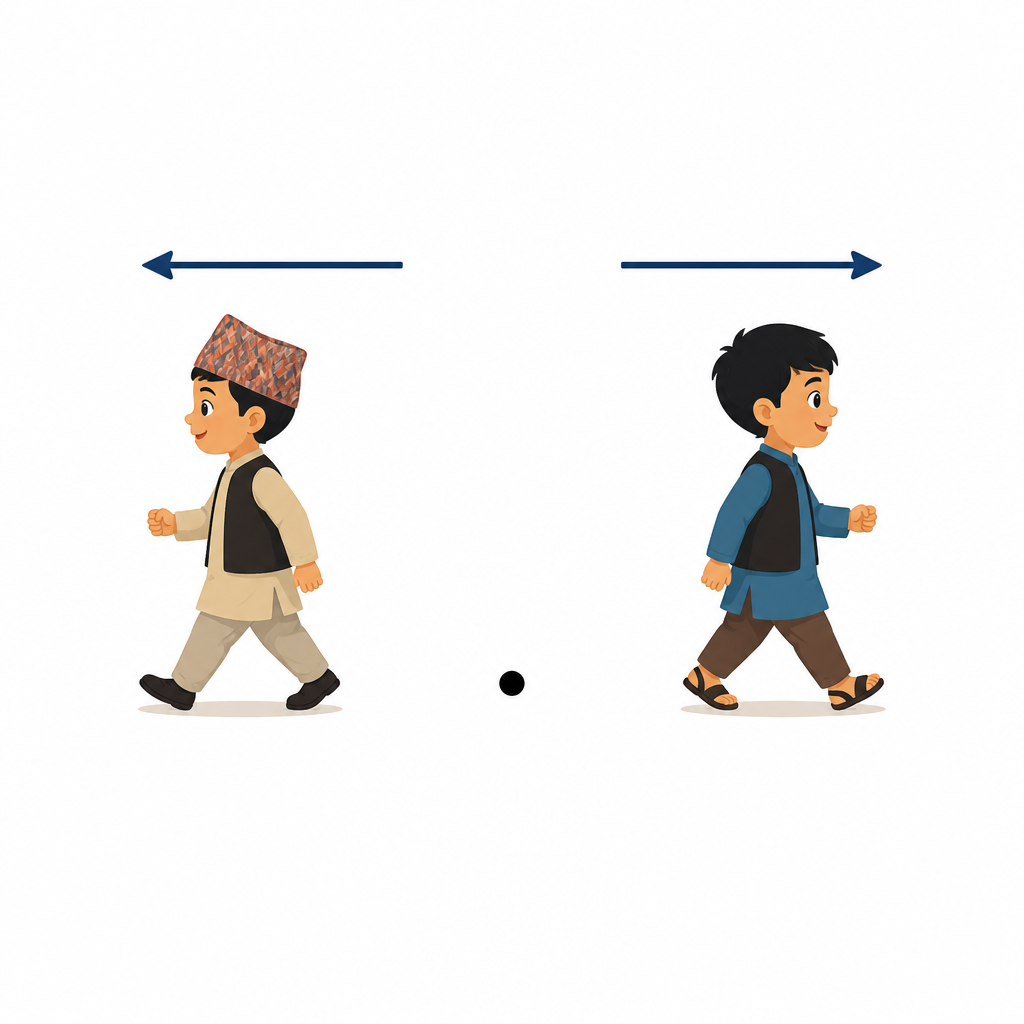
Sometimes you need to know not only how fast something went but also which way it went. The distance covered in a definite direction in unit time, that is, in one second, is called velocity. Velocity too is measured in metres per second. Below, \( s \) stands for the distance covered in the definite direction and \( t \) for the total time taken to cover it.
\[ v = \frac{s}{t} \]
Velocity: the distance covered in a definite direction in unit time is called velocity. Because velocity has both magnitude and direction, it is called a vector quantity.
When you write an answer for velocity, you must write the direction along with the number and the unit. For example, the cycle moved with a velocity of 12 metres per second towards the east. An answer with no direction in it is an answer for speed, not for velocity.
Telling Speed and Velocity Apart
In everyday talk, speed and velocity may sound like the same thing, but in physics their meanings are different. The comparison below makes the two easy to keep apart.
| Basis | Speed | Velocity |
| Meaning | Distance covered in unit time | Distance covered in a definite direction in unit time |
| Direction | Has no direction | Has a definite direction |
| Kind of quantity | Scalar | Vector |
| Unit | Metres per second (m/s) | Metres per second (m/s) |
| Example | The speed of the car is 20 metres per second | The velocity of the car is 20 metres per second towards the east |
In ordinary speech, speed and velocity are used as if they meant the same thing, but in physics they are two different quantities. A value without a direction is speed, and a value with a direction is velocity.
The full lesson is waiting for you
The notes are free to read in full. A free account opens the rest of the practice, and tracks your progress and confidence score for every subject. Presentations and videos need approval from Learn Yeti.