Pressing With a Sharp End and a Blunt End
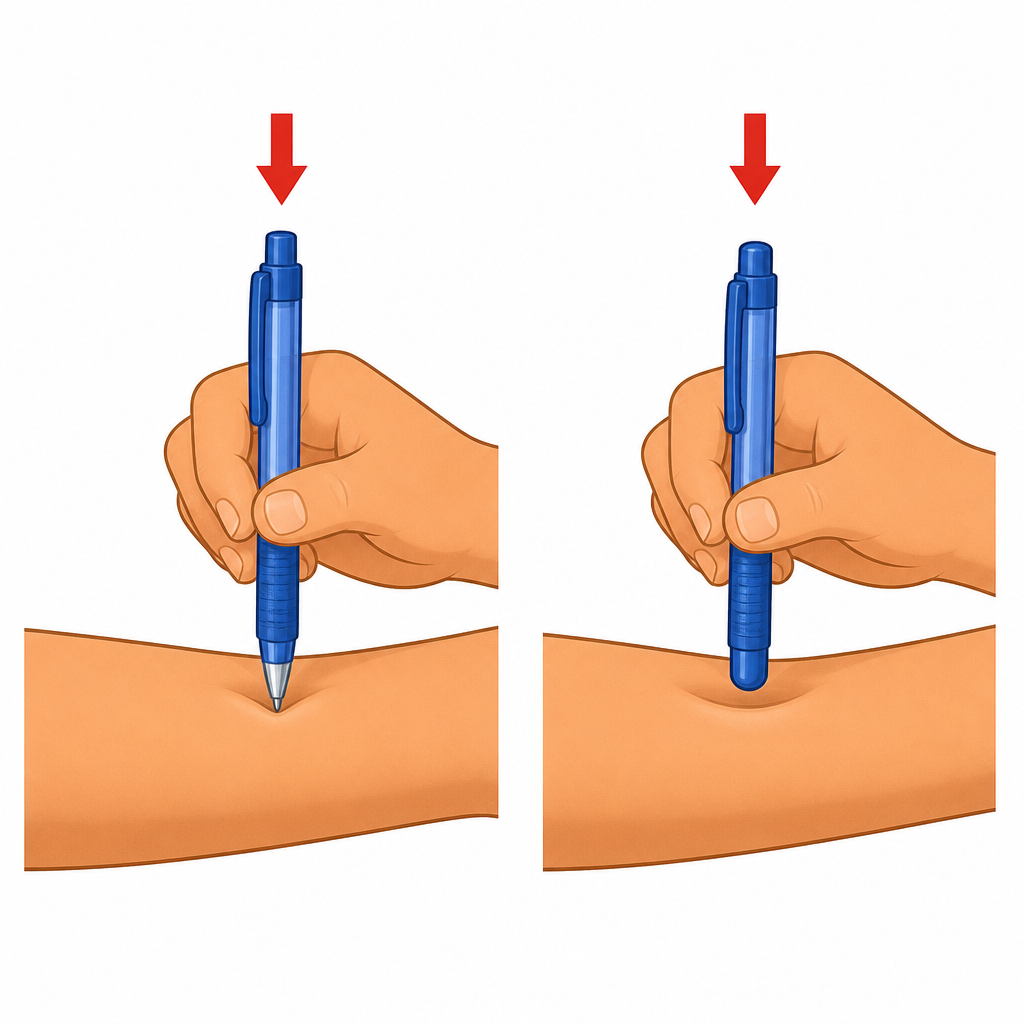
Take a ball pen that has no refill in it. First press the pointed front end of it gently against your wrist. Then press the blunt back end of the same pen against the same spot with the same push. The force your hand gives is the same both times, yet the pointed end hurts more and leaves a small dent in the skin. The blunt end hardly hurts at all. The difference is not in the force. The difference is in the area that the force acts on. The pointed end touches only a tiny patch of skin, so the whole force is crowded onto that tiny patch. The blunt end touches a much wider patch, so the very same force is spread out across it.
Do not jab the pointed end hard. Press only enough to feel the skin give way, because on a very small area even a small force is enough to break the skin.
What a Brick on a Foam Pad Shows
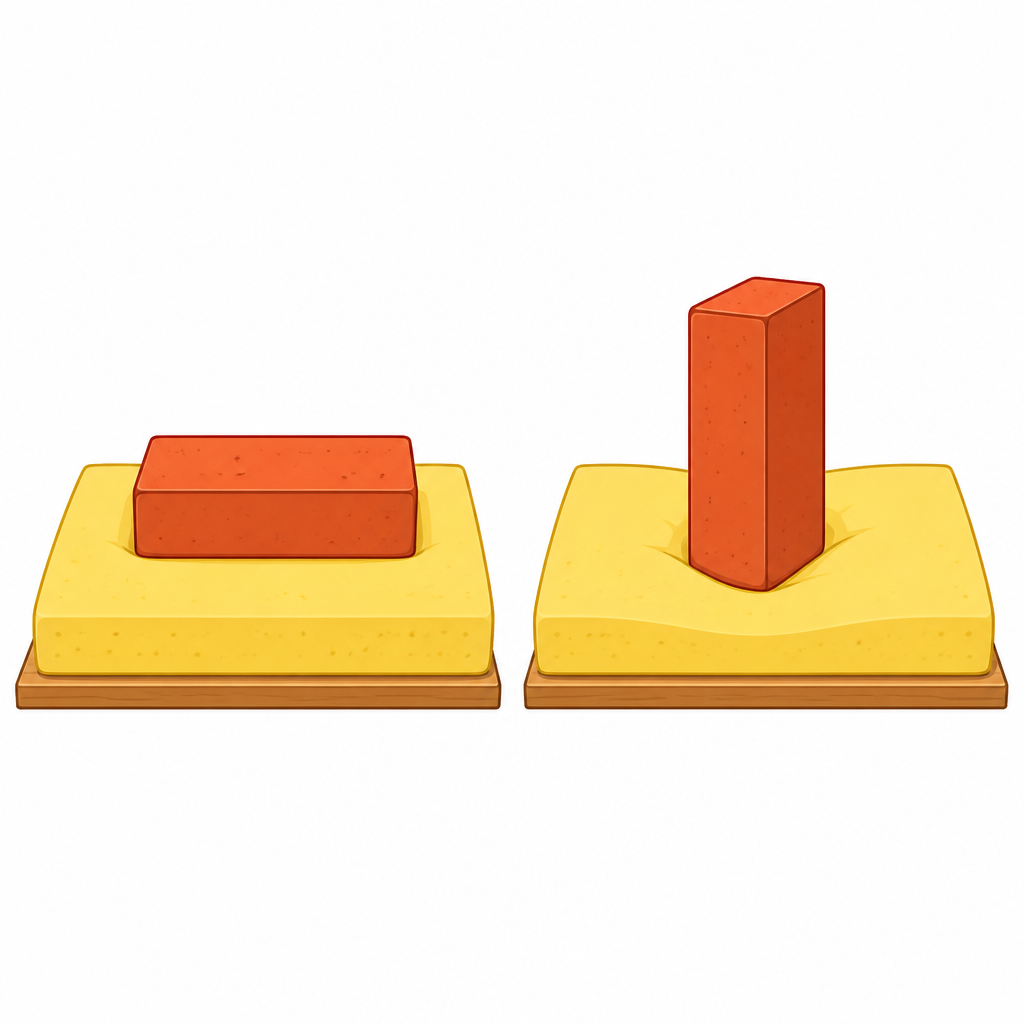
Take a brick and a pad of foam. Rest the foam on a plank or a table. First lay the brick on the foam on its broad face and watch how far the foam sinks. Then stand the same brick upright on the foam so that only its narrow face touches. Now the foam sinks much deeper than before. The brick is the same brick and its weight has not changed, so the force on the foam is the same both times. The only thing that has changed is the area of foam the brick is touching. On the broad face the force is shared over a large area and the foam dips only a little. On the narrow face the same force is concentrated on a small area and the foam is pushed in deeply.
What Pressure Is
Both of those activities show one and the same thing. When a force is applied to something, the effect is small if the force acts over a large area, and the effect is large if the same force acts over a small area. The force acting perpendicularly on a definite area is what we call pressure. Perpendicular means that the force meets the surface at a right angle, pushing straight into it. A force that slides along a surface or meets it at a slant is not counted as pressure in this sense.
Pressure: the force applied perpendicularly on unit area is called pressure.
Keep the force the same and make the area smaller, and the pressure rises. Make the area larger, and the pressure falls. To change pressure we usually change the area, not the force.
Measuring Pressure
The pressure produced at a place depends on the force applied there. A bigger force gives a bigger pressure. In the same way, a smaller area of contact gives a bigger pressure, while a larger area of contact gives a smaller pressure. If the force applied at a place is F, the area of that place is A and the pressure is P, then pressure is worked out like this:
\[ P = \frac{F}{A} \]
Force is measured in newtons (N) and area is measured in square metres (m²). So the unit of pressure is the newton per square metre (N/m²). This same unit is also called the pascal (Pa). When you calculate, the force must always be in newtons and the area always in square metres, and only then does the answer come out in pascals.
\[ 1\ \text{Pa} = 1\ \text{N/m}^2 \]
One Pascal of Pressure
One pascal of pressure: the pressure produced when a force of 1 N acts on an area of 1 m² is called one pascal.
One pascal is a very small pressure. Spreading the weight of about one small apple over a whole square metre gives roughly that much pressure. That is why the pressures met in everyday examples run into hundreds or thousands of pascals.
If the area is given in square centimetres, change it into square metres before using it. Putting it straight into the formula does not give an answer in pascals, and the number comes out thousands of times wrong.
Worked Example: The Pressure a Cupboard Puts on the Floor
A cupboard weighing 1800 N covers an area of 1.5 m² on the floor. How much pressure does it put on the floor? And if the same cupboard is placed so that it covers 3 m², what difference does that make to the pressure?
Step 1: The weight of the cupboard is the force pressing straight down on the floor, so the force is \( F = 1800\ \text{N} \) and the area covered is \( A = 1.5\ \text{m}^2 \). The formula to use is:
\[ P = \frac{F}{A} \]
Step 2: Putting the force and the area into the formula and dividing:
\[ P = \frac{1800\ \text{N}}{1.5\ \text{m}^2} = 1200\ \text{Pa} \]
Step 3: Now the same cupboard is placed so that it covers 3 m². The force stays 1800 N and only the area changes:
\[ P = \frac{1800\ \text{N}}{3\ \text{m}^2} = 600\ \text{Pa} \]
Here a smaller area gives a greater pressure and a larger area gives a smaller pressure. Doubling the area has halved the pressure.
If the force does not change, doubling the area halves the pressure and halving the area doubles it. This opposite relationship between pressure and area is the reason many everyday tools are shaped the way they are.
Pressure in Everyday Life
Pressure has an important part to play in many of the things we do every day. Sometimes we need a large pressure, and then the working part of the tool is made small. The iron share of the plough that turns the field is made sharp, so that even a small force produces a large pressure and ploughing becomes easy. In the same way a sickle and a weeding hoe are given a keen edge for cutting firewood and wood. So that an iron nail can be driven easily into wood or a wall, the tip of the nail is made pointed. The point of a needle, the edge of a knife and the tip of a syringe needle are kept small for exactly the same reason.
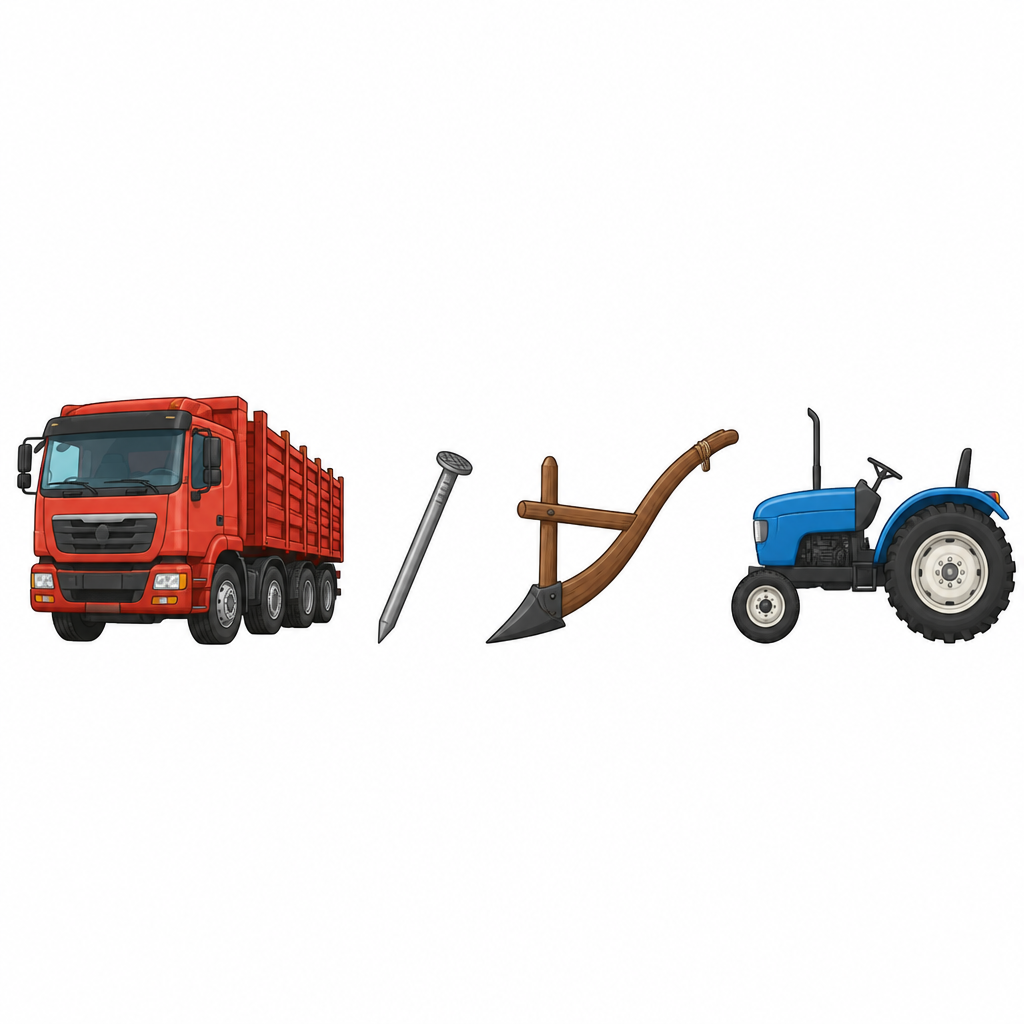
Sometimes too much pressure makes work difficult, and then the pressure has to be brought down by making the area of contact wider. So that a tractor does not sink into the field it is ploughing, its rear wheels are made large. In the same way, trucks that carry heavy loads are given many wheels at the back, so that the pressure on the road stays low and the road is not damaged even under a great weight. A house is given a wide foundation and a school bag is given broad shoulder straps for the very same reason.
Ways of Increasing and Reducing Pressure
| Aim | What is done to the area | Example |
| To increase pressure | The area of contact is made small | The sharp share of a plough, the tip of a nail |
| To increase pressure | The edge is made thin | The keen edge of a sickle and a hoe, the point of a needle |
| To reduce pressure | The area of contact is made large | The large rear wheels of a tractor |
| To reduce pressure | The load is put on more points | The many wheels of a heavy truck, the wide foundation of a house |
The full lesson is waiting for you
The notes are free to read in full. A free account opens the rest of the practice, and tracks your progress and confidence score for every subject. Presentations and videos need approval from Learn Yeti.