Moving a Heavy Rock with a Bar
Imagine a large rock in a field that is far too heavy to shift by hand. People solve this with a long iron bar. They push one tip of the bar under the rock, set a small stone under the bar close to the rock, and press down on the far end of the bar. The rock that would not move for bare hands now starts to lift.
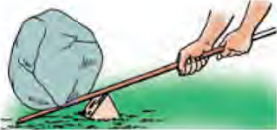
A hammer at home is another such tool. It drives nails in, and the split claw at the back of its head pulls nails out. Looking at these two tools raises three questions. What jobs are they used for? How can a small push move a large weight? What other tools of daily life work the same way? The idea of a lever answers all three.
What Is a Lever?
Think of a beam balance, a rice-pounding lever, scissors, tongs, a wheelbarrow and the bar used on the rock. Each one is long and stiff. Each one rests on a single fixed point, turns about it freely, and works against some weight. Every tool like this is called a lever.
Lever: a long, rigid object that rests on a fixed point and can turn freely about that point is called a lever.
The Greek scientist Archimedes is famous for saying, "Give me a point to rest my lever on and I will move the Earth." He had worked out the lever as early as 240 BC.
Parts of a Lever
Go back to the bar and the rock. There is the small stone the bar rests on, the heavy rock being lifted, and the end your hands press. Every lever has these three places. Each has a name, and so do the distances between them.
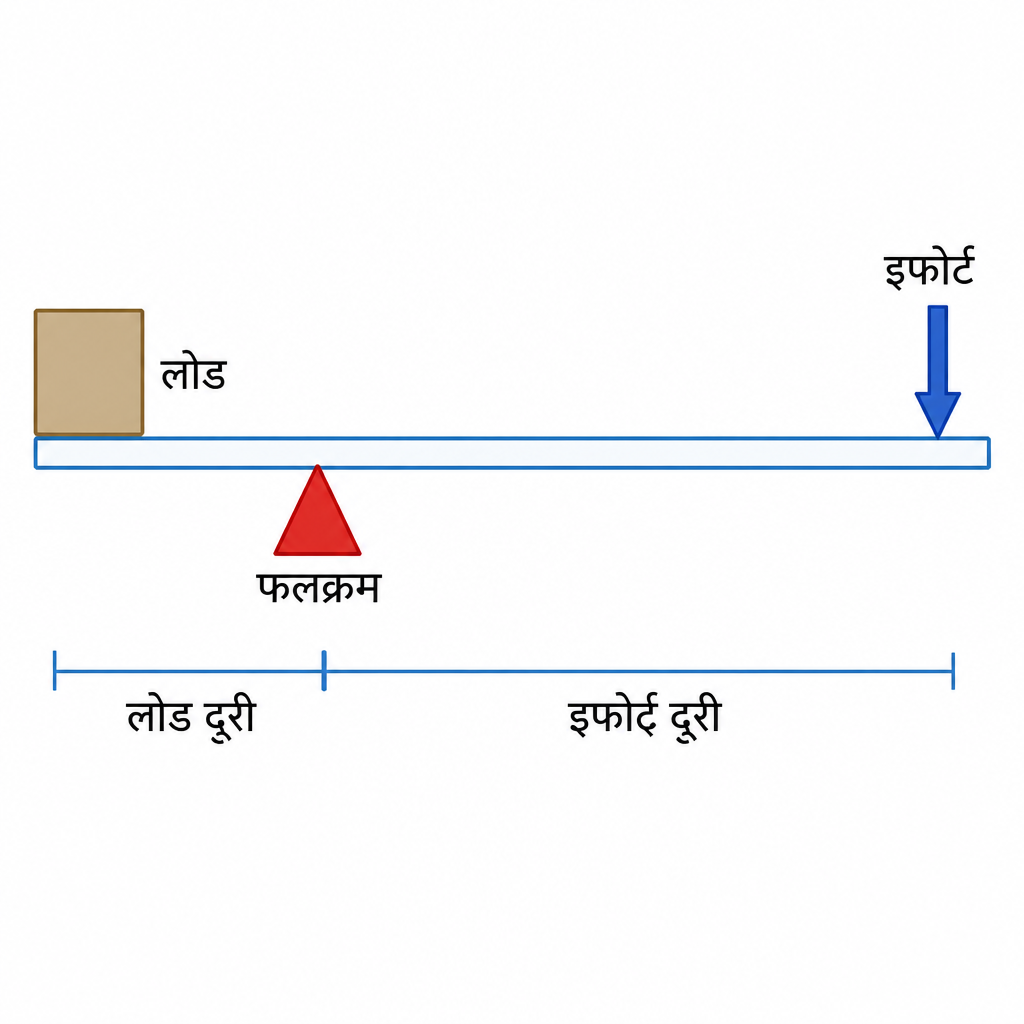
Fulcrum: the fixed point on which a lever rests and about which it turns.
Effort: the force we apply to a lever.
Load: the object that the lever has to lift or move.
Effort distance: the distance from the point where the effort is applied to the fulcrum.
Load distance: the distance from the load to the fulcrum.
Effort arm and load arm: the part of the lever from the fulcrum to the effort is the effort arm, and the part from the fulcrum towards the load is the load arm.
An arm and a distance are not the same kind of thing. An arm is a piece of the lever itself, something you could touch. A distance is a length you measure and write in centimetres or metres. On the bar, the fulcrum is close to the rock and the hands are far away, so the effort distance is long and the load distance is short. That is why a small effort lifts the heavy rock.
| Part | Where it is | In the rock and bar |
| Fulcrum | The point the lever rests on | The small stone under the bar |
| Load | The object to be lifted or moved | The heavy rock |
| Effort | The force applied | The push of the hands |
| Load distance | From the load to the fulcrum | Rock to small stone, short |
| Effort distance | From the effort to the fulcrum | Hands to small stone, long |
Types of Lever
Every lever has a fulcrum, a load and an effort, but they are not always in the same order along the bar. In some levers the fulcrum is in the middle, in some the load is, and in some the effort is. Levers are sorted into three classes according to the positions of the fulcrum, the load and the effort.
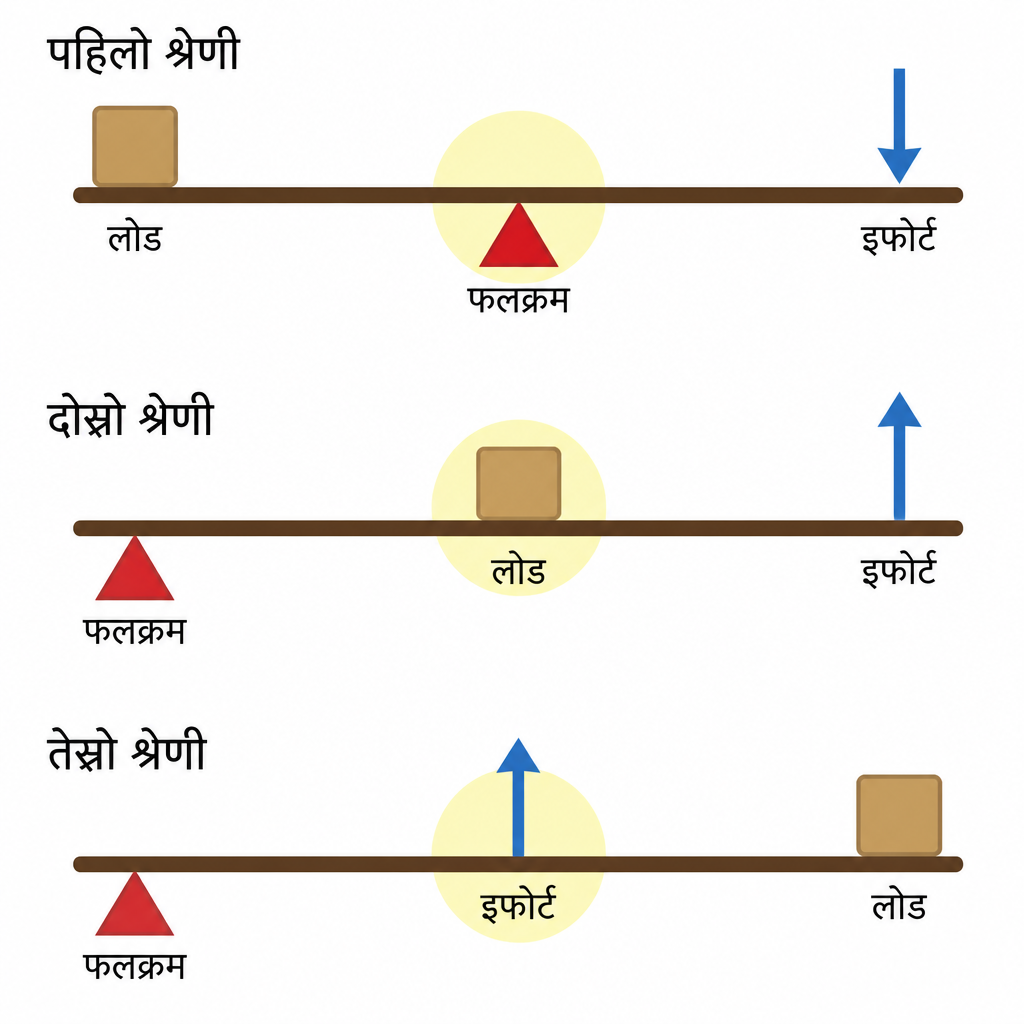
Fulcrum in the middle: first class. Load in the middle: second class. Effort in the middle: third class.
First Class Lever
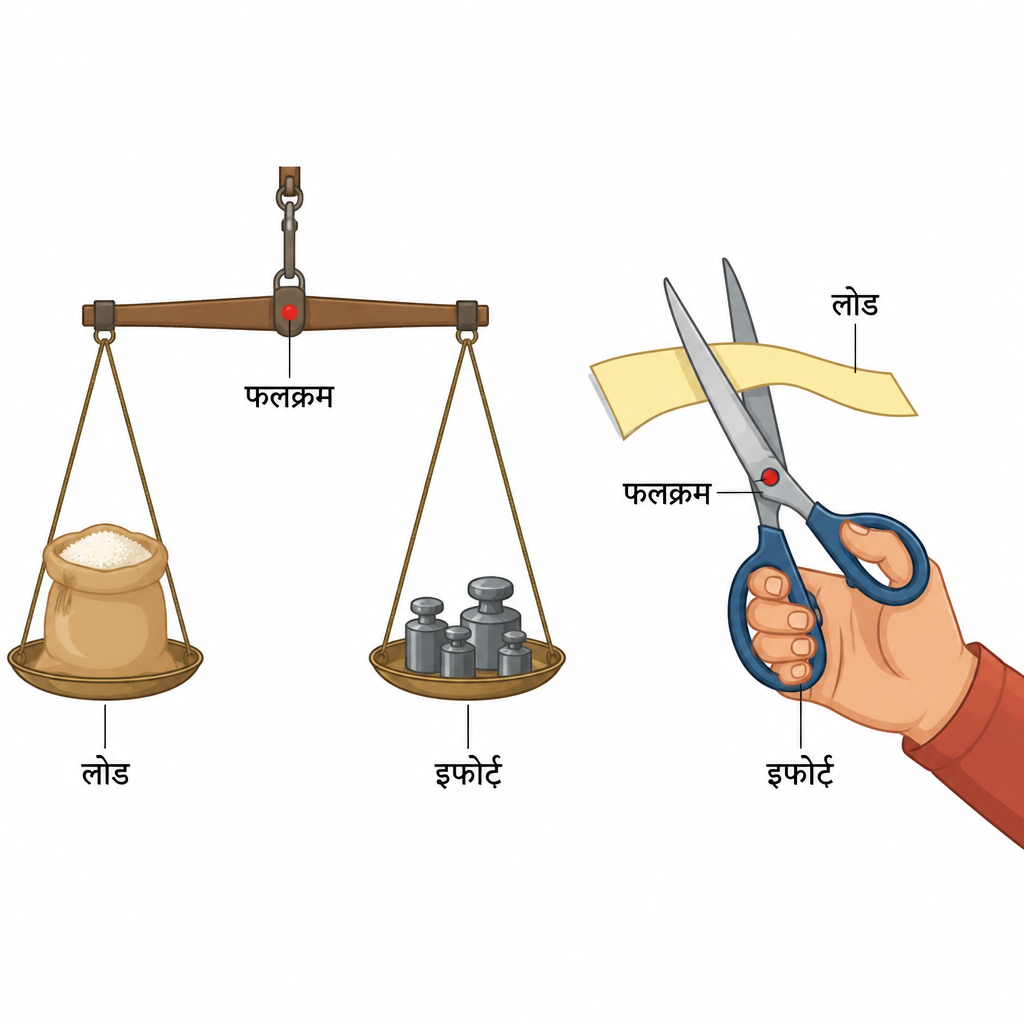
First class lever: a lever with the fulcrum between the load and the effort, the load at one end and the effort at the other.
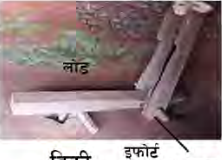
A beam balance, scissors, a rice-pounding lever and a crowbar are first class levers. A beam balance hangs from its middle, which is the fulcrum. The goods in one pan are the load and the standard weights in the other pan provide the effort. In scissors the rivet joining the blades is the fulcrum, the paper or thread being cut is the load, and the handles squeezed by your fingers carry the effort. A rice-pounding lever is a heavy wooden beam on a pivot. A foot presses one end, the beam turns on the pivot in the middle, and the heavy head at the other end rises and drops to pound the grain.
Second Class Lever
Second class lever: a lever with the load between the fulcrum and the effort, the fulcrum at one end and the effort at the other.
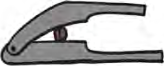
A betel nut cutter, a lemon squeezer and a one-wheeled wheelbarrow are second class levers. The two handles of the nut cutter are hinged together at one end, and that hinge is the fulcrum. The nut sits in the middle as the load. Your hand squeezes the far ends of the handles as the effort. A lemon squeezer works the same way. In a wheelbarrow the wheel is the fulcrum, the stones or soil in the tray are the load, and the handles lifted by your hands carry the effort.
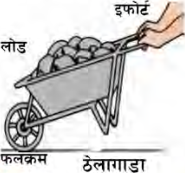
In a second class lever the load always lies between the fulcrum and the effort, so the effort distance is always longer than the load distance. That is why a wheelbarrow full of stones is still easy to lift at the handles.
Third Class Lever
Third class lever: a lever with the effort between the fulcrum and the load, the fulcrum at one end and the load at the other.
A shovel, tongs and a hammer are third class levers. The two arms of a pair of tongs are joined at one end, and that joint is the fulcrum. Your fingers press in the middle as the effort, and the roti or piece of coal gripped at the tips is the load. When you dig with a shovel, the top hand stays still as the fulcrum, the lower hand pushes in the middle as the effort, and the soil on the blade is the load. When a hammer drives a nail, your elbow or wrist is the fulcrum, the hand gripping the handle gives the effort, and the nail struck by the head is the load.
Because the effort is in the middle of a third class lever, the effort distance is shorter than the load distance. So you must push harder than the load. In return the load end moves quickly and a long way, which is why tongs flip a hot roti neatly and a shovel throws soil far.
The class can change with the way a tool is used. A hammer driving a nail is a third class lever. When its claw pulls a nail out, the head rests on the wood as a fulcrum between the nail and your hand, so it becomes a first class lever. Always look at the job the tool is doing before you name its class.
The Three Classes Side by Side
| Class | In the middle | At the two ends | Examples |
| First class | Fulcrum | Load and effort | Beam balance, scissors, rice-pounding lever, crowbar |
| Second class | Load | Fulcrum and effort | Betel nut cutter, lemon squeezer, one-wheeled wheelbarrow |
| Third class | Effort | Fulcrum and load | Shovel, tongs, hammer |
Finding the Class of Any Tool
When you meet a tool you have not seen before, work out whether it is a lever and which class it belongs to like this:
- Find the point the tool turns about or rests on. That is the fulcrum. If there is no such point, the tool is not a lever.
- Find what the tool lifts, cuts, grips or moves. That is the load.
- Find where your hand or foot pushes or pulls. That is the effort.
- See which of the three is in the middle: the fulcrum means first class, the load means second class, the effort means third class.
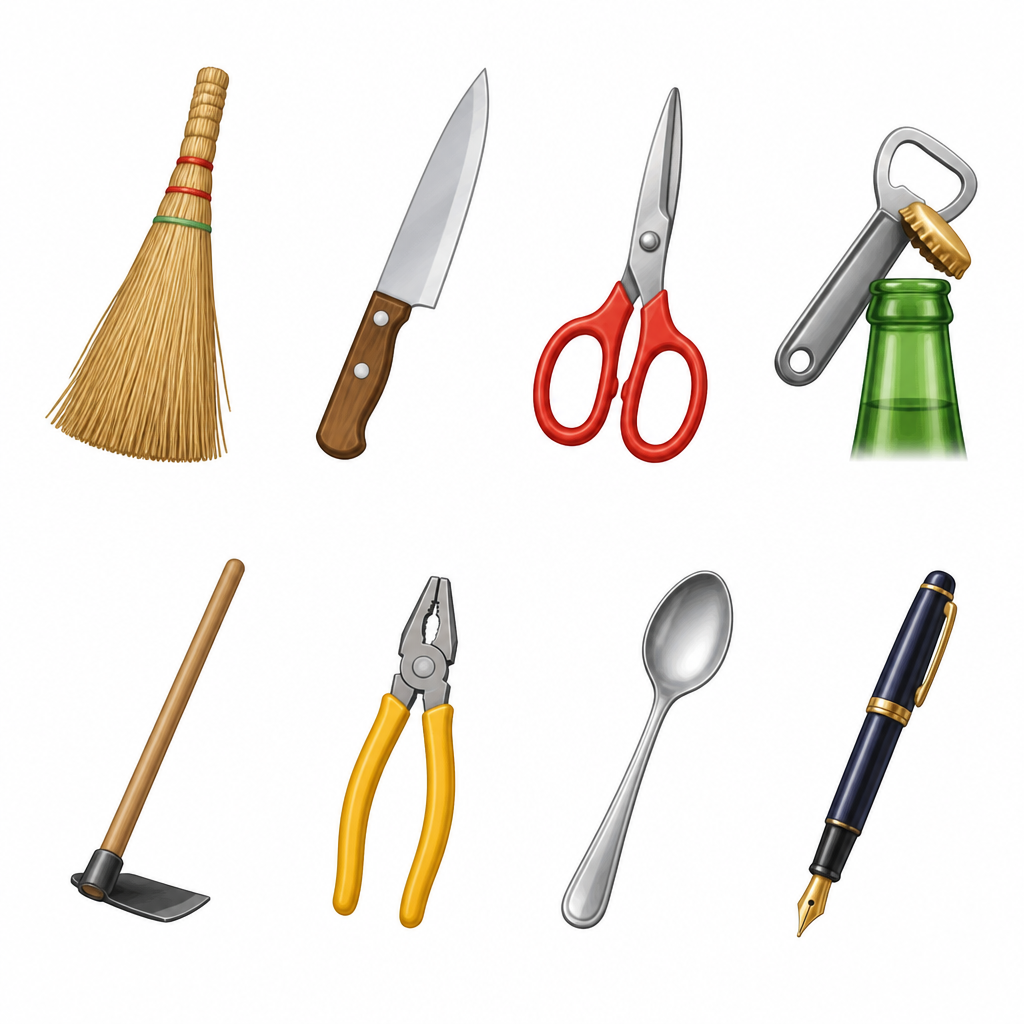
Try the method on the eight objects below. Scissors and pliers turn on a rivet in the middle, so both are first class levers. A bottle opener rests its tip on top of the cap with the cap's edge in the middle, so it is a second class lever. When you sweep with a broom, the top hand stays still and the lower hand pushes in the middle, so it is a third class lever. A knife, a spoon and a pen do not turn about a fixed point in normal use, so they are not being used as levers.
Your home, kitchen, farm and school are full of levers: a see-saw, a nail clipper, a pair of forceps, a boat's oar. Collect as many as you can and sort them into first, second and third class.
The full lesson is waiting for you
The notes are free to read in full. A free account opens the rest of the practice, and tracks your progress and confidence score for every subject. Presentations and videos need approval from Learn Yeti.