Less Force, but a Longer Path
A heavy stone lying across a path cannot be lifted by bare hands. Push a long rod under it, rest the rod on a small stone acting as the fulcrum, and the same stone rises under a much smaller push. In the picture below a 600 N stone is being lifted by an effort of only 150 N. The lever has made the force smaller, but it has not given that away for free. The end where the effort is applied has to sweep down a long way while the load rises only a little.
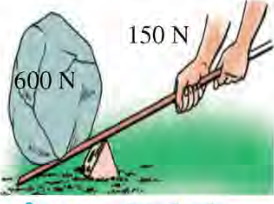
A machine never manufactures work. All it does is trade force against distance. Halve the force and the distance travelled roughly doubles. So when a lever is studied, two distances are measured: the distance moved by the effort, written E.D., and the distance moved by the load, written L.D. Everything that follows, the velocity ratio, the input work, the output work and the efficiency, is built out of those two distances.
Velocity Ratio
When a load is raised with a lever, both the load and the effort move through some distance. Those two distances are never equal. If a small effort is to raise a large load, the effort has to travel much further than the load travels. Covering more distance in the same time means moving faster, so the velocity of the effort is greater than the velocity of the load.
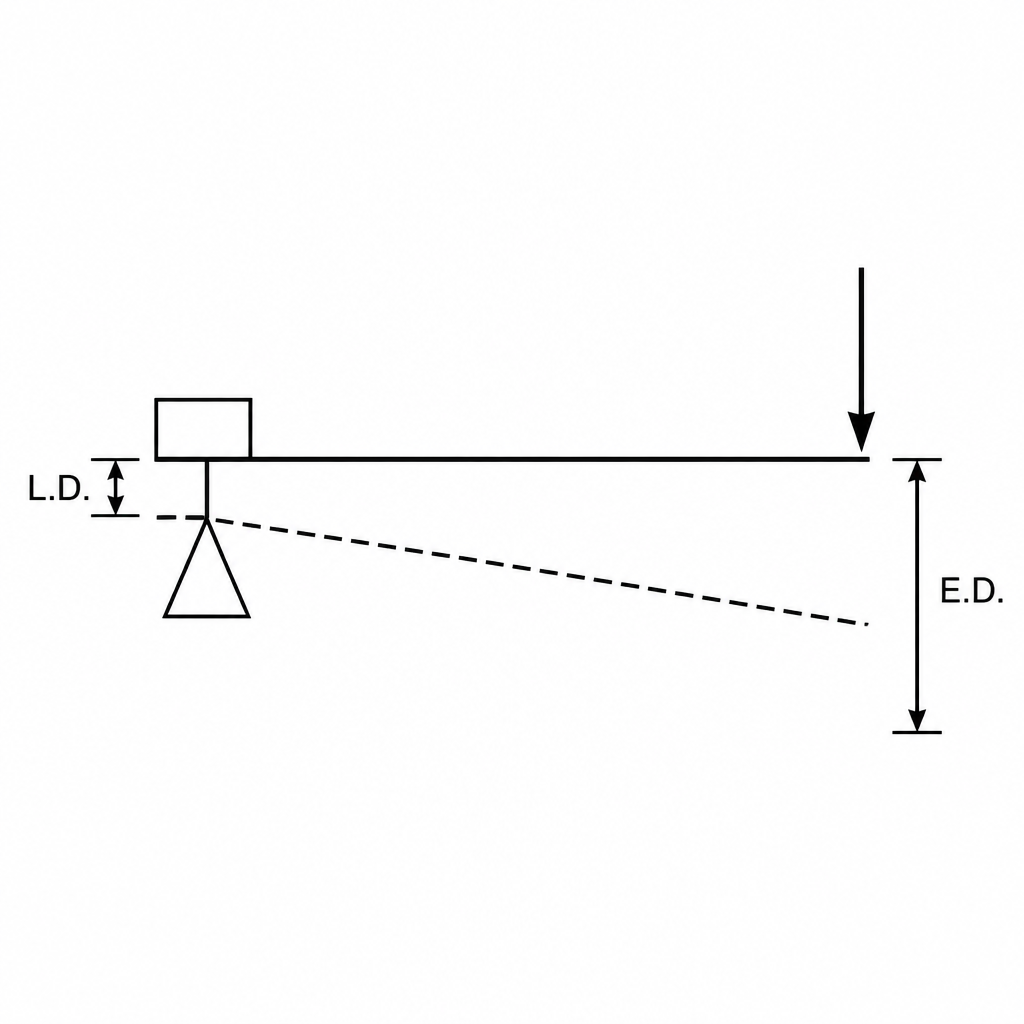
The ratio of the velocity of the effort to the velocity of the load is called the velocity ratio of the lever. Velocity is the distance covered in one unit of time. The load and the effort cover their own distances during the same interval of time, so the same time t appears above and below in the formula.
\[ VR = \frac{E.D./t}{L.D./t} \]
Since the same time t stands both above and below, it cancels out, and the velocity ratio becomes a ratio of two distances only.
\[ VR = \frac{E.D.}{L.D.} \]

Velocity ratio: the ratio of the distance covered by the effort to the distance covered by the load. It is written as VR.
The velocity ratio is one distance divided by another, so metres cancel metres and the answer has no unit at all. The answer is 5, never 5 metres.
Why Friction Does Not Change the Velocity Ratio
How far the effort moves and how far the load rises are settled by the shape of the lever alone. The position of the fulcrum, the length of the effort arm and the length of the load arm fix those two distances. Whether the rod is rusty or smooth, whatever friction there may be at the fulcrum, the longer effort arm still sweeps through the same larger distance. So friction has no effect at all on the velocity ratio of a simple machine.
Mechanical advantage is a different story. Some of the force has to be spent on overcoming friction, so a larger effort is needed to raise the same load, and a larger effort means a smaller mechanical advantage. Friction pulls the mechanical advantage down while leaving the velocity ratio untouched, and that is why the mechanical advantage of a real machine is always smaller than its velocity ratio.
In every real machine, where friction is present, the mechanical advantage MA is less than the velocity ratio VR.
Input Work and Output Work
Work is force multiplied by the distance moved in the direction of that force. In a lever, work happens at two places. First, when we press the end of the rod down with our effort, we do work on the machine. Second, when the other end lifts the load, the machine does work on the load.
Input work: the work done when the effort is applied to the machine.
\[ \text{input work} = E \times E.D. \]
Output work: the work the machine itself does on the load when the effort is applied.
\[ \text{output work} = L \times L.D. \]
Both kinds of work are measured in joules, because a newton multiplied by a metre gives a joule. In an ideal machine with no friction the two are exactly equal, and that equality is the working principle of the lever: effort multiplied by effort distance equals load multiplied by load distance. In a real machine part of the work is used up in overcoming friction, so the output work is always smaller than the input work.
| Basis | Input work | Output work |
| Who does it | We do it, by applying the effort | The machine does it, on the load |
| Formula | Effort × effort distance | Load × load distance |
| Unit | Joule (J) | Joule (J) |
| In a real machine | Always the larger | Always the smaller |
Efficiency
Efficiency tells us how much of the work we put into a machine comes back out as useful work. To find it, the output work is divided by the input work and the result is multiplied by one hundred, so that the answer is a percentage. Efficiency is written with the Greek letter η, said as eta.
Efficiency: the ratio of the output work to the input work, expressed as a percentage.
\[ \eta = \frac{L \times L.D.}{E \times E.D.} \times 100\% \]
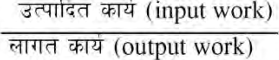
Do not swap the two works. The work done by the effort is the input work and it goes underneath. The work done by the machine on the load is the output work and it goes on top. If they are swapped the answer always comes out above one hundred percent, which no machine can ever reach.
Efficiency from Mechanical Advantage and Velocity Ratio
The formula above can be rearranged, and a much handier formula falls out of it.
Step 1: The ratio of output work to input work is:
\[ \frac{L \times L.D.}{E \times E.D.} \]
Step 2: Pairing the forces together and the distances together gives:
\[ \frac{L/E}{E.D./L.D.} \]
Step 3: The upper part \( L/E \) is the mechanical advantage MA and the lower part \( E.D./L.D. \) is the velocity ratio VR. Therefore the efficiency is:
\[ \eta = \frac{MA}{VR} \times 100\% \]
There are two roads to the efficiency. If you know the two works, divide output work by input work. If you know the forces and distances, divide MA by VR. Both give the same answer.
Why Efficiency Never Reaches 100 Percent
Not all of the work we put into a machine ends up lifting the load. The rod rubs on the fulcrum, the joints scrape against each other, and some of the work is used up in overcoming that friction. That part turns into heat and is lost, doing nothing for the load. So the output work is always smaller than the input work, and their ratio is always less than one.
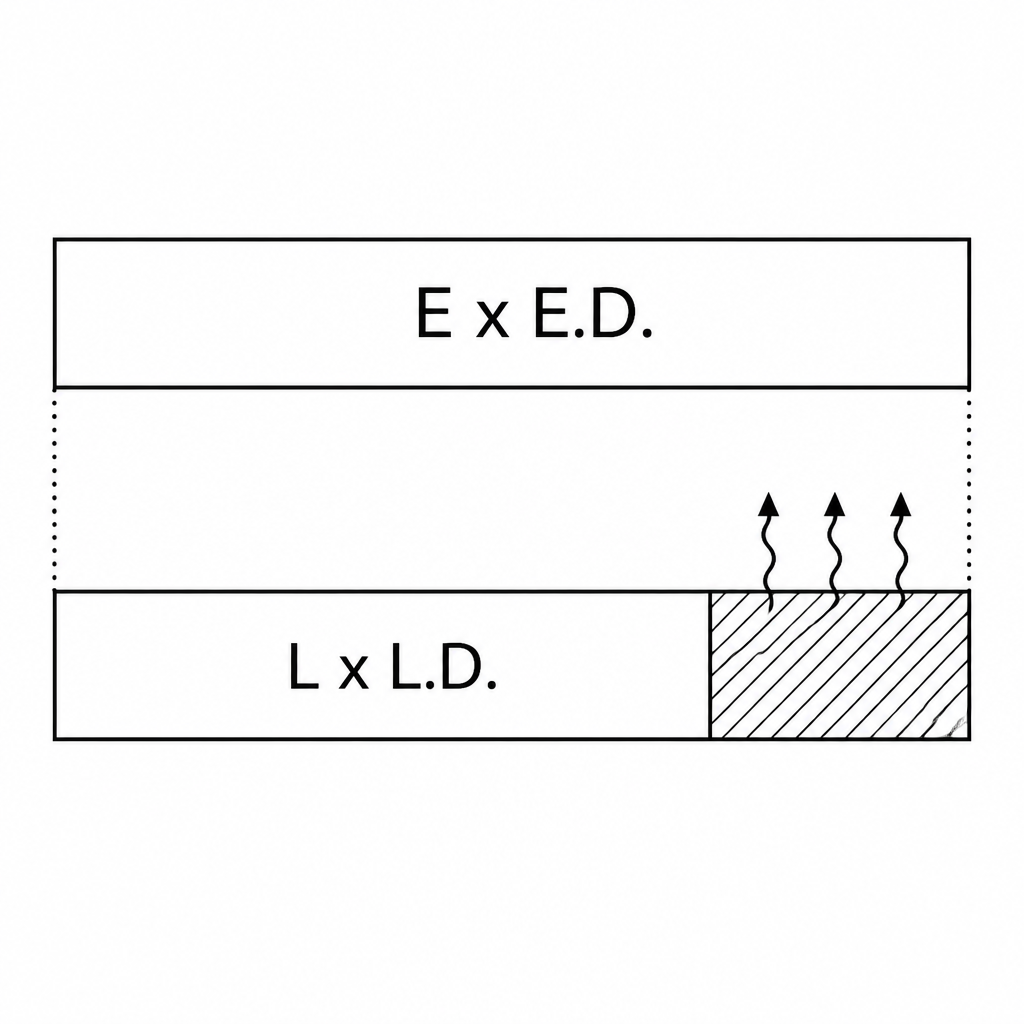
The other formula shows the same thing. Because friction keeps the mechanical advantage below the velocity ratio, the fraction \( MA/VR \) is always less than one, and multiplying by a hundred gives an answer under one hundred percent. Only in an ideal machine with zero friction would MA equal VR and the efficiency come out at exactly 100%. A practice problem that ignores friction can indeed give 100%, but a real lever never reaches it.
Mechanical advantage and velocity ratio carry no unit, so never write N or m after them. Efficiency, however, must always carry the % sign. And an answer for work must always carry the joule.
The full lesson is waiting for you
The notes are free to read in full. A free account opens the rest of the practice, and tracks your progress and confidence score for every subject. Presentations and videos need approval from Learn Yeti.