Splitting a Soaked Bean Open
Before beans, chickpeas or soybeans are cooked, they are put to soak in water. After a night in water the seed swells and its thin outer skin peels off easily with a fingernail. Once the skin is off, the seed can be split into two halves with your fingers. Those two halves are the thick food stores packed inside the seed. Where the two halves join, a small whitish curved piece stays attached. That small piece is the beginning of the plant, the part that will later make the root and the shoot.
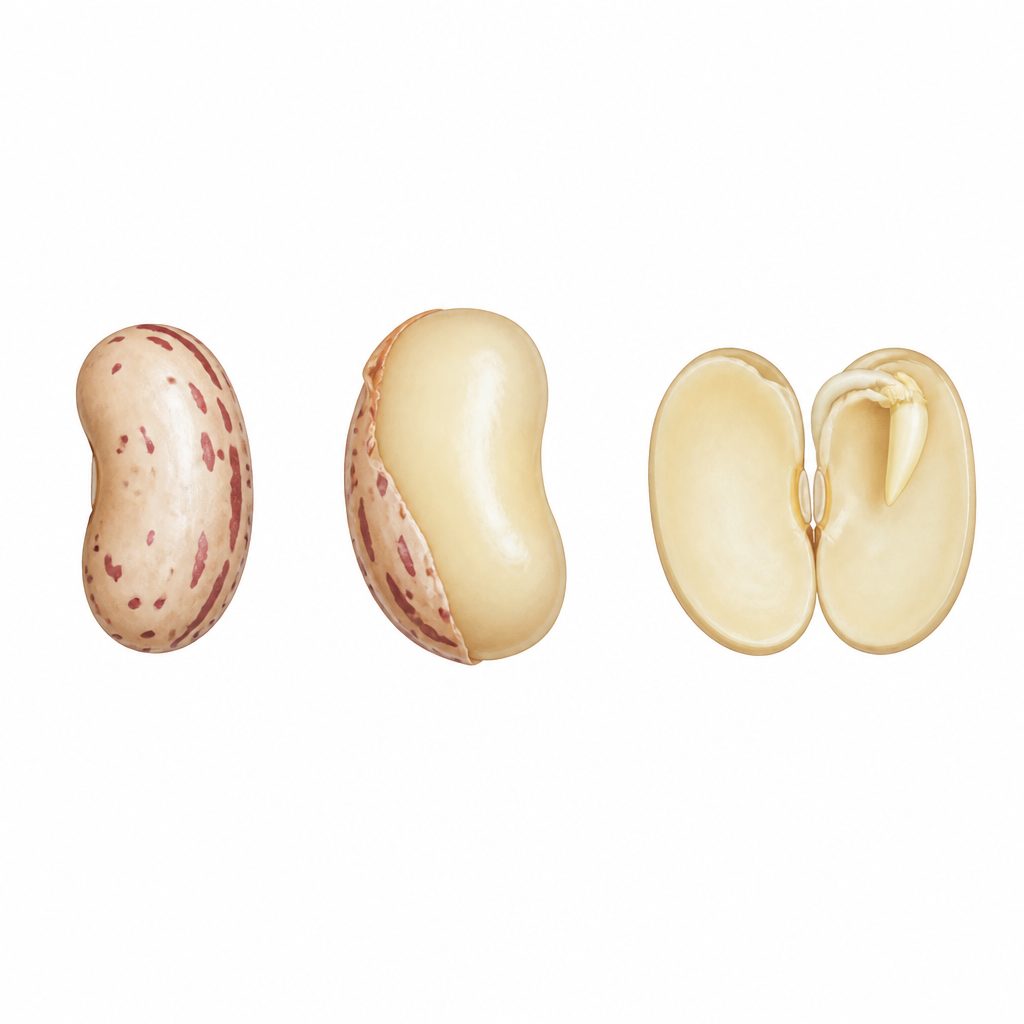
A grain of maize, rice or wheat does not split like that. Even after soaking it stays as one piece. So seeds are not all built the same way. To understand what is inside a seed, and what changes from one kind of seed to another, the parts of a seed have to be named and recognised.
The Three Parts of a Seed
A seed is formed inside the ovule after fertilisation. It carries a young plant, the food that young plant will need, and an outer covering that protects both. The structure of a seed is divided into three parts:
- (a) Seed coat
- (b) Embryo
- (c) Endosperm
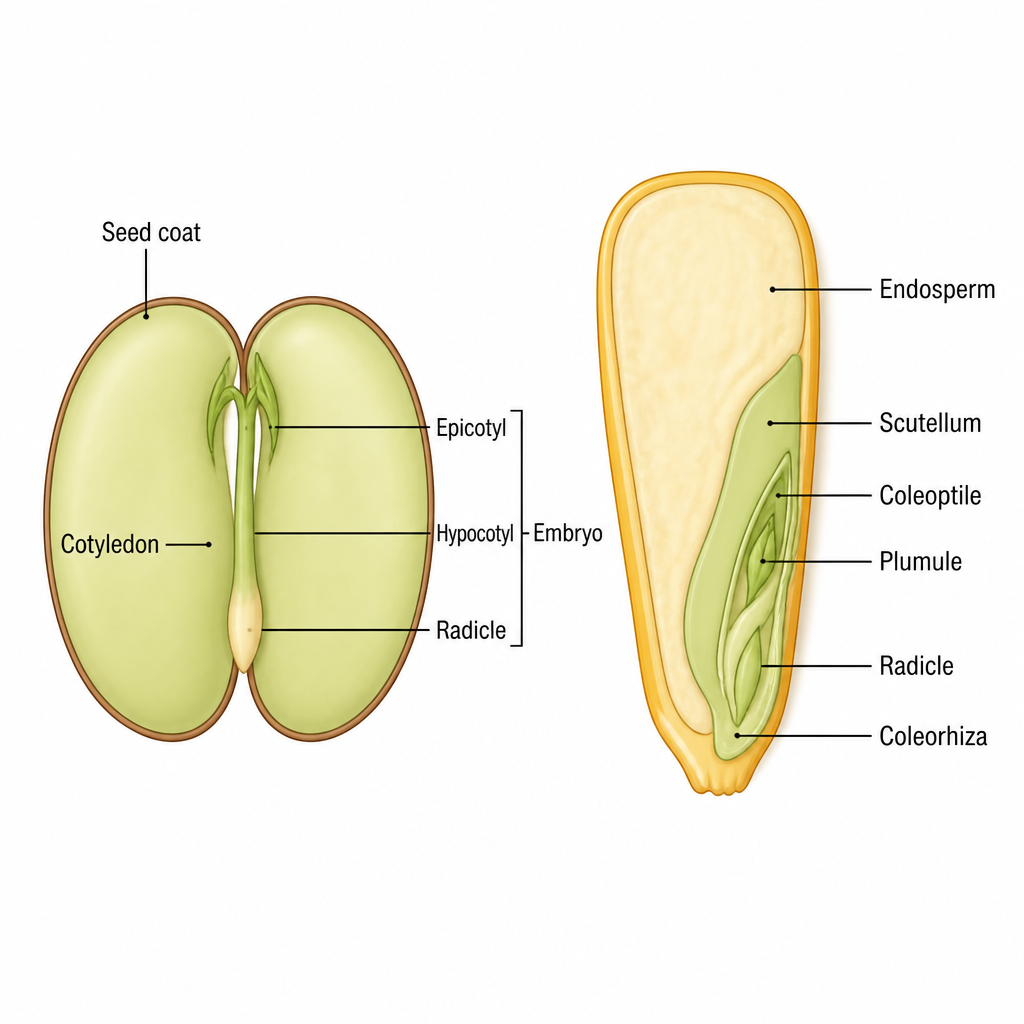
The three parts do three different jobs. The seed coat protects, the embryo grows into the new plant, and the endosperm supplies food.
The Seed Coat
The seed coat is the outer covering of the seed. It is multicellular and it has two layers. The thick outer layer is called the testa and the thin inner layer is called the tegmen. The skin you peel off a soaked bean with your nail is this coat. In plants such as litchi and coconut the seed coat is very hard.
Seed coat: the outer multicellular covering of a seed, made of a thick outer layer called the testa and a thin inner layer called the tegmen.
The seed coat protects the seed from the effect of strong sunlight and of water. It also keeps the seed from germinating for a long time when the surroundings are not suitable. That second job matters a great deal. A seed that fell on the ground and sprouted in the cold or in a dry spell would not survive as a young plant, so a tough coat makes the seed wait.

The Embryo
The embryo is the main part of the seed. It is formed from the zygote produced by fertilisation inside the ovule. The embryo has three main parts: the cotyledon, the plumule and the radicle.
Cotyledon: the thick, soft part of the embryo. It holds nutrients in the form of protein and starch, and when the seed germinates it changes into the embryonic leaf.
The number of cotyledons tells you what kind of seed you are holding. A dicot seed has two cotyledons, a monocot seed has one, and a gymnosperm has more than two. This is why a soaked bean splits into two halves, because those two halves are its two cotyledons.
Plumule: the small feather-like part of the embryo, from which the shoot system develops when the seed germinates.
Radicle: the lower part of the embryo, from which the root develops.
In a diagram of a seed, the part of the embryo axis above where the cotyledons are attached is marked as the epicotyl and the part below it as the hypocotyl. The plumule sits at the epicotyl end and the radicle at the foot of the hypocotyl. In a monocot plant the plumule is wrapped in a covering called the coleoptile, and the first leaf is formed from it when the seed germinates. In the same way the radicle is wrapped in a covering called the coleorhiza. In a maize grain the single shield-shaped cotyledon lying against the endosperm is called the scutellum.
Do not swap the plumule and the radicle. The plumule gives the shoot system that grows upward, and the radicle gives the root that grows downward. Exchanging these two names is one of the commonest mistakes in an exam answer.
The Endosperm
The food-filled part lying inside the seed coat is called the endosperm. It takes up a large share of the seed. It holds plenty of protein, carbohydrate, starch and water. In the coconut this food stays in liquid form, and that liquid is the coconut water people drink. The endosperm supplies nutrients while the embryo is developing and while the seed is germinating.
Endosperm: the nutrient-rich part inside the seed coat, which supplies food while the embryo develops and while the seed germinates.
Both the cotyledon and the endosperm hold food, but they are not the same part. The cotyledon is a part of the embryo itself, while the endosperm is a separate food store lying outside the embryo.
Monocot and Dicot Seeds Compared
The differences you can see when you open a seed are set out below. They rest on the number of cotyledons, on where the food is stored, and on the coverings that wrap the parts of the embryo.
| Basis | Dicot seed | Monocot seed |
| Number of cotyledons | Two | One (the scutellum) |
| Where food is stored | Mostly in the thick cotyledons | In a separate endosperm, which fills a large part of the seed |
| Covering over the plumule | No coleoptile | Wrapped in a coleoptile |
| Covering over the radicle | No separate covering | Wrapped in a coleorhiza |
| When soaked and opened | Splits easily into two halves | Does not split into two halves |
| Examples | Bean, soybean, pea, chickpea | Maize, rice, wheat, barley |
The pulses in a kitchen are mostly dicot seeds and the cereal grains are mostly monocot seeds. Soaking one and trying to split it is enough of a test to tell which is which.
Looking Inside a Soybean Seed
You can study the structure of a soybean seed by observing one yourself. For this you need soybean seeds, water, a hand lens, forceps, a beaker and a watch glass.
- (a) Put the soybean seeds in a beaker of water to soak and leave them for a few days.
- (b) Place a swollen soaked seed on the watch glass and remove its seed coat slowly with the forceps.
- (c) Separate the two halves of the seed gently and observe the different parts of the seed with the hand lens.
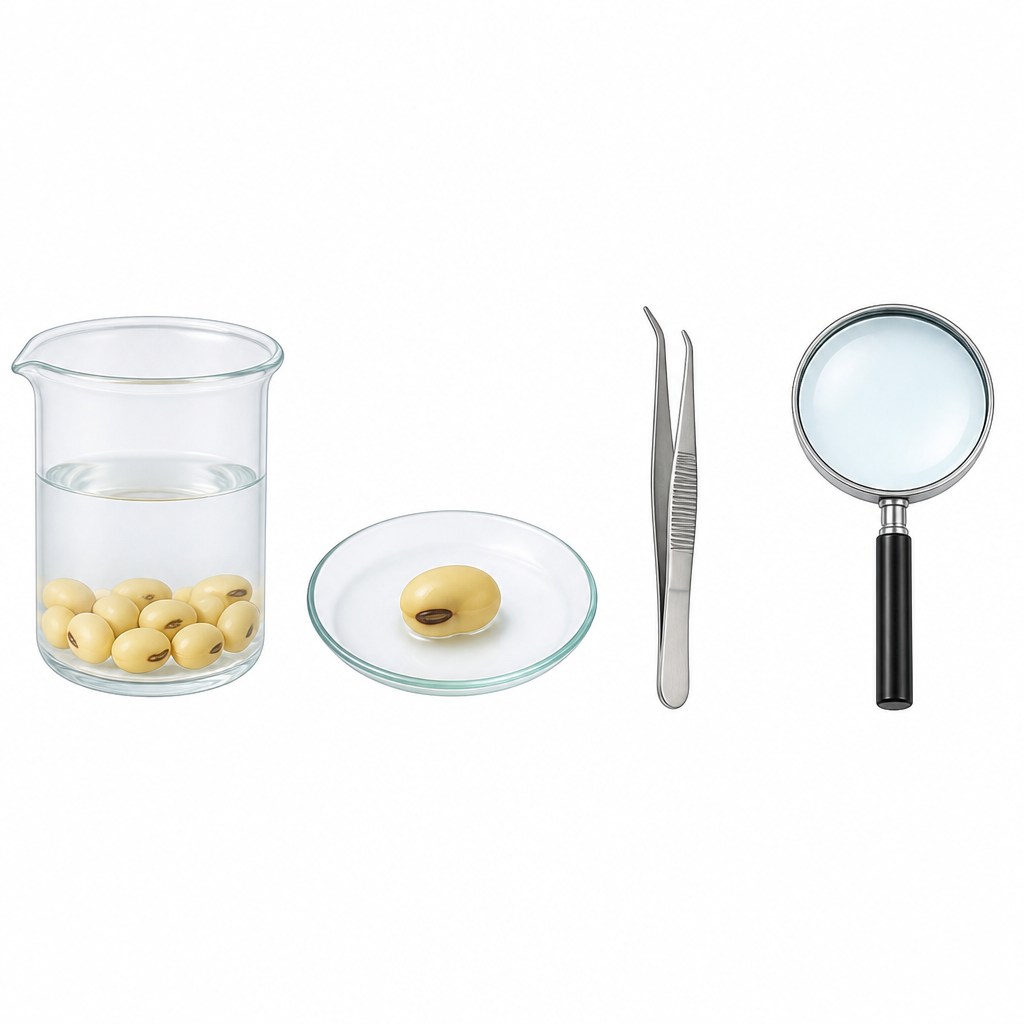
Draw the parts you observed and write the features of each one. Under the hand lens the plumule and the radicle can be told apart where the two halves meet. From this you can conclude that the soybean is a dicot seed.
The tip of the forceps is sharp, so do not pull it towards your fingers while removing the seed coat. The beaker and the watch glass are glass, and they break if they fall.
The full lesson is waiting for you
The notes are free to read in full. A free account opens the rest of the practice, and tracks your progress and confidence score for every subject. Presentations and videos need approval from Learn Yeti.