Living Things Make More of Their Own Kind
A hen settles on her eggs and keeps them warm. After some days the shells crack open and tiny chicks step out. Those chicks grow up and become hens that will lay eggs of their own. In the field a maize plant grows tall, a cob forms on it, and the cob fills with grains. Sow one of those grains and a new maize plant pushes out of the soil. A hen and a maize plant have almost nothing in common, yet both are doing the same job. Both are making new living things that are like themselves.
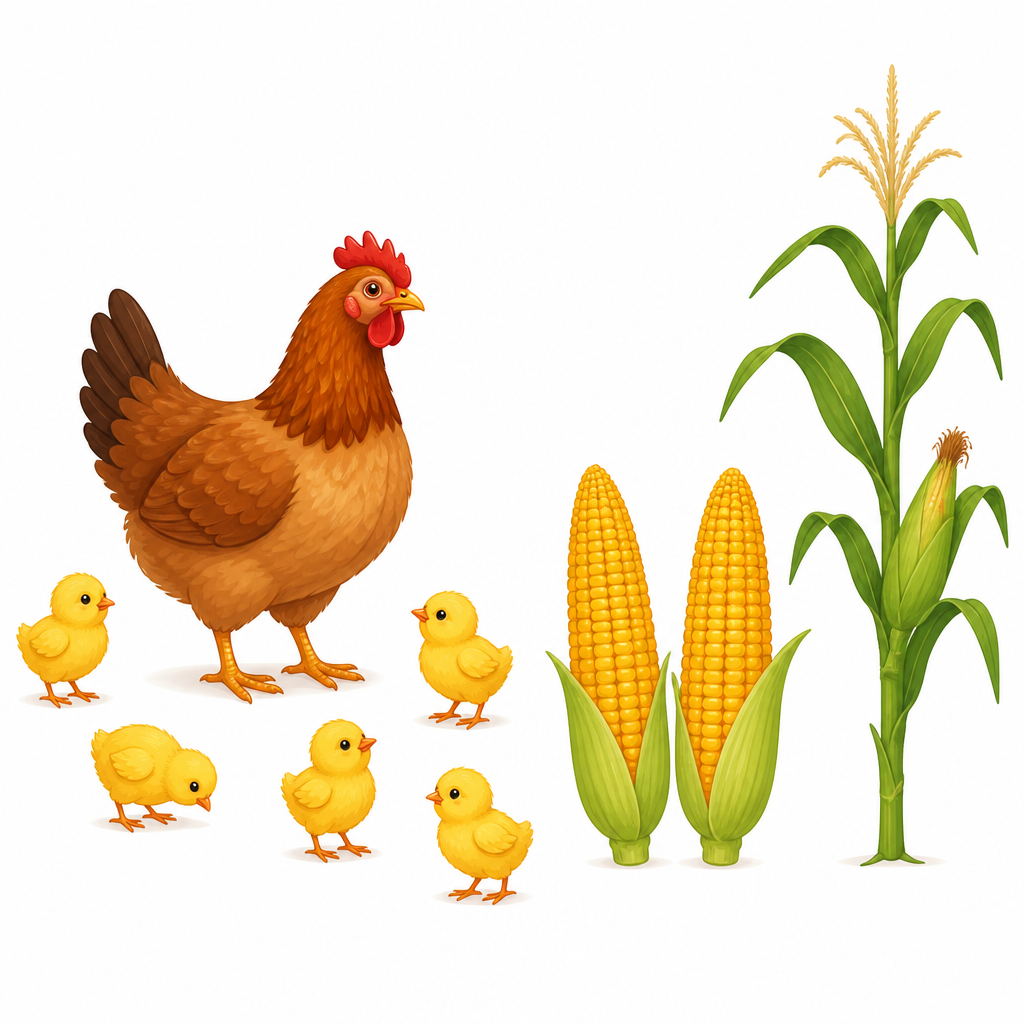
Now stop and think about something. What if no hen anywhere hatched a single chick, and no maize cob anywhere filled with grains? The hens alive today would grow old and die. The maize plants would dry up without leaving anything behind. Within a few years both hens and maize would be gone from the earth. The ability to make offspring is the only thing that keeps a kind of living thing going.
What Reproduction Is
The earth carries a huge number of different living things, and every one of them is producing offspring in some way. Animals get their young by laying eggs, by giving birth, or by other methods. Plants produce new plants from seeds or by other methods. The methods look very different, but the result is always the same. A new living thing appears, and it resembles the parents it came from.
Reproduction: the biological process by which a living thing produces offspring like itself.
Reproduction is a natural property built into living things. Nobody teaches an animal or a plant to do it, and nothing has to be added from outside. It is simply part of being alive. When a living thing reproduces, a starting piece of the future offspring is formed inside its body. That piece is called a reproductive unit, and the whole journey of the new life begins from it.
Reproductive unit: the special cell or part from which an offspring begins. Seeds, spores and sex cells are all reproductive units.
Breathing, digesting food and moving are life processes an animal or a plant needs in order to stay alive itself. Reproduction is different. No individual needs it to survive, but its whole species needs it.
Do not treat growth and reproduction as the same thing. A plant getting taller or a calf getting heavier is growth, and growth never increases the number of living things. Only reproduction adds a new individual.
How Plants Produce Offspring
In a flowering plant the reproductive work is finished inside the flower, and the flower then produces seed. Given soil, water, air and a suitable temperature, that seed germinates and grows into a new plant, which is the offspring of the old one. A single grain on a maize cob, a single grain of paddy or a single mango stone is a whole plant waiting to start.
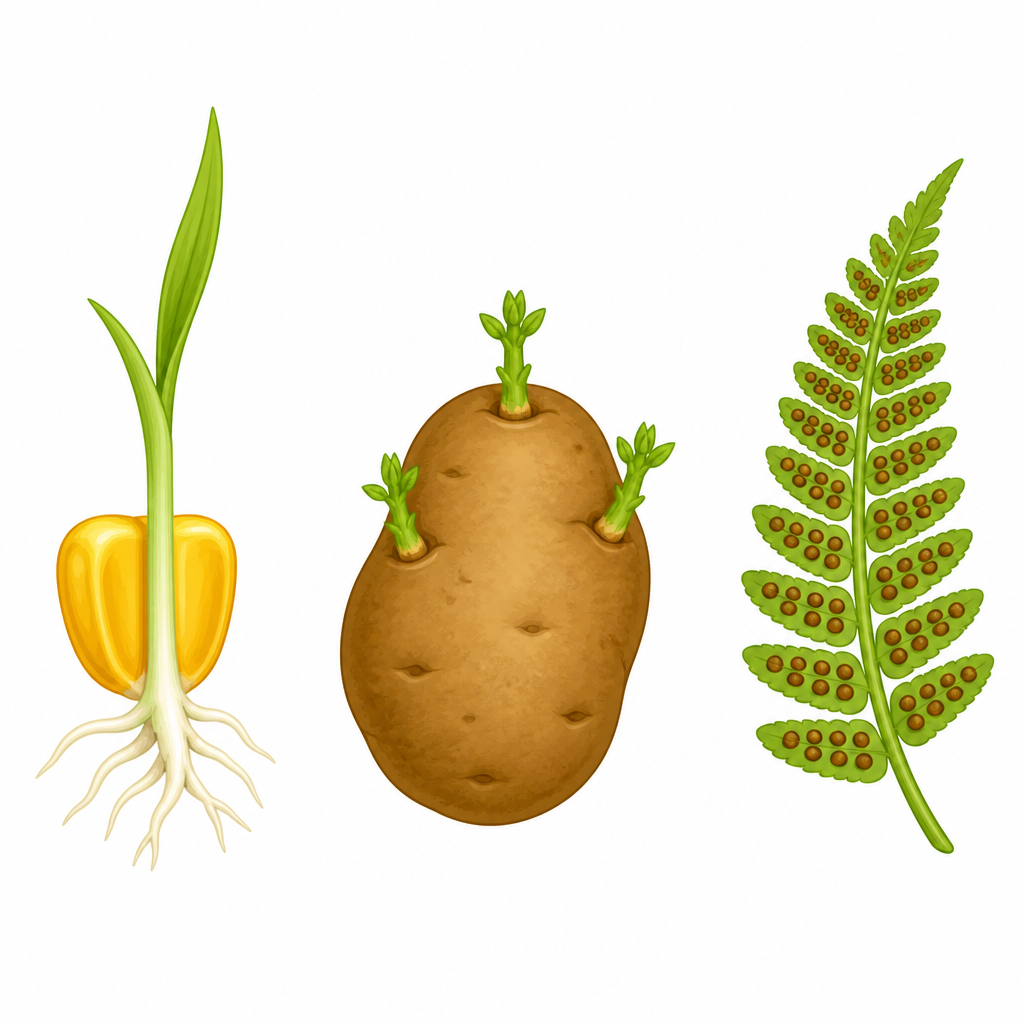
In many plants a new plant starts straight from a stem, a root, a leaf or some other part, with no flower and no seed involved at all. A potato tuber sprouts from the small eyes on its skin. A piece of sugarcane stem pushes out shoots at its joints. The edge of a bryophyllum leaf grows tiny plantlets that drop off and root themselves. Offspring made this way look exactly like the parent plant.
Some plants that never flower build a special kind of reproductive unit called a spore. The brown patches under a fern frond and the underside of a mushroom cap are full of them.
Spore: a reproductive unit so small and light that wind carries it away. When it lands in a suitably damp place, it grows into a new plant.
- From a seed: a flower forms seed, and the seed germinates into a new plant.
- From a stem, a root or a leaf: a part of the parent plant grows directly into a new plant.
- From a spore: ferns and mushrooms release spores that travel in the air and grow where they settle.
How Animals Produce Offspring
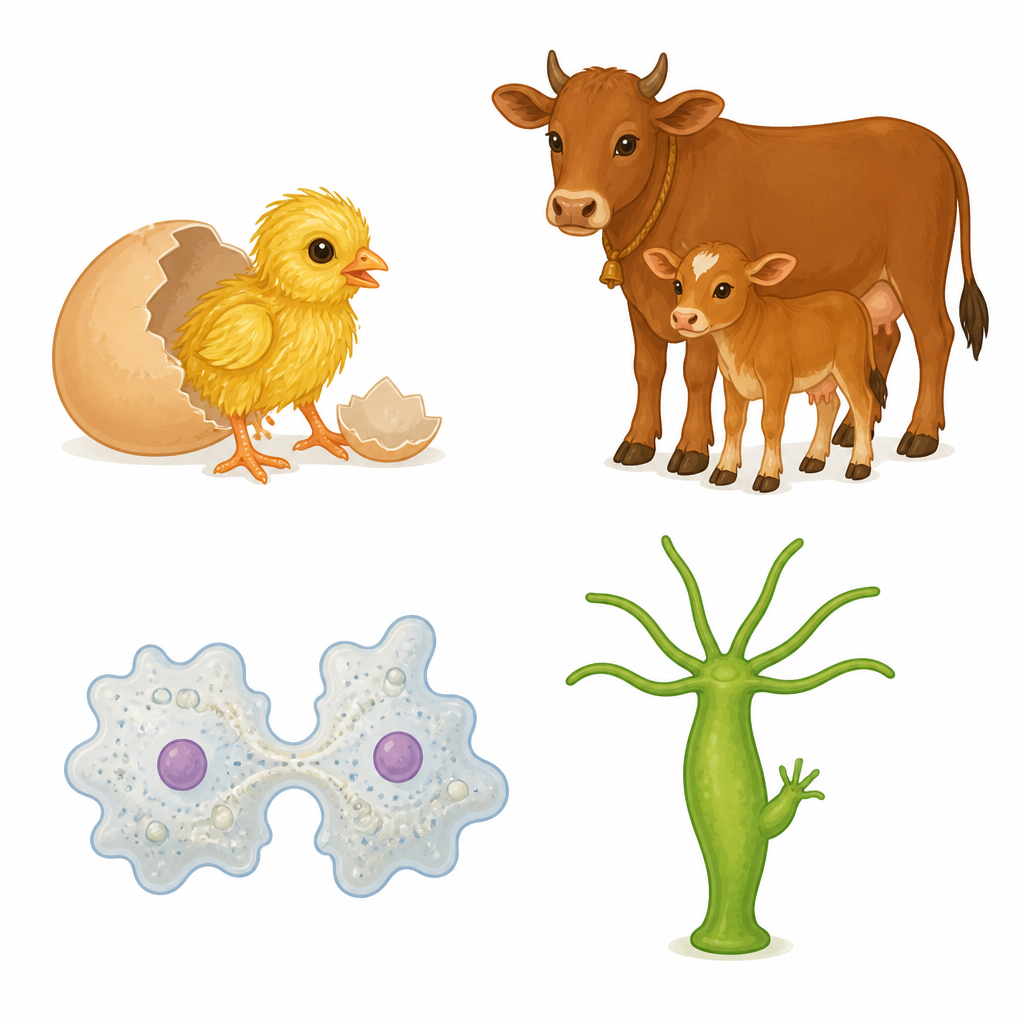
In the more developed animals the male and the female are two separate individuals. After they mate, their sex cells join together, and the new life starts from that joining. What happens next differs from animal to animal. Hens, fish and frogs lay eggs. Cows, dogs and human beings give birth to young ones directly.
Sex cell: the reproductive cell formed in the body of a male or a female animal. A new individual begins only when the two sex cells join.
Simpler animals, and plants without a high reproductive capacity, increase their numbers by an asexual process instead. An amoeba simply divides its body into two, and where there was one amoeba there are now two. A hydra grows a bud on the side of its body, and once the bud is big enough it breaks away as a new hydra. No male and no female are needed here. One individual is enough.
| Point of comparison | Plants | Animals |
| Reproductive unit | Seed, spore, or a piece of stem or leaf | Sex cells |
| How the offspring appears | A seed germinates or a shoot sprouts | An egg is laid or a young one is born |
| Examples | Maize, potato, fern | Hen, cow, amoeba |
| What is the same | A new living thing like the parent | A new living thing like the parent |
Why Reproduction Matters
Reproduction is not a convenience for one animal or one plant. It is a need of the whole species, and of nature as a whole. These are the main reasons it matters:
- Reproduction keeps a species going from one generation to the next, and so saves it from dying out.
- It keeps the birth rate and the death rate of a species in balance.
- It is the basis on which new individuals come into being.
- It keeps the biological diversity of an ecosystem in balance.
Every day some living thing dies. A tree falls, a fish dies, an insect finishes its life. If new individuals were not born at roughly the same rate, the balance of the ecosystem would break down. Less grass means fewer grass eating animals, and fewer grass eaters means fewer of the animals that feed on them. Reproduction keeps refilling every link of that chain, and this is why it counts as one of the important life processes.
Life Cycles and the Continuity of a Species
Every living thing passes through a fixed order of stages. First it is born, then it grows, then as an adult it reproduces, and in the end it dies. That order is called a life cycle. One point deserves attention here. Reproduction does not happen at just any stage of the cycle. A plant or an animal gains this ability only after it has grown up.
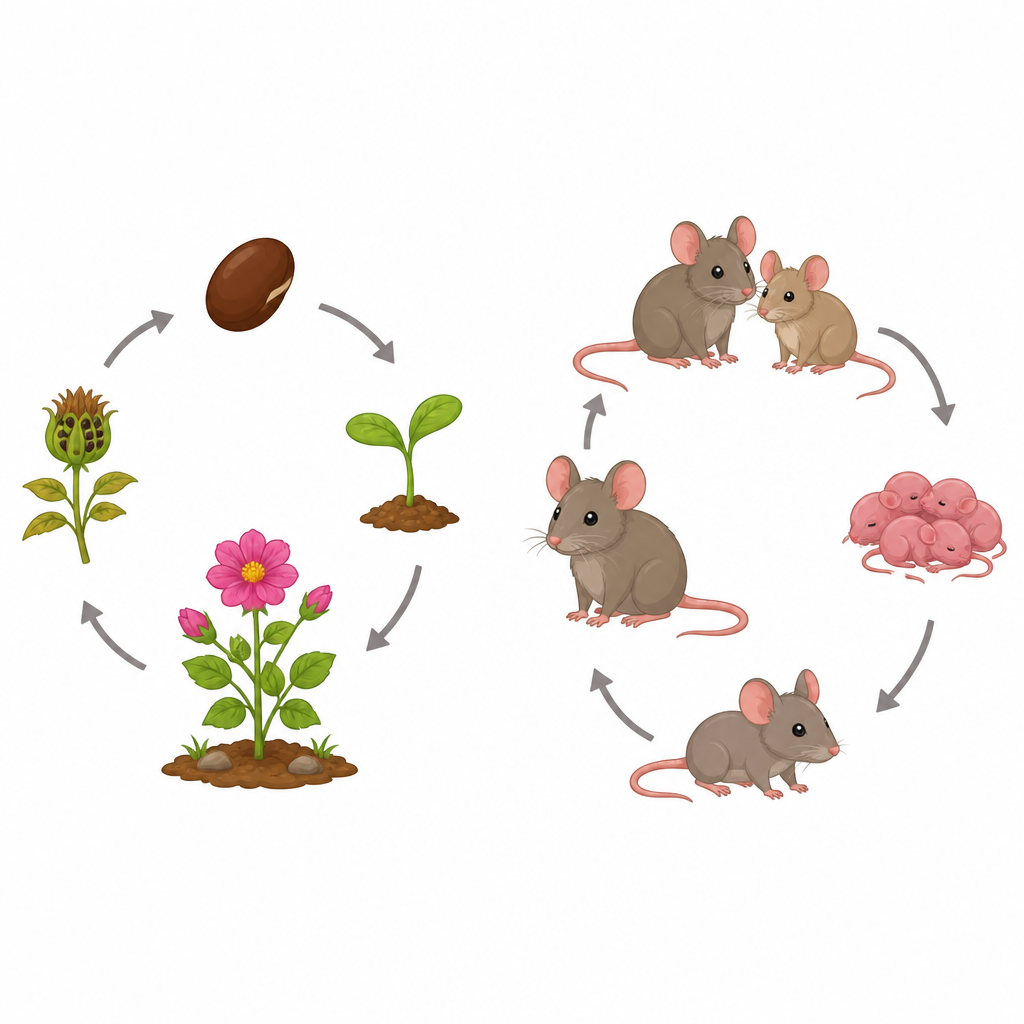
Reproduction is what joins the end of one cycle back to the beginning of another. A maize plant leaves hundreds of grains behind before it dries up. A hen raises many chicks before her own life ends. So an individual dies, but its line does not. Keeping the life cycle turning and handing the species on to the next generation is exactly the work that reproduction does.
Reproduction Around You
Look around your house, your field and your school, and watch how five animals and five plants there produce their young. Sort out which one lays eggs, which one gives birth, which one comes up from a seed and which one grows from a stem or a leaf, and set your findings out in a table. The table below shows how it is done.
| Name of the living thing | Type | Way of reproducing |
| Ant | Animal | From eggs |
| Hen | Animal | From eggs |
| Cow | Animal | Gives birth to a calf |
| Maize | Plant | From seed |
| Potato | Plant | From the stem tuber |
| Fern | Plant | From spores |
As you fill a table like this, one thing shows itself. The methods differ enormously, but the goal behind all of them is the same. Every living thing is leaving behind a new living thing like itself.
The full lesson is waiting for you
The notes are free to read in full. A free account opens the rest of the practice, and tracks your progress and confidence score for every subject. Presentations and videos need approval from Learn Yeti.