How a New Living Thing Begins
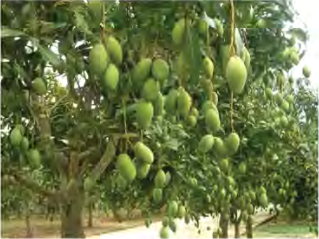
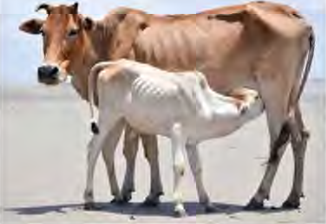
Walk past a mango tree in spring and you see small green fruits hanging all over the branches. A few months earlier the same tree carried only flowers. In a shed you see a calf standing beside its mother. These two sights share one thing. Before either new life began, two cells had joined together.
Living things reproduce in more than one way. In multicellular eukaryotes, reproduction happens by making special cells called gametes. The organ that makes a gamete is called a reproductive organ. The male reproductive organ makes the male gamete, and the female reproductive organ makes the female gamete.
Gamete: the special reproductive cell made by a reproductive organ. A new living thing starts only when one gamete joins with another.
In some living things the male and the female reproductive organs sit in separate individuals. Such a living thing is called unisexual. In others, both organs are present in the same individual, and that one is called bisexual. A mustard flower carries both the male and the female organ, while in human beings the male organ is in the man and the female organ is in the woman.
Unisexual: when the male and the female reproductive organs are carried by separate individuals.
Bisexual: when one and the same individual carries both the male and the female reproductive organs.
Reproduction that happens when a male gamete and a female gamete combine is called sexual reproduction. The joining of the two gametes makes a zygote, and the zygote grows, develops and changes until it becomes a new living thing.
Sexual reproduction: reproduction in which a male gamete and a female gamete combine, and a new living thing is formed from that union.
Zygote: the first cell formed when two gametes combine. All the growth and development of the new living thing starts from it.
What Marks Out Sexual Reproduction
- (a) Male and female gametes are produced, and then they combine.
- (b) There are separate male and female reproductive organs.
- (c) It keeps the reproductive capacity of the living thing going.
- (d) The offspring born this way adapt better to a changing environment.
- (e) The offspring show hereditary variation.
- (f) The chance of new kinds of living things arising is greater.
The Flower Is the Plant's Reproductive Part
Sexual reproduction in a plant works a little differently from the way it works in an animal. The flower is the part of a plant that carries out sexual reproduction, and both the male and the female reproductive organs sit inside it. In a mustard plant the whole process runs inside the yellow flowers at the top, and the pod and its seeds form from there. Plants that do not bear flowers have reproductive organs of their own special kind.
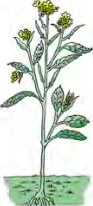
In a flowering plant, sexual reproduction is studied in two parts: pollination and fertilization.
The Parts of a Flower
The gynoecium, also called the pistil, is the female organ of a flower. It has the stigma at the top, the style in the middle, and the swollen ovary at the base. Inside the ovary lies the ovule, and the female gamete sits inside that ovule.
Gynoecium (pistil): the female reproductive organ of a flower, made of three parts, the stigma, the style and the ovary.
The thread like male organs of a flower are together called the androecium, and each one is a stamen. At the top of a stamen sits a sac like anther, and the slender stalk that holds it up is the filament. Inside the anther, in the pollen sacs, fine dust like pollen grains are formed.
Androecium: the male reproductive organ of a flower, made of the anther and the filament, with pollen grains formed inside the anther.
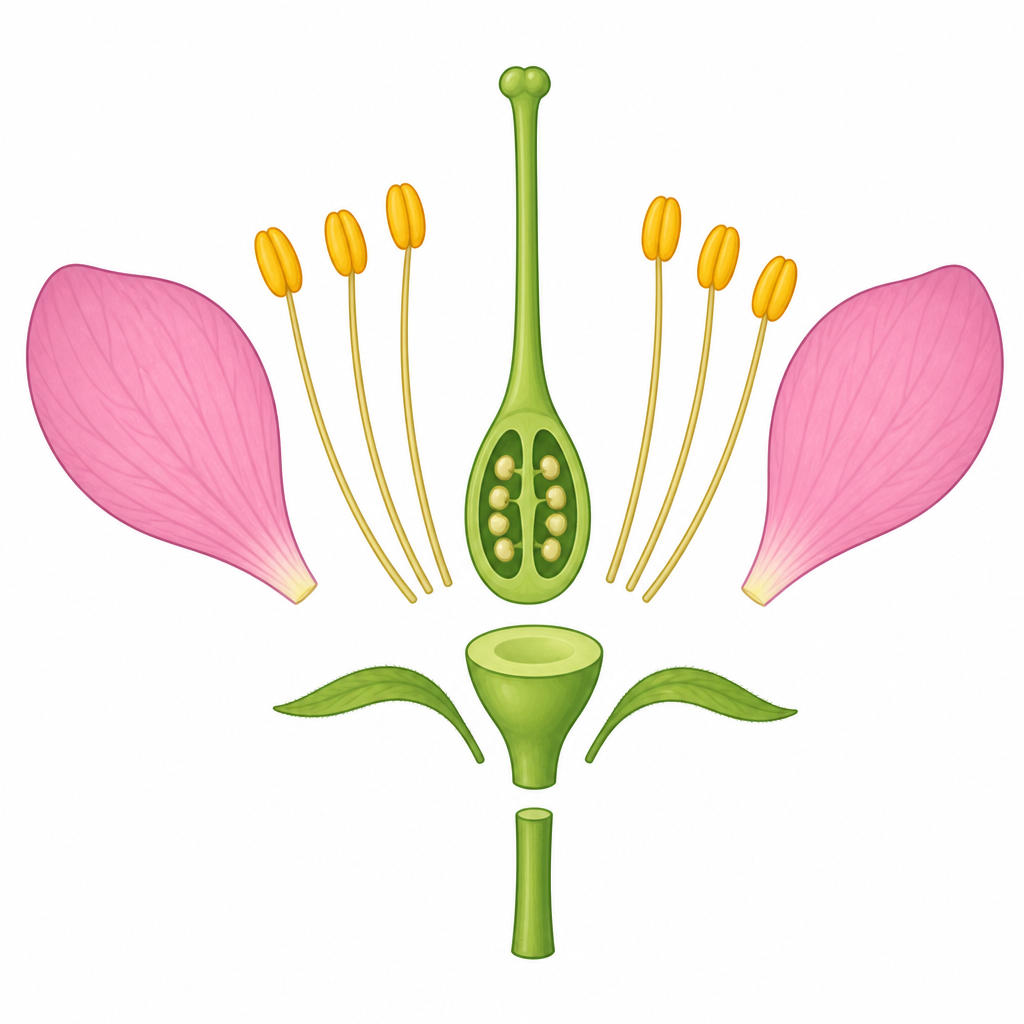
| Part of the flower | What it does |
| Stigma | the sticky top where pollen grains land |
| Style | the tube like part joining the stigma to the ovary |
| Ovary | the swollen part that holds the ovules |
| Ovule | the place where the female gamete lies |
| Anther | the sac like part in which pollen grains form |
| Filament | the slender stalk that holds the anther up |
| Petal | the coloured part that attracts agents |
| Sepal | the part that protects the inner parts while the flower is a bud |
Pollination
When the pollen grains are ripe, the anther splits open, the grains come out and they are scattered into the air. Those grains then reach the stigma of a gynoecium in one way or another. That journey is what we call pollination.
Pollination: the process by which pollen grains released from an anther reach a stigma.
A pollen grain is tiny, it is single celled, and it is covered by two layers. Fine hairs on the outer covering help the grain stick to a stigma when it lands there. Pollination happens in two ways, self pollination and cross pollination.
Pollination and fertilization are not the same thing. Pollination is finished the moment a pollen grain reaches the stigma, while fertilization happens only when the gametes actually fuse. Pollination can take place and fertilization can still fail to follow.
Self Pollination
When pollen from the anther of a flower reaches the stigma of a flower on the same plant, it is called self pollination. It happens in flowers of both kinds, the ones carrying a single organ and the ones carrying both. Self pollination is usually seen in flowers that are small, plain in colour, without scent and without nectar, so no carrying agent is needed. Rice, wheat, groundnut and lily are pollinated this way.
Self pollination: pollen from the anther of a flower reaching the stigma of a flower on the very same plant.
Self pollination takes two forms. When the pollen of a flower reaches the stigma of that same flower, it is called autogamy. When it reaches the stigma of another flower on the same plant, it is called geitonogamy. Geitonogamy needs the help of a carrying agent.
Autogamy: self pollination in which the pollen of a flower lands on the stigma of that same flower.
Geitonogamy: self pollination in which pollen from one flower lands on the stigma of another flower of the same plant.
Self pollination brings these benefits.
- (a) The good qualities of the parent plant are kept in the plants produced this way.
- (b) It makes seed production certain.
- (c) The process is simple and happens easily in nature.
Self pollination has these drawbacks.
- (a) No new quality develops in the offspring.
- (b) If a plant keeps reproducing this way, its reproductive strength weakens over time.
- (c) Poor and unproductive qualities already in the plant cannot be improved.
Cross Pollination
When pollen from the anther of one flower reaches the stigma of a flower on another plant of the same kind, it is called cross pollination. It is usually seen in flowers that are colourful and scented, and in flowers whose anther and stigma ripen at different times. Here a carrying agent plays the important part of taking the pollen to the stigma.
Cross pollination: pollen from one flower reaching the stigma of a flower on a different plant of the same species.
Cross Pollination and Its Carrying Agents
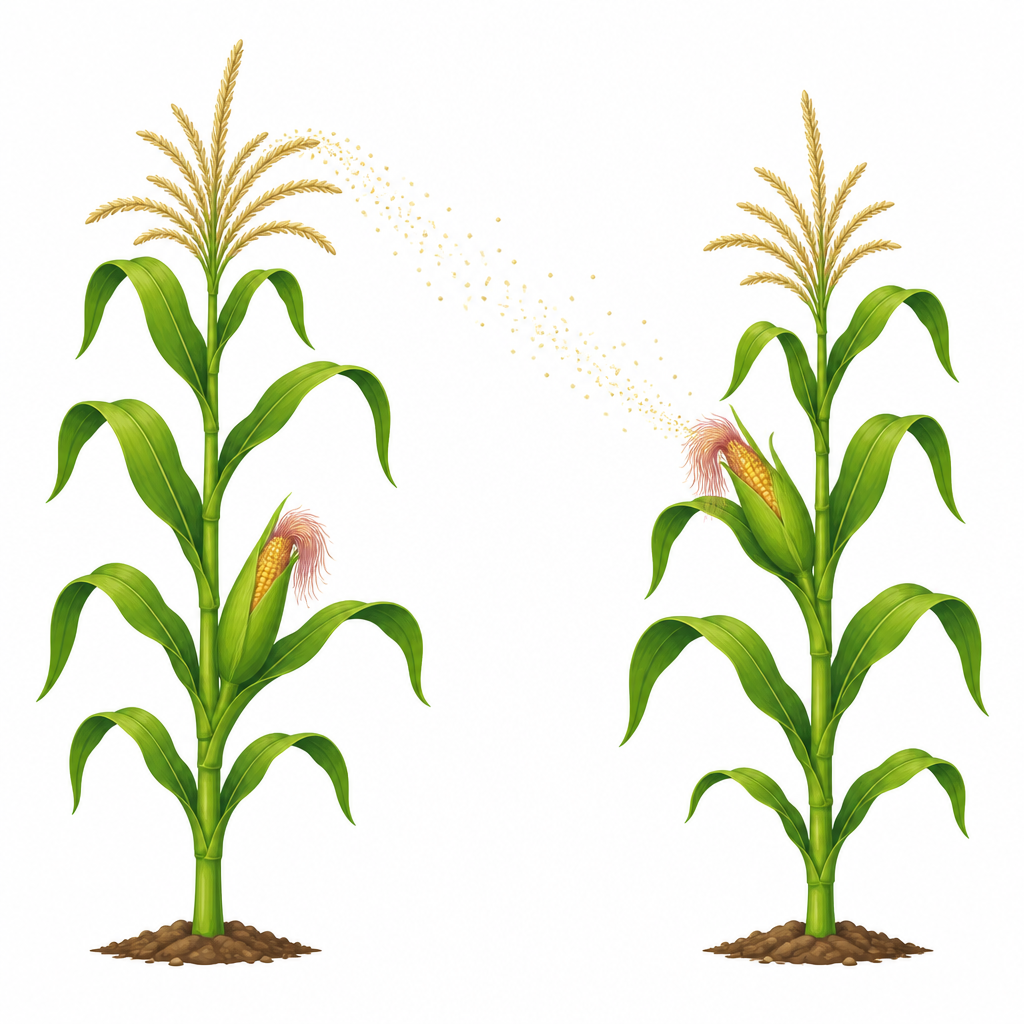
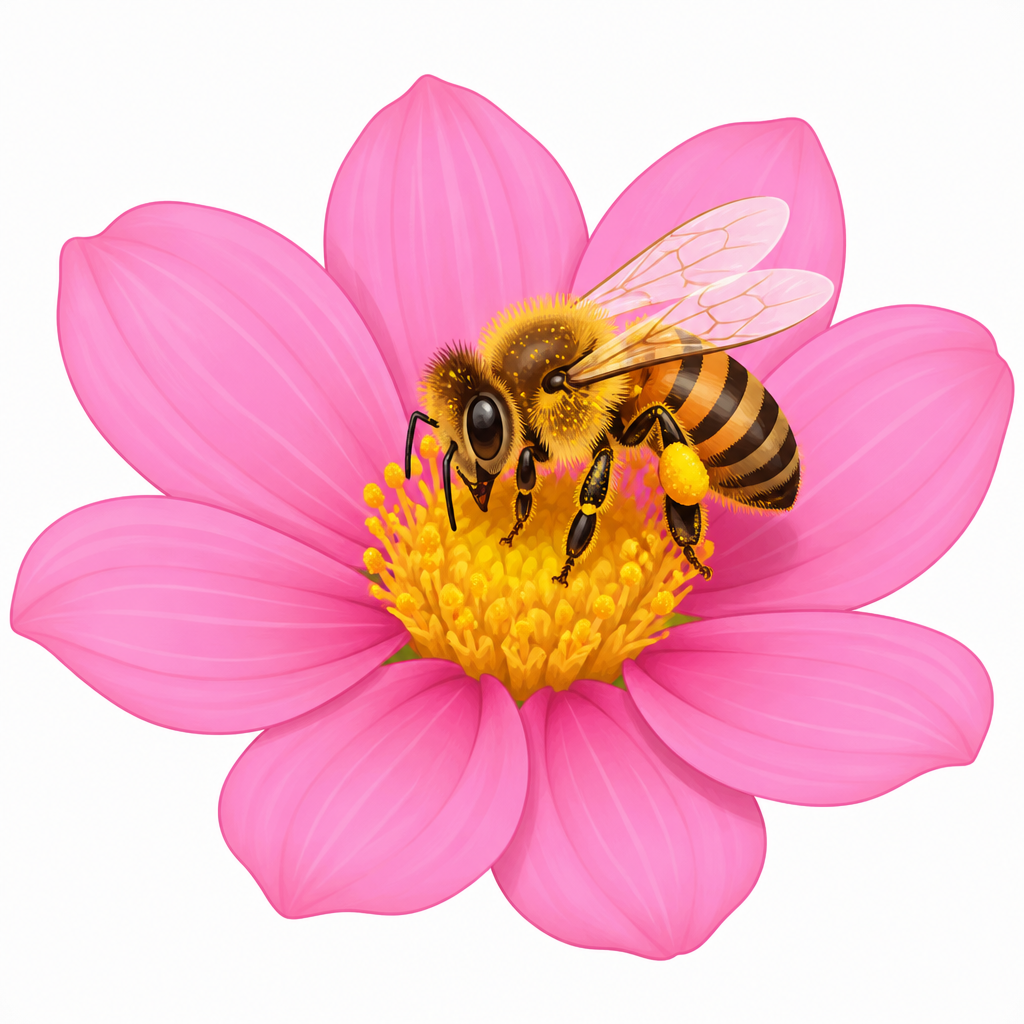
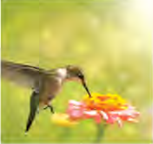
Cross pollination happens in several ways, named after the agent that carries the pollen. In maize, pine, mango and lychee the wind blows the pollen to the stigma, and this way is called anemophily. In water plants the water itself carries the pollen along, and that is called hydrophily. Scented flowers that hold nectar attract insects such as bees and butterflies, pollen sticks to their legs and wings, and pollination follows on another plant, which is called entomophily. Small birds such as the sunbird, the hummingbird and the flowerpecker come to drink the sweet nectar in a flower and carry pollen on to the next one, and that is called ornithophily.
| Type of pollination | Agent | Example |
| Anemophily | wind | maize, pine, mango, lychee |
| Hydrophily | water | water plants |
| Entomophily | insects | flowers such as mustard that attract bees and butterflies |
| Ornithophily | birds | flowers visited by the sunbird, hummingbird and flowerpecker |
Cross pollination brings these benefits.
- (a) New varieties of better quality are produced.
- (b) The plants produced adapt better to the environment.
- (c) The seeds produced have a greater power of germination.
Cross pollination has these drawbacks.
- (a) It depends on an agent, and without one the pollination may not happen at all.
- (b) The good and useful qualities of a plant are hard to keep.
- (c) Unwanted qualities may appear in the offspring.
Fertilization and Double Fertilization
The process in which a male gamete and a female gamete fuse is called fertilization. In a flowering plant it takes place inside the ovary, within the ovule. Pollen grains that have arrived on the stigma begin to germinate there. With the help of water, glucose and nutrients, a germinating grain grows out a shoot like tube that pushes down into the style. This tube is called the pollen tube.
Pollen tube: the tube that grows out of a germinating pollen grain and pushes down through the style to reach the ovule.
The nucleus of the pollen grain moves into the pollen tube, divides, and forms two male gametes. As the tube grows, both male gametes enter the ovule. One of them fuses with the female gamete lying inside the ovule, and this union is called the first fertilization.
The second male gamete that is left joins with the secondary polar nucleus inside the ovule, and that union is the second fertilization. So in a flowering plant fertilization happens twice, and for that reason it is called double fertilization.
Double fertilization: the two unions that take place inside one ovule, one male gamete fusing with the female gamete and the other fusing with the secondary polar nucleus.
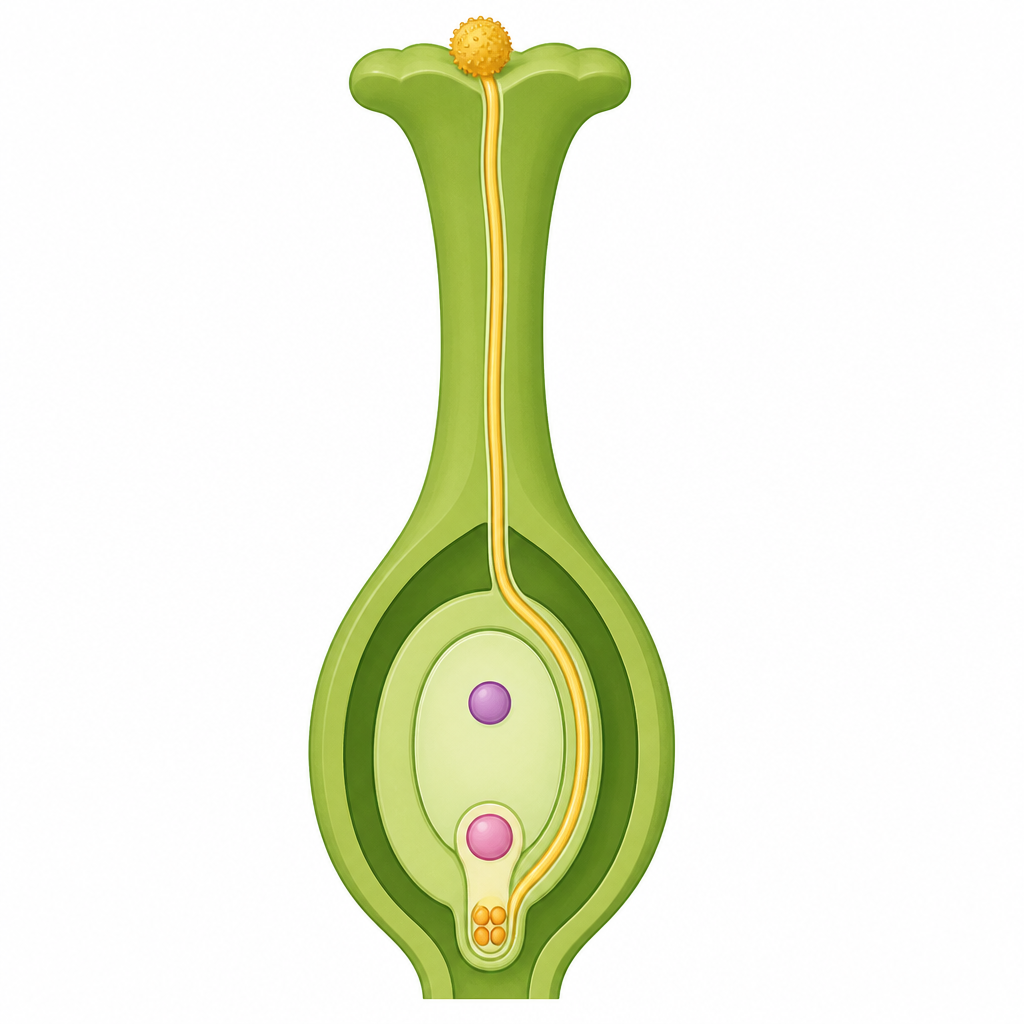
After fertilization the ovule turns into the seed and the ovary turns into the fruit.
Looking at Pollen Grains and the Stigma
You can see for yourself what a pollen grain looks like. You need a flower, a brush, a slide, a cover slip and a microscope. The method is this.
- (a) Collect a flower from any plant and gently remove its corolla, that is, its petals.
- (b) With the brush, shake the pollen grains down onto the middle of the slide, add one drop of water and close it with the cover slip.
- (c) Put the slide under the microscope and observe.
Pollen germinating on a stigma can be watched in the same way. For this you need a flower, forceps, scissors, a watch glass, a slide and a simple microscope.
- (a) Collect the gynoecium of the flowers and place them in the watch glass.
- (b) Hold the gynoecium with the forceps and cut the stigma free with the scissors.
- (c) Put the stigma on the slide and observe it under the simple microscope.
When cutting the stigma, cut only at the part held by the forceps, never towards your fingers. A slide and a cover slip are thin glass, so never press hard on them, and never pick up broken glass with your bare hands.
The full lesson is waiting for you
The notes are free to read in full. A free account opens the rest of the practice, and tracks your progress and confidence score for every subject. Presentations and videos need approval from Learn Yeti.