Male and Female Animals Are Separate Individuals
In most animals the male and the female are two separate individuals. A newborn animal cannot reproduce. Only after its body has grown and become mature does the animal become fit for reproduction. A mature animal carries special organs whose work is to produce sex cells. When a sex cell made by the male joins a sex cell made by the female and a new living thing is formed, that kind of reproduction is called sexual reproduction. This is why one animal on its own is never enough here. A male and a female are both needed.
Take the human being as an example. Sex cells are produced in the testes of the man and in the ovary of the woman. Whether the animal is a hen or a cow, a dog or a fish, the male body carries an organ that makes male sex cells and the female body carries an organ that makes female sex cells. The names of these organs differ from animal to animal, but the work they do is the same.

Making the Sex Cells: Gametogenesis
Sex cells do not simply appear. Inside the reproductive organs, ordinary cells divide and change until they become sex cells. This whole process of producing sex cells is called gametogenesis. Gametogenesis in the testes of a man produces sperms, and gametogenesis in the ovary of a woman produces ova. Without gametogenesis there are no sex cells at all, and without sex cells sexual reproduction cannot even begin.
Gametogenesis: the process by which sex cells are produced inside the reproductive organs.
The male sex cell is called the sperm and the female sex cell is called the ovum. Both are unicellular, which means one sperm is a single cell and one ovum is also a single cell. In human beings sperms are produced in hundreds of thousands, while only one ovum is produced each month. This large difference in number is the first thing that tells the two sex cells apart.
Sperm: the male sex cell, made in the male reproductive organ. It is a single cell and it has a tail.
Ovum: the female sex cell, made in the female reproductive organ. It is a single cell and it is oval in shape.
The Sperm, the Male Sex Cell
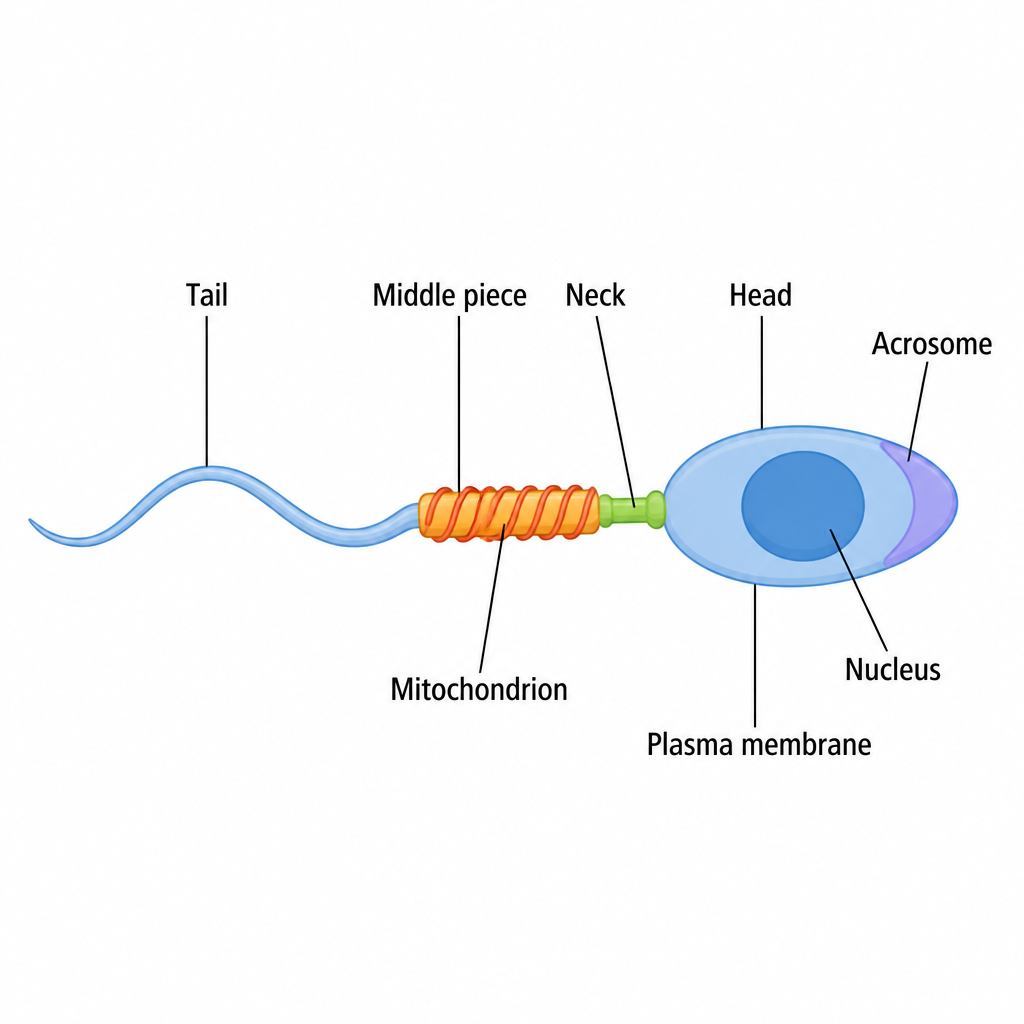
A sperm has a long, slender shape with a long tail behind it. The swollen front part is called the head, and a cap called the acrosome sits on its tip. Inside the head lies the nucleus, which carries the hereditary characters coming from the father. The narrow region joining the head to the rest of the cell is the neck. The middle piece has a mitochondrion wound round it in a spiral shape, and this supplies the energy the cell needs for swimming. A plasma membrane covers the whole cell. By lashing its tail like a whip, the sperm swims and reaches the ovum.
The Ovum, the Female Sex Cell
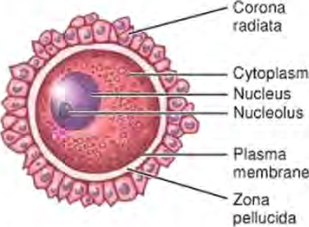
An ovum is oval and it is much larger than a sperm. It has no tail, so it cannot swim by itself. The nucleus lies at its centre, and inside the nucleus a nucleolus can be seen. Around the nucleus the cell is filled with cytoplasm, which stores the food the new living thing will need for its earliest growth. A plasma membrane covers the cell. Over that lies a thick coat called the zona pellucida, and outermost of all is a ring of small cells called the corona radiata.
| Feature | Sperm | Ovum |
| Shape | Long and slender, with a tail | Oval, with no tail |
| Size | Small | Large |
| Where it is made | In the male reproductive organ | In the female reproductive organ |
| Number | Hundreds of thousands | One a month in human beings |
| Movement | Swims using its tail | Cannot move on its own |
Fertilization and the Making of the Zygote
After a male and a female mate, the sperm and the ovum join together. This joining is called fertilization. Many sperms reach the ovum, but only one of them fertilizes it. Once that single sperm has entered the ovum, the nuclei of the two cells fuse and a single cell is formed. This single cell made after fertilization is called the zygote.
Fertilization: the joining of a sperm and an ovum to form a single cell.
Zygote: the single cell formed after fertilization, from which the new living thing begins to grow.
Do not think that because many sperms reach the ovum, many of them fertilize it. One ovum is fertilized by one sperm only, and all the rest are lost.
Although the zygote is only one cell, it holds hereditary characters coming from both the male and the female. That is why a young one born through sexual reproduction resembles both of its parents in some ways and differs from them in others.
The Embryonic Period
Once the zygote is formed it does not stay as it is. It divides again and again, and the number of cells keeps increasing. This growing structure is called the embryo. Bit by bit the cells of the embryo change into the different parts of the body, and after a fixed length of time a new living thing is formed. This stretch of time from zygote to new living thing is called the embryonic period or pregnance period.
Embryonic period or pregnance period: the length of time taken by a zygote to grow and develop into a new living thing.
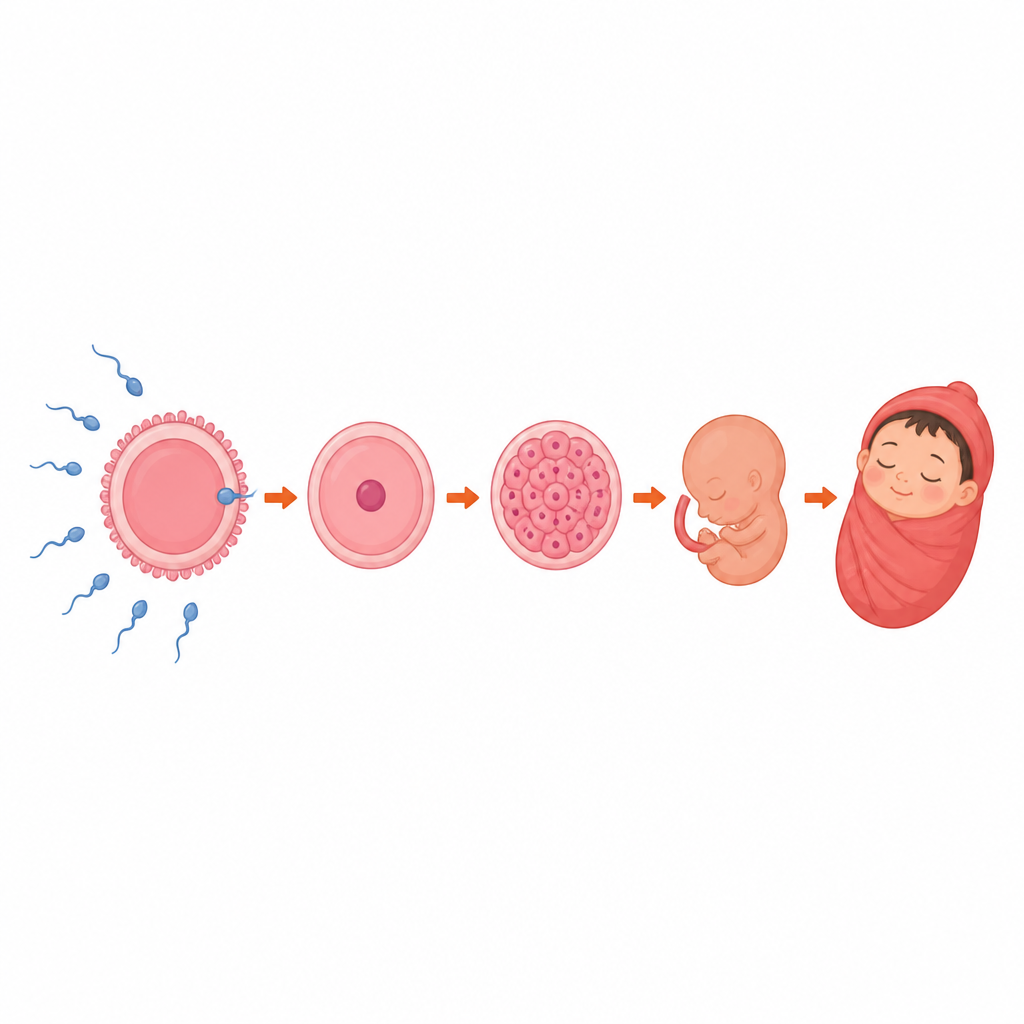
This period is not the same length in every animal. In some it lasts only a few days, in others many months. The order of events, though, is the same in all of them: first the sperm and the ovum join, then comes the zygote, then the embryo, and at the end a new individual.
Internal Fertilization
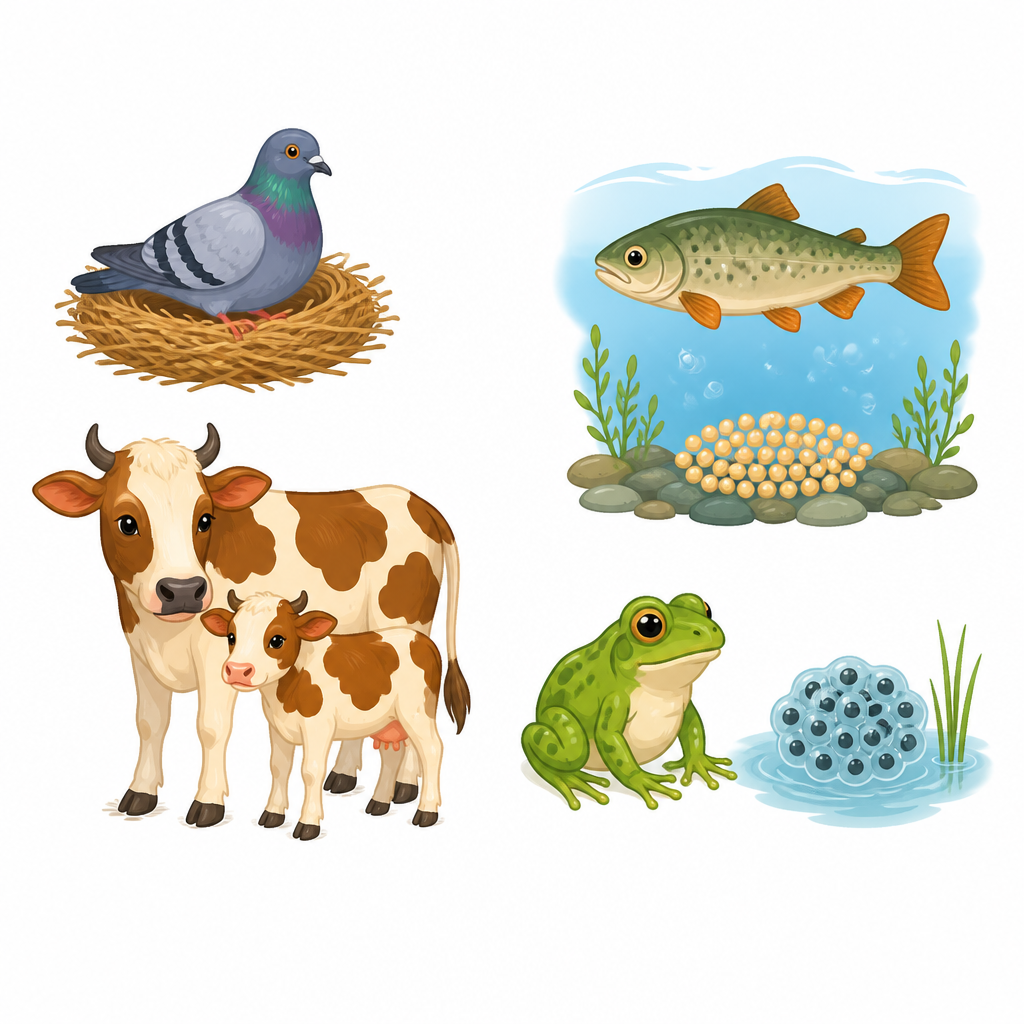
Animals show two kinds of fertilization: internal fertilization and external fertilization. Fertilization that takes place inside the body of the female is called internal fertilization. In this process the sperm and the ovum fuse in the fallopian tube. Birds and mammals have internal fertilization. Because the ovum stays protected inside the body, such animals manage with only a few ova.
Internal fertilization: fertilization that takes place inside the body of the female.
External Fertilization
In animals such as fish and frogs, fertilization takes place outside the body of the female. This is called external fertilization. Here the female first releases her ova into water or onto the ground, and the sperms of the male later fertilize them. Out in the open water the ova are at the mercy of currents, other animals and the weather, so many of them are destroyed. That is why such animals release a great many ova at one time.
External fertilization: fertilization that takes place outside the body of the female, in water or on the ground.
Internal and External Fertilization Side by Side
Both kinds of fertilization need a sperm and an ovum, and both end in a zygote. The only difference lies in where the two cells meet. The comparison below sets that difference out.
| Basis | Internal fertilization | External fertilization |
| Where it happens | Inside the female's body | Outside the female's body, in water or on the ground |
| The ovum | Stays inside the body | Is released outside first |
| Which animals | Birds, mammals, lizards | Fish, frogs |
| Number of ova | Few | Many |
| Safety | Safer | Less safe |
The basic order of sexual reproduction is the same in every animal: gametogenesis, then the sperm and the ovum, then fertilization, then the zygote, then the embryonic period, and at last a new individual.
Studying a Frog's Eggs
The ova of an animal that fertilizes externally can be looked at with your own eyes. For this you need a wire mesh, a watch glass, a hand lens, a permanent slide of an ovum and a microscope. Follow the order given below.
- Using a wire mesh, collect frog eggs from the water and place them in a watch glass.
- In the laboratory, study the eggs with a hand lens and observe whether fertilization has taken place or not.
- Observe the permanent slide of an ovum under the microscope and compare it with the eggs you collected.
Frog eggs are soft and jelly like, so lift them with the wire mesh gently. When the study is over, return the remaining eggs to the same pond, and wash your hands with soap and water after touching pond water.
Compare the eggs you collected with the ovum on the permanent slide, then draw what you saw and write down its features in your practical copy. Note in which eggs the dark point inside was clearly visible and in which it was not.
The full lesson is waiting for you
The notes are free to read in full. A free account opens the rest of the practice, and tracks your progress and confidence score for every subject. Presentations and videos need approval from Learn Yeti.