New Plants Made by Human Hands
A single mango tree in a courtyard may give unusually sweet fruit. If its seed is sown, there is no guarantee that the new tree will give fruit of the same taste, and it may take many years before it fruits at all. So growers found another way. They take a part of that very tree, a branch, a piece of stem, a bud, or even a small piece of tissue, and raise a complete new plant from it. The plant that grows this way is a copy of its parent, so the taste, the size and the quality of the fruit stay the same.
Artificial vegetative propagation is the process of producing new plants from a part of a plant, using modern techniques, in order to improve the quality of fruits, vegetables, food crops and plants.
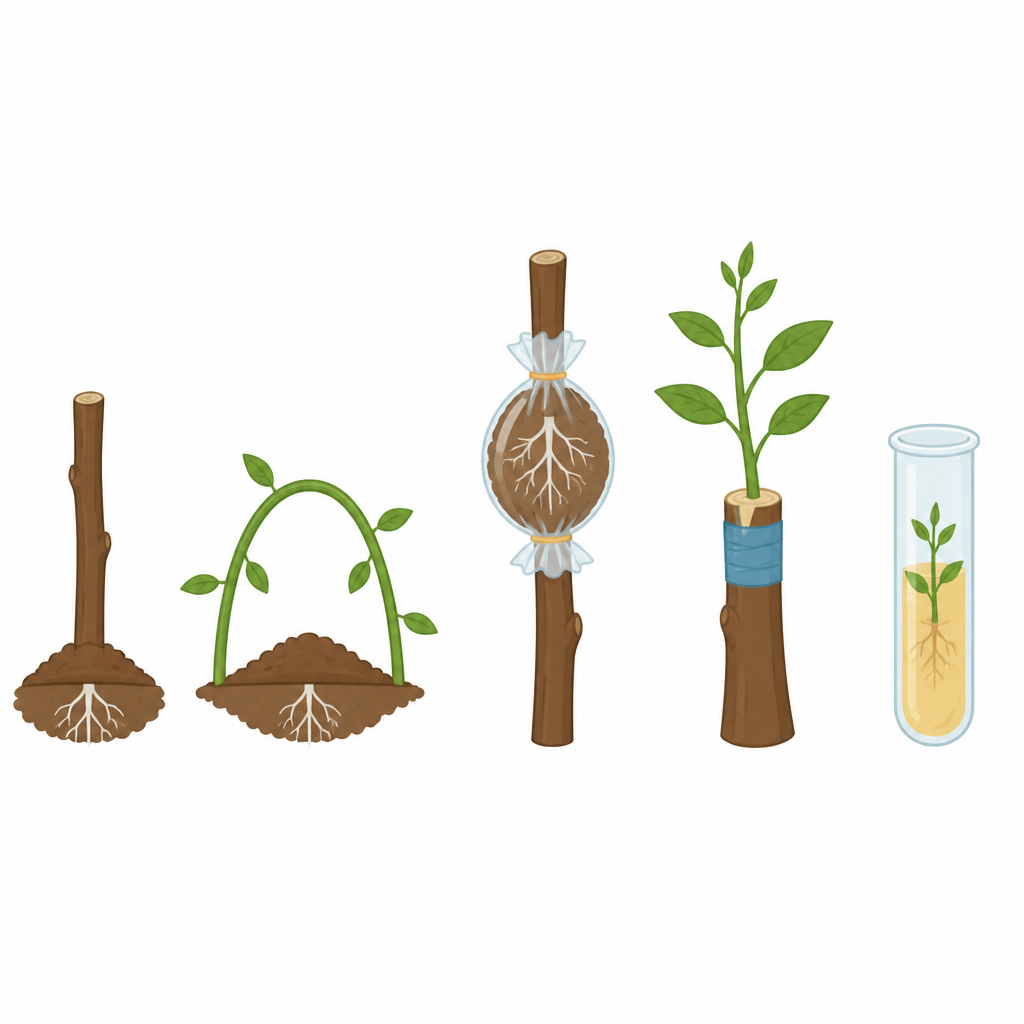
Flowers, pollination and seeds play no part in this method. The work of making a new plant is done by people, with a knife, a rooting hormone, clay and sometimes a laboratory. Plants raised this way are of good quality and they begin to bear fruit early. Cutting, layering, gootee, grafting and tissue culture are the five methods used.
Cutting: a piece of stem, root or leaf is cut off and planted straight into the soil.
Layering: a soft branch is bent into the soil, without being cut off, until roots grow on it.
Gootee: soil is wrapped around a hard branch so that roots grow up in the air.
Grafting: parts of two plants are cut and joined to each other.
Tissue culture: a complete plant is raised in a laboratory from a tiny piece of tissue.
Why Growers Choose This Method
The advantages of this method explain why a farmer or a nursery owner is willing to take so much trouble over it.
- The breed and the line of the plant are improved by this method.
- Plants that bear fruit early can be produced by this method.
- This method is used to produce many new plants from one plant in a short time.
- New plants can be produced by this method even from plants whose seeds do not germinate actively.
A plant grown from seed can turn out different from its parent. A plant raised by artificial vegetative propagation carries exactly the qualities of the parent plant.
Cutting
Cutting is the process in which a stem, a root or a leaf of a plant is cut off, planted, and grown into a new plant.
Which part is used depends on the plant. In plants such as ground raspberry, blackberry and raspberry the root is used for cutting, while in sugarcane, lime, pear and rose the stem is used. As a rule the stem chosen should be one full year old and should carry more than two nodes, and it is planted in the soil. Within a few days roots grow from the lower end of the stem and a new shoot with leaves grows out of a node. In this way many pieces taken from one plant each become a separate plant.
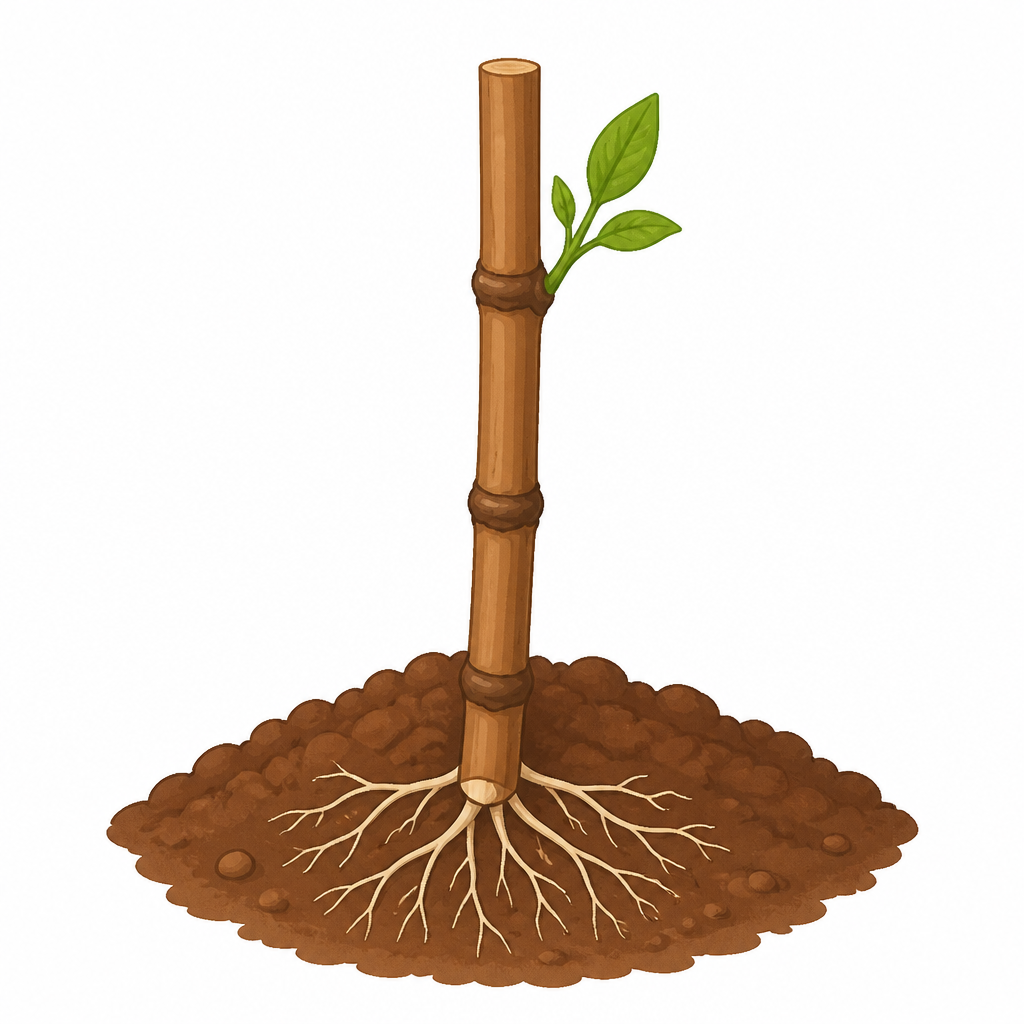
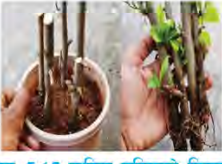
A soft tip with no nodes on it will not sprout when it is planted. The new shoot and its leaves come out of a node, so the stem chosen for a cutting must carry more than two nodes.
Layering
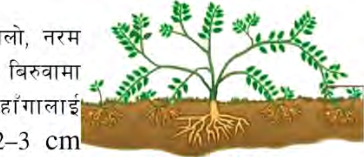
Layering is the process in which a soft branch is bent into the soil while it is still joined to the parent plant, and is cut off as a separate plant after roots have grown on it. The branch used for layering is called a layer.
Layering is done on plants with soft, tender branches that grow right from the base, such as lime, jasmine and grape. About 2 to 3 cm of bark is scraped off all the way round the middle of the layer. The branch is then bent down, laid in the soil and covered with earth, while its tip is left above the ground. After some days roots grow at the scraped part of the layer, and that part is cut off and planted elsewhere. Because the branch stays joined to the parent plant until the roots appear, it keeps receiving food and water from it, and that is why layering succeeds so often.
Gootee
Gootee is the process in which the bark of a hard branch is removed, soil is wrapped round that place until roots grow there in the air, and the branch is then cut off to make a new plant. It is also called air layering.
Gootee is done on plants with hard branches, such as lychee, mango, guava, orange and pomelo. Such a branch cannot be bent down to reach the ground, so the soil is carried up to the branch instead. About 2 to 3 cm of bark is removed all round the branch, and grafting clay or rich cow dung soil mixed with a rooting hormone is packed on to that place. The ball is then wrapped in plastic so that water cannot get in. After about one month roots can be seen inside the plastic. The branch is then cut off and planted in the soil.
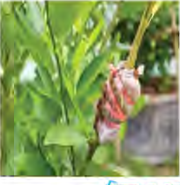
Bark is scraped in layering and in gootee alike, so the two are easily mixed up. An easy way to hold the difference: in layering the branch goes down to the soil, while in gootee the soil goes up to the branch.
Grafting
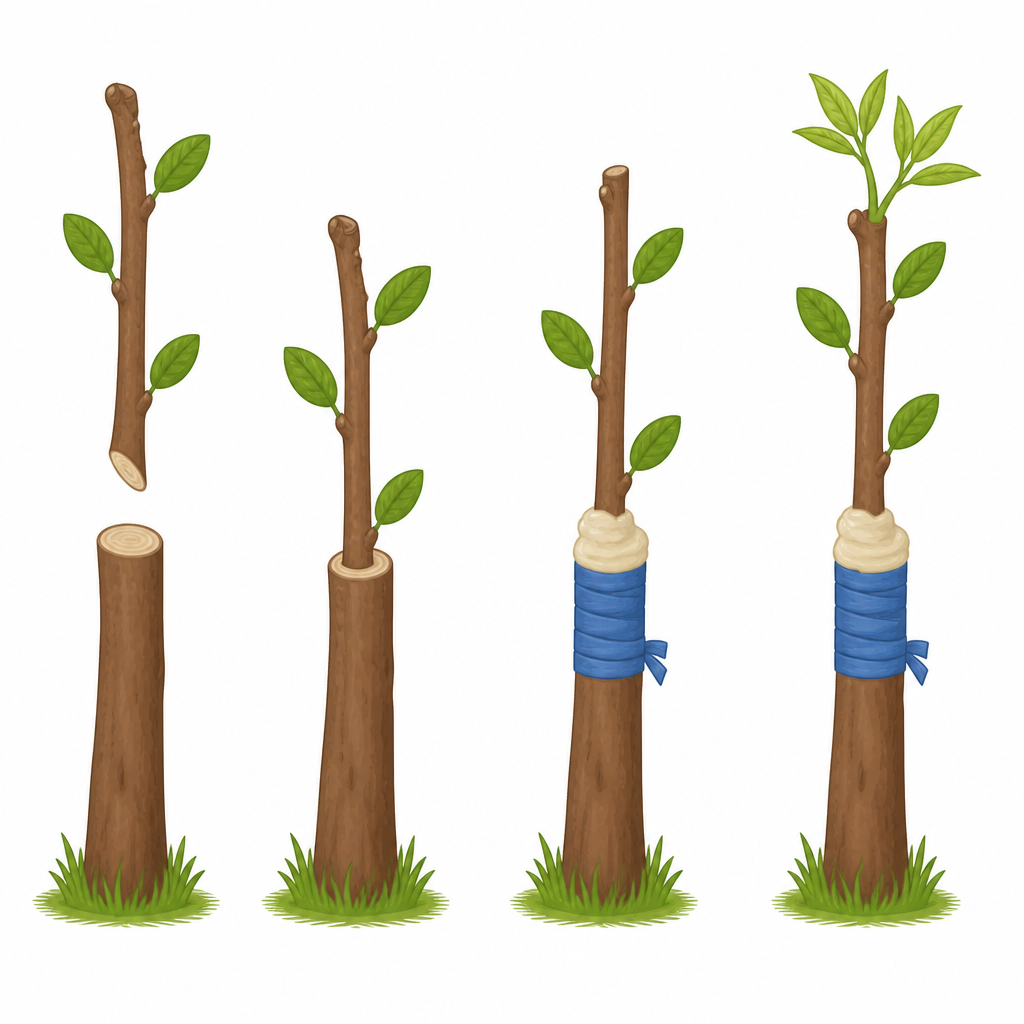
Grafting is the process in which parts of two plants of the same species, or of closely related varieties, are joined to each other.
A Maldah variety of mango, for example, can be grafted on to a Dasheri mango. In this method the part of the chosen plant that has the root system is called the stock, and the part that has the shoot system is called the scion or graft. The stock does the work of drawing water and minerals from below, while the scion does the work of producing branches, leaves and fruit above.
Step 1: The stock is made ready. When a plant grown from seed is one year old, the part above 20 to 30 centimetres from the surface is cut off and removed.
Step 2: The scion is chosen. It is taken from a branch of a plant that is already bearing fruit.
Step 3: The stock and the scion are joined at the cut, so that the two cut surfaces meet exactly.
Step 4: Grafting wax is applied at the join and it is tied with string. After a few days the two parts unite and work as one new plant.
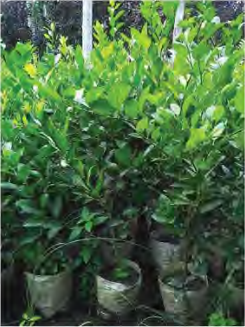
In Nepal the Agricultural Research Council grafts fruit plants such as mango, lychee, lime, orange and kiwi and distributes them to farmers. Farmers have gained from this, because they plant good quality fruit trees that yield quickly, and it has supported the modernisation of farming in the country.
The stock is the lower part and it carries the roots. The scion is the upper part and it is the one that will give the fruit later. Swapping these two names is the mistake that is repeated most often in examinations.
Tissue Culture
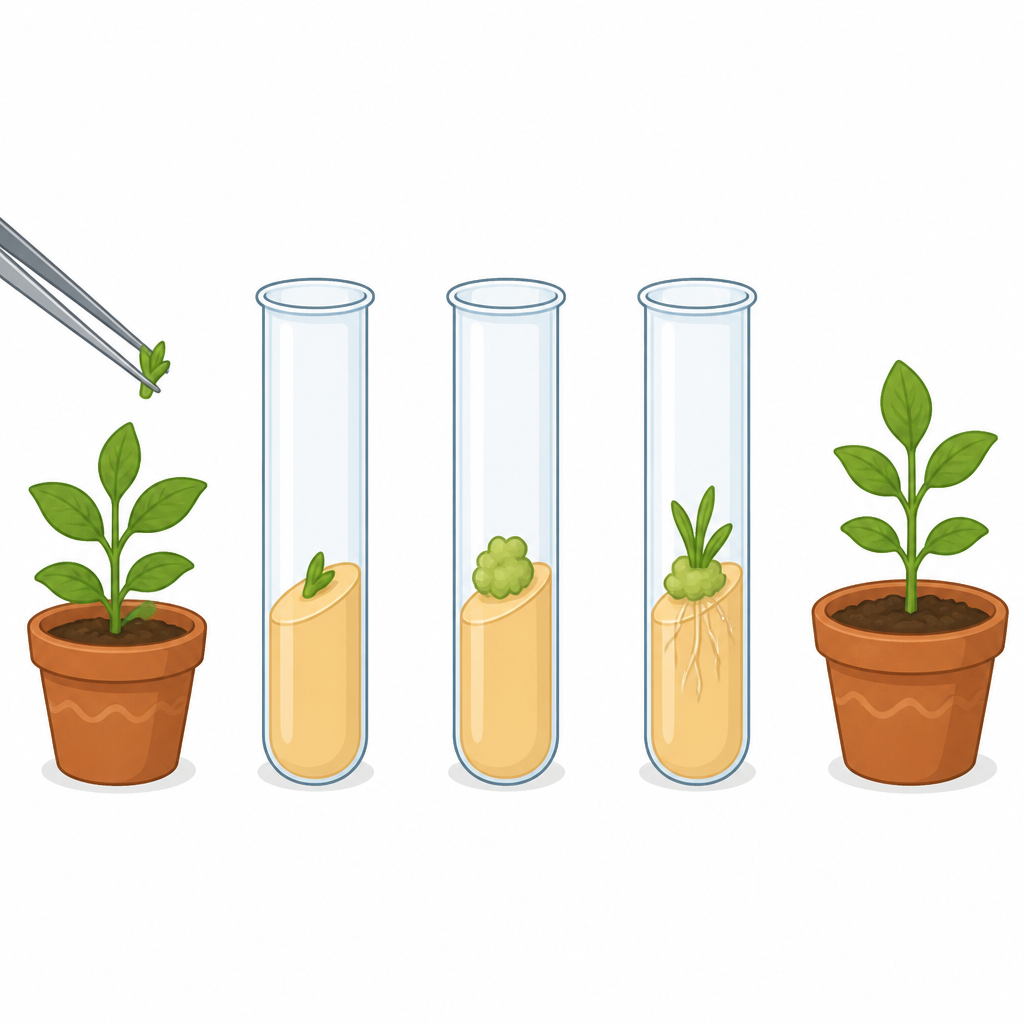
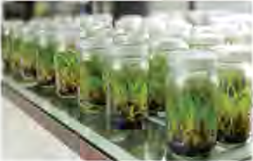
Tissue culture is the method in which a small part, a cell or a tissue of a plant is placed on a nutrient medium in the controlled environment of a laboratory and grown into a complete plant.
Tissue culture is a modern, advanced technique. After some days on the nutrient medium, the piece of plant forms a small lump called a callus, which has no roots, no stem and no leaves. Shoots and roots then grow from the callus, many new plants are produced, and these are planted out in the garden. This method needs no whole branch and no whole tree, only a small piece, so thousands of plants can be raised from one plant in a small space. Because all the work is done in a clean, controlled environment, the plants obtained are free of disease.
Doing It Yourself: A Cutting and a Graft
These methods are not understood by reading alone, they are understood by doing. A cutting of rose or of some other plant from the school flower garden can be taken and planted in a pot in this way.
- Choose a branch that is one year old and carries more than two nodes.
- Make a clean cut with a sharp knife to prepare the cutting.
- Plant the lower end of the cutting in a pot filled with soil.
- Keep the planted pot where it gets sunlight and water.
- Observe the planted cutting every day for fifteen days and write down the change you see each day.
- Discuss your notes with your friends in class.
Grafting can also be done in class. For it you need two plants of the same kind, tomato or lime for example, a knife, scissors, adhesive tape, grafting clay and a brush.
- Take two plants of the same kind, each in its own pot.
- Clean the place on the plants where the graft will be made, using the brush.
- Cut a branch from one plant to make the scion, and join it to the cut part of the other plant, which is the stock.
- Apply grafting clay at the join and bind it with the adhesive tape.
- Make a video of the whole process from the very beginning, and keep the plant in the shade.
- Observe the plant kept in the shade every day for fifteen days and present the change you see to the class.
A knife and a pair of scissors are sharp. Use them only under your teacher's supervision, cut with the blade turned away from your body, and never walk about pointing the sharp edge at anyone.
The Five Methods Side by Side
| Method | Part used | Plants it suits | The main point |
| Cutting | Stem, root or leaf | Sugarcane, lime, pear, rose, ground raspberry | The cut piece is planted straight into the soil |
| Layering | A soft branch, called the layer | Lime, jasmine, grape | The branch is buried in soil without being cut off |
| Gootee | A hard branch | Lychee, mango, guava, orange, pomelo | Soil is wrapped on the branch so roots grow in the air |
| Grafting | Stock and scion | Mango, lychee, lime, orange, kiwi | Parts of two plants are joined together |
| Tissue culture | A small cell or tissue | Any plant that can be raised in a laboratory | A callus forms on the medium and many plants grow from it |
The full lesson is waiting for you
The notes are free to read in full. A free account opens the rest of the practice, and tracks your progress and confidence score for every subject. Presentations and videos need approval from Learn Yeti.