Batuli's Bus Journey
Batuli boarded a bus at place A and travelled to place B. When she got on at A, the bus stood still for some time. Once the driver started the engine, the force from the engine made the bus roll slowly, and after a while it sped up. All along the road the bus sometimes crawled and sometimes rushed. Whenever the driver braked, her body jerked forward. Hidden inside this ordinary journey are several important ideas about motion.
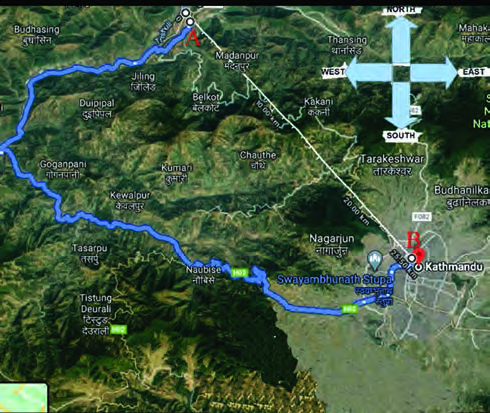
On the road the bus kept turning toward different directions. At every bend Batuli watched the driver turn the steering wheel and change the direction of the bus. So the bus was not moving in one fixed direction; its direction of motion changed at each bend.

As the bus moved, Batuli watched the distance posts by the roadside and kept noting the distance covered against the time taken. Her record looked like this:
| Time (in minutes) | Distance covered (in km) |
| 10 | 5 |
| 25 | 10 |
| 30 | Bus stopped |
| 40 | 15 |
| 50 | 20 |
While the bus rolled steadily along a straight stretch, the speedometer in front of the driver showed 50 km/h. Batuli kept checking such readings and worked out how long the bus would take to cover the distance ahead when it moved steadily.

At her destination Batuli asked the driver and learnt that the journey had covered 74 km. Back home she searched the route on Google Maps and found that in going from place A to place B her displacement was only 25.5 km toward the southeast. The bus rolled along 74 km of road, yet in a straight line she had shifted just 25.5 km. This difference is where the ideas of distance and displacement begin.
Distance and Displacement
If a bus goes from place A through B, C, D and E to place F, the total distance it covers is the full length of the road ABCDEF, but its displacement is the straight line AF, and that displacement points toward the northeast.
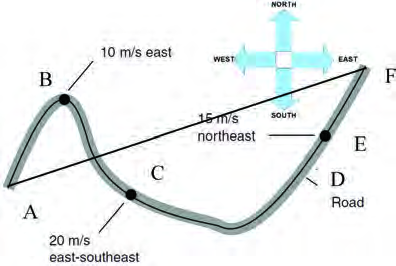
The total length of the path covered by a moving object is called its distance. Distance is expressed by magnitude alone, without naming any direction, so it is a scalar quantity.
The shortest distance covered in going from the initial position to the final position in a definite direction is called displacement. It is really the straight line distance between the two points. A displacement is stated with both a magnitude and a direction, so it is a vector quantity.
On Batuli's journey the distance was 74 km while the displacement was only 25.5 km southeast. Because roads wind, the distance is always equal to or greater than the displacement. Had the bus returned to place A, the distance would have grown even larger but the displacement would have been zero, because the starting point and the final point would have been the same.
Speed
Dividing the total distance the bus covers by the time taken to cover it gives the value of its speed. The 50 km/h on the speedometer is also a measure of speed: it means that at that instant the bus is moving at a rate that would cover 50 km in one hour.
The distance covered by an object per unit time is called its speed. Speed is expressed by magnitude alone, without any direction, so it is a scalar quantity.
The formula for average speed is:
\[ V_{av} = \frac{d}{t} \]
Here \( d \) stands for the distance covered and \( t \) for the time taken. Its unit is m/s. This is exactly the formula Batuli used to find the average speed of her own journey.
Velocity
Dividing the distance a bus covers in a definite direction along some section of the road by the time taken gives the bus's velocity in that section. At place B the bus was heading east, covering 10 metres every second. At place C its velocity had changed to 20 metres per second toward the southeast. Along the section DF its velocity was 15 metres per second toward the northeast. Whenever a velocity is stated, the direction is stated along with the magnitude.
The distance covered by an object per unit time in a definite direction is called its velocity. Velocity is stated with both magnitude and direction, so it is a vector quantity.
If an object moving in a definite direction goes sometimes fast and sometimes slow, its motion is non-uniform. For such non-uniform motion, the average velocity is found by dividing the total distance covered in that definite direction by the time taken to cover it:
\[ AV = \frac{s}{t} \]
Here \( s \) is the distance covered in a definite direction and \( t \) is the time taken to cover it. The answer comes in m/s, and the direction is written along with it.
Many students forget to write the direction with a velocity. Writing 15 m/s alone gives only a speed; it becomes a velocity only when you write 15 m/s northeast.
Positive and Negative Velocity
Speed is a scalar quantity and velocity is a vector quantity. So even when only the direction changes and the magnitude stays the same, the velocity changes while the speed remains constant. On a bend the speedometer may keep showing the same 50 km/h, yet because the direction has changed, the velocity of the bus has changed.
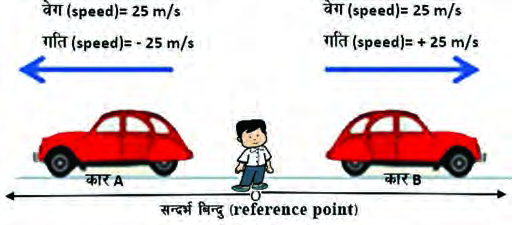
With respect to a reference point, an object moving in one direction has a positive velocity, and moving in exactly the opposite direction its velocity becomes negative. Car B moving east from the reference point has a velocity of + 25 m/s, while car A moving in exactly the opposite direction has a velocity of - 25 m/s. The speed of an object, however, is always positive, because speed carries no direction.
Acceleration
Moving objects do not always keep the same velocity. A running bus's velocity keeps rising in some places and keeps falling in others. On a uniform slope, an object rolling under the pull of the Earth's gravity gains velocity every second. The quantity that measures this rate of change of velocity is acceleration.
The change in velocity per unit time is called acceleration. Its SI unit is m/s².
The formula for acceleration is:
\[ a = \frac{v - u}{t} \]
Here \( u \) is the initial velocity, \( v \) the final velocity and \( t \) the time. Since velocity is a vector, acceleration is a vector quantity too.
Acceleration Due to Gravity
The acceleration produced in an object falling freely under the Earth's gravitational force is the acceleration due to gravity. It is denoted by 'g'. Its average value at the Earth's surface is 9.8 m/s². This means the velocity of a falling object grows by 9.8 m/s in every second of the fall.
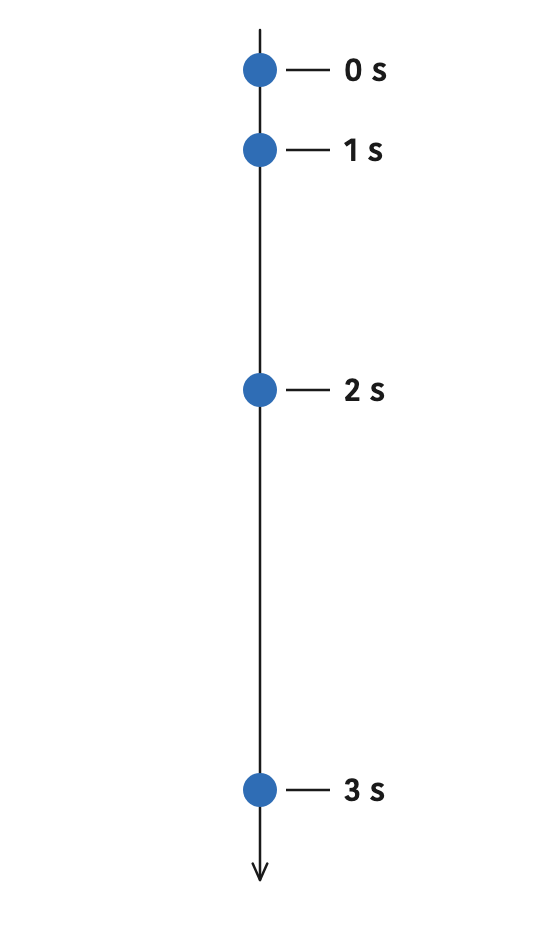
The data obtained by observing a free fall are given below:
| Time t (s) | Distance covered y (m) | Velocity v (m/s) | Acceleration a (m/s²) |
| 0 | 0 | 0 | 9.8 |
| 1 | 4.9 | 9.8 | 9.8 |
| 2 | 19.6 | 19.6 | 9.8 |
| 3 | 44.1 | 29.4 | 9.8 |
The direction of a freely falling object is fixed, yet the distance it covers each second keeps changing, so this is non-uniform motion. Its acceleration, however, is the same in every second of the fall. Let us find its average velocity from this data in two different ways.
Step 1: Dividing the 44.1 m covered in the fixed direction in 3 seconds by the time taken:
\[ v_{av} = \frac{44.1}{3} = 14.7 \ \text{m/s} \]
This average velocity points toward the centre of the Earth.
Step 2: Taking the mean of the initial velocity u = 0 m/s and the final velocity v = 29.4 m/s:
\[ v_{av} = \frac{0 + 29.4}{2} = 14.7 \ \text{m/s} \]
Both methods give the same 14.7 m/s toward the centre of the Earth. When an object falls or moves in a straight line with uniform acceleration, the mean of its initial and final velocities gives its average velocity. So for an object in straight line motion with uniform acceleration:
\[ V_{av} = \frac{u + v}{2} \]
Free fall is non-uniform motion with uniform acceleration: the distance covered changes every second, but the acceleration stays fixed at 9.8 m/s².
Retardation
When the brakes are applied gently on a moving bus, we can feel its velocity falling. This is also why Batuli's body jerked forward whenever the driver braked: the velocity of the bus was dropping suddenly.
The rate at which the velocity of a moving object decreases per unit time is called retardation. It is also called negative acceleration.
When velocity falls, the acceleration formula gives a negative answer. For example, when velocity drops from 20 m/s to 10 m/s, the acceleration is negative, and that negative acceleration is what we call retardation. Do not treat the negative sign as a mistake in your working.
The full lesson is waiting for you
The notes are free to read in full. A free account opens the rest of the practice, and tracks your progress and confidence score for every subject. Presentations and videos need approval from Learn Yeti.