The push the ground gives back
Watch your own walking for a moment. At every step your sole presses the ground downward and backward. Can you move forward without pressing on the ground like that? Try it once. You cannot. The instant your foot pushes the ground backward, the ground pushes your foot forward with exactly the same force. That returned push is what carries you forward, not the force of your own leg acting on itself.
This also explains why walking on ice or a wet, slippery floor is so hard. On a slippery surface the foot cannot grip and press the ground properly, so the ground cannot return a proper push, and we slip instead of moving ahead. Hidden inside this small everyday experience is one of the great rules of nature: a force never acts alone. Forces always act in pairs.
Two spring balances in a tug
This pairing of forces can be seen with your own eyes. Take two identical spring balances. Fix one end of spring balance B against a wall and join the hook of spring balance A to the free hook of B. Now pull the free end of A slowly outward. Something remarkable shows up: both balances always display the same reading. When A reads 4 N, B reads exactly 4 N as well. Pull harder and both readings rise together, yet the directions of the two pulls are exactly opposite.
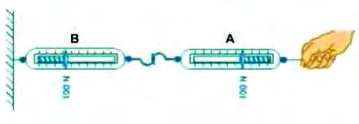
The meaning is clear. While balance A pulls balance B, balance B is pulling balance A just as hard in the opposite direction. Even though the pulling was started from one side only, an equal force appears on both sides at the same time.
Newton's third law of motion
Newton expressed this observation as a law. Whenever one body applies a force on a second body, the second body applies a force of the same magnitude on the first body, in exactly the opposite direction. Of this pair of forces acting on the two bodies, one is called the action and the other is called the reaction.
Newton's third law of motion: for every action there is an equal and opposite reaction.
Action: of the pair of forces between two bodies, the force that the first body applies on the second body is called the action.
Reaction: the equal force that the second body applies back on the first body, in the opposite direction, is called the reaction.
Forces always act in pairs. A single, lonely force does not exist anywhere: the moment an action appears on one body, its reaction appears on the other body at that very instant.
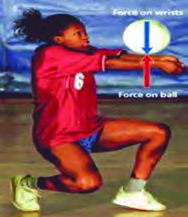
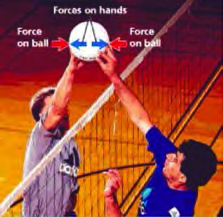
A volleyball game shows these force pairs beautifully. When a player digs the ball with her wrists, the ball presses down on the wrists while the wrists push the ball upward with an equal force. When two players press the ball at the net at the same moment, each player's hands exert a force on the ball, and the ball returns an equal force onto both players' hands.
Action and reaction never cancel each other
A natural question comes up here. If action and reaction are equal and opposite, should they not cut each other out, so that nothing could ever start moving? No. The resultant force becomes zero only when two equal and opposite forces act on the same body. Action and reaction always act on two different bodies: the action on one body, the reaction on the other. Since they never sit on the same body, there is no question of adding them up to zero. That is why action and reaction never cancel each other.
It is wrong to think that action and reaction cancel each other just because they are equal and opposite. Forces can cancel only when both act on the same body, and action and reaction always act on two different bodies. An answer that leaves out this reason is not complete.
Action and reaction in daily life
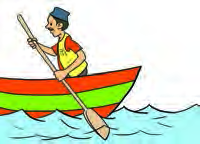
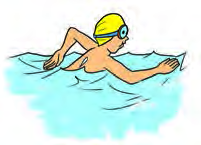
In every activity around us that sets a body moving, we can pick out the action and the reaction. When a boatman rows, the oar pushes the water backward: that is the action. The water applies an equal force back on the oar, and the boat is pushed forward: that is the reaction. Swimming works exactly the same way: the swimmer's hands push the water backward, the water returns an equal force to the hands, and the body shoots forward.
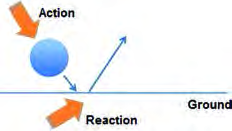
Look also at what happens when a ball is bounced on the ground. The ball strikes the ground, pressing on it downward: that is the action. The ground returns an equal force on the ball, directed upward: that is the reaction. The ball rises again precisely because of that reaction force from the ground.
The same law is at work when a rocket is launched, when a bird flies and when a gun is fired. The table below separates the action and the reaction in each of these examples.
| Example | Action | Reaction |
| Rowing a boat | The oar pushes the water backward. | The water pushes the boat forward with an equal force. |
| Swimming in water | The hands push the water backward. | The water drives the body forward with an equal force. |
| Bouncing a ball on the ground | The ball presses on the ground downward. | The ground pushes the ball upward with an equal force, so the ball bounces. |
| Launching a rocket | The rocket throws the hot gases from its burnt fuel downward at great speed. | The gases push the rocket upward with an equal force. |
| A bird flying | The bird's wings push the air downward. | The air pushes the bird upward with an equal force. |
| Firing a gun | The gun applies a large forward force on the bullet. | The bullet pushes the gun backward with an equal force, which is why the gun recoils. |
The balloon rocket
You can demonstrate Newton's third law for yourself. Thread a string through a drinking straw, tie both ends of the string to two supports, and tape an inflated balloon to the straw. The moment you release the balloon's mouth, the air inside rushes out backward through the mouth: that is the action. The escaping air applies an equal forward force on the balloon: that is the reaction. Because the balloon is taped to the straw, it has a straight track to follow, and it races along the string like a rocket.
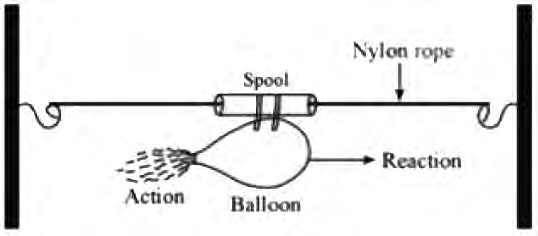
A real rocket flies in exactly the same way. It throws the hot gases from its burning fuel downward at great speed, and those gases push the rocket upward with an equal force. A balloon's air and a rocket's exhaust are different things, but the rule behind them is one and the same: for every action there is an equal and opposite reaction.
The full lesson is waiting for you
The notes are free to read in full. A free account opens the rest of the practice, and tracks your progress and confidence score for every subject. Presentations and videos need approval from Learn Yeti.