The Five Quantities the Equations Connect
When an object moves along a straight line with uniform acceleration, five quantities describe its motion completely. The initial velocity of the object is written u, the final velocity is v, the distance covered, that is the displacement, is s, the acceleration produced is a, and the time the object spends moving is t. If any three of these five are known, the rest can be calculated, and the relations that do this calculating are called the equations of motion.
The equations of linear motion are the equations that relate the initial velocity (u), final velocity (v), acceleration (a), time (t) and displacement (s) of an object moving along a straight line with uniform acceleration.
There are four of these equations, and all four come out of two small ideas: the definition of acceleration and the idea of average velocity. They are derived one by one below. Read each step noticing what is being done and why it is allowed, because examinations ask for these derivations in full.
The First Equation: v = u + at
Suppose an object in straight line motion starts with velocity u. That velocity changes at a steady rate, and after some time t it has become the final velocity v. Now recall what acceleration means: acceleration is the change in velocity in each unit of time.
Step 1: By the definition of acceleration, dividing the change in velocity by the time taken gives:
\[ a = \frac{v - u}{t} \]
Step 2: Multiplying both sides by t:
\[ at = v - u \]
Step 3: Moving u to the other side and writing v as the subject:
\[ v = u + at \ \dots \text{(i)} \]
Equation (i) contains no displacement s at all. So when a problem mentions only velocities, acceleration and time, and says nothing about distance, this is the equation to reach for.
The Second Equation and v² = u² + 2as
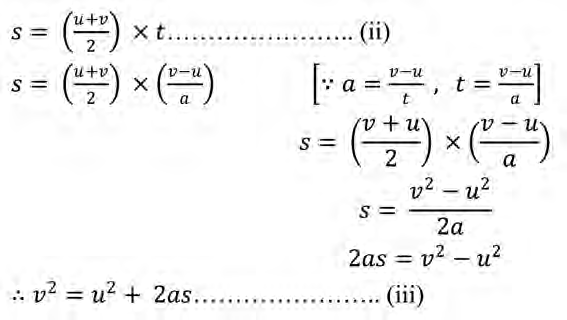
Suppose an object in straight line motion is displaced by s from one place to another. During the displacement its initial velocity u changes steadily, and after time t it reaches a definite final velocity v. Because the velocity changes at a uniform rate, the average velocity over this interval is exactly midway between the starting and finishing velocities, that is (u + v)/2. Displacement is average velocity multiplied by time. Therefore:
\[ s = \left( \frac{u+v}{2} \right) \times t \ \dots \text{(ii)} \]
Equation (ii) is itself one of the four equations of motion. Now let us squeeze a further equation out of it, one that contains no time t.
Step 1: Rearranging equation (i) gives t = (v - u)/a. Substituting this value of t into equation (ii):
\[ s = \left( \frac{v+u}{2} \right) \times \left( \frac{v-u}{a} \right) \]
Step 2: Since the product of (v + u) and (v - u) is v² - u², this becomes:
\[ s = \frac{v^2 - u^2}{2a} \]
Step 3: Multiplying both sides by 2a:
\[ 2as = v^2 - u^2 \]
Step 4: Rearranging to make v² the subject:
\[ v^2 = u^2 + 2as \ \dots \text{(iii)} \]
The Fourth Equation: s = ut + ½at²
Suppose an object with uniform acceleration a is displaced by s from one place to another, and during the time t in which the acceleration acts, its initial velocity u changes into a final velocity v. This time we want an equation with no v in it, because many problems never tell us the final velocity.
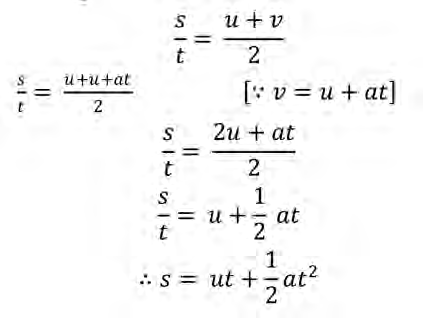
Step 1: Dividing both sides of equation (ii) by t:
\[ \frac{s}{t} = \frac{u+v}{2} \]
Step 2: Replacing v with u + at, using equation (i):
\[ \frac{s}{t} = \frac{u + u + at}{2} \]
Step 3: Adding the two u terms in the numerator:
\[ \frac{s}{t} = \frac{2u + at}{2} \]
Step 4: Dividing each term of the numerator by 2:
\[ \frac{s}{t} = u + \frac{1}{2}at \]
Step 5: Multiplying both sides by t:
\[ s = ut + \frac{1}{2}at^2 \ \dots \text{(iv)} \]
The Four Equations at One Glance
Each equation grips only four of the five quantities and leaves one out. Once you know which equation drops which quantity, choosing the right one for a problem takes no time at all.
| Equation | Quantities it connects | Quantity it leaves out |
| \( v = u + at \) ... (i) | u, v, a, t | displacement (s) |
| \( s = \left(\frac{u+v}{2}\right) \times t \) ... (ii) | u, v, s, t | acceleration (a) |
| \( v^2 = u^2 + 2as \) ... (iii) | u, v, a, s | time (t) |
| \( s = ut + \frac{1}{2}at^2 \) ... (iv) | u, a, t, s | final velocity (v) |
The route through any problem: first list the quantities given, then write the quantity wanted. Pick from the table the one equation holding all four of them, put the values in, and solve.
When the speed of an object is falling, the acceleration must be taken as negative. A braking motorcycle with a retardation of 6 m/s² goes into the equations as a = -6 m/s². Forget the minus sign and both the displacement and the velocity come out wrong.
All four equations hold only for straight line motion with uniform acceleration. If the acceleration keeps changing, as for a vehicle darting and stopping through traffic, these equations cannot be applied directly.
Free Fall: a = g and s = h
When an object is falling freely towards the Earth and air resistance is small enough to ignore, the only acceleration acting on it is the acceleration due to gravity. So in the equations of motion we simply write g in place of a and the height fallen, h, in place of the displacement s. Near the Earth's surface g is 9.8 m/s², which means a falling object gains 9.8 m/s of velocity in every second.
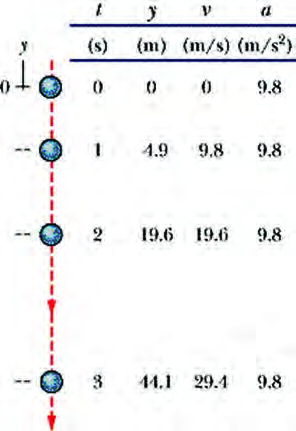
You can check that the equations give exactly these figures. The object falls from rest, so u = 0. Equation (i) gives the velocity after 2 s as \( v = 0 + 9.8 \times 2 = 19.6 \) m/s, and equation (iv) gives the height fallen in 3 s as \( h = 0 + \frac{1}{2} \times 9.8 \times 3^2 = 44.1 \) m. Both values match the table in the figure exactly. It is a small proof that the equations really work.
The full lesson is waiting for you
The notes are free to read in full. A free account opens the rest of the practice, and tracks your progress and confidence score for every subject. Presentations and videos need approval from Learn Yeti.