Newton's Three Laws of Motion
Sir Isaac Newton was a physicist and a mathematician. In 1687 he put forward three laws about the motion of objects. These three laws explain scientifically why an object stays still, why it starts to move, how quickly its motion changes, and what kind of property a force has. Everyday events such as riding a bicycle, passing a football and a bus coming to a stop all follow these laws.
- The first law gives the definition of force.
- The second law describes how the acceleration of an object is related to the applied force and to the mass of the object. Using it, force can be measured.
- The third law tells us about the property of force.
Newton's First Law of Motion
Before Newton put forward his laws of motion, the scientist Galileo Galilei had already studied motion in a systematic way and had given the law of inertia. Newton then defined inertia and stated the first law of motion. So the first law stands on the foundation that Galileo built.
Newton's first law of motion: An object at rest stays at rest, and an object in motion keeps moving with the same speed in the same direction, until an unbalanced force is applied to it.
According to this law, if the resultant force acting on an object is zero, the object stays exactly as it is. A still object remains still, and a moving object keeps moving at the same speed. To bring an object from rest into motion, or to bring an object moving with uniform speed to rest, an unbalanced force must act on it. The definition of force comes straight out of this.
Force is the cause that changes the state of an object.
The first law describes the tendency of a still object to stay still and of a moving object to keep moving, until an unbalanced force acts. This tendency of an object is called inertia. For this reason the first law is also called the law of inertia.

The state of an object can change in three ways, and every one of them needs an external resultant force. When players pass a football around a field, all three changes can be seen inside one game:
- From rest to motion: when the first player kicks, the resultant force of the kick sets the ball rolling in the direction of that force.
- Change of direction: the ball rolls straight in the direction of the first force. Only the resultant force applied by another player changes its direction.
- From motion to rest: if no friction acted between the ball and the ground, the ball would keep rolling for ever, which is impossible in practice. Friction and the resultant external force applied by other players bring the ball to rest.
It is wrong to think that a continuous force is needed to keep an object moving. Force is needed only to change the state of the object. A moving object slows down because opposing forces such as friction act on it, not because force has run out.
Newton's Second Law of Motion
When a bicycle has to be taken from rest and made to speed up quickly, two things make a difference. With the rider alone, the bicycle picks up speed quickly, but when another person sits behind the rider the same effort speeds it up more slowly, because the total mass has increased. In the same way, on a smooth even road, pedalling with less force produces a smaller acceleration and pedalling with more force produces a larger one. Both experiences show that acceleration depends on the force as well as on the mass.
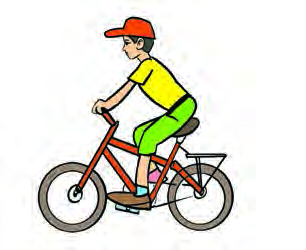
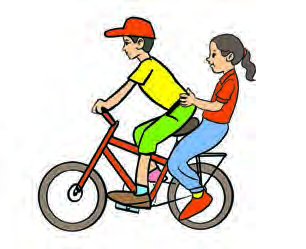
If the applied force stays the same, increasing the mass decreases the acceleration. If the mass stays the same and the rider can increase the force, the acceleration increases too.
| How a change in the mass of an object affects its acceleration | How a change in the applied force affects the acceleration |
| After putting down a heavy load, we can walk much faster empty handed. | When the muscles apply more force, we can break into a fast run in a moment. |
| When the load of a truck climbing uphill is reduced, its motion changes much more quickly. | In a vehicle, pressing the accelerator increases the engine's force and produces acceleration, while pressing the brake hard produces a rapid slowing down. |
| An empty handcart is much easier to push along than one loaded with goods. | On the playground, to make a ball roll faster, more force has to be used. |
The relation of acceleration to force and mass can be seen directly by experiment. A dynamics trolley is tied by a string that runs over a pulley to a hanging hook. The weight of the masses placed on the hook acts as the force pulling the trolley. By measuring the time the trolley takes to cover a distance of one metre, its acceleration can be worked out.
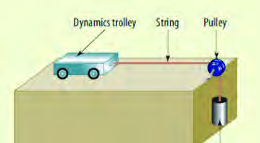
In this experiment, when the mass of the trolley is kept constant and the pulling force is increased by adding masses to the hook, the acceleration of the trolley keeps increasing. Likewise, when the pulling force is kept constant and masses are added to the trolley itself, the acceleration keeps decreasing. Newton stated exactly this conclusion as his second law.
Force, Mass and Acceleration: F = ma
Newton's second law of motion: The acceleration produced in an object by the application of force is directly proportional to the force applied and inversely proportional to the mass of the object.
When the mass of an object stays constant, increasing the resultant force acting on it increases the acceleration produced. This is written as relation (i):
\[ a \propto F \]
When the resultant force on the object stays constant, the acceleration decreases as the mass increases, and increases as the mass decreases. This is relation (ii):
\[ a \propto \frac{1}{m} \]
Combining relations (i) and (ii):
\[ a \propto \frac{F}{m} \]
The same thing can be written the other way round as \( F \propto ma \). To turn a proportionality into an equation, a constant k has to be introduced. That gives relation (iii):
\[ F = kma \]
The Newton: The Unit of Force
One newton: the force used to produce an acceleration of 1 m/s² in an object of mass 1 kg is called 1 N.
When the force is 1 N, the value of k in relation (iii) becomes 1 as well, because the mass there is 1 kg and the acceleration is 1 m/s². So with force in newtons, mass in kilograms and acceleration in metres per second squared, the second law becomes the equation:
\[ F = ma \]
This equation is what makes the second law a tool for measuring force. Once the mass of an object and the acceleration produced in it are known, the force can be calculated. The direction of the acceleration produced is always the direction of the applied resultant force.
The full lesson is waiting for you
The notes are free to read in full. A free account opens the rest of the practice, and tracks your progress and confidence score for every subject. Presentations and videos need approval from Learn Yeti.