Elastic and Plastic Things Around Us
When you hear the word elastic, which things come to mind? A rubber band, the elastic of a garment, a rubber ball, an air filled balloon. And when you hear plastic in the sense of mouldable, you might think of kneaded clay, a lump of dough or candle wax. These two groups of objects behave very differently when a force acts on them, and that difference is the whole story of this topic.
Pull a rubber band slowly and its length increases. The moment the pulling force is removed, it returns to its original length. Squeeze a rubber ball or an air filled balloon and its shape changes, but when you let go it takes back its real shape. Press a finger into kneaded clay, though, and the dent stays there even after the finger is lifted. One kind of body comes back, the other does not.
The Deforming Force
When forces act on a body from several directions, their overall effect appears as a single force called the resultant force. Depending on the structure of the body and on the size and direction of the applied forces, this resultant force can change the shape and the size of the body. When a rubber band is pulled from its two ends, it is the resultant effect of those two forces that makes it longer.
The resultant force that changes the shape and size of a body is called the deforming force.
A body whose shape has been changed by a deforming force is called a deformed body. Up to a certain limit, a deformed body returns to its original state when the deforming force is removed. Beyond that limit it can no longer return. This gives us two properties by which bodies can be sorted.
Elasticity
Elasticity is the property of a body by which it regains its original state when the deforming force acting on it is removed.
Different bodies have different elasticity depending on their structure. A body with high elasticity is hard to deform, because inside it a restoring force develops against the deforming force, and that restoring force pulls the body back to its original state. Steel has very high elasticity, so it is used for building strong houses, bridges and similar structures. The rods of a bridge stretch a tiny amount while carrying the weight of thousands of vehicles, and spring back to their own shape when the load passes.

Now think about this question. If a steel spring is stretched as far as it will go, will it still return to its original state? It will not. When a deforming force greater than a certain amount acts on a body, the body becomes permanently deformed. Even a material as elastic as steel has a limit beyond which it cannot come back.
Plasticity
Plasticity is the property of a body by which its shape and size change permanently when a force acts on it.
Plasticity is the reason kneaded clay can easily be shaped into bricks. A candle moulded from melted wax keeps that shape forever. Toothpaste squeezed out of its tube never goes back in. No restoring force develops inside such bodies, so the changed shape simply stays. Remember, though, that if the force on a permanently deformed body keeps on increasing, the body finally tears or breaks.
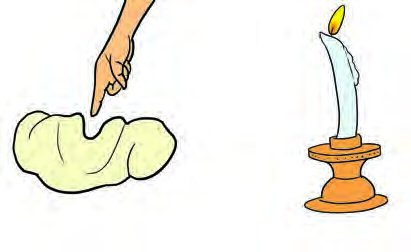
Never stretch an elastic object such as a rubber band beyond its limit. Past that limit the object becomes permanently deformed, loses its elastic property, and snaps if the force is increased further.
Elasticity and Plasticity Compared
| Property | When the deforming force is removed | Kind of change in shape | Restoring force |
| Elasticity | The body returns to its earlier shape | Temporary | Develops |
| Plasticity | The changed shape stays as it is | Permanent | Does not develop |
A Toy That Runs on Elasticity
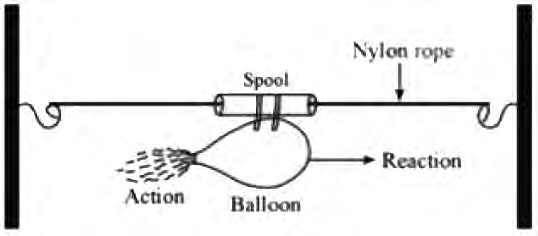
Elasticity can be turned into the engine of a toy. When a balloon is inflated, a restoring force builds up in its stretched skin. The moment the mouth is released, that force squeezes the air out backward, and the air pushes the balloon forward. This pairing, a push one way answered by a push the other way, is something you meet everywhere in daily life.


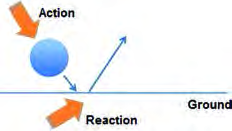
Tape a balloon to a straw threaded on a string and release its mouth, and the balloon races along the string like a rocket. Put the same arrangement on a light body with wheels and you have a balloon powered toy car. Balloons of different elasticity supply different forces, and loading the car with different weights makes the same force produce different accelerations, so this one toy even demonstrates Newton's second law of motion.
The Shape of a Graph Tells the Story of Motion
Let us place the unit's main tools side by side. The slope of a displacement time graph gives speed, while the slope of a speed time graph gives acceleration. Just from the shape of the line, a graph tells you a great deal about how the body is moving.
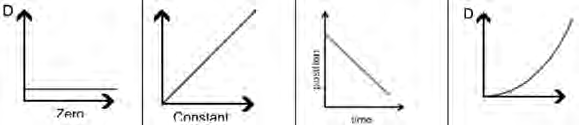
| Shape of the line | Meaning on a displacement time graph | Meaning on a speed time graph |
| What the slope gives | Speed | Acceleration |
| Parallel to the x-axis | Zero slope, the body is at rest | Zero slope, uniform speed |
| Straight line going upward | Constant slope, moving forward with uniform speed | Constant slope, uniform acceleration |
| Straight line going downward | Constant slope, moving backward with uniform speed | Constant slope, uniform retardation |
| Curved line | Different slopes at any two points, non uniform speed | Different slopes at any two points, non uniform acceleration |
Reading a Race from a Graph
The famous race between the hare and the tortoise fits on a single displacement time graph. The hare's line is steep at first, because it sprinted. Then the line runs parallel to the x-axis for a long stretch, because the hare slept and its displacement stopped growing. At the end the line turns steep again as the hare wakes and runs desperately. The tortoise's line is one straight line of constant slope from start to finish. It never stopped, it crossed the hare's line while the hare was asleep, and it reached the goal first.
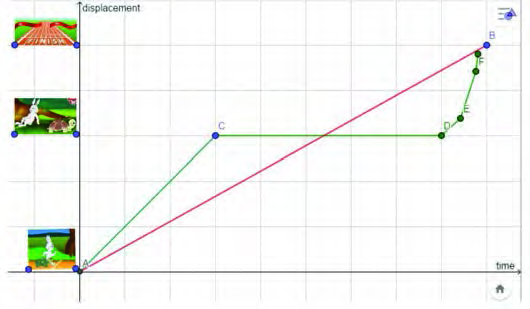
Whenever you read a motion graph, look for these same four shapes: a parallel line, a straight line going up, a straight line going down, and a curve. Check which kind of graph it is, and the table above turns each shape into its meaning.
Equations of Motion in a Straight Line
To use the equations of horizontal motion for vertical motion, replace the acceleration a with the acceleration due to gravity g and the displacement s with the height h. Which equation you need is decided by which quantities the problem gives and asks for.
| Quantities involved | Equation for horizontal motion | Equation for vertical motion |
| Any three of initial velocity (u), final velocity (v), acceleration (a) and time (t) | \( v = u + at \) | \( v = u + gt \) |
| Any three of initial velocity (u), final velocity (v), acceleration (a) and displacement (s) | \( v^2 = u^2 + 2as \) | \( v^2 = u^2 + 2gh \) |
| Any three of initial velocity (u), acceleration (a), time (t) and displacement (s) | \( s = ut + \frac{1}{2}at^2 \) | \( h = ut + \frac{1}{2}gt^2 \) |
Newton's Three Laws of Motion
- First law: unless an unbalanced force acts on it, a body at rest stays at rest, and a body in motion keeps moving with uniform speed in the same direction.
- Second law: the acceleration produced in a body by a force is directly proportional to the force applied and inversely proportional to the mass of the body.
- Third law: for every action there is an equal and opposite reaction.
The full lesson is waiting for you
The notes are free to read in full. A free account opens the rest of the practice, and tracks your progress and confidence score for every subject. Presentations and videos need approval from Learn Yeti.