Everyday Things and Scientific Questions
Look around any kitchen and you will find lemons, bitter gourds, cucumbers, oranges, watermelons, salt, soda and soap. A lemon tastes sour, a bitter gourd tastes bitter, soap feels slippery. Behind each of these tastes and properties there is a chemical reason. You cannot tell by looking whether a substance is acidic, basic or neutral. Finding out needs an organised way of working. Raising questions about the things and events around us, and then answering those questions with experiments and evidence, is what scientific study means.

To study whether such fruits and chemical substances are acidic, basic or neutral, we first frame a question, then put forward a hypothesis as a possible answer, test it through experimental work, and collect the data the study needs, such as pH values. For example, the question of whether lemon juice is acidic is answered with litmus paper or a pH measurement. Answering from measured data, not from guesswork or hearsay, is the way of science.
Never taste or touch a substance to find out whether it is acidic or basic. Laboratory chemicals can harm the body. Use a safe method such as litmus paper or a pH measurement instead.
Steps of Scientific Learning
Learning science is not a haphazard affair. Scientific learning moves forward through fixed steps in order, and when needed it returns to the very beginning. The steps are these:
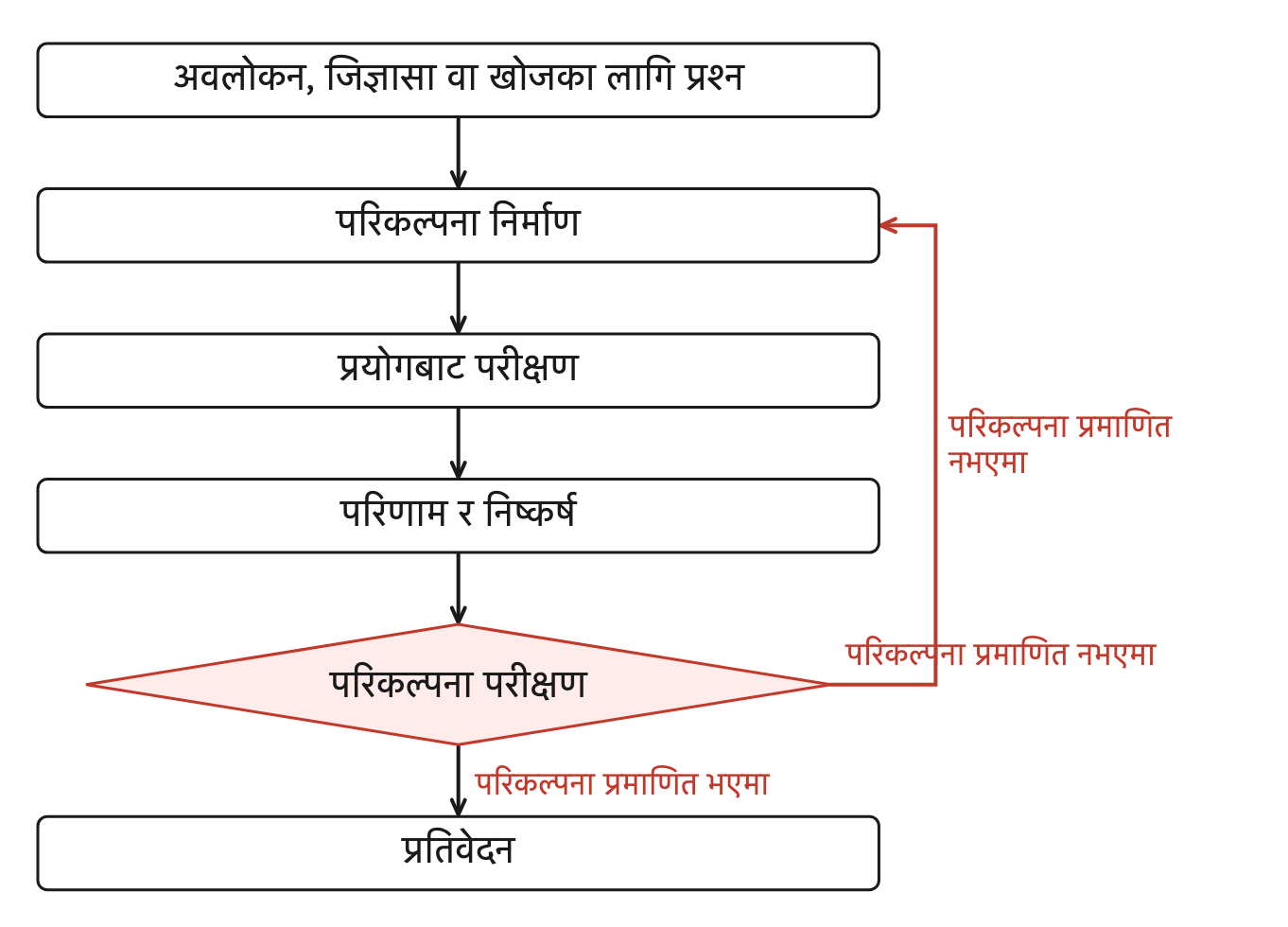
- Observation, curiosity or a question for inquiry: the things and events around us are watched carefully and a testable question is framed.
- Forming a hypothesis: a possible answer to the question is put forward.
- Testing by experiment: experimental work is carried out to see whether the hypothesis holds.
- Result and conclusion: the data the experiment gives are examined and a conclusion is drawn.
- Examining the hypothesis: it is checked whether the conclusion verifies the hypothesis or not.
- If the hypothesis is verified, a report is prepared.
- If the hypothesis is not verified, a new hypothesis is formed and the study starts again.
A hypothesis is a possible answer to a question that can be tested by experiment. It is not a final verdict; it is a tentative answer put forward so that it can be checked.
A hypothesis that is not verified is not a failure. It sends us back into the study with a better question and a new hypothesis. This habit of correcting its own mistakes is what makes science trustworthy.
Collecting Data and Measuring
The data and evidence scientific learning needs are collected through different kinds of experimental work. Such experiments are done not only inside a laboratory but also out in the field. The quality of the soil of a farm is tested on the farm itself, while a chemical solution is tested in the laboratory. Collecting data means taking measurements, small and large, from the size of a cell to the flow of a river. Every measurement is recorded according to the scientific method, and every measurement carries its unit, every time.
Any measurement can carry some error. To reduce the possible error, the same quantity is measured several times and the average value is taken. For example, if the distance a paper aeroplane flew is measured three times as 6.2 metres, 6.4 metres and 6.3 metres, then the average \( \frac{6.2 + 6.4 + 6.3}{3} = 6.3 \) metres is taken as the measurement of that flight.
Process Skills and Scientific Attitude
Memorising the facts and principles of science does not make anyone learn scientifically. Besides knowledge about science, we need science process skills and a scientific attitude. The skills show what to do and how to do it, while the attitude builds the habits of accepting evidence, staying curious and being patient. Together these two prepare the foundation of scientific learning.
Science process skills are the practical skills used in the course of scientific learning, from observing through to communicating. These skills prepare the foundation of scientific learning.
A scientific attitude is the frame of mind needed for learning science: accepting evidence, staying curious, and being honest and patient.
The Eight Science Process Skills
Eight skills come under the science process skills. The meaning of each skill and one example are given in the table below:
| Skill | What it means | Example |
| Observing | Using the senses to notice things and events carefully and gather information | Looking closely at how each aeroplane design is built |
| Questioning | Turning curiosity about what we see into questions for inquiry | Asking why one design flies farther than another |
| Classifying | Sorting things into groups on the basis of shared properties | Putting substances into acidic, basic and neutral groups |
| Predicting | Saying what the result will be before the test is done | Saying this design will fly the farthest |
| Interpreting | Working out what the collected data are saying | Seeing which design the flight distances show to be better |
| Measuring | Taking the measure of a quantity with its proper unit | Measuring the distance flown in metres |
| Concluding | Reaching a final judgement on the basis of evidence | Deciding that the wide winged plane stayed up longest |
| Communicating | Telling others your findings, in speech or in writing | Presenting your result to the class |
Do not mix up predicting and concluding. A prediction is made before the test and it may turn out wrong. A conclusion is drawn after the test, on the basis of evidence.
Practising the Skills with a Paper Aeroplane
The skills above are not learnt by reading alone; they are learnt by doing. Even the small job of making a paper aeroplane exercises them one after another. Studying how the different designs are built is observing. Wondering which design will stay in the air longest and fly farthest exercises both questioning and predicting. Flying the plane and taking the distance and the time is measuring. Comparing your plane with your friends' planes and going through the results is interpreting, and deciding which design came out best is concluding. Finally, telling the class what you found brings in communicating as well.
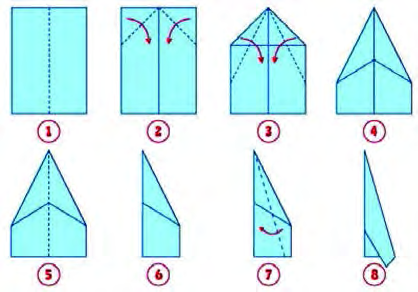
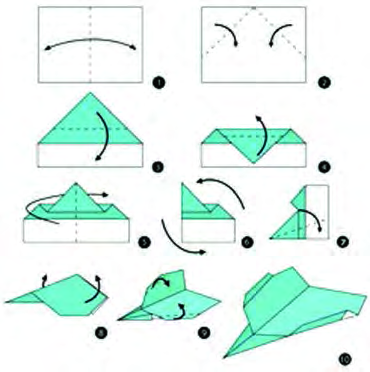
The work does not end with one flight. Widen the wings a little, add some weight at the nose or sharpen a fold, and the next flight may come out different. This cycle of modifying your chosen design, testing it again and improving it step by step is the steps of scientific learning in miniature: predict, test, look at the result, and if it does not hold, start again.
The full lesson is waiting for you
The notes are free to read in full. A free account opens the rest of the practice, and tracks your progress and confidence score for every subject. Presentations and videos need approval from Learn Yeti.