Practical Work Needs Caution
Science is not learned from a book alone. Scientific study includes practical work: mixing chemicals in the laboratory, heating substances, and going outside to observe and measure. Wherever an experiment is done, one thing is always true. Working without caution can cause an accident. A hot vessel can burn a hand, an acid can burn the skin, and a flammable liquid can catch fire. So before any experiment, a student must think about what could go wrong and follow the safety measures that prevent it.
Safety is not an extra added to an experiment. It is part of the method itself. An experiment done unsafely is not an experiment done well.
Heating Alcohol Safely: The Water Bath
Alcohol catches fire very easily. If alcohol is put in a beaker and heated directly over a flame, it burns, and that causes an accident. Even the vapour rising from alcohol burns, so the moment it reaches the flame the fire spreads. This is why alcohol, and any liquid that burns like it, is never heated directly over a flame.
A water bath is a way of heating a substance without putting it over a flame: its container is stood in a vessel of water, and only the water is heated.
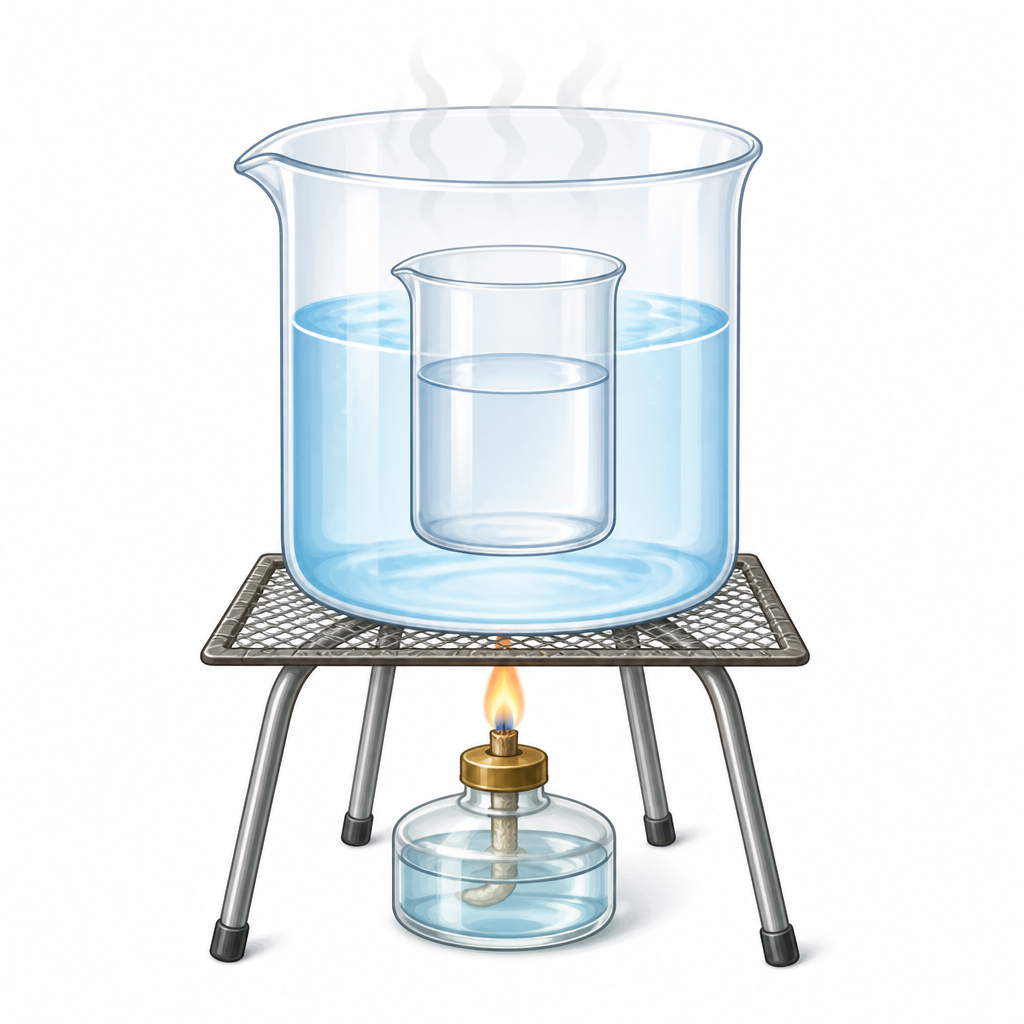
Why is a water bath safe? Because the flame never touches the container of alcohol. The flame heats the water, and the hot water then warms the alcohol gently. Water never becomes hotter than 100 degrees Celsius, so the alcohol never gets hot enough to be dangerous, and its vapour never meets the flame. Heated in water this way, the alcohol warms up safely.
Never heat alcohol, spirit or any liquid that burns easily directly over a flame. Always heat it on a water bath.
Making Dilute Acid from Concentrated Acid
Many experiments need a dilute acid, but acid usually comes concentrated, and a concentrated acid is dangerous. On the skin it causes serious burns. So the concentrated acid is mixed with water to make it dilute. The important thing about this job is not the mixing itself but the direction of the mixing.
A dilute acid is an acid mixed with plenty of water so that it becomes much weaker than the concentrated acid it came from.
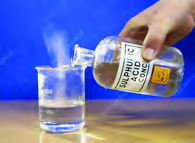
When acid and water mix, a lot of heat is produced. If the acid is added slowly to water, the large amount of water soaks up that heat easily and the mixture stays safe. But if water is added to acid, a little water lands in a lot of acid. The heat makes that little water boil instantly, and drops of acid spit out of the container. Those drops can land on the eyes or the skin. So a dilute acid is always made by adding the acid slowly to the water.
Never pour water into a strong acid. Always pour the acid slowly into the water.
Eleven Safety Rules for the Laboratory
Heating alcohol and diluting acid are only two examples. Every kind of experiment must be done carefully, and the safety measures below apply to all practical work:
- Do an experiment only when the teacher is present.
- Wear a lab coat, goggles, gloves and other safety materials while working in the laboratory.
- Report any accident to the teacher at once.
- Learn about a piece of equipment before operating it.
- Take only as much of a chemical as the experiment needs.
- Handle every chemical with care.
- Keep the windows and doors open while experimenting.
- Tell the teacher whenever a strong acid is needed.
- Never taste any chemical.
- After the experiment, clean the working place and return every piece of equipment to where it belongs.
- Wash your hands with soap and water after the experiment.
The rules look small when read, but each one has a reason behind it. Open windows and doors stop harmful gases collecting inside the room. Taking only the amount needed wastes nothing and keeps less of a dangerous chemical on the bench. Tasting a chemical carries poison straight into the body, so it is never done. Washing with soap and water removes any chemical clinging to the hands before it can travel to the mouth with food.
Before, During and After an Experiment
An easy way to remember all eleven measures is to sort them into three stages: what is done before the experiment starts, what care is taken while it runs, and what is done after it ends.
| Stage | Safety measures |
| Before | Make sure the teacher is present, put on the lab coat, goggles and gloves, learn about the equipment |
| During | Take only the chemical needed, keep windows and doors open, never taste anything, tell the teacher if a strong acid is needed or an accident happens |
| After | Clean the working place, return the equipment to its place, wash hands with soap and water |
The Lesson of Marie Curie

The strongest example of what happens when safety is ignored comes from the history of science itself. Marie Curie was a great scientist who studied radioactive substances. But proper precautions against radiation were not taken during that work, and the effect of radioactive radiation gave her leukaemia, the disease that killed her. The harm from radiation is not like fire or acid. It cannot be seen at the moment it happens. It builds up in the body over years and appears later as disease. So a danger that cannot be seen is still a danger. A hazard that did not spare a great scientist will certainly not spare a student, and that is why safety measures belong in every experiment.
Proper precautions were not taken while Marie Curie experimented with radioactive substances, and the radioactive radiation gave her leukaemia, from which she died.
The full lesson is waiting for you
The notes are free to read in full. A free account opens the rest of the practice, and tracks your progress and confidence score for every subject. Presentations and videos need approval from Learn Yeti.