The Main Fields of Science
Science is the systematic study of nature. Nature is so vast that no single scientist can study all of it. Some study living things, some study energy and motion, and some study substances. For this reason science is divided into different fields. The main fields of science are life science, physical science, chemistry, earth and space science, and environmental science.
- Life science: the study of living things
- Physical science: the study of force, motion and energy
- Chemistry: the study of matter and the changes in its properties
- Earth and space science: the study of the earth and of space
- Environmental science: the study of the environment and the changes in it
Among these, biology, physics and chemistry are taken as the three main fields, because many other fields of science are built on the knowledge gained from these three. Let us now meet these fields one by one.
Biology, the Science of Life
Biology is the field of science in which living things are studied systematically. A scientist who studies biology is called a biologist.
Biologists study the characteristics of living things, their reproduction, excretion, respiration and way of living, their body structure, and their interactions with other organisms and with the environment. The field covers everything from microscopic organisms that the eye cannot see up to large multicellular mammals. How a bacterium lives and how an elephant lives are both questions of biology.
New discoveries keep arriving in biology. Scientists at the Nepal Agricultural Research Council, known as NARC, studied the genes of the maize plant and developed a new nutritious variety of maize. To develop a new variety of any organism, its genes must be studied deeply, and that study belongs to biology.

Nepal's own eye surgeon Dr. Sanduk Ruit, working within biology, invented an intraocular lens, a small artificial lens placed inside the eye. Because of it, cataract, the clouding of the eye's lens, can now be treated cheaply and reliably, and many patients have got their sight back with ease.

Photo: “Sanduk Ruit in 2017” by ASB-Iclif Executive Education Centre, Wikimedia Commons · CC BY 4.0

Physics, the Science of Energy and Motion
Physics is the subject that studies force, motion, energy and other physical processes. A scientist who studies physics is called a physicist.
Physics studies physical processes all the way from the atom up to the universe. Sir Isaac Newton propounded the law of the gravitational force that arises between any two bodies, and the laws of motion. Likewise, Stephen Hawking carried out a vast study of the universe. That one field can study something as small as an atom and something as huge as the universe is what makes physics special.

You do not have to go far to see a physical process. When water is heated in a kettle, it turns into vapour and rises. When that vapour strikes a cold surface, it turns back into droplets of water. These two processes, in which heat energy changes the state of a substance, are evaporation and condensation. Energy and the changes it brings are what physics studies.

Chemistry, the Science of Matter and Its Changes
Chemistry is the field in which matter, and how its properties change, is studied systematically. A scientist who studies chemistry is called a chemist.
John Dalton propounded the theory of the structure of the atom. Likewise, Dmitri Mendeleev studied the properties of the elements and classified them on the basis of their atomic weights. Standing on that classification, today we can recognise the elements in an ordered way.

Chemistry studies the properties of matter on the basis of atoms and molecules. Its study runs from ordinary chemical reactions up to nuclear reactions. Iron rusting is an ordinary chemical reaction, while a reaction in which the very centre of the atom changes is a nuclear reaction.
Water turning into vapour, or vapour turning back into droplets, is not a chemical reaction. These are physical processes, because only the state of the substance changes and no new substance is formed. A change in which a new substance is actually formed is what chemistry studies.
Interdisciplinary Fields
Special fields of science that are built by combining the knowledge gained from two or more main fields can be taken as interdisciplinary fields.
On the basis of the knowledge gained from the three main fields, biology, physics and chemistry, some special fields of science have been formed. Geology, space science, agricultural science and environmental science are examples of interdisciplinary fields. Agricultural science uses biology to understand crops, chemistry to understand soil and fertiliser, and physics to understand irrigation and tools.
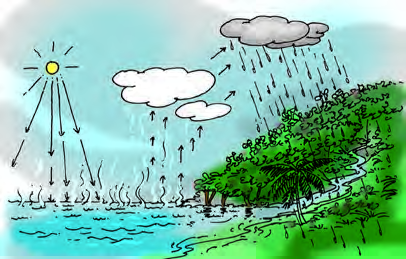
Look at the water cycle. The heat of the sun turns the water of seas and lakes into vapour, the vapour gathers into clouds, and after cooling it returns as rain. Here physics explains the work of heat, chemistry explains the properties of the substance called water, and biology and environmental science explain what the rain does to forests, crops and living things. Interdisciplinary fields exist precisely because understanding one natural event needs the knowledge of many fields at once.
Branches and Careers
At higher levels of study, each field of science divides into smaller branches, and each branch opens the door to a separate profession. Studying biology, some become doctors and some become genetic engineers. Studying physics, one can become an engineer or a radiologist, while studying chemistry one can become a pharmacologist or a chemical engineer.
| Field | Main branches | Career opportunities |
| Biology | Zoology, Botany, Genetics, Microbiology, Medical Science, Biotechnology | Biologist, doctor, genetic engineer |
| Physics | Nuclear Physics, Atomic Physics, Optics, Astrophysics, Modern Physics, Engineering, Radiography, Measurement | Engineer, radiologist, metrology expert, physicist |
| Chemistry | Organic Chemistry, Inorganic Chemistry, Physical Chemistry, Biochemistry, Nano Chemistry | Pharmacologist, chemist, chemical engineer |
| Interdisciplinary fields | Geology, astronomy, environmental science, agricultural science | Geologist, astronomer, crop expert, soil expert, environmentalist |
Important Achievements of Science
The study of the different fields of science has given us many important achievements that have changed human life. The table below shows which achievements came from which field.
| Field | Important achievements |
| Biology | Surgery, cloning, organ transplantation, vaccines, test tube babies, the development of hybrid varieties |
| Physics | The electric engine, the microscope, the X-ray, the development of communication technology and of transport technology |
| Chemistry | Medicines, and industrial chemicals such as fuel, plastic, metals, cement, chemical fertiliser and insecticides |
These achievements did not arrive overnight. Take the vaccine. Using the knowledge of biology, scientists develop a vaccine, test it on selected animals, and only after its complete success is it tested on human volunteers. Only after the vaccine succeeds as a whole is permission given to use it on other people. The vaccine against the corona virus is the latest example developed this way.
The fields of science look separate, but the knowledge comes from one store. A field you like today can become your profession and your path of discovery tomorrow.
The full lesson is waiting for you
The notes are free to read in full. A free account opens the rest of the practice, and tracks your progress and confidence score for every subject. Presentations and videos need approval from Learn Yeti.