When Numbers Get Too Big and Too Small
Measurement sits at the heart of science. During practical work objects are measured, and the data collected from those measurements is analysed to reach conclusions. Depending on what is being studied, the numbers can run from the size of the tiniest bacteria and viruses all the way up to the mass of the Earth and the mass of the Sun. A scientist therefore has to work comfortably with the smallest and the largest numbers there are.
A virus measures about 0.00000000001 metres across. The distance between the Earth and the Sun is about 150,000,000 kilometres. Numbers like these are painful to write and read as they stand, because dropping or adding a single zero changes the value ten times over. Such very small and very large numbers are instead written as powers of ten, and this way of writing them is called scientific notation. With it, everything from the distances between heavenly bodies down to the size of an atom, far too small for the eye to see, can be expressed easily.
Scientific notation is the method of writing a very large or very small number in short form, as a coefficient multiplied by a power of ten.
Powers of Ten
A power of ten means ten multiplied by itself again and again. For example 10 × 10 × 10 = 1000 is written \( 10^{3} \), where the raised 3 says that ten was multiplied three times. When the exponent is negative it means division instead, so \( 10^{-3} \) is 1 divided by 1000, which is 0.001. The table below shows both kinds of powers:
| Power | Value | Power | Value |
| \( 10^{1} \) | 10 | \( 10^{-1} \) | 0.1 |
| \( 10^{2} \) | 100 | \( 10^{-2} \) | 0.01 |
| \( 10^{3} \) | 1000 | \( 10^{-3} \) | 0.001 |
| \( 10^{6} \) | 1000000 | \( 10^{-6} \) | 0.000001 |
| \( 10^{9} \) | 1000000000 | \( 10^{-9} \) | 0.000000001 |
Each step of the exponent moves the decimal point one place. A positive power names a large number, and a negative power names a number smaller than 1.
The Parts of Scientific Notation
The East West Highway is about 1030 km long. Written in metres that is 1030 × 1000 m = 1030000 m. To put it into scientific notation, the decimal point sitting at the end is moved 6 places to the left, and that 6 is written as the power of ten, giving \( 1.030 \times 10^{6} \) m. Inside this one short expression every part of scientific notation can be seen.
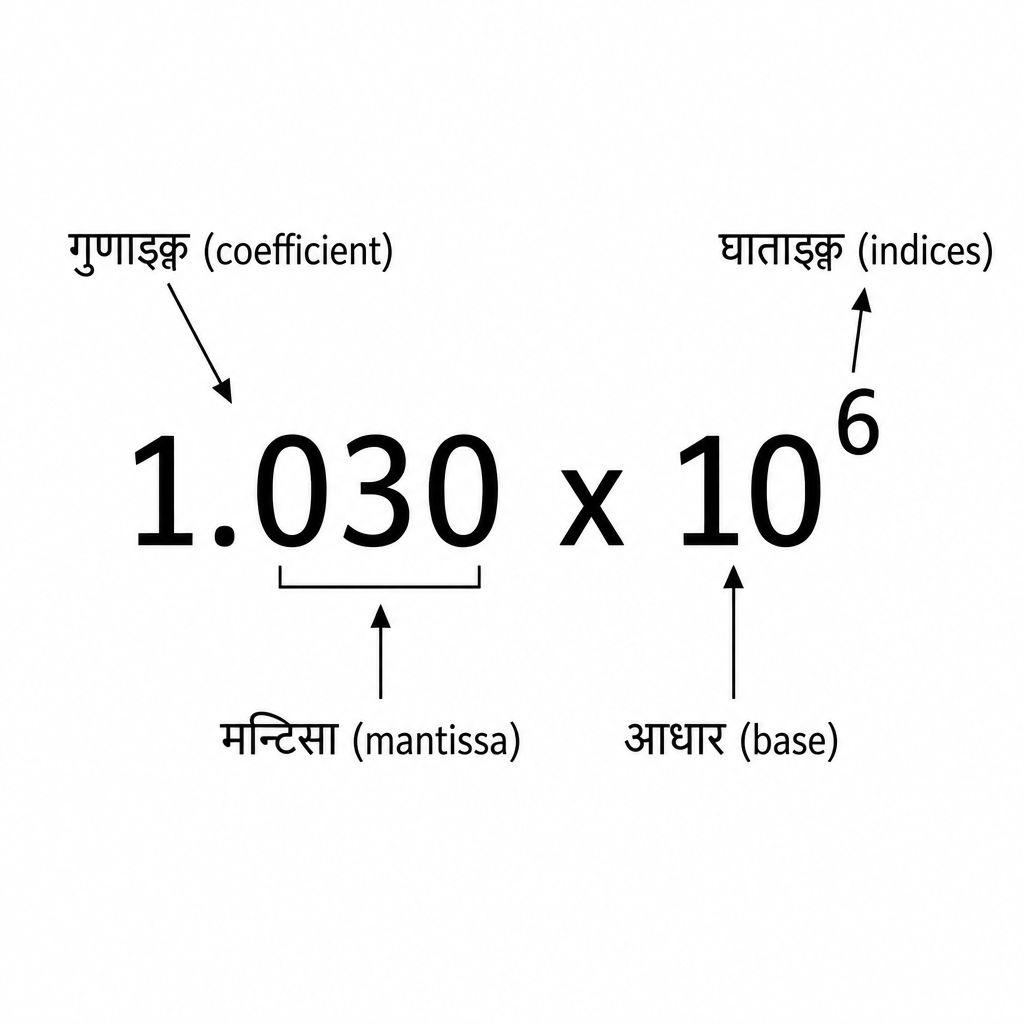
The coefficient is the number written before the multiplication sign. Only one digit stands before its decimal point, and that digit is from 1 to 9. In the example above, 1.030 is the coefficient.
The base is the number that carries the power. In scientific notation the base is always 10.
The index is the small raised number written on the base 10. It counts how many places the decimal point was moved. In the example above, 6 is the index.
The digits written after the decimal point of the coefficient are called the mantissa. In 1.030, the part .030 after the decimal point is the mantissa.
How to Write a Number in Scientific Notation
To write any number in scientific notation, place the decimal point just after the first nonzero digit. However many places the point moved becomes the index. If the point moved towards the left, the index is positive, and if it moved towards the right, the index is negative. Watch the method work on two real measurements.
Worked example 1: Nepal's estimated hydroelectric capacity is 83,000 megawatts. Write it in watts, in scientific notation.
Step 1: Writing the capacity in watts, since 1 megawatt is 1000000 W:
\[ 83{,}000 \text{ MW} = 83000000000 \text{ W} \]
Step 2: Placing the decimal point after the first digit 8 moves it 10 places to the left, so the index is a positive 10:
\[ 8.3 \times 10^{10} \text{ W} \]
Worked example 2: The corona virus measures 0.0000001 metres. Write it in scientific notation.
Step 1: The size of the virus in metres is:
\[ 0.0000001 \text{ m} \]
Step 2: Moving the decimal point 7 places to the right, past the zeros, makes the index negative:
\[ 1 \times 10^{-7} \text{ m} \]
In the same way, the distance from the Earth to the Sun, 150000000 km, becomes \( 1.5 \times 10^{8} \) km once the decimal point moves 8 places to the left.
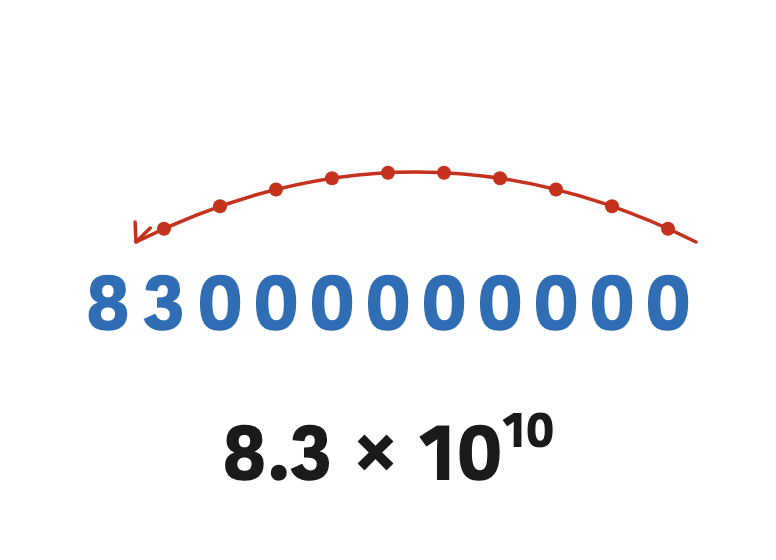
Writing 83000000000 W as \( 83 \times 10^{9} \) W is wrong, because only one digit may stand before the coefficient's decimal point. Likewise, a negative index does not mean the number is negative; it only means the number is smaller than 1.
The Rules of Scientific Notation
When a number is written in scientific notation, these five rules are followed:
- The base is always 10.
- The index is never zero; it is either positive (+) or negative (-).
- Only one digit stands before the coefficient's decimal point, and that digit is from 1 to 9.
- If the given number is a multiple of 10, the decimal point moves to the left and the power of ten is positive; for example, 600000 in scientific notation is \( 6 \times 10^{5} \).
- If the given number is less than 1, the decimal point moves to the right and the power of ten is negative; for example, 0.00006 in scientific notation is \( 6 \times 10^{-5} \).
Metric Prefixes
Changing kilometres into metres means multiplying by 1000, and changing metres into millimetres means multiplying by 1000 again. How do you know which number to multiply or divide by when converting units? The answer hides in the metric prefix joined to the front of the unit's name.
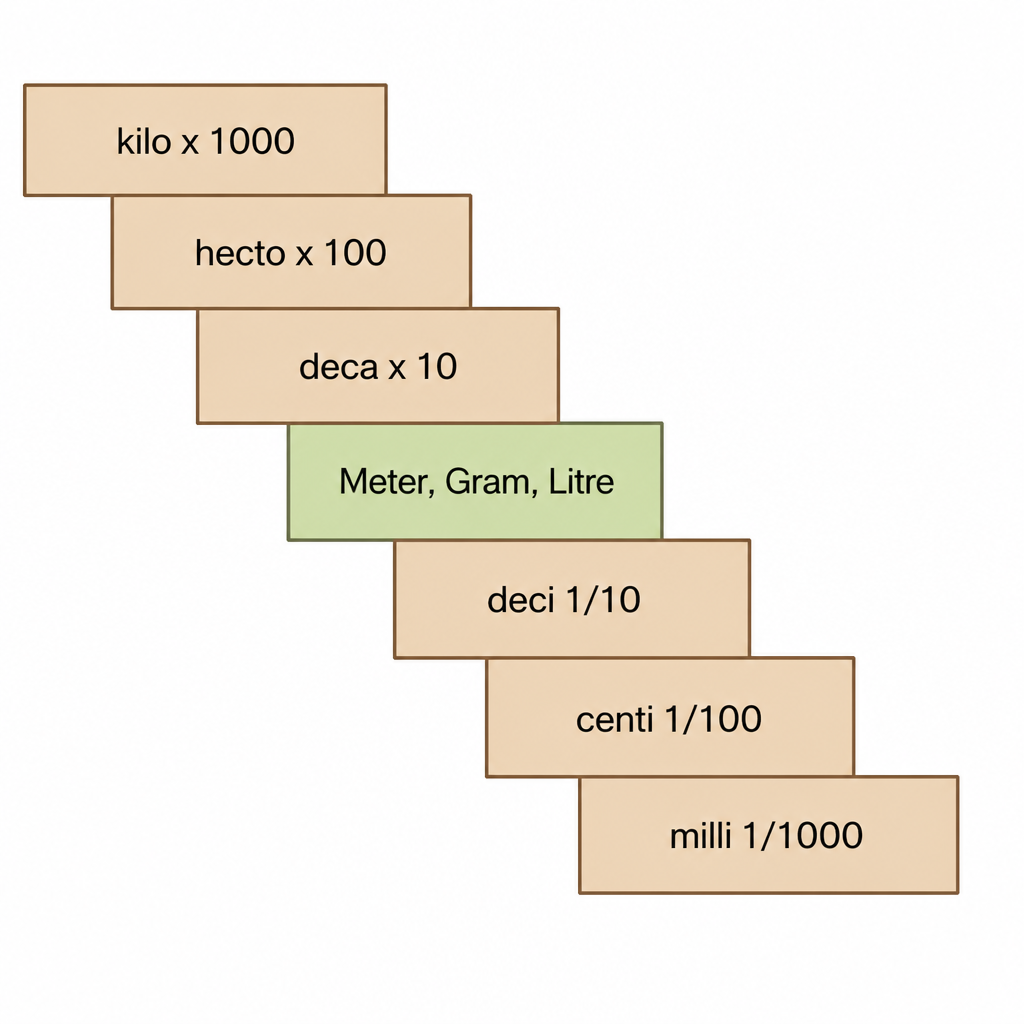
Multiplying the unit by 10 step after step expresses a metric measurement in a bigger unit, and dividing by 10 expresses it in a smaller one. Above metre, gram and litre sit deca (times 10), hecto (times 100) and kilo (times 1000), while below them sit deci (1/10), centi (1/100) and milli (1/1000). So 1 kilogram = 1000 g = \( 10^{3} \) g, and in the same way 1 milligram is \( 10^{-3} \) g.
In everyday measurements the prefixes look like this:
| Small measurement | Example with its prefix | Large measurement | Example with its prefix |
| Dose of a medicine | 500 milligrams | Mass of gas filled in a cylinder | 14.5 kilograms |
| Diameter of a human hair | 17 to 181 micrometres | Nepal's estimated hydroelectric capacity | 83,000 megawatts |
In the table above, milli and micro are joined to the front of the small measurements' units, while kilo and mega are joined to the front of the large ones. These words fixed to the front of a unit are the metric prefixes.
The Prefix Table: Multiples and Fractions
The prefixes used for large measurements are called multiples. Their symbols and multipliers are these:
| Prefix | Symbol | Multiplier |
| deca | da or D | \( 10^{1} \) |
| hecto | h | \( 10^{2} \) |
| kilo | k | \( 10^{3} \) |
| mega | M | \( 10^{6} \) |
| giga | G | \( 10^{9} \) |
| tera | T | \( 10^{12} \) |
The prefixes used for small measurements are called fractions:
| Prefix | Symbol | Multiplier |
| deci | d | \( 10^{-1} \) |
| centi | c | \( 10^{-2} \) |
| milli | m | \( 10^{-3} \) |
| micro | µ | \( 10^{-6} \) |
| nano | n | \( 10^{-9} \) |
| pico | p | \( 10^{-12} \) |
Capital M and small m are not the same symbol: M stands for mega (\( 10^{6} \)) while m stands for milli (\( 10^{-3} \)). Change the size of the letter and the measurement is off by a factor of billions.
Some Very Small and Very Large Measurements
With scientific notation and the prefixes, the very small and very large measurements of science can be written in short form:
- Eukaryotes measure from \( 10^{-4} \) up to 10 mm.
- Prokaryotes fall in the range \( 10^{-6} \) to \( 10^{-4} \).
- A molecule measures about \( 10^{-9} \) m, which is 1 nm.
- An atom measures about \( 10^{-10} \) m.
- The speed of light is \( 3 \times 10^{8} \) m/s.
- The mass of the Earth is \( 6 \times 10^{24} \) kg.
- The mass of the Sun is \( 2 \times 10^{30} \) kg.

Looking at these measurements makes the power of scientific notation plain: instead of writing thirty zeros, writing 30 in the index is enough, and anyone reading the number sees at a glance how large or small it is.
The full lesson is waiting for you
The notes are free to read in full. A free account opens the rest of the practice, and tracks your progress and confidence score for every subject. Presentations and videos need approval from Learn Yeti.