Three instruments, three quantities
We measure something almost every day, in the laboratory, at home and on the playground. To measure the length of a notebook we reach for a scale, to measure the time taken in a race we reach for a stopwatch, and to measure an angle we reach for a protractor. Look closely at these three instruments. Each one carries rows of small marks on its surface. A scale has lines for centimetres and millimetres, a stopwatch shows changing digits on its display, and a protractor carries degree marks around its half circle. These marks decide how small a quantity the instrument can measure.
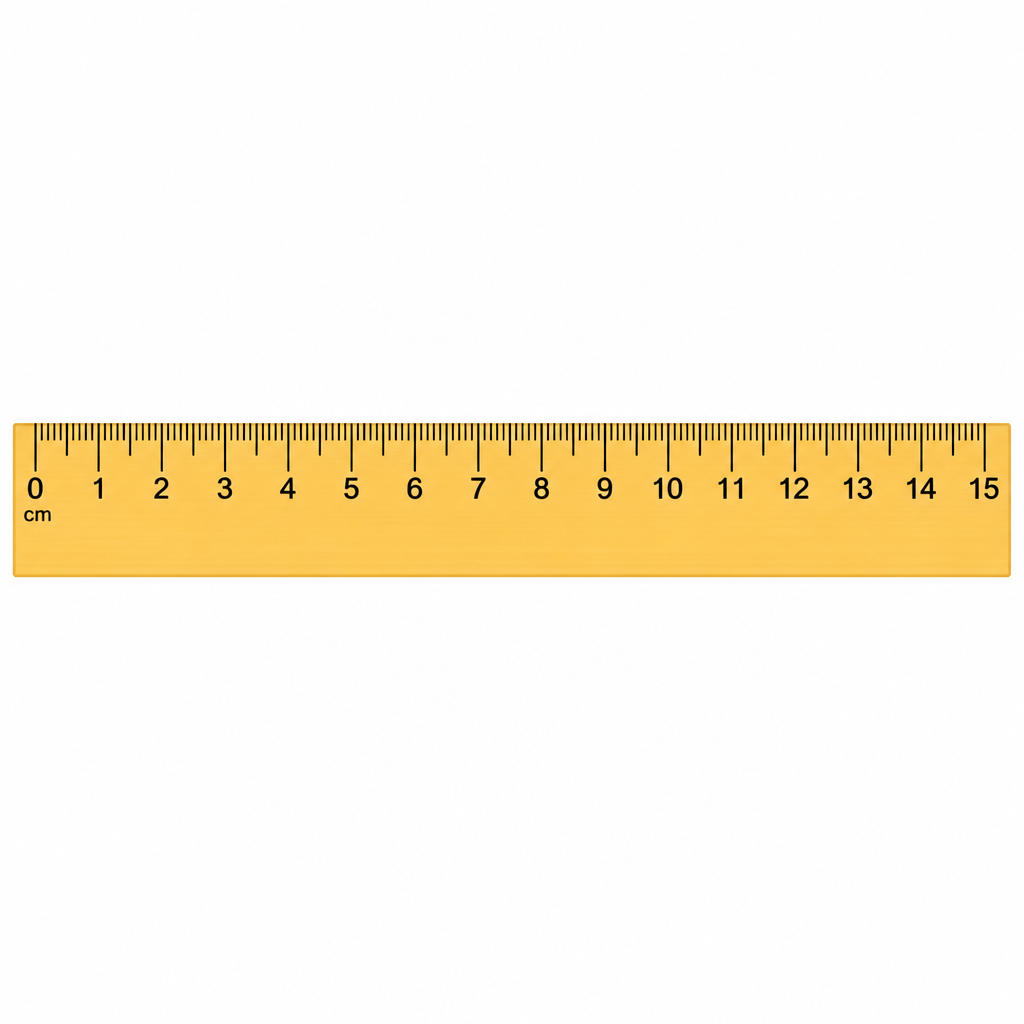
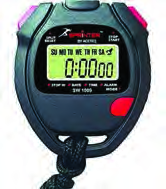
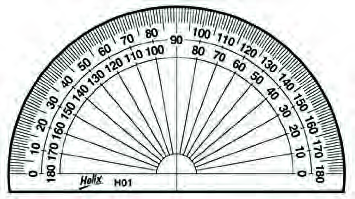
Which physical quantity does each of these instruments measure? The scale measures length, the stopwatch measures time and the protractor measures angle. Now think about a second question. What is the smallest amount each instrument can measure? Can a scale show half a millimetre or not? Can a stopwatch record a time smaller than one second or not? The answer to these questions leads us to an important idea called the least count.
What least count is
Stopwatches are used in all kinds of sports competitions. In a 100 metre race, two runners often reach the finishing line almost together. Our eyes cannot separate the first from the second, because the gap between them is a hundredth of a second. So a time of 0.01 second read from a stopwatch is used to separate the first runner from the second. This 0.01 second is one part out of 100 equal parts of one second:
\[ \frac{1}{100} \text{ s} = 0.01 \text{ s} \]
This 0.01 second is called the least count of a digital stopwatch. The stopwatch simply cannot show any time smaller than this. The same idea applies to every measuring instrument.
The smallest measurement that can be taken with an instrument is called the least count of that instrument.
Take an example. A scale gives the thickness of a notebook as 1.2 cm. The last digit of this reading sits in the first place after the decimal. That means the instrument can only tell differences of 0.1 cm apart. So the least count of that instrument is 0.1 cm, which is 1 mm. You can even guess an instrument's least count from one of its readings, because the smallest place in the reading shows the limit of the instrument.
Least count of a scale
A scale carries two kinds of markings. One edge is marked in inches and the other edge is marked in centimetres. Look at the centimetre edge. There, every 1 cm is divided into 10 small parts, and each small part stands for 1 mm. To find the least count of the scale, divide 1 cm by those 10 parts:
\[ \frac{1}{10} \text{ cm} = 0.1 \text{ cm} = 1 \text{ mm} \]
Therefore the least count of a scale is 1 mm. This means a scale can tell 5.3 cm and 5.4 cm apart, but it cannot give a finer reading such as 5.34 cm. If a length smaller than 1 mm has to be measured, a scale is not enough and a different instrument with a smaller least count is needed.
Least count of a stopwatch
On the display of a digital stopwatch, two more digits appear after the minutes and the seconds. Those two digits count hundredths of a second. Each time the last digit changes, 0.01 second has passed. So the least count of a digital stopwatch is 0.01 second. Because it can separate such tiny gaps of time, the digital stopwatch is the instrument used in sports to decide first, second and third place. A wristwatch, on the other hand, cannot show any time smaller than one second.
Least count of a protractor
A protractor carries marks from 0 up to 180 degrees. Two numbered marks are 10 degrees apart, and between them sit 10 tiny divisions covering those 10 degrees. One division stands for 1 degree. Working out the fineness of the protractor:
\[ \frac{10^\circ}{10} = 1^\circ \]
So the least count of a protractor is 1 degree. It can tell 42 degrees and 43 degrees apart, but it cannot read 42.5 degrees.
Different instruments, different least counts
The least count differs from instrument to instrument. The least count of a wristwatch is a second, while that of a digital stopwatch is a centisecond, which is 0.01 second. Both measure time, yet one reads a hundred times finer than the other. The table below compares the least counts of the instruments we have met.
| Instrument | Quantity measured | Least count |
| Scale | Length | 0.1 cm = 1 mm |
| Digital stopwatch | Time | 0.01 s |
| Protractor | Angle | 1 degree |
| Wristwatch | Time | 1 s |
A bigger least count is not a better one. The smaller the least count of an instrument, the finer the measurement it gives. A stopwatch reading 0.01 second is finer than a wristwatch reading 1 second.
Why least count matters in science
In scientific study, the least count carries great importance. If you know the least count of your instrument before an experiment, you know exactly how fine a reading you can take, and you do not write down more digits than the instrument can honestly give. The choice of instrument for a task also rests on the least count. To time a race, you pick a stopwatch and not a wristwatch. Measurements taken this way become data that can be trusted.
- Measurements can be taken correctly.
- The right instrument can be chosen for each task.
- Data can be collected, analysed and turned into conclusions.
Know the least count of your instrument before you measure. No reading can ever be finer than the least count of the instrument that gave it.
The full lesson is waiting for you
The notes are free to read in full. A free account opens the rest of the practice, and tracks your progress and confidence score for every subject. Presentations and videos need approval from Learn Yeti.