A shared commitment the world agreed on
It is not enough that development happens. Development must also last, and it must not eat up the very land, water and forest that it stands on. To fix that idea in one place, the countries of the world made a shared promise. The 70th General Assembly of the United Nations, in which 193 countries took part, approved the Sustainable Development Goals in 2015. These goals came into implementation from 2016 and are set for the period up to 2030.
Sustainable Development Goals: the common goals fixed through the United Nations for the years 2016 to 2030, so that the development of every country stays lasting and does not damage the future.
These goals are not one country's plan. They are a roadmap that countries all over the world accepted, each of them working on it at home. A roadmap says where you are going and by when you must get there. That is why the Sustainable Development Goals carry both a destination and a deadline.
Seventeen goals, 169 targets and 232 indicators
The Sustainable Development Goals contain 17 goals, 169 targets and 232 indicators. These three levels are three views of the same thing. A goal says what has to be achieved. A target breaks that goal into the pieces of work that must actually be finished. An indicator is the measure by which we check whether the work really happened. Without indicators a country could only claim progress. With them, progress can be shown.
| Level | How many | What it does |
| Goal | 17 | States the large aim to be reached |
| Target | 169 | Breaks the goal into the smaller pieces of work |
| Indicator | 232 | Measures whether the work has been done |
Do not swap 17, 169 and 232 for one another. There are 17 goals, 169 targets and 232 indicators. In the same way, the goals were approved in 2015, while their implementation began in 2016.
To reach these goals Nepal too has prepared a roadmap of its own action plan, with extra indicators added. In other words, alongside the indicators the world agreed on, Nepal has added measures that suit its own situation.
Economy, society and environment on one roadmap
The Sustainable Development Goals were built by joining three sides together: the economic side, the social side and the environmental side. Raising income is the economic side. Bringing education and health within everyone's reach is the social side. Protecting air, water, soil and living things is the environmental side. Development lasts only when all three move together. A factory that brings jobs but kills the river beside it has bought a few good years and lost the ones after.
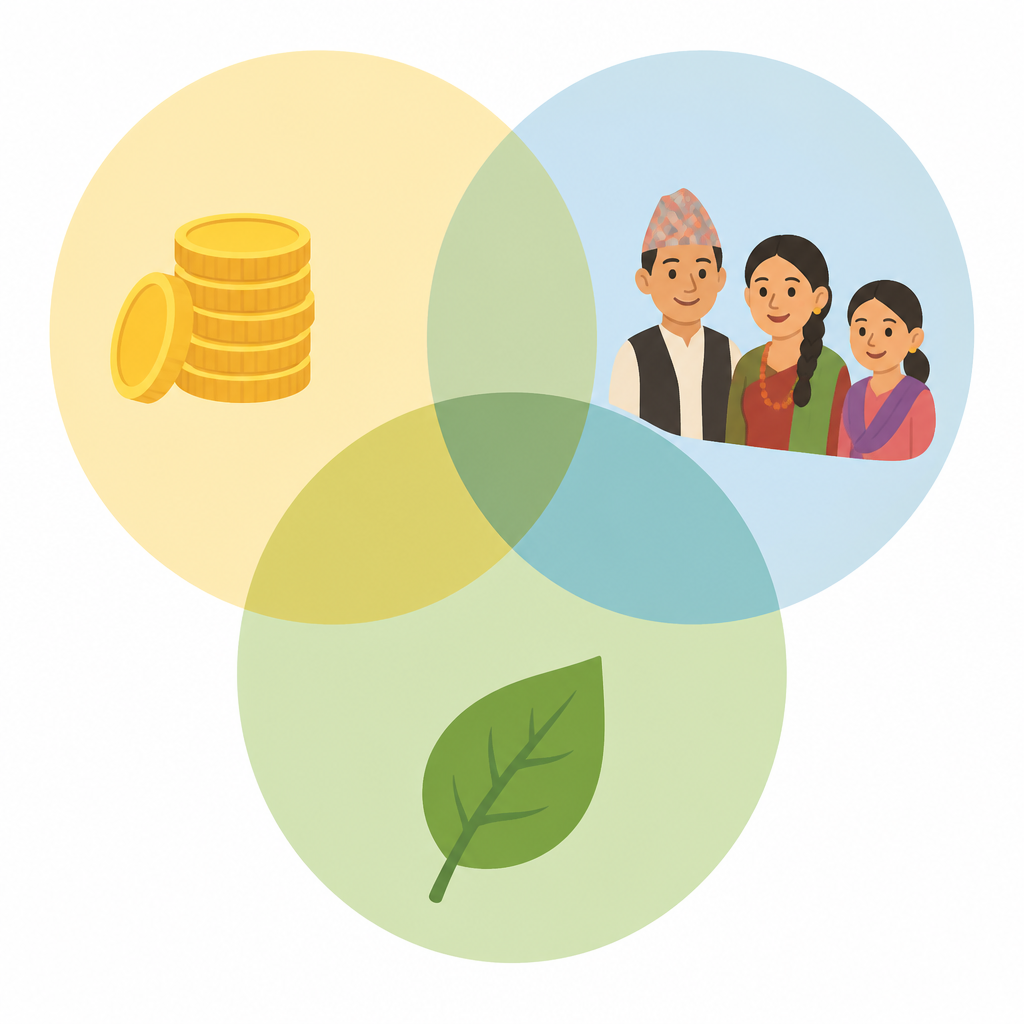
Every one of these goals touches the environment, some of them directly and the rest indirectly. One goal speaks straight about forests and land. Another speaks about food, water or infrastructure, and reaches the environment through them.
Goal 15: the terrestrial ecosystem
Goal 15 puts the greatest weight of all on the environment and on biodiversity. It is the goal that speaks directly about the living things of the land and the home they depend on.
Terrestrial ecosystem: the system made by the plants, animals and micro-organisms living on land together with the soil, water, air and sunlight around them, all of them depending on one another.
The following are included inside this goal:
- Use the terrestrial ecosystem sustainably, restore it where it has been damaged and conserve it.
- Manage forests in a sustainable way.
- Control desertification.
- Control the erosion of land.
- Save biodiversity from loss.
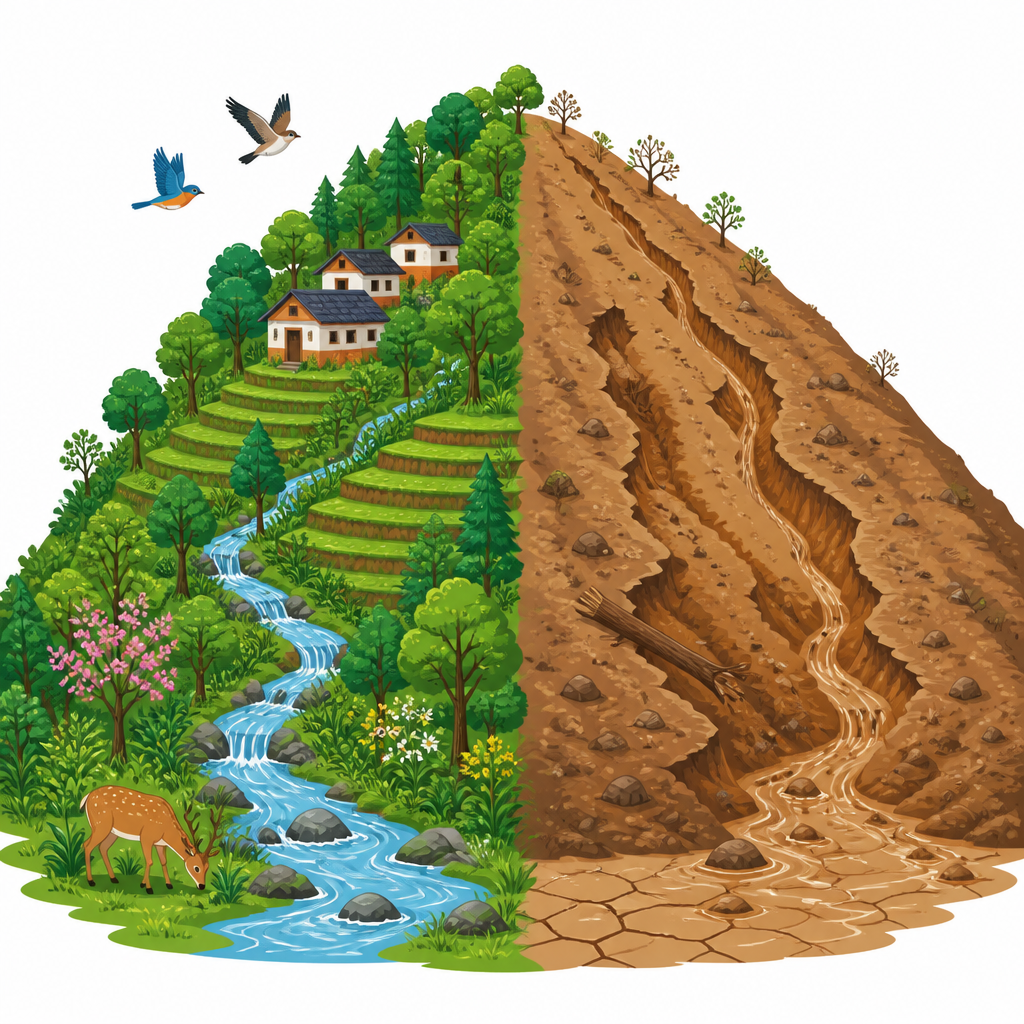
In a hill country the goal matters even more. When trees are cleared, the roots that held the soil are gone, the rain carries the soil away and the slope slips. Once the soil has gone the field turns barren, barren land dries out, and the insects, birds and plants that lived there disappear with it. Saving the land, then, is also saving the living things on it.
Goals that reach the environment indirectly
Besides the goal named above, other goals also carry environment and biodiversity inside them, though less directly. They include the following:
- Food security.
- Ensuring inclusive and equitable quality education, and promoting learning that continues through life.
- Lasting availability of drinking water and sanitation for everyone.
- Strong and reliable infrastructure.
- Reducing the effects of climate change.
- Conserving the seas and the coasts, and using them sustainably.
Under food security, the world's growing food shortage is met in two main ways: by saving the traditional native species of food plants from dying out, and by adopting measures that conserve farming land. Native species are the crop varieties that have been grown in one place for generations. They have already learned to bear that soil, that water and that weather, so losing them leaves food security weaker than before.
In the same way, healthy drinking water reaches everyone through the search for water sources and through the conservation and improvement of watersheds, and environment friendly infrastructure plays an important part in that work. A watershed is the whole area whose rainfall collects and flows into one stream. Protect the watershed and the source does not dry up.
Climate change and biodiversity
Climate change has struck biodiversity directly all over the world. On one side it has harmed the life cycle of sea creatures. On the other side it has raised the number of disasters on land. These disasters are themselves an effect of climate change, and they have disturbed the natural balance in which animals and plants live.
- Floods
- Landslides
- Forest fires
- Too much rain, and too little rain
- Hailstorms
- Desertification
According to the global circulation model of the environment, when the environment goes out of balance at any one place on the earth, the effect of it is felt all over the world. Pollution, therefore, is never one country's problem alone.
For that reason the goal of lasting environmental protection can be reached only through the solidarity of all the countries of the world on environmental matters: controlling pollution, cutting the emission of carbon dioxide gas, carrying out industrialisation in an orderly way, and using natural resources in proportion. The effort of a single country is not enough, because the air and the ocean do not stop at borders.
Nepal's roadmap and its 12 year programme
To complete the work of sustainable development, the Government of Nepal has settled a twelve year programme built on a national framework with its own indicators. The programme follows the government's long term strategic vision. It is not a single year's task. It is work carried on steadily for twelve years.
Nepal has been carrying out a range of work to reach the Sustainable Development Goals, together with the aim of becoming a middle income country by 2030. The following programmes run under it:
- The poverty alleviation programme
- The climate change adaptation programme
- The biodiversity conservation programme
- Increased investment for quality education
- The community development programme
These programmes are put into practice through the periodic plans and the annual budget. The plan shows the road and the budget pays for walking it, so neither one works without the other.
Steps Nepal has taken on climate change
To reduce the effects of climate change and to adapt to them, a Climate Change Council was formed in 2009. Under it, through the national adaptation plan of action, programmes for the conservation of water sources, watersheds and biodiversity are run at the local level. Adaptation means changing the way we farm, live and manage water so that it fits the weather we now actually get.
To draw the attention of the world to what climate change has done to Nepal, a meeting of Nepal's Council of Ministers was held in 2009 at a place called Kalapatthar, the base area of Sagarmatha, at a height of 5550 metres.
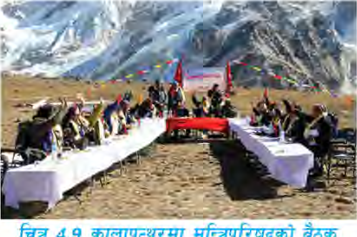
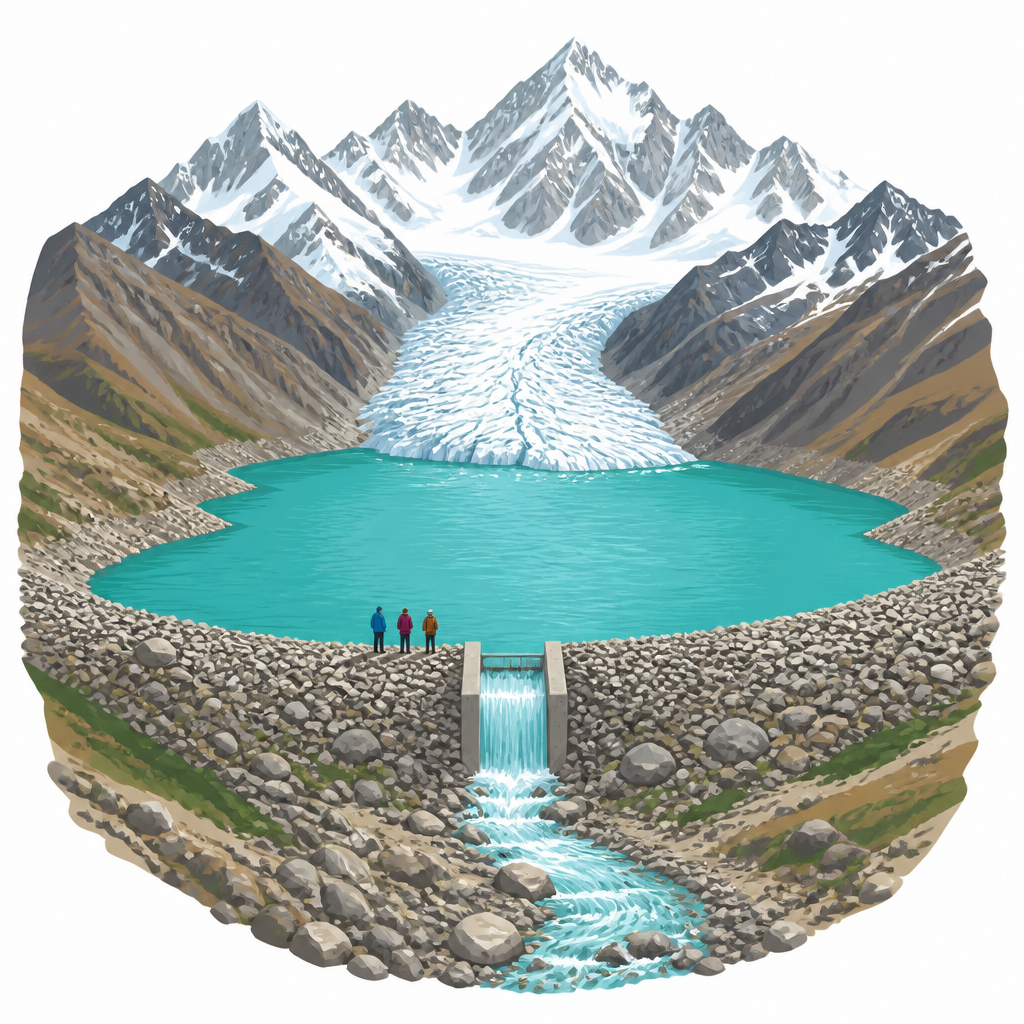
In the same way, a cabinet meeting was held in 2018 at Rara lake, which lies at a height of 2990 metres. At Tsho Rolpa glacial lake in the Rolwaling valley of Dolakha district, which lies at 4580 metres and was in danger of bursting, a dam and a drain were put in place in 2020 and the lake has since been kept from bursting.
Community forests: management in people's hands
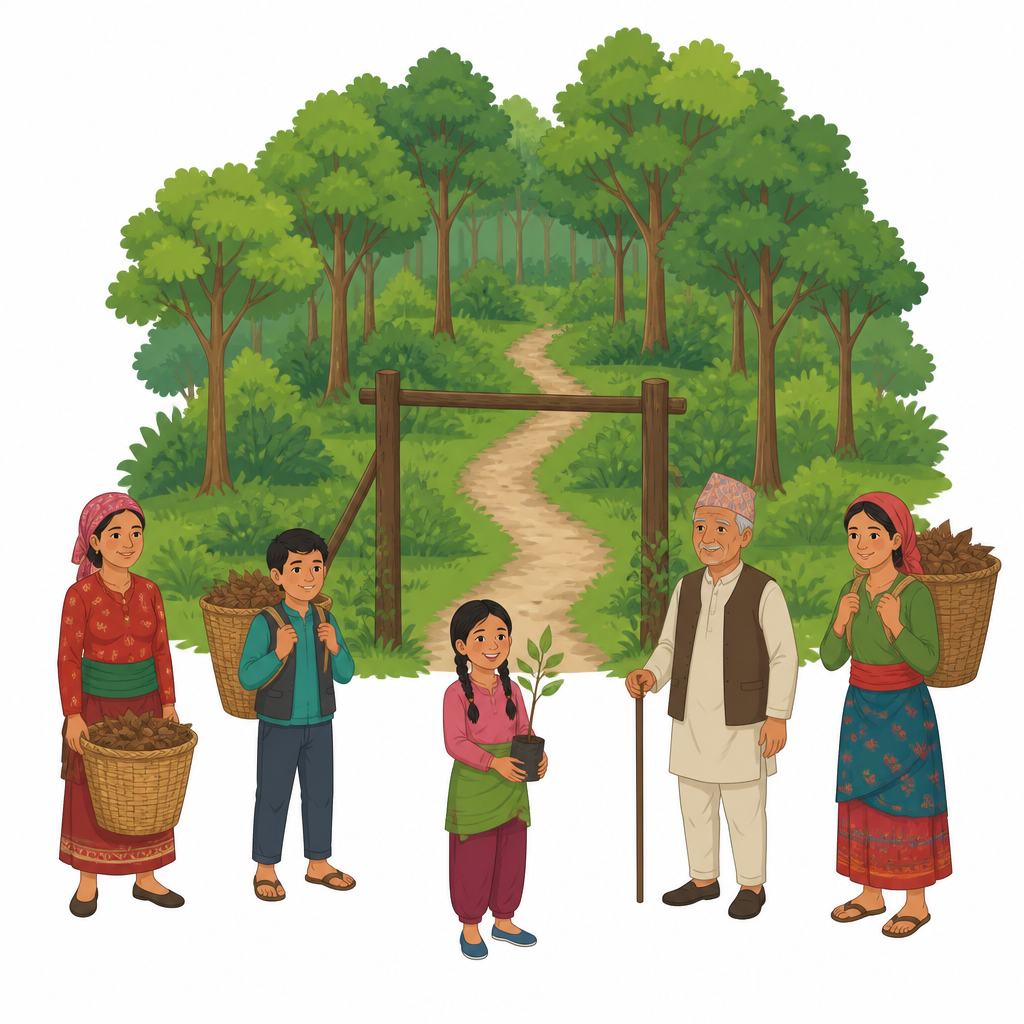
To protect its forests, Nepal has been running a community forest programme since 1970. After the Community Forest Act of 1993 was issued, responsibility for managing the forest was handed to local communities, and under that arrangement the area under forest has grown noticeably. Once people feel that the forest is theirs, they become its guards themselves, and that is why the programme has worked.
What the plans, the policy and the law provide
From the fourteenth three year plan of 2016 to 2019 onwards, the Government of Nepal has run national programmes aimed at the Sustainable Development Goals. Income generation work for the reduction of poverty, the creation of employment, a push for technical education under education for all, sanitation and health programmes, and biodiversity conservation programmes are all in operation. The plans, the policy and the law that followed have made the same road clearer.
| Provision | What it mainly does |
| Fourteenth three year plan, 2016 to 2019 | Started national programmes aimed at the Sustainable Development Goals |
| Fifteenth periodic plan | Put forward the vision of a clean, pure and green environment |
| National Environment Policy, 2076 BS | Set the goal of pollution control, waste management and greenery |
| Environment Protection Act, 2076 BS | Gave legal protection to the basic right to live in a healthy environment |
The fifteenth periodic plan, carrying the vision of a clean, pure and green environment, works through pollution control, waste management and the growing of greenery to secure the citizen's right to live in a clean and healthy environment. The National Environment Policy of 2076 BS was then drawn up, and it takes the same path towards the same right.
The Environment Protection Act of 2076 BS was then issued. It gives weight to protecting the basic right of every citizen to live in a clean and healthy environment, to making the polluter pay compensation to those harmed by environmental pollution or degradation, to keeping a proper balance between environment and development, to reducing the harmful environmental effects that fall on nature, the environment and biodiversity, and to facing the challenges of climate change. Programmes have been settled in line with the Act and are being carried out.
Do not treat a policy and an Act as the same thing. A policy states the direction the government intends to take. An Act turns that direction into law, and gives ground for action when it is broken.
The goals were set by the world, but the work happens close to home. Planting a tree, sorting waste, protecting a water source and keeping native seed alive are all things a student can do in their own village or neighbourhood.
The full lesson is waiting for you
The notes are free to read in full. A free account opens the rest of the practice, and tracks your progress and confidence score for every subject. Presentations and videos need approval from Learn Yeti.